Table of Contents
The digital change is forcing companies to provide software at scale, embrace new technologies, and develop more quickly. Relying solely on local teams frequently restricts speed and flexibility as product complexity and development demands increase. In response to this, businesses are building or collaborating with an offshore development center in order to increase development capacity globally.
An offshore software development center offers a dedicated offshore team that easily integrates with internal workflows, tools, and goals without sacrificing quality. This model helps to scale more quickly, access specialized worldwide talent, and increase cost effectiveness. Businesses could reduce delivery time, increase performance, and achieve measurable outcomes from offshore development projects. This happens through organized onboarding, open communication, and efficient offshore team management.
An offshore development center (ODC) is a remote facility that specializes in providing offshore development services to a single company. Companies often partner with an experienced software provider to set up and manage ODCs seamlessly. The ODC is responsible for everything from development, testing, and deployment to continuous support. Through access to a specialized global team, organizations can tap into global expertise quickly and at a lower cost without compromising service quality.
Long-term and compatible with your procedures, tools, and culture, the offshore development team best collaborates with an in-house team.
This strategy ensures consistent delivery results, improved communication, and increased information retention. Also, an offshore development center gives companies the flexibility to scale resources while keeping full ownership over project performance and governance.
Traditional outsourcing is commonly project-specific and lacks integration. Consequently, there are typically gaps in long-term accountability, communication, and knowledge transfer. In contrast, an offshore development center model speaks of continued collaboration and sustained involvement. An effective offshore team enables knowledge retention, dependable delivery, and alignment with corporate objectives.
Organizations can benefit from the structure of offshore development centers that facilitate long-term software development in two ways: scalable expansion and strategic alignment. Practically, companies can onboard dedicated developers through an offshore software development center in weeks and integrate them into the existing workflow using the same tools, sprint cycles, and reporting structures.
Companies create an offshore development center in order to gain access to specialist expertise that might either be prohibitively expensive or scarce in their geographic area.

By using the services of offshore development, businesses can quickly build a specialized team with expertise in AI/ML, cloud platforms, cybersecurity, and full-stack development. This offshore development center approach makes sure that the teams are in sync with the technical roadmaps from day one and helps with quicker onboarding.
An offshore software development center helps companies reduce costs related to employment, infrastructure, and operations without compromising on quality.
When companies adopt a structured offshore team, they can maintain coding standards, security regulations, and delivery benchmarks while paying only for the resources they use. Due to this, the idea of an offshore development center is more affordable than growing inside teams.
By scaling specialized talent up or down as project needs evolve, offshore development teams enable businesses to access the right resources at the right time. This adaptability supports both short-term demands and long-term objectives, helping organizations accelerate development timelines and bring products to market faster through an offshore software development center.
Our IT staff augmentation services help you quickly build high-performing teams without the hassle of long-term hiring commitments.
When businesses require a reliable offshore development team to work on essential systems, they employ an offshore development center. Developers often need to be hired for long-term projects for tasks such as QA and DevOps.
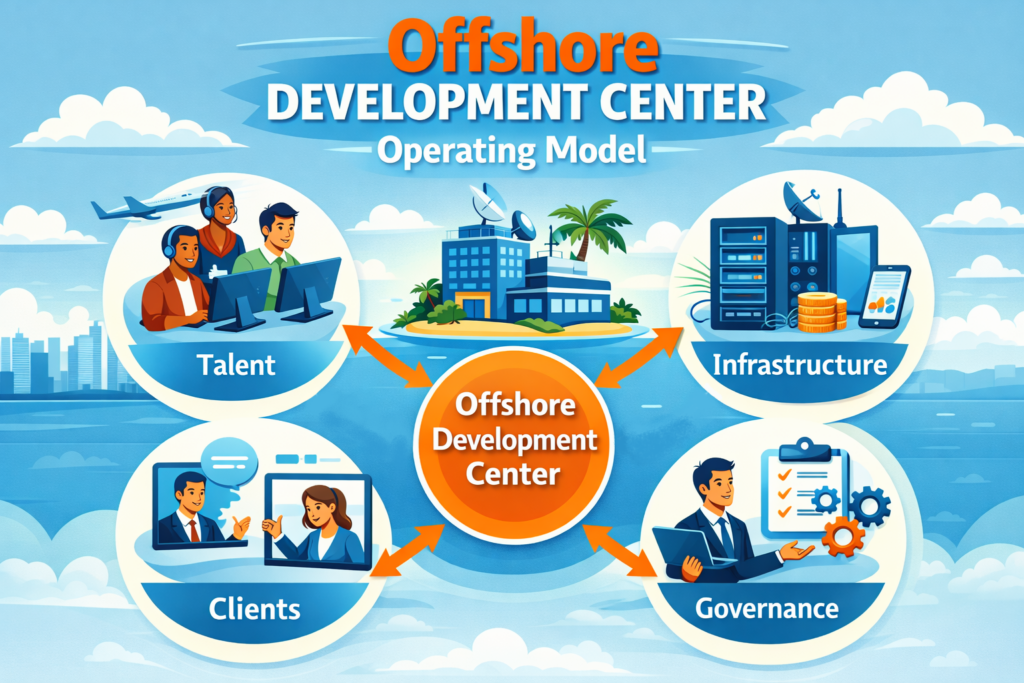
The offshore development center follows the client’s release cycles, code reviews, sprint planning, and security measures. An offshore software development center approach can be used for SaaS products, ERP systems, and product development improvements when expertise and close collaboration are critical for the product.
An ERP product company created a dedicated offshore development team that worked in sync with its sprint cycles and long-term vision. Release cycles increased by 25% in just six months as a result of shared ownership and smooth integration.
Organizations that set up their first offshore development center favor the Build Operate Transfer (BOT) model. The customer has the concentration on delivery goals, with the business partner tackling the role of running payroll, office establishment, and hiring. This ensures continuous distribution for the organization, reduces time to set up, and avoids legal concerns.
Using the BOT model, a US healthcare technology company established its first offshore development center without having to deal with compliance or local employment. The transfer of full ownership after two years led to stable operations and total governance control of the offshore software development center.
While product ownership and architecture are maintained within the hybrid offshore delivery center, feature builds, regression testing, and support are managed by the offshore development center. The management of an offshore team assists businesses in maintaining delivery schedules, scaling quickly during periods of high demand, and keeping control of costs without additional staff.
One SaaS company managed feature development and regression testing with an offshore team while maintaining its own product architecture through an offshore development center. The hybrid offshore delivery center increased sprint completion by 40% during periods of high expansion.
Make a detailed decision on the tasks your offshore development center will perform first. It could be developing new features, QA automation, legacy system support, and anything. Set measurable performance indicators such as cost savings, defect rate, release frequency, and sprint velocity. This helps the offshore development center to produce predictable results.
Choose a location with a skilled talent pool within your technology stack, reliable electricity and internet infrastructure, and IP and data protection regulations. In order to promote regular meetings and faster issue resolution with the offshore development team, companies seek out certain hours of time zone overlap.
Hire developers, testers, and DevOps engineers through regional recruiters or offshore development partners to create a committed offshore team. Set up security restrictions, cloud access, CI/CD pipelines, and teamwork software like Jira or Slack before starting delivery for the offshore development center.
Within two weeks, a healthcare company employed three overseas developers and one DevOps engineer. They had secured AWS access and Jira tracking set up, and they released their first feature update within the first sprint cycle through an offshore development center.
Carried out code reviews, mentoring, and documentation within a structured onboarding process. Regular reviews and information exchange reduce the starting time and ensure long-term collaboration. Provide mentors for the offshore developers during the first few sprints to help with code reviews and procedures.
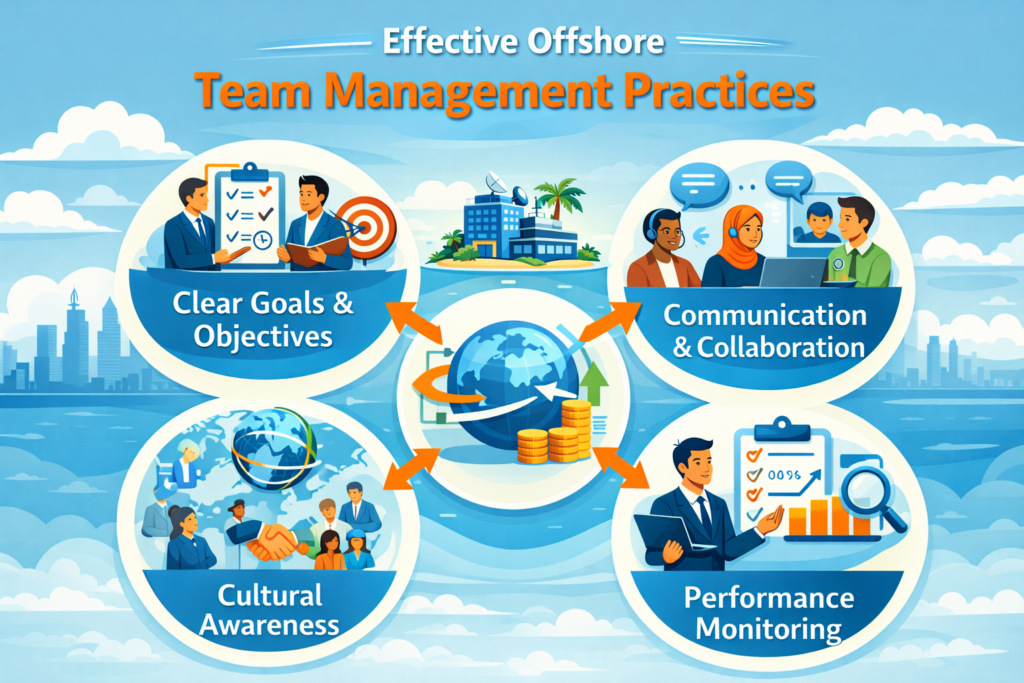
Setting up clear communication procedures is the first step to offshore team management. Teams in an offshore development center make use of Jira or Slack for video conferencing, weekly status reports, sprint review, and daily meetings. The offshore development team keeps aligned on priorities and delivery timelines through shared dashboards and documented decisions.
Effective operations in offshore development centers revolve around well-measurable KPIs such as defect leakage, sprint pace, code quality, and on-time delivery. Monitoring these KPIs throughout the offshore delivery center helps to adjust workloads, notice early delays, and maintain consistent quality from the committed offshore staff.
Businesses that use an offshore development center model spend money on cross-team cooperation meetings, virtual team gatherings, and recognition initiatives. These procedures enhance long-term performance, build trust, and boost engagement throughout offshore development. This helps to understanding team effectiveness and bridge the communication gap.
Accountability and product ownership are increased through rotating feature ownership and include offshore developers in planning discussions.
Patoliya Infotech supports companies in creating an offshore development center through offering access to skilled engineers in full-stack, cloud, AI/ML, and DevOps technologies. Every offshore development team is carefully analyzed and matched with your delivery procedures, technical stack, and business objectives.
We promise seamless onboarding, quick starts, and sustained cooperation by using a tested offshore development center model. As a part of your internal team, our committed offshore team follows your security policies, coding standards, and sprint cycles.
Patoliya Infotech facilitates consistent innovation, knowledge retention, and reliable delivery from your offshore software development center through an organized offshore development team.
Over time, accountability is maintained, and results are optimized with the support of reporting and regular performance assessments. Looking to build a scalable offshore development center for your business? Book a free consultation with our experts now.
To optimize the value of your offshore development center, Patoliya Infotech provides a variety of engagement models. Our offshore development services help startups and large corporations, from a specialized offshore team to a scalable offshore development. With precise procedures and measurable KPIs, clients lower hiring, infrastructure, and operating expenses without sacrificing quality.
Companies can scale resources up or down in response to project demand with our hybrid delivery strategy. This helps in financial control and a quicker time to market. We offer cost-effectiveness without compromising performance, security, or delivery consistency through an effective offshore development team. Additionally, this gives clients visibility through sprint reports, real-time dashboards, and regular delivery reviews.
An offshore development center can facilitate cost effectiveness, scalability, delivery resilience, and access to worldwide talent, which can enhance business operations. Strong offshore team management, well-defined goals, organized onboarding, and regular communication are all necessary for the offshore development center model to be successful. Businesses can keep high development standards, increase teams according to demand, and speed digital efforts when properly executed. Organizations can easily integrate offshore teams and promote sustainable growth by investing in reliable tools and procedures with choosing the right engagement model.