Table of Contents
TL;DR: AI vendor evaluation is the process of testing a provider's technical strength, security posture, and contract terms before you sign anything. Most buyers only check pricing and demo output, then get stuck with tools that cannot scale or protect their data. A structured AI vendor due diligence checklist stops that mistake before it costs you a renewal cycle.
The success of an AI initiative depends as much on the vendor as the technology itself. An AI solution keeps learning, evolving, and influencing critical business decisions long after deployment.
For instance, a customer support AI that delivers 95% accurate responses during a pilot can gradually decline in quality if the model isn't monitored or updated. That's why AI vendor evaluation is no longer just about comparing capabilities; it's about assessing long-term reliability, security, and business fit. This guide walks you through the complete AI vendor selection process.
Traditional procurement checks feature once. AI vendor evaluation has to check behavior over time, because the system keeps learning, and its outputs can shift without a single code change on your side. A very different rhythm from the fixed release cycles behind most traditional software development methodologies.
AI Systems Continue Learning After Deployment
AI models evolve after deployment as data changes over time. A solution that performs well today may produce different results months later if model drift isn't monitored. isn't monitored. That's why AI vendor evaluation should include questions about model monitoring, retraining, and update governance.
AI Introduces New Business, Legal, and Operational Risks
AI systems process sensitive data and influence business decisions, making security, compliance, and bias critical concerns. Every AI vendor evaluation should assess how the vendor manages privacy, governance, and regulatory requirements before deployment.
Why Vendor Selection Impacts Long-Term ROI
The wrong AI vendor selection can lead to costly migrations, poor scalability, and hidden operational expenses. Effective AI vendor evaluation helps identify partners that can support long-term growth as part of a broader digital transformation strategy, maximize ROI, and reduce future business risks. Businesses that skip this step often end up repeating the same mistakes outlined in any solid guide to choosing an IT solution provider.
You cannot run an honest AI vendor evaluation without first writing down the exact problem you are solving and how you will measure success.
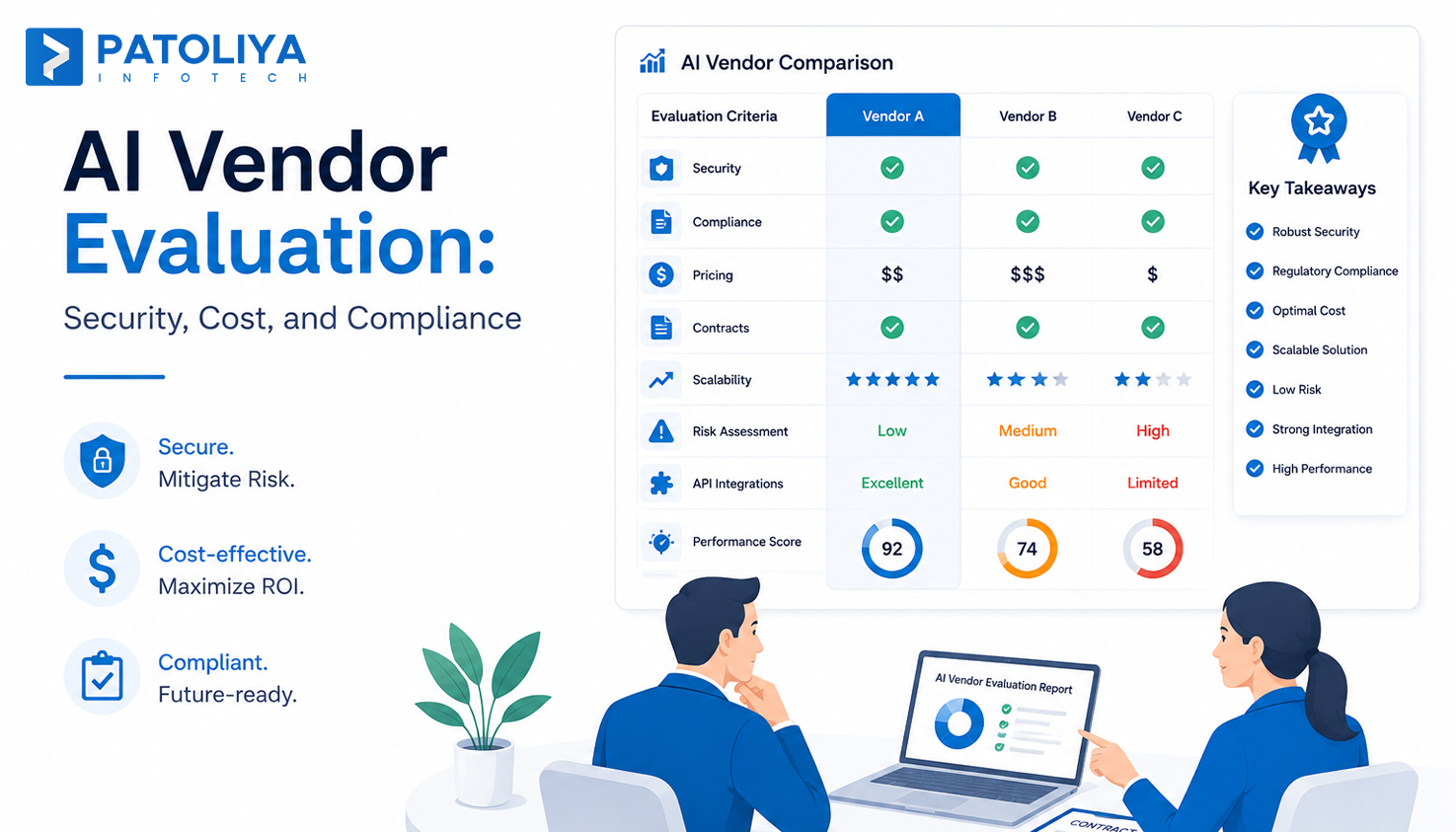
Every serious AI vendor evaluation rests on five pillars: business fit, technical strength, security, operational readiness, and true cost. Skip one, and the whole decision gets shaky later.
Ask for two or three reference clients in your sector and call them directly. Real AI vendor selection depends on proof that the vendor understands how your business actually operates. Skipping this check is the most common mistake we see during AI vendor evaluation.
Check which models power the platform, whether it supports large language models you already use, and how open its APIs are for your engineering team, many AI vendors ship their product as a subscription-based SaaS platform, so the same delivery-model questions you'd ask any SaaS provider apply here too.
Ask directly about scalability limits and how the vendor monitors the model after launch.
Weak monitoring is one of the biggest gaps we see during AI vendor evaluation, because vendors talk about accuracy at launch and stay silent about accuracy six months later.
Here is a quick reference table for the technical questions worth asking every candidate before you sign:
| Area | Question to Ask |
| Model support | Which foundation models and LLMs does the platform run on |
| Integration | Are the APIs open and documented, or closed and proprietary |
| Scalability | What happens to speed and cost as usage grows tenfold |
| Monitoring | How is model drift tracked and reported to us |
This pillar decides whether your customer data stays safe or becomes tomorrow's headline. Every data security AI vendor review should confirm encryption at rest and in transit, current compliance certifications such as SOC 2, clear data residency terms, strict access control, and full audit logs, the same fundamentals that sit behind any strong AI-driven approach to cybersecurity.
Ask the vendor to name their responsible AI policy in writing, not verbally on a sales call. A vendor that hesitates on this pillar during AI vendor evaluation is telling you something important before you even sign a contract.
Look past the sales deck and ask how implementation actually runs day to day. A strong vendor gives you a named implementation manager, a written training plan, and documentation your team can follow without hand-holding, worth comparing against the tradeoffs laid out in staff augmentation vs. managed services, since an AI vendor engagement often behaves like one model or the other.
During AI vendor selection, a weak support structure shows up fast once you ask for a real ticket resolution time, not a marketing promise. We treat this pillar as a hard filter in every AI vendor evaluation we run for clients.
License fees are only the starting number. Usage-based pricing, infrastructure costs, and hidden implementation expenses can double your real spend within a year.
Serious AI vendor evaluation always models total cost across three years, beyond the first invoice, because that is where vendors quietly build in margin.
Total cost modeling belongs at the top of your AI vendor due diligence checklist.
A contract review is not optional inside AI vendor evaluation, because the fine print decides who owns your data and what happens if the vendor shuts down.
Data Ownership and Intellectual Property Rights
Confirm in writing that your input data and output content remain yours, not licensed back to the vendor for their own model training.
Many vendors bury this clause deep in AI contract terms, so read the data usage section twice before signing and if you're unclear on how your provider separates operational data from analytical storage, it helps to first understand the basic database vs. data warehouse distinction the vendor is likely relying on.
Service Level Agreements
SLA AI tools need clear uptime commitments, response time guarantees for support tickets, and financial penalties if the vendor misses them.
A vendor that will not commit to a number in writing is telling you the number is not good. This is exactly where a rushed AI vendor evaluation usually falls apart later.
Pricing Escalation and Renewal Clauses
Ask how much the price can rise at renewal and whether that cap is written into the contract or left open.
Silent renewal clauses that auto-lock you in for another year are common, and they undercut the point of doing careful AI vendor evaluation in the first place.
Exit Strategy and Data Portability
Confirm you can export your data in a usable format within a set number of days after cancellation.
Without this clause, your AI vendor due diligence checklist is incomplete, because a vendor that traps your data on the way out was never a safe choice on the way in.
Vendor lock-in is the single biggest regret teams report after skipping a proper AI vendor evaluation, and it shows up years after the contract, not during it.
Technology Lock In vs Data Lock In
Technology lock-in happens when your workflows depend on proprietary features that do not exist anywhere else. Data lock-in happens when your historical data cannot leave the platform in a usable format.
Both forms limit future AI vendor selection, so map out which type of dependency each vendor creates before you commit a question that ties directly back to how the vendor handles cloud and database transformation behind the scenes. Map this distinction early in your AI vendor evaluation so the decision holds up years later.
Evaluating Integration Flexibility
Favor vendors that support open standards and common APIs over closed ecosystems that only talk to their own tools, and vendors whose roadmap shows genuine cloud migration maturity rather than a single locked-in hosting environment. This single choice protects every future AI vendor evaluation cycle your company runs, because it keeps your options open when contracts come up for renewal.
Building an Exit Strategy Before Implementation
Write your exit plan before you sign, not after a problem forces your hand. A documented exit strategy is a core line item on any real AI vendor due diligence checklist, and it gives your legal team leverage during every renewal conversation.
Use this checklist to run a complete AI vendor evaluation without missing a stage that comes back to bite you later.
Business Evaluation Checklist
Technical Evaluation Checklist
Security and Compliance Checklist
Commercial and Contract Checklist
Deployment Readiness Checklist
This full AI vendor due diligence checklist works as a repeatable process, so your team runs the same standard every time a new vendor comes up for review, without reinventing the process from scratch. Treat it as a living part of every future AI vendor evaluation, not a one-time form.
A weighted scoring matrix turns subjective opinions into a number every stakeholder can agree on during AI vendor evaluation.
| Evaluation Criteria | Recommended Weight |
| Business Alignment | 20% |
| Technical Capability | 20% |
| Security and Compliance | 20% |
| Integration Readiness | 15% |
| Commercial Terms | 10% |
| Support and SLA | 10% |
| Vendor Reputation | 5% |
Score each vendor from one to ten on every row, multiply by the weight, and add the totals. This method removes the bias that creeps in when one team member falls in love with a slick demo.
Procurement teams that adopt this framework report faster AI vendor selection decisions because the debate moves from opinion to numbers, and every stakeholder can see exactly why a vendor won or lost. This scoring habit turns AI vendor evaluation into a repeatable system.
Vendor risk assessment does not end at signature. The real test of any AI vendor evaluation happens in the first year of live usage.
Monitor AI Performance and Business KPIs
Track the same success metrics you defined before the contract, not new ones the vendor suggests after launch. A drop in accuracy or output quality should trigger a formal review, not a quiet email.
Review Security and Compliance Regularly
Compliance certifications expire, and data residency rules change. Schedule a security review every six months, so your AI vendor evaluation does not become a one-time event that ages badly.
Reassess Vendor Roadmaps and Support Commitments
Vendors change ownership, pivot their product, or quietly reduce support staff. Revisit the roadmap yearly to confirm the vendor still matches the reason you chose them during AI vendor selection. This step protects the value of your original AI vendor evaluation, beyond just the vendor relationship.
Patoliya Infotech builds AI strategy, custom AI solutions, and secure implementation plans for companies that refuse to guess their way through AI vendor evaluation.
If your team is stuck comparing vendors on price alone, talk to Patoliya Infotech about building an AI vendor selection process that protects your data and your budget at the same time.
We built this process directly from a working AI vendor due diligence checklist, not a generic template. Book a call and bring your current shortlist.
Effective AI vendor evaluation goes far beyond comparing feature lists and demo scores. It requires assessing technical expertise, security, compliance, scalability, contract terms, total cost of ownership, and the vendor's ability to support your business as AI evolves.
Following a structured AI vendor due diligence checklist helps reduce risk, avoid costly migrations, and maximize long-term ROI. The right AI partner doesn't just deliver a solution; they become a strategic part of your growth. Ready to build your evaluation process with confidence? Let's discuss your shortlist and find the right AI partner for your business.