Table of Contents
TL;DR: AI agents vs workflow automation comes down to one thing: fixed steps versus real decisions. Workflow tools follow the rules you wrote. Agents read a situation and choose what happens next. The gap between the two shows up fastest in support and finance teams, where a single exception that a rulebook cannot handle costs more than months of routine automation ever saved.
Most automation projects fail for one simple reason: businesses use the wrong solution for the wrong process. Some tasks only need predefined workflows, while others require systems that can analyze context and make decisions. Mixing the two leads to costly rework and automation that struggles with real-world exceptions.
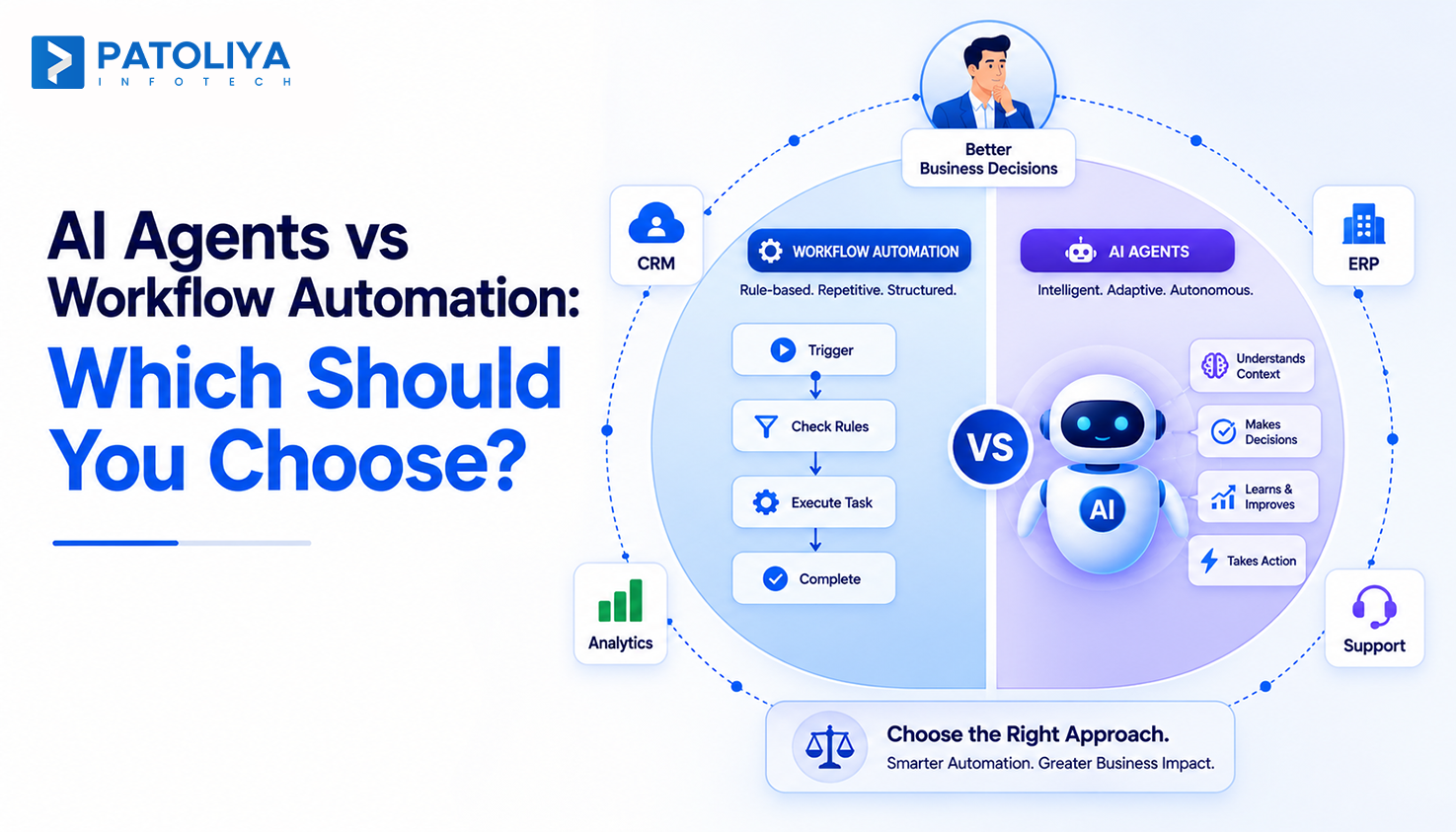
The AI agents vs workflow automation debate is about choosing the right architecture. Workflow automation follows rules, while AI agents reason, adapt, and act based on changing inputs. This guide explains where each approach fits within your broader digital transformation strategy, how agentic automation vs traditional automation differ, and when AI workflow automation is all your business really needs.
What Is Workflow Automation
Workflow automation runs a fixed sequence when a trigger fires. Think invoice approval: file arrives, system checks amount, routes to manager, done.
It relies on rule-based automation, meaning a human wrote every branch in advance. Change the rule, and someone has to edit the workflow manually, which is exactly why trust strategies for a smoother workflow matter as automation scales, and the first limit anyone studying AI agents vs workflow automation should understand.
What Are AI Agents
An AI agent reads context, forms a plan, and acts without a pre-written script for every branch. It uses autonomous decision-making to handle situations nobody coded for. A support agent deciding whether to refund, escalate, or troubleshoot based on the customer's tone and history, the kind of judgment call increasingly built into modern conversational user interfaces is a real-world example of AI agents vs. workflow automation playing out in a single ticket.
How Enterprise Automation Is Evolving
Static workflows break the moment reality gets messy. A refund exception, an unusual purchase order, a customer asking something the flowchart never anticipated, all of it stalls a rules-only system.
This is the real gap agentic automation vs traditional automation exposes: agents absorb the exception, workflows choke on it.
Support tickets involving refunds, complaints, or multi-step troubleshooting benefit from agents who read sentiment and account context before responding. This is where AI agents vs workflow automation decisions save the most money, since a single misrouted escalation can cost a support team hours.
Lead qualification that depends on reading intent from emails or call transcripts needs an agent, not a static scoring rule. AI agents vs workflow automation matters here because static lead scores miss buyers who signal urgency in ways a form field cannot capture.
HR onboarding exceptions, vendor negotiation follow-ups, and policy interpretation questions all need judgment. Agents can read a policy document and answer an employee's specific edge case correctly.
Code review triage, incident response, and log analysis increasingly run on agents that investigate root cause beyond a simple threshold alert a natural extension of automation testing in modern development. This is a textbook case of AI agents vs workflow automation, where reasoning beats a static alert rule.
Fraud detection, claims adjudication, and clinical documentation review all involve judgment calls that a rules engine cannot make safely. Choosing between AI agents vs workflow automation here is a cybersecurity and compliance decision as much as a technical one, and it is the clearest agentic automation vs traditional automation case in regulated industries today.
Highly Standardized Processes
Payroll runs, data backups, and scheduled reports never change shape, so a workflow handles them at near-zero cost.
Do not force an agent onto a job that has one path, ever, since this is where AI agents vs workflow automation debates waste real budget on the wrong problem.
Compliance Driven Operations
Regulated steps that must happen in an exact order, like KYC document checks, need the predictability workflows guarantee.
Auditors trust a workflow log more than an agent's reasoning trace, at least for now, and this is one place where agentic automation vs traditional automation still favors the traditional side.
Low-Complexity Business Workflows
If a task takes one glance to solve and never branches, a workflow wins on cost every time. Save agent budget for problems that actually require judgment, since a well-built AI workflow automation setup already handles the simple stuff for a fraction of the price, and every honest AI agents vs workflow automation review should say so plainly.
| Factor | Workflow Automation | AI Agents |
| Intelligence | Rule-based, fixed logic | Contextual, model-driven |
| Decision Making | Predefined branches only | Real-time judgment |
| Learning Ability | None without manual edit | Improves with feedback loops |
| Maintenance | Low, until rules change | Ongoing prompt and guardrail tuning |
| Cost | Low per execution | Higher per interaction |
| Governance | Simple audit trail | Needs monitoring and approval gates |
| Human Intervention | Rare after setup | Regular, especially early on |
| Scalability | High for repetitive volume | High for varied, judgment-heavy tasks |
| Best Use Cases | Payroll, backups, reporting | Support, fraud review, sales triage |
| ROI Timeline | Fast, often under 3 months | Slower, 6 to 12 months typically |
This table is the fastest way to settle AI agents vs workflow automation arguments in a planning meeting. Print it, pin it above your Jira board, and use it before greenlighting any new automation project.
Most teams that skip this comparison end up building an agent for a job that a workflow could have solved for a tenth of the cost, which is the single most common agentic automation vs traditional automation mistake we see in first-time projects, and a solid AI workflow automation baseline usually fixes it.
Assess Process Complexity First
Map every process on two axes: volume and variability. High volume, low variability goes to workflows. Low volume, high variability goes to agents. This single exercise borrows directly from the same discipline behind solid software development methodologies, and it prevents most of the wasted spend teams see when they pick AI agents vs workflow automation without data.
Select the Right Automation Architecture
Pick a hybrid stack where workflows handle triggers and data movement while an agent handles the judgment step in the middle, the same hybrid thinking behind our DevOps consulting engagements that blend automation with human oversight. Tools like n8n now ship a native n8n AI agent node that lets a workflow call an LLM mid-sequence, which is the most practical version of this hybrid pattern available today.
Integrating Existing Business Systems
Connect the agent or workflow to your CRM, ticketing system, and data warehouse through existing APIs before building new logic. Integration debt kills more AI agents vs workflow automation projects than model quality ever does.
Measuring Business Outcomes
Track resolution time, error rate, and escalation volume weekly for the first quarter after launch. AI workflow automation only proves its value when you can show a number that moved, not a demo that looked impressive, and this is the metric that every AI agents vs workflow automation rollout should report to leadership monthly.
Initial Development Investment: Workflow builds typically run lower upfront since they use existing automation platforms with drag and drop logic.
Agent builds cost more upfront because they need prompt engineering, testing, and guardrail design before launch, which is the first real number in any AI agents vs workflow automation budget conversation.
Infrastructure and Operating Costs: Workflows carry flat, predictable hosting costs. Agents carry variable costs tied to model usage per interaction, which means high-volume agent deployments need some disciplined cloud cost management you'd apply to any other production workload, not a rough guess, and a mature AI workflow automation stack tracks both cost lines separately from day one.
Productivity Gains: Teams running AI agents vs workflow automation side by side usually see workflows save time on repetitive tasks while agents cut resolution time on complex tickets, often by a wide margin once tuned properly.
Long-Term Return on Investment: Workflows return value fast and flatten out. Agents return value slower but keep compounding as they absorb more edge cases over time, which changes the entire AI agents vs workflow automation cost conversation for a CFO planning three years out, and it flips the usual agentic automation vs traditional automation payback math on its head.
Questions Every CTO Should Ask
Ask whether the process branches based on judgment or on fixed data fields. Ask how often the rules would need updating.
Ask if a wrong decision costs more than a slow one, because that answer usually settles AI agents vs workflow automation on its own.
What CIOs Should Evaluate Before Adoption
Evaluate data readiness, system integration maturity, and whether staff can monitor an agent's output daily. A CIO who skips this step ends up with an agent nobody trusts and a workflow nobody updates.
Budget Considerations for CFOs
Budget agent projects with a testing and monitoring line item, beyond the simple build cost. Agentic automation vs traditional automation spending patterns differ enough that treating them the same way in a budget sheet guarantees a bad surprise later.
Risk and Governance for Enterprise Leaders
Set approval thresholds for anything an agent decides above a defined dollar or risk value. Governance is the line item most enterprise leaders underfund, and it is the one that causes the most public AI agents vs workflow automation failures once an unsupervised agent makes a costly call, which is exactly why a solid AI workflow automation foundation with clear checkpoints matters before scaling agents at all.
Technical Capabilities: Ask for a live demo on your actual data, not a canned example. A vendor who can only show scripted demos cannot handle your real edge cases, and this single test settles most AI agents vs workflow automation vendor pitches fast.
Integration Flexibility: Confirm the vendor supports your existing CRM, help desk, and data warehouse through documented APIs before signing anything. Custom connectors add months to a timeline.
Security and Compliance: Require SOC 2 or equivalent certification, confirm it through the same rigor as proper application security testing, and ask exactly where your data is processed and stored. This matters twice as much once an agent starts making decisions with customer data.
Support and SLAs: Get a written response time guarantee for production incidents, not a vague promise. Agents fail differently from workflows, so your support contract needs to reflect that.
Scalability and Future Roadmap: Ask what the vendor's roadmap looks like for agentic automation vs traditional automation convergence, since most platforms are merging both capabilities into one product over the next two years.
This entire checklist mirrors the fundamentals in any solid guide to choosing an IT solution provider, the details just shift toward model behavior instead of code quality.
A 2014-founded firm with 250+ specialists building AI agents, agentic automation, and enterprise AI solutions for growing companies.
Key Features: Custom agent architecture, enterprise-grade security, rapid deployment cycles.
Best For: SMBs and enterprises comparing AI agents vs workflow automation for the first time.
Pricing: Custom quote.
Client Review: 4.8/5.
Founded in 1989 with over 700,000 employees, Accenture runs large-scale enterprise AI transformation and agentic AI programs globally.
Key Features: Global delivery network, deep industry vertical expertise, and change management support.
Best For: Global enterprises needing full-scale transformation.
Pricing: Custom quote.
Client Review: 4.5/5.
A 2009-founded enterprise AI applications company with 1,000+ staff building AI agents for large regulated industries.
Key Features: Prebuilt industry models, strong data pipeline tooling, enterprise-scale infrastructure.
Best For: Large enterprises in energy, defense, and manufacturing.
Pricing: Custom quote.
Client Review: 4.4/5.
Founded in 2007 with 250+ engineers focused on AI agent development and large language model solutions for mid-market clients running a full AI workflow automation stack.
Key Features: Custom LLM fine-tuning, agent orchestration frameworks, API first architecture.
Best For: Mid-market and enterprise teams.
Pricing: Custom quote.
Client Review: 4.6/5.
A 2015-founded team of 100+ specialists delivering AI agents, generative AI, and intelligent automation for startups weighing AI agents vs workflow automation on a tight budget.
Key Features: Fast prototyping, generative AI integration, flexible engagement models.
Best For: Startups and growing businesses.
Pricing: Custom quote.
Client Review: 4.5/5.
SaaS Companies: SaaS support and onboarding involve constant edge cases, which makes agents a strong fit for reducing churn driven by slow, generic responses, a natural evolution for any team already relying on SaaS solutions and a common first AI agents vs workflow automation upgrade for growing SaaS teams.
Healthcare Organizations: Healthcare teams handling claims, scheduling exceptions, and clinical documentation need agents that can reason across patient history, not a rigid workflow that stops at the first exception.
Financial Services: Fraud review, underwriting exceptions, and compliance monitoring all benefit from AI agents vs workflow automation thinking, since a missed fraud pattern costs far more than a slightly slower automated review.
Ecommerce Businesses: Order exceptions, return disputes, and personalized upsell timing all need judgment that static workflows cannot deliver at scale during peak season.
Enterprises Managing Complex Operations: Any enterprise running cross-department processes with constant exceptions should treat AI agents vs workflow automation as a standing budget line, not a one-time project.
Patoliya Infotech helps businesses make the right AI agents vs workflow automation decision by designing solutions around real operational needs.
Whether you're exploring agentic automation vs traditional automation or planning your first AI initiative, Patoliya Infotech helps you build the right automation strategy for long-term business value.
Automation Maturity Model
Most companies sit at stage two of the automation maturity model, running workflows well but with zero agent coverage for exceptions.
Stage four companies run a blended stack where agents handle judgment calls and workflows handle volume, the operating model we describe in the new era of the AI virtual organization.
Agentic AI Adoption Trends
Agentic AI adoption is accelerating fastest in support, finance, and software engineering, where exception volume is highest, and the cost of a slow decision is measurable in dollars per hour. Gartner's own 2026 Hype Cycle for Agentic AI places the category at the Peak of Inflated Expectations, meaning enterprise enthusiasm is currently running ahead of production-ready maturity.
This trend is quietly rewriting the agentic automation vs traditional automation balance inside every large enterprise IT budget.
Building an AI First Enterprise
An AI-first enterprise treats AI agents vs workflow automation as one continuous system, not two separate vendor contracts, and reviews the split every quarter as processes change.
Companies that skip this review keep paying for a setup built for last year's process, not this year's.
AI agents vs workflow automation is about applying the right approach to the right business process. Workflow automation delivers efficiency for predictable tasks, while AI agents create value where reasoning and adaptability are essential. The most successful organizations combine both to maximize productivity, reduce costs, and scale intelligently.
Start by evaluating your existing workflows, identifying where intelligent decision-making adds value, and prioritizing the processes with the greatest operational impact. Making the right decision today can deliver measurable business impact for years to come. Talk to Patoliya Infotech to identify where AI agents, workflow automation, or a hybrid approach much like choosing between staff augmentation vs. managed services will generate the highest return for your business.