Table of Contents
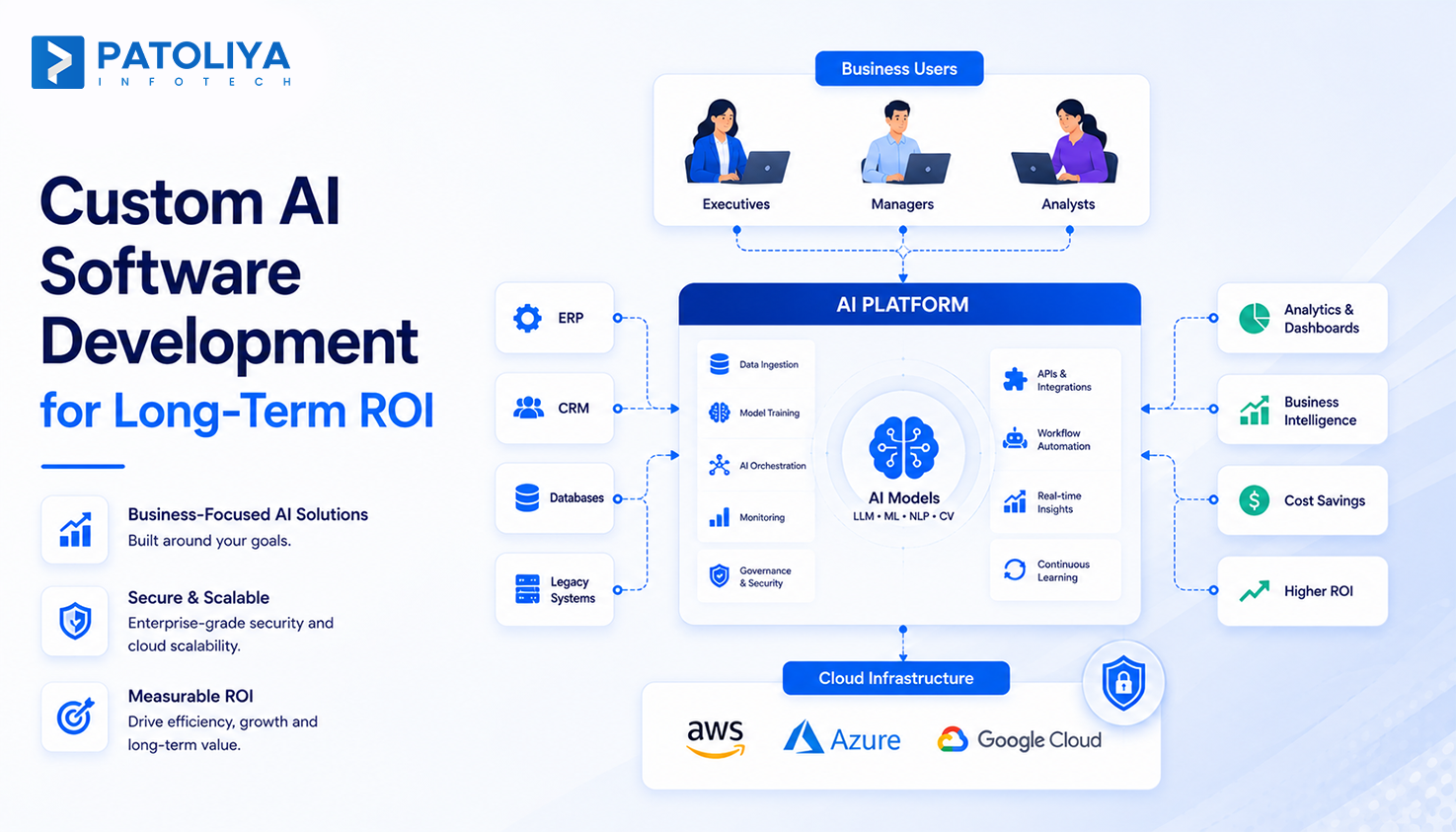
TL;DR: Generic AI tools break down once your data, compliance needs, or workflows get specific. Custom AI software development gives you full control over accuracy, security, and integration, which is why more mid-market and enterprise teams are moving in this direction as their AI usage matures.
Every SaaS AI tool looks powerful until your compliance team asks where the data actually lives. That single question sends most enterprise teams straight into custom AI software development, because off-the-shelf tools were never built to answer it. Companies do not choose custom builds for fun.
They choose it because generic tools hit a wall on security, accuracy, or workflow fit, and that wall shows up fast once you scale past a pilot. Many teams also explore enterprise AI development services once internal engineering bandwidth runs out and the project needs specialized model and infrastructure expertise.
This guide explains when custom AI makes financial sense, what a real project actually costs, how the build process works, and how to pick a partner who will not disappear after the demo. It also explains when it makes more sense to build custom AI application projects with your own team versus leaning on outside help.
Not every process needs a model. The strongest candidates are high-volume, repetitive, and measurable, such as claims triage, contract review, or customer support routing.
If you cannot describe the current manual process in five steps, custom AI software development is premature, and you need process clarity first.
Teams that jump straight to enterprise AI development services without this clarity usually end up paying twice, once for the wrong build and again for the correct one.
Your data quality decides your outcome more than your model choice does. Clean, labeled, accessible data is the real prerequisite for any build custom AI application initiative, and skipping this step is the top reason projects stall in testing.
More than half of organizations still report their data isn't AI-ready by Gartner's own measure, which is exactly why this step gets skipped so often and costs so much when it is.
Run a data audit before you write a single line of a project brief, since even the best enterprise AI development services team cannot fix bad inputs with a better model.
Teams that define success metrics upfront, such as time saved per ticket or error rate reduction, see far stronger adoption after launch.
Enterprise AI development services providers will always ask for this number first, because a model without a target metric is just a demo, not a business tool.
Skipping this step is the fastest way to make custom AI software development feel expensive when the real issue was a missing goal.
Custom AI software development only pays off when the business case is defined before development starts, and that discipline is what separates a working system from an expensive pilot.
| Evaluation Criteria | Off the Shelf AI | Custom AI Software Development |
| Initial Investment | Low upfront cost | Higher upfront cost, lower long-term cost |
| Customization | Limited to vendor settings | Built around your exact workflow |
| Data Ownership | Vendor controlled | Fully owned by your business |
| Integration Flexibility | Restricted to available APIs | Open, built for your stack |
| Security and Compliance | Shared responsibility model | Full control over data handling, the same standard covered in firewall AI innovation in cybersecurity |
| Long Term ROI | Flattens after initial gains | Compounds as the model learns your data |
If your use case is generic, like drafting emails or summarizing meetings, a subscription tool wins on cost and speed. There is no reason to invest in custom AI software development for a problem that a $20 monthly tool already solves well.
Bringing in enterprise AI development services for a low-stakes task burns budget that a future, higher-value project will need.
Once your workflow touches sensitive data, needs a specific accuracy threshold, or must connect to five internal systems at once, buying stops working.
This is exactly when teams choose to build custom AI application projects instead, because ownership and control become worth the extra investment. The break-even point usually arrives once monthly subscription costs across multiple tools exceed the cost of one focused build.
A rules-based assistant costs a fraction of a system that requires fine-tuning or machine learning development on proprietary datasets.
The more your use case depends on judgment over a simple lookup, the higher your custom AI software development cost climbs, because the model needs more training cycles and evaluation rounds.
This is the single biggest variable that separates a cheap build custom AI application quote from an accurate one.
Every legacy system you connect to adds engineering time. These project budgets often underestimate this line item, and it is usually the single biggest driver of scope creep during a project.
Ask any experienced provider, and they will confirm integration work, not the model, drives most budget overruns.
Pipelines, storage, and vector databases form the backbone of any serious AI system, and the same database vs. data warehouse distinction that governs traditional software applies here, just with an added retrieval layer on top.
Skipping this layer to save money guarantees a rebuild within a year, so custom AI software development teams should budget infrastructure as a first-class cost.
Any build custom AI application plan that skips this line item is not a real budget; it is a placeholder.
A shipped model is not a finished model. Continuous monitoring, retraining, and prompt tuning keep accuracy high, the same ongoing discipline covered in winning by maintaining your app regularly, and enterprise AI development services providers typically price this as a monthly retainer separate from the initial build.
Treat this retainer as part of the true cost of custom AI software development, not an optional add-on.
| AI Solution Type | Estimated Timeline | Typical Cost Range |
| AI Assistant | 6 to 10 weeks | Lower five figures to mid five figures |
| Workflow Automation | 3 to 5 months | Mid five figures to low six figures |
| Enterprise AI Platform | 6 to 12 months | Six figures and above |
Cost always tracks complexity and integration count more than it tracks the model itself, the same pattern covered in cloud cost management trends, so scope your integrations honestly before you request a quote.
| Comparison | AI Consultants | End-to-End AI Development Companies | Best Choice When |
| Primary Focus | AI strategy, assessments, and roadmaps. | Complete custom AI software development, from strategy to deployment. | You need a production-ready AI solution. |
| Deliverables | Workshops, recommendations, and architecture documents. | Working on AI applications, integrations, testing, deployment, and support. | You want a live product, not just a plan. |
| Technical Execution | Limited or outsourced implementation. | In-house development, deployment, and maintenance. | End-to-end ownership is required. |
| Business Value | Defines opportunities and use cases. | Delivers measurable business outcomes through deployed software. | You need execution and long-term ROI. |
| Best For | Early-stage AI strategy and feasibility studies. | Enterprise AI initiatives and scalable AI products. | Organizations ready to build AI solutions. |
This same divide, strategy advice versus a team that can actually build custom AI application systems end to end, is worth weighing before you sign anything.
| Comparison | AI-First Agencies | Enterprise Software Companies | Best Choice When |
| Core Expertise | AI models, prototypes, and experimentation. | Enterprise software with integrated AI capabilities. | You need AI embedded into existing business systems. |
| Development Focus | Rapid proof of concepts (PoCs) and MVPs. | Production-ready enterprise AI development services. | Security, scalability, and reliability matter. |
| Security & Compliance | Varies by agency. | Mature governance, compliance, and security practices. | Working with regulated industries or sensitive data. |
| System Integration | Basic integrations. | Deep ERP, CRM, database, and legacy system integration. | Enterprise-wide AI adoption. |
| Best For | Validating new AI ideas quickly. | Long-term enterprise AI transformation. | Businesses are planning production deployments. |
| Comparison | Offshore Teams | Nearshore Teams | Local Teams |
| Development Cost | Lowest | Moderate | Highest |
| Time Zone Alignment | Limited | Good | Excellent |
| Communication | Slower due to time differences. | Faster collaboration. | Real-time collaboration. |
| Project Management | Requires structured coordination. | Easier to manage. | Simplest communication and decision-making. |
| Scalability | Access to large global talent pools. | Strong regional talent availability. | Limited by the local hiring market. |
| Best For | Cost-sensitive, well-defined projects. | Ongoing collaboration with the budget balance. | Complex custom AI software development projects require frequent stakeholder involvement. |
This decision runs on the same tradeoffs covered in offshoring vs. outsourcing, and once you've picked a model, it's worth weighing against staff augmentation vs. managed services for how the engagement itself gets structured.
This journey follows the same phased discipline outlined in the lifecycle of software development, adapted for the extra uncertainty a model introduces.
Discovery and AI Proof of Concept: Every serious engagement starts with an AI proof of concept, a small-scope build that proves the model can hit your accuracy target before you commit full budget.
This phase should take weeks, not months, and it exists specifically to kill bad custom AI software development ideas before they consume a full budget.
Solution Design and Development: Once the proof of concept clears the bar, the team moves into full development, covering model selection, architecture, and interface design, guided by the same software development methodologies that keep traditional builds on track.
This is where the product actually takes shape around your real workflow, and where a team that can truly build custom AI application systems earns its fee.
AI Integration Services Across Existing Systems: Connecting the model to your CRM, ERP, or ticketing platform through AI integration services is often harder than building the model itself.
Plan for this phase to take as long as development, because a rushed integration schedule is the most common reason custom AI software development timelines slip.
Deployment, Monitoring, and Continuous Improvement: Launch is the midpoint, not the finish line. Ongoing monitoring catches drift early, and teams offering enterprise AI development services should include a 90-day stabilization window in every contract.
This window is where most custom AI software development projects earn or lose the trust of their end users.
A project only counts as successful once it survives contact with real users, so budget time and attention for the weeks right after launch.
RAND Corporation's research on AI project failure found that more than 80 percent of AI projects fail to reach production, roughly double the failure rate of non-AI IT projects and the reasons below track closely with what RAND's interviews with practitioners uncovered.
Building AI Without a Business Objective: Teams that start with the technology over the actual problem end up with a demo nobody uses. Custom AI software development only works when it maps directly to a revenue or cost metric that leadership actually tracks.
Poor Data Quality and Governance: Dirty data produces dirty outputs regardless of model quality. Governance gaps here quietly kill more custom AI software development projects than any technical limitation ever does.
Ignoring User Adoption: A model with 95 percent accuracy that nobody opens delivers zero value. Training and change management deserve the same budget line as the build custom AI application phase itself, not an afterthought at the end.
Choosing the Wrong Development Partner: A partner without real production experience will optimize for the demo, not the deployment. Vet enterprise AI development services providers on their post-launch track record ahead of their pitch deck.
Ask them to name a project where they had to redo the work twice because the first version missed the mark.
Most custom AI software development failures trace back to planning gaps, not model performance, which is exactly why the evaluation stage earlier in this guide matters so much.
This decision deserves the same scrutiny covered in our guide to choosing an IT solution provider, with a few AI-specific checks layered on top.
A strong AI implementation partner understands infrastructure, security, and integration just as deeply as they understand models. Ask for architecture diagrams from past projects, on top of accuracy benchmarks, since real custom AI software development skill shows up in the details a demo never covers.
Confirm the team has connected AI systems to platforms similar to yours before. Building without integration experience leads to expensive rework once the build meets your real tech stack. This is exactly why any serious partner should walk you through their integration history before scoping anything new.
Ask how the partner handles data encryption, access control, and regulatory requirements specific to your industry, using the same standards covered in how application security testing safeguards sensitive systems. This single question filters out a large share of vendors before your custom AI software development budget is even finalized.
The best partners stay involved after launch, tuning the model as real usage data comes in. If a vendor cannot describe their support plan clearly, treat that as a warning sign, not a minor gap, especially for a project with real users on day one.
Successful custom AI software development requires more than building AI models; it demands expertise in enterprise software, integrations, security, and long-term scalability.
At Patoliya Infotech, we help businesses move from AI strategy to production with solutions designed around real business outcomes.
Whether you're validating an AI idea or planning a large-scale enterprise implementation, our team helps you define the right roadmap, estimate realistic costs, and build AI software that delivers measurable business value.
Ready to build enterprise AI with confidence? Talk to Patoliya Infotech and schedule a strategy session today.
The success of custom AI software development depends on solving real business challenges with a clear strategy, reliable data, and scalable technology, and it belongs squarely inside any serious digital transformation guide for the years ahead.
Selection of the right development partner is equally important, as enterprise AI development services require expertise in architecture, integration, security, and ongoing optimization to deliver long-term results.