Table of Contents
In 2026, companies are increasingly looking to hire offshore developers to maintain their position in changing markets. Fast delivery, accountability, and long-term team stability are now the main priorities over cost cutting. Teams with the ability to maintain code quality, manage scalable product roadmaps in remote settings, and easily connect to internal processes are essential for modern businesses.
Many companies work with a reliable custom software development company to build distributed teams that maintain long-term quality and delivery discipline.
Because they were designed for linear workflows and co-located teams, traditional offshore hiring manuals often don't work. Time zone differences, poor administration, and lack of performance monitoring are common causes of technical load and missed deadlines. Organizations must now prioritize organized onboarding, role-specific assessments, and proactive collaboration to succeed.
Hiring skilled offshore web developers helps companies accelerate project deliveries among multinational teams, as well as maintain high technical standards.
By 2026, companies hire offshore developers or hire remote software developers talent to source specialized engineering expertise not available locally. This saves on fixed recruitment costs and accelerates revenue-driven releases. Market volatility has a direct impact on how competitors position themselves.
This transforms offshore partnerships from a plan to reduce costs into a strategic growth lever. To bridge technology gaps faster, companies use offshore PHP developers for scalable web platforms or offshore NET developers for enterprise modernization.
These initiatives are often supported by professional web application development services that ensure scalability, security, and seamless system integration.
For instance, a SaaS company entering a new market hire offshore developers to deliver localized features within 90 days instead of delaying expansion due to talent shortages.
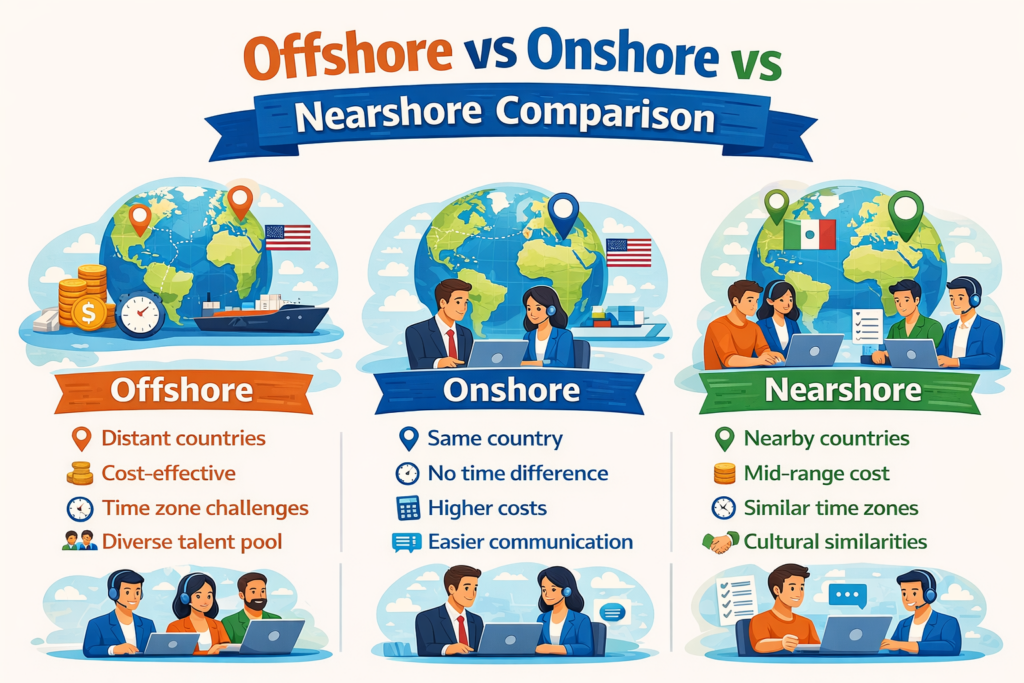
While hiring onshore ensures proximity, it limits scalability and increases the wage burden. NearShore strikes a balance between reasonable savings and easy communication. Hire offshore developers offers the best cost-effectiveness and the widest technological range. When rapid scalability, deep backend expertise, and reliable execution are more important than location, companies choose to outsource. This applies in particular to complex and results-based development projects.
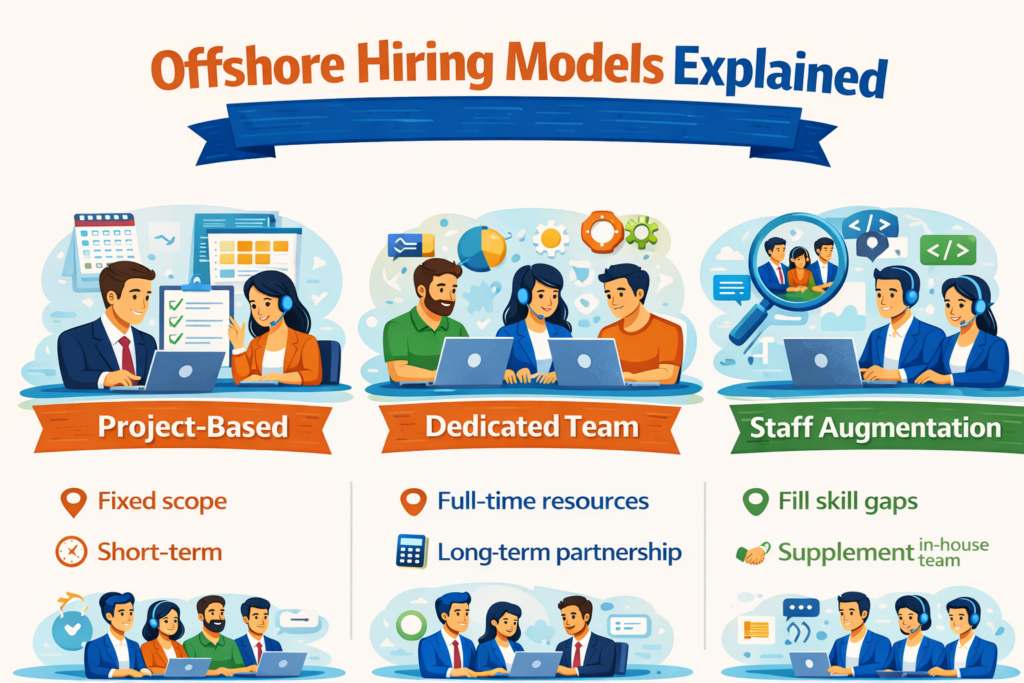
Organizations must match the engagement structure with risk appetite and business goals to successfully hire offshore developers. The dedicated team approach ensures strong domain alignment and consistent sprint velocity, promoting long-term product scalability. Fixed cost contracts provide budget stability and are best suited for projects with clear deliverables and fewer scope changes. On the other hand, time and materials agreements offer the flexibility needed for experimental builds and modified MVPs where requirements may vary over time.
Management should consider architectural skill, communication maturity, delivery management, and past performance with offshore Java developers or offshore PHP developers when considering hire offshore developers. Project risk increases when cost efficiency is combined with a lack of implementation discipline.
Offshore hiring is transformed from transaction-based outsourcing to a managed growth strategy through structured onboarding, milestone-based tracking, and SLA-backed accountability.
Startups prioritize time and materials to maintain flexibility while validating their products. Growth-stage companies use dedicated teams to hire offshore developers or hire remote developers to improve iteration cycles and ensure roadmap consistency.
To ensure compliance controls, predictable budgets, and long-term scalability in line with digital transformation goals, companies use structured agreements with offshore Java developers.
For instance, to increase feature velocity without raising fixed payroll expenses, a startup business hires a specialized offshore PHP development team.
Organizations can hire offshore developers accurately by using a role-based structure that links technical expertise to architectural complexity and business outcomes.
Sprint responsibility is increased, and delivery gaps are reduced with clear ownership structures. Companies are increasingly evaluating backend expertise, DevOps maturity, and system scalability before hiring external developers to ensure measurable performance impact.
An offshore NET developer requires advanced ASP.NET Core expertise, microservices design skills, and solid knowledge of enterprise integration. By hire offshore developers, you can consider maintainable coding standards, Azure cloud implementations, and API performance optimization. This helps to modernize mission-critical business processes in a scalable way.
When choosing an offshore PHP developer, it's important to consider database scalability, backend security implementation, and demonstrated Laravel or Symfony experience. To verify production-grade engineering capability during hire offshore developers, examine previous builds of high-traffic applications, API integrations, and organized testing processes.
Offshore Java developers must be proficient in CI/CD workflows, distributed architecture, and Spring Boot. Evaluate the effectiveness of system design, scalability planning, and performance tuning to support long-term platform reliability and high-performance enterprise applications through hire offshore developer.
Employers now evaluate offshore development rates based on value-driven pricing rather than traditional hourly billing in 2026. Pricing structures vary according to delivery maturity, domain experience, and skills.
Because of their architectural responsibilities and impact on scalability, backend professionals, such as skilled offshore Java developers, offshore NET developer, or offshore PHP developers, typically command higher rates.
Especially for long-term product roadmaps, monthly dedicated team pricing offers more stability than random hourly fees.
When choosing to hire offshore developers, companies must weigh costs against print quality, communication standards, and SLA promises.
Project management, QA processes, and sprint transparency are often included in the prices of experienced vendors who offer shielded external developers. This is reducing operational risk and unexpected expenses during hire offshore developers.
Many businesses misjudge the complexity of onboarding and the time required for knowledge transfer when engaging hire offshore developers in the hope of achieving immediate productivity.
Inadequate sprint management, poor scope documentation, and communication errors lead to delays in sprint delivery.
Choosing an offshore NET developer who is misaligned or an underqualified offshore Java developer results in technical debt and inconsistent architecture.
Lack of measurable KPIs, inadequate compliance checks, and poor supplier screening increase operational risk.
Companies that quickly hire offshore developers without using formal evaluation processes often end up with cost overruns and exceeding deadlines.
Companies that employ remote developers without clear ownership structures have problems with consistency in delivery and accountability.
Unrealistic expectations, insufficient onboarding documentation, and a lack of technical alignment are the main causes of failure to hire offshore developers. In the absence of detailed sprint planning, specified KPIs, and communication processes, offshore teams work more reactively than strategically. In the first quarter, early-stage misalignment reduces returns and damages confidence due to performance delays.
Many organizations now follow established remote team management best practices to improve alignment and early-stage performance.
Companies that hire offshore developers effectively put in place systematic vetting procedures before contract signing. Live coding tests, system design talks, and practical problem-solving evaluations are all essential components of technical screening.
When considering an offshore PHP developer, an offshore NET developer, or an offshore Java developer, look at their scalability experience and previous production deployments. For long-term delivery success, DevOps expertise, documentation standards, and clear communication are equally important.
To minimize operational risk, companies hire offshore developers should also confirm compliance processes, intellectual property protection policies, and sprint management maturity. These evaluations should align with recognized software security guidelines to protect intellectual property and user data.
For instance, before signing a contract with remote developers for hire, a fintech company conducted trial sprints and architecture interviews. This ensures that the selected offshore workforce complies with security and scalability standards.
Patoliya Infotech assists enterprises in hiring offshore developers while mitigating risk and delivering measurable ROI. We offer a methodical approach to hiring, beginning with technical screening that is in line with project objectives and role-based evaluation.
Experienced offshore NET developers, offshore PHP developers, and offshore Java developers can create scalable, secure, and high-performance solutions as part of our screening teams.
To ensure delivery predictability, we comply with milestone tracking, SLA-backed accountability, and transparent sprint reporting.
Flexible engagement models include dedicated teams, fixed-cost projects, and time and materials agreements. This enables companies to effectively scale development.
In many cases, organizations benefit from having specialists review their hiring strategy to identify skill gaps, delivery risks, and scalability challenges.
In 2026, strategy, organized processes, and partner selection should be the main priorities for businesses hire offshore developers. Delivery of high-quality and scalable operations is ensured by accurate role descriptions, comprehensive technical screening, and efficient administration.
Hiring reliable talent, such as offshore PHP developers or offshore NET developers, should be seen as an investment in development and not a way to save costs. By prioritizing planning, accountability, and measurable results, companies can achieve faster delivery, predictable ROI, and long-term operational efficiency in distributed development teams.