Table of Contents
TLDR: Developer experience (DX) is the sum of every interaction a developer has with their tools, processes, and environment while building software. Poor developer experience (DX) costs engineering organizations an estimated 30% of total developer capacity in friction, context-switching, and avoidable rework. This guide covers measurement frameworks, investment costs, ROI, and the vendors worth evaluating in 2026.
Developers do not quit companies. They quit friction. When building pipelines takes 45 minutes, onboarding takes three weeks, and internal tooling is held together with undocumented scripts, the best engineers leave first because they have the most options. Developer experience (DX) is the discipline that fixes that. It is not a culture initiative or a perk program. It is an engineering investment with measurable ROI in velocity, attrition, and time-to-market. Organizations that treat developer experience (DX) as a product discipline outship, outretain, and outscale those that treat it as a morale exercise. This guide will help you to understand every framework, cost, and decision you need to build a serious DX program.
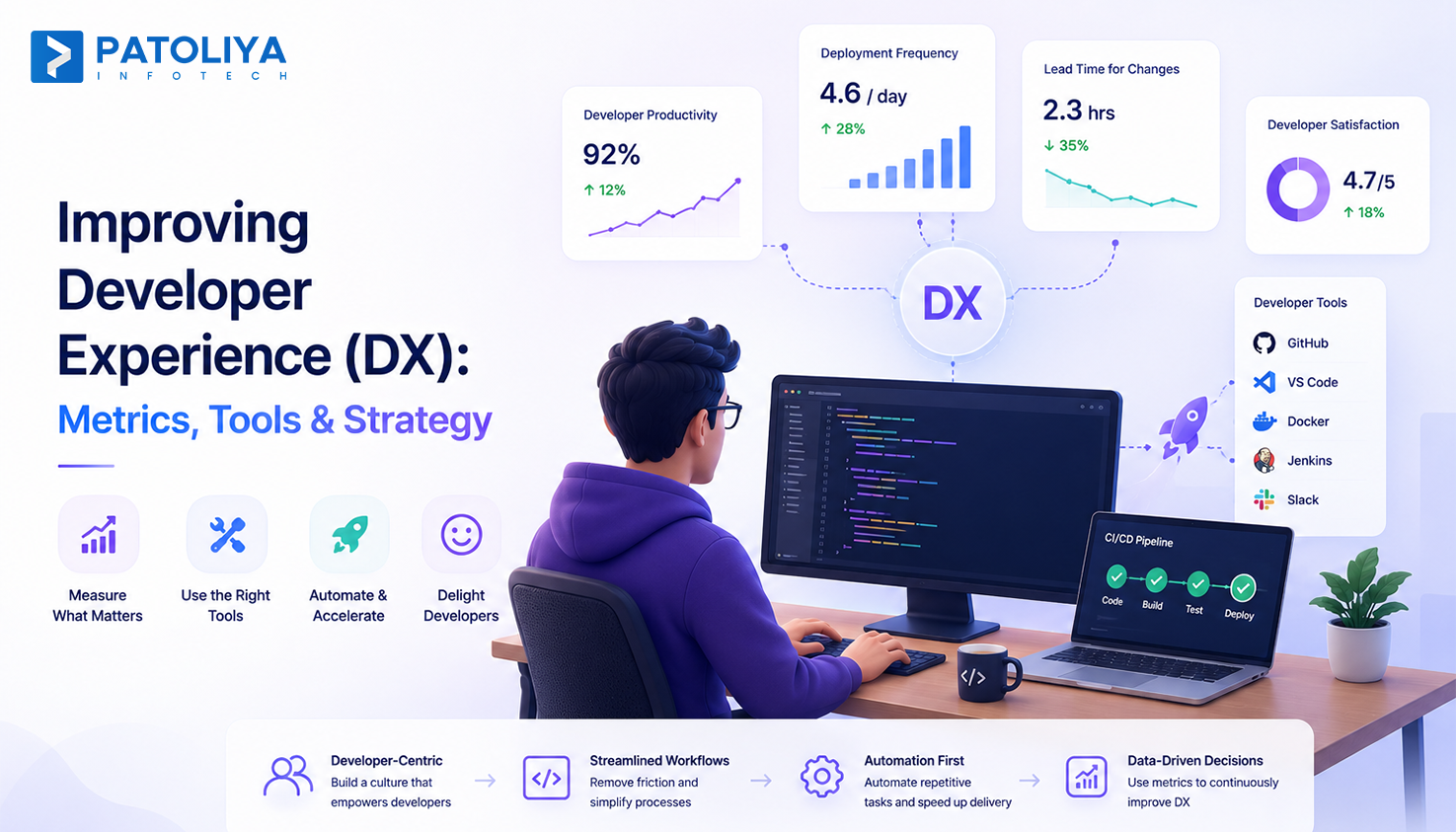
Developer experience (DX) is the holistic quality of a developer's interaction with every system, tool, process, and person involved in building and shipping software. It covers the full engineering workflow from environment setup through code review, testing, deployment, and incident response.
Improving developer experience is not about making developers happy in an abstract sense. Developer productivity tools are about removing friction that directly reduces output quality and velocity.
Developer experience (DX) operates across three dimensions:
| Dimension | What It Covers |
| Tooling | IDE, CI/CD, build systems, test frameworks |
| Process | Onboarding, code review, deployment workflows |
| Environment | Local dev setup, cloud environments, documentation |
Improving developer experience means measuring friction in each dimension, prioritizing the highest-cost problems, and fixing them with the same rigor you apply to product engineering.
Developer experience (DX) done well is invisible. Developers just move faster, stay longer, and build better software.
Developer experience (DX) programs address five capability areas. Each one has a measurable friction cost and a documented improvement path.
Inconsistent local environments waste engineering time before a single line of production code is written. Developer productivity tools like dev containers, Nix, and Codespaces standardize environments across the team to improving developer experience. New engineers get a working environment in minutes, not days. Existing engineers stop debugging "works on my machine" issues with the help of Developer Experience (DX). Modern web application development services increasingly rely on standardized development environments for faster delivery cycles.
Slow pipelines destroy developer experience (DX) at scale. A 40-minute build cycle running 20 times per day per engineer adds up to over three hours of blocked time daily. Developer productivity tools for pipeline optimization, remote caching, and parallelization cut that directly. Target under 10 minutes for full CI runs as your baseline. Mature CI/CD systems often depend on structured DevOps Consulting for deployment automation and pipeline optimization.
A developer portal centralizes API docs, runbooks, service catalogs, and onboarding guides in one searchable interface. Without Developer experience (DX), developers spend 20 to 30 minutes per day hunting for information that should take 30 seconds to find. Backstage is the leading open-source developer portal framework for improving developer experience. Many engineering organizations use the Backstage developer portal to centralize documentation, service catalogs, and onboarding workflows.
Cognitive load reduction is the most underinvested area in developer experience (DX). Every unnecessary tool, undocumented process, and inconsistent pattern adds mental overhead. Simplifying toolchains and standardizing patterns directly reduces cognitive load reduction and increases sustained output quality.
Fast feedback loops are a core DX metrics signal. Code review turnaround, CI result latency, and deployment feedback time all measure how quickly developers know if their work is correct. Slow loops of Developer productivity tools break flow state and compound daily.
These five capabilities define where your developer experience (DX) investment goes first.
Developer experience (DX) investment targets four problems that show up in DX metrics before they show up in attrition numbers.
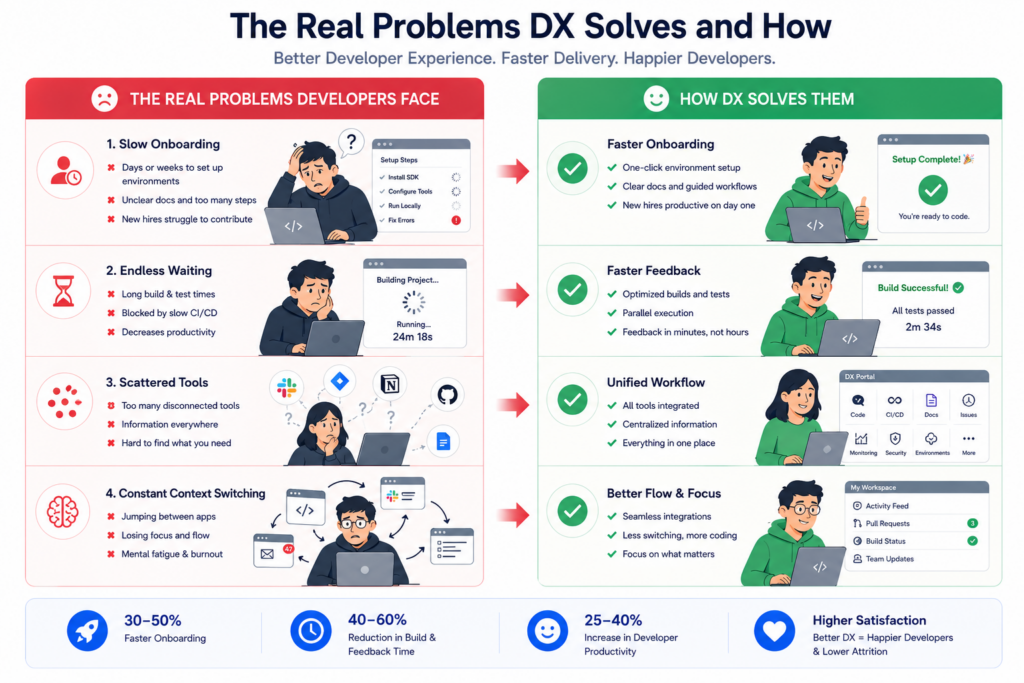
Industry average onboarding time to first production contribution is 30 to 90 days. Improving developer experience through automated environment setup, structured onboarding paths, and a developer portal cuts that to 5 to 10 days. Every week of compressed onboarding is a week of productive output recovered in Developer experience (DX). Distributed resource augmentation models often increase onboarding and tooling standardization complexity.
Developers lose flow state after 20 minutes of waiting. Improving developer experience through CI optimization and remote caching restores that time directly. The productivity impact is not linear through Developer experience (DX). Restored flow state produces disproportionate output quality gains through Developer productivity tools.
Ten tools with ten different interfaces, authentication methods, and notification systems add up to a significant developer experience (DX) tax. Toolchain consolidation and internal tooling standardization reduce that overhead. Companies that hire offshore developers usually require stronger documentation and workflow consistency.
Developer satisfaction goes unmeasured until an exit interview reveals it for Developer experience (DX). Quarterly pulse surveys tied to DX metrics surface friction before it becomes a resignation.
Measurement frameworks give these problems a common language.
The selection of the right DX metrics framework determines what you measure, what you optimize for, and what story you tell to leadership.
DORA metrics measure four pipeline-level signals: deployment frequency, lead time for changes, change failure rate, and mean time to recovery. They are the most widely adopted DX metrics baseline for Developer experience (DX) because they connect directly to business outcomes. High DORA performers deploy 973x more frequently than low performers. The DORA engineering metrics framework helps engineering organizations benchmark deployment performance and delivery reliability.
DORA metrics are a floor, not a ceiling. They tell you how your pipeline performs. They do not tell you why developers are burning out or which tooling friction is killing velocity.
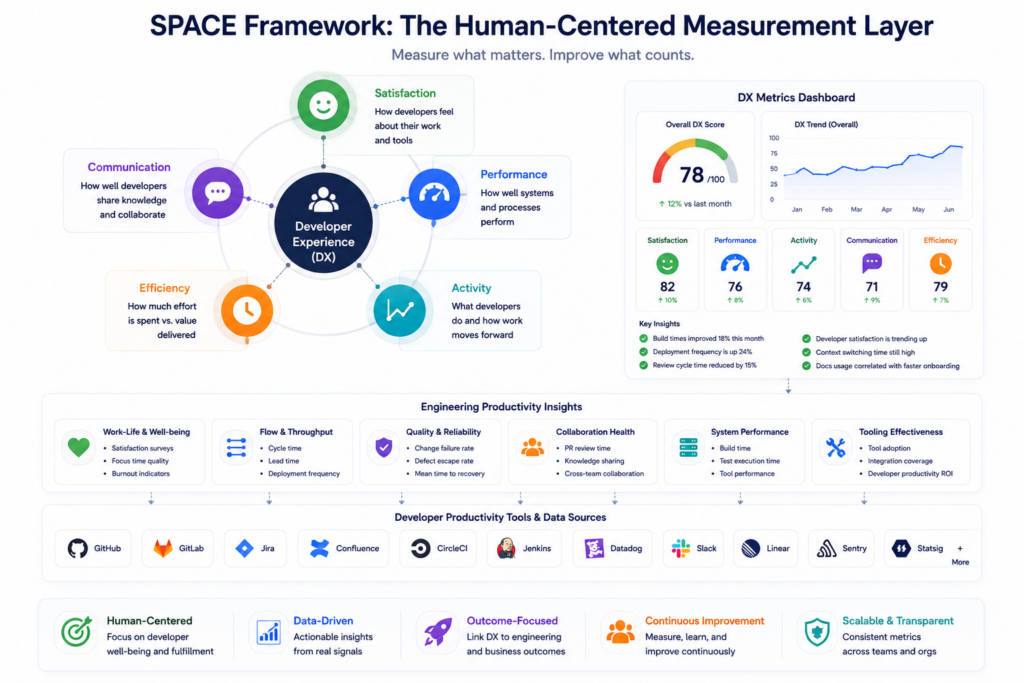
The SPACE framework adds five dimensions to DX metrics: Satisfaction, Performance, Activity, Communication, and Efficiency. It captures the human experience of engineering work that DORA misses entirely. Use SPACE for org-level developer experience (DX) reporting and quarterly executive reviews.
The DevEx framework from the paper by Nils Doehler and colleagues focuses on three dimensions: feedback loops, cognitive load, and flow state. It is the most actionable DX metrics model for teams doing daily improving developer experience work. It maps directly to engineering workflow decisions through Developer experience (DX).
| Framework | Primary Focus | Best Used For |
| DORA metrics | Pipeline performance | CI/CD benchmarking, exec reporting |
| SPACE | Human and team factors | Org health, developer satisfaction |
| DevEx | Workflow friction | Sprint-level DX improvement prioritization |
Developer experience (DX) programs that use all three frameworks get a complete picture: pipeline performance, human factors, and daily workflow friction. Using only one gives you a partial view that leads to incomplete investment decisions.
Developer experience (DX) investment spans four cost categories. Understanding each one prevents budget surprises and incomplete business cases.
Building an internal platform engineering team for improving developer experience costs $160,000 to $220,000 per dedicated engineer annually, including salary, benefits, and tooling. A three-person DX team runs $480,000 to $660,000 per year before infrastructure costs for Developer experience (DX).
A consulting-led developer experience (DX) audit and roadmap runs $25,000 to $75,000. This covers baseline measurement, friction mapping, prioritized improvement recommendations, and implementation planning. For organizations without existing DX metrics baselines, this is the fastest path to a defensible investment case.
Developer productivity tools licensing adds $15,000 to $80,000 annually, depending on team size and platform choices for Developer experience (DX). Developer portal setup, CI infrastructure upgrades, and toolchain consolidation each carry one-time implementation costs of $10,000 to $40,000.
| Model | Cost Range | Best For |
| DX audit only | $25,000 to $40,000 | Baseline measurement |
| Roadmap and implementation | $50,000 to $75,000 | Full program design |
| Ongoing managed DX partnership | $8,000 to $20,000/month | Continuous improvement |
Developer experience (DX) investment ROI turns positive within 6 to 12 months for most engineering organizations with 15 developers.
Developer experience (DX) ROI shows up in four measurable places. Each one has a financial value that translates directly to board-level language.
Developer experience (DX) programs that reduce build time, onboarding friction, and context-switching tax recover 20 to 30% of total engineering capacity. On a 20-person team at $120,000 average salary, that is $480,000 to $720,000 in recovered output annually.
Replacing a mid-level engineer costs 1.5x to 2x annual salary in recruiting, onboarding, and ramp-up time. Poor developer experience (DX) is a documented attrition driver. DX metrics programs that surface friction before it becomes resignation save $180,000 to $240,000 per retained engineer.
Improving developer experience through CI optimization and deployment automation directly compresses release cycles. Faster releases mean faster revenue realization on every feature shipped in Developer Experience (DX).
Developer productivity tools that eliminate manual overhead scale output without scaling headcount. Developer experience (DX) investment is one of the few engineering investments where returns increase as team size grows.
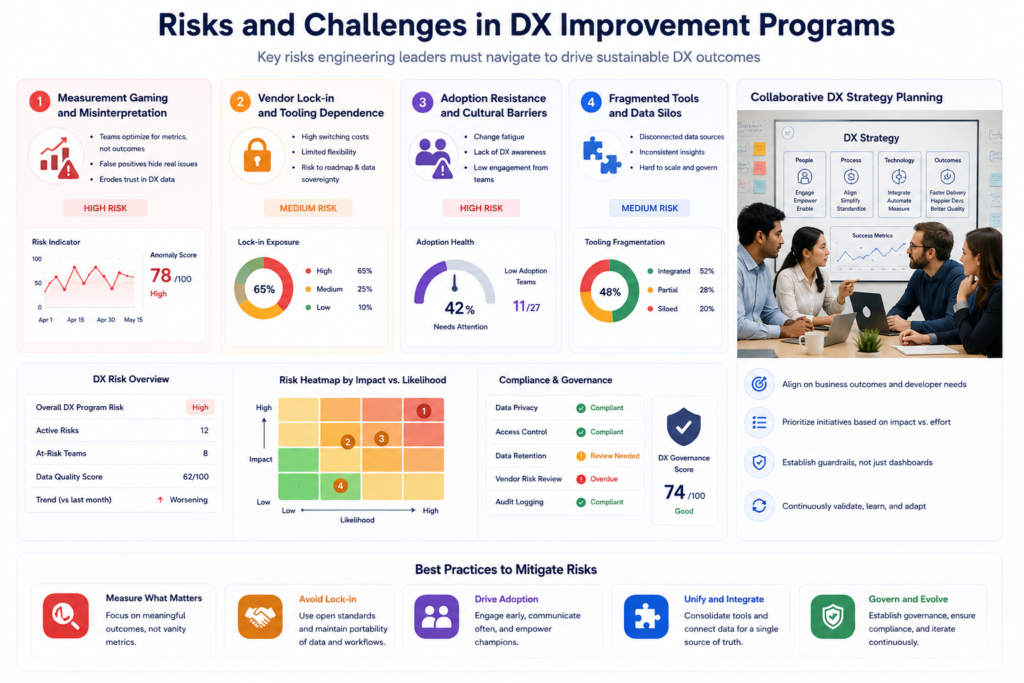
Every developer experience (DX) program carries four risks that determine whether the investment delivers or stalls.
DX metrics that get tied to performance reviews get gamed. Deployment frequency increases with trivial commits. PR count rises with unnecessary splits. Track developer experience (DX) metrics at the team level for improvement signal, not at the individual level for evaluation. That distinction of Developer productivity tools prevents the measurement from corrupting the outcome.
Improving developer experience requires developers to adopt new tools and workflows for Developer Experience (DX). Adoption that is mandated without buy-in produces shadow toolchains and compliance theater. Run DX improvements as opt-in pilots with visible results before org-wide rollout.
Developer productivity tools consolidation reduces fragmentation but concentrates dependency. A single platform outage takes down your entire engineering workflow. Maintain portability in toolchain design and evaluate vendor exit costs before committing. Large-scale IT outsourcing operations often struggle with fragmented engineering workflows and disconnected tooling.
Developer experience (DX) ROI is real, but attribution is complex. Velocity improvements happen across multiple variables simultaneously. Build your measurement baseline before the program starts. Without a pre-program baseline, improving developer experience ROI becomes a narrative argument rather than a data argument at budget review time.
Selection of the right partner for developer experience (DX) requires evaluating eight criteria before any engagement begins.
| Evaluation criteria | What to Verify |
| Measurement methodology | Which DX metrics frameworks do they use? |
| Baseline assessment process | Do they measure before recommending? |
| Toolchain experience | Familiarity with your existing stack |
| Developer productivity tools coverage | CI/CD, portals, environment tooling |
| Change management approach | How do they drive adoption? |
| Engineering team size experience | Track record at your organisation scale |
| ROI documentation | Can they show before/after DX metrics? |
| Engagement flexibility | Fixed scope vs ongoing partnership models |
Patoliya Infotech delivers developer experience (DX) as an engineering partnership, combining baseline measurement, toolchain improvement, and ongoing velocity optimization for product engineering teams.
Best for: Engineering organizations that need a DX baseline, a prioritized roadmap, and implementation support without building an internal platform team.
Engagement: Audit, roadmap, and managed partnership models available.
Backstage is the leading open-source developer portal framework, originally built by Spotify and now maintained by the CNCF.
Best for: Engineering organizations with 30 developers ready to invest in improving developer experience at the portal layer.
Pricing: Open source, implementation cost varies.
LinearB is a DX metrics and engineering productivity platform that connects Git and project management data to surface velocity and flow metrics.
Best for: Engineering leaders wanting DX metrics visibility without building custom dashboards.
Pricing: From $16/user/month.
Cortex is an engineering productivity and service ownership platform that improves developer experience (DX) through scorecards, service catalogs, and automated standards enforcement.
Best for: Platform engineering teams managing service quality at scale.
Pricing: Custom enterprise pricing.
Developer experience (DX) programs fail when they start with tool selection instead of measurement. We start every developer experience (DX) engagement with a baseline assessment that maps your actual friction points before recommending a single change. As an enterprise software development company, Patoliya Infotech helps engineering teams improve workflow efficiency and developer productivity at scale.
Here is what that looks like in practice:
If your engineering team is losing capacity to friction you cannot yet quantify, let Patoliya Infotech run your DX baseline first. Get a scoped assessment before your next planning cycle.
Developer Experience (DX) has matured from an abstract cultural aspiration into a measurable, investable discipline with clear frameworks (DORA, SPACE, DevEx), quantifiable ROI, and a growing market of purpose-built tooling.
The decision to invest in DX comes down to three variables: your current friction cost per developer, the velocity delta between your team and your competitive benchmark, and your leadership's readiness to treat developer experience as a product discipline, not a perk.
Get a scoped DX baseline assessment from Patoliya Infotech - identify your highest-leverage improvement points before your next planning cycle.