Table of Contents
TLDR: Low code development platforms let enterprises build and deploy applications 10x faster than traditional custom development by replacing hand-written code with visual configuration and pre-built components. The best low code platforms 2026 reduce application delivery time from months to weeks while cutting development costs by 50 to 70%.
Enterprise IT backlogs are not a resourcing problem. They are an architectural problem. When every internal application requires a full development cycle, business teams wait 9 to 12 months for tools that should take 6 weeks. Low code development platforms fix the architecture problem directly. They compress application delivery from months to weeks, reduce dependency on scarce developer talent, and govern citizen development inside a security and compliance framework.
The enterprises winning on digital velocity in 2026 are not hiring more developers. They are deploying low code development platforms that multiply the output of the developers they already have. This guide explains every capability, cost, risk, and vendor decision you need.
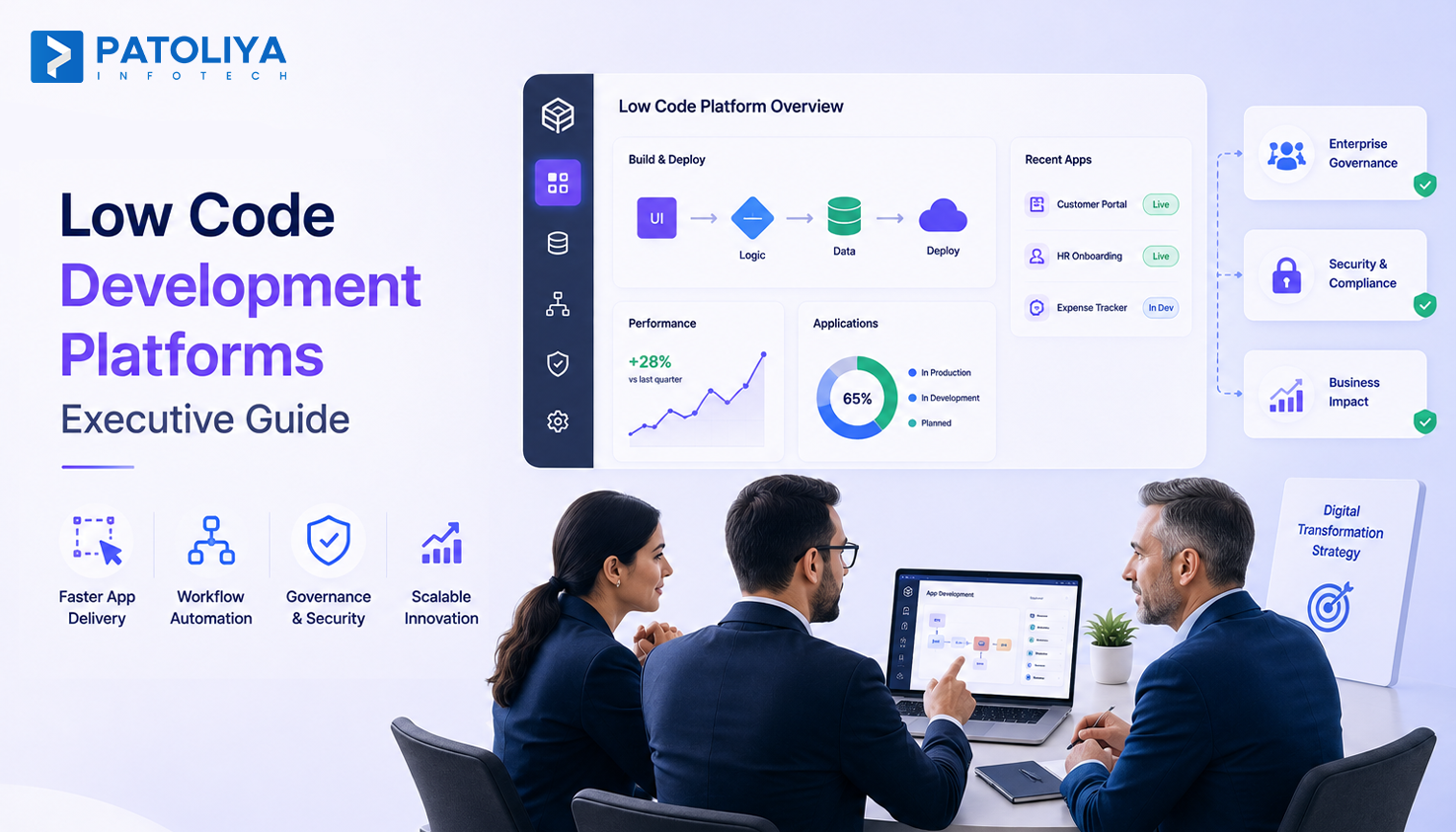
Low code development platforms are software environments where applications are built through visual interfaces, drag-and-drop components, and configuration rather than hand-written code. Developers write code only for complex logic that visual tools cannot handle.
Enterprise low code tools differ from consumer-grade low code development platforms and basic low code vs no code tools in four ways:
| Dimension | Consumer Low-Code | Enterprise Low Code Tools |
| Governance | Minimal | Role-based access, audit trails |
| Integration | Basic connectors | Enterprise API and ERP layer |
| Scalability | Limited | High-throughput production workloads |
| Compliance | None | HIPAA, SOC 2, GDPR configurable |
Low code development platforms sit between full custom development and low code vs no code tools. They require developer involvement for production deployments, but reduce development time by 50 to 80% compared to traditional coding.
Enterprise low code tools are now the primary application delivery mechanism for organizations that cannot scale engineering headcount at the rate their digital roadmap demands.
The best low code platforms 2026 share five core capabilities. Gaps in any one of them create adoption ceilings that surface 12 to 18 months into deployment.
Low code development platforms provide drag-and-drop UI builders with responsive design templates. The best best low code platforms 2026 support custom CSS and JavaScript injection for teams that need pixel-level control beyond standard components. Modern web application development services increasingly combine low-code delivery with traditional frontend engineering workflows. Modern web application development services increasingly combine low-code delivery with traditional frontend engineering workflows.
Enterprise low code tools connect to ERP, CRM, legacy databases, and third-party APIs through pre-built connectors. The integration layer is where most low code development platforms differ most sharply. Shallow integration forces workarounds that accumulate into technical debt.
Workflow automation software capabilities inside low code development platforms handle approvals, notifications, conditional logic, and process routing without custom code. This is the feature that business teams use most, and IT teams govern least carefully. Modern business process management strategies help enterprises automate workflows and improve operational efficiency.
Enterprise low code tools enforce role-based access, audit logging, and data residency configuration at the platform level. These controls are what separate enterprise-grade low code development platforms from departmental tools that create shadow IT at a higher velocity. Enterprise low-code deployments should follow OWASP application security guidelines to strengthen governance and application security controls.
The best low code platforms 2026 support cloud, on-premise, and hybrid deployment from the same application model. Single-cloud dependency is a risk factor, not a feature in low code vs no code. Enterprise Cloud Migration Services projects often include low-code application modernization and hybrid deployment planning.
Low code development platforms that lock you into one cloud provider create a hidden cost that surfaces at contract renewal, not at procurement. Your negotiating leverage disappears when your entire application portfolio runs on one vendor's infrastructure.
Low code development platforms address four operational problems that traditional development cannot solve at the pace business demands.
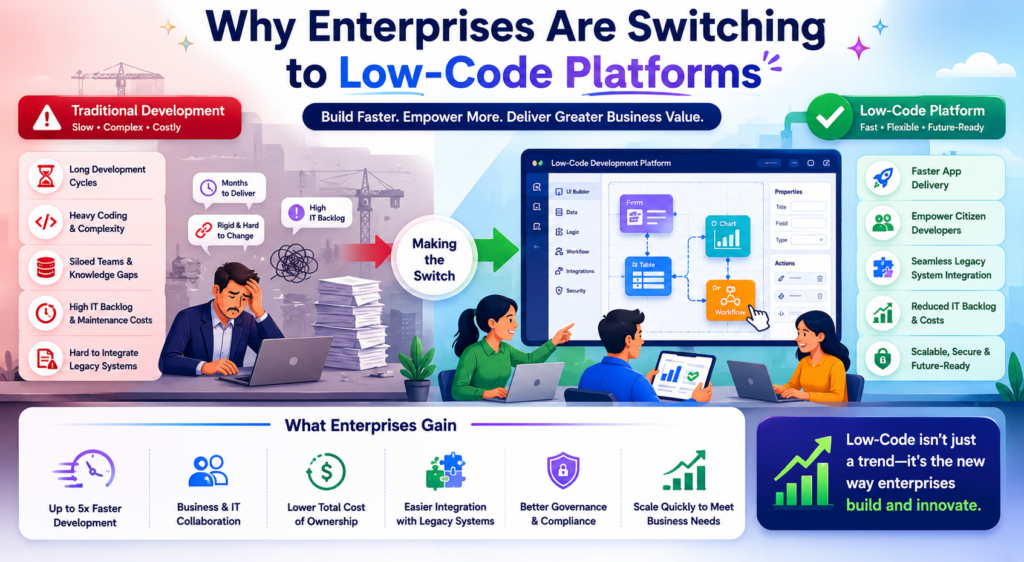
The low code vs no code decision is the first choice every enterprise makes wrong when evaluating low code development platforms.
| Dimension | Low-Code | No-Code |
| Who builds | Developers and analysts | Business users only |
| Complexity ceiling | High | Low |
| Integration depth | Enterprise-grade | Basic connectors |
| Governance | Platform-level | Minimal |
| Low code vs no code use case | Production enterprise apps | Simple internal forms |
Low code development platforms require developer involvement for production deployments. In low code vs no code comparisons, no-code tools are suitable for simple forms and basic workflow automation where IT governance is not required.
Custom development wins when you need sub-100ms high-throughput transactional performance, highly proprietary algorithms, or complete architectural control. Large-scale Custom Software Development projects remain essential for highly specialized transactional systems and proprietary workflows.
Low code development platforms win for everything else: internal tools, workflow applications, customer portals, and departmental systems.
Workflow automation software handles process routing and repetitive task flows. Enterprise low code tools build full applications with broader customization and integrations.
The distinction of low code vs no code matters when scoping what you actually need to buy and implement in best low code platforms 2026.
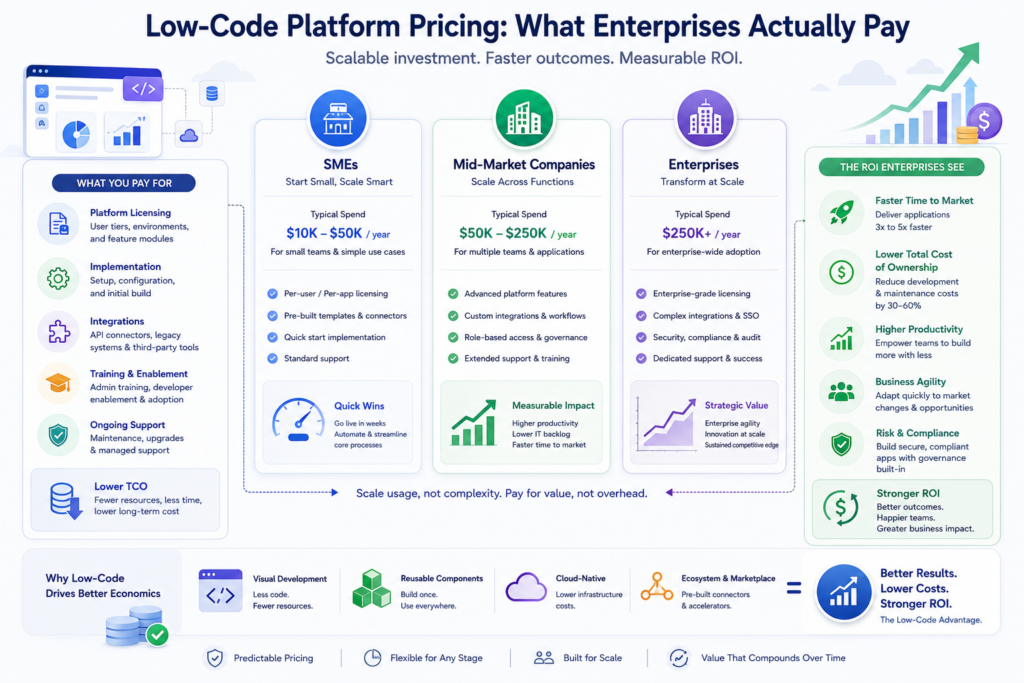
Low code development platforms pricing has three tiers. The license cost is rarely the real number.
| Platform | Monthly Cost |
| Zoho Creator | $12 to $37/user/month |
| Microsoft Power Apps | $10 to $20/user/month |
| Entry-tier low code development platforms | $500 to $3,000/month |
Best low code platforms 2026 at this tier run $3,000 to $15,000/month. Mendix and OutSystems mid-market plans fall here. Implementation adds $40,000 to $120,000 in year one.
Enterprise low code tools at this tier run $50,000 to $250,000+ annually. Appian, OutSystems Enterprise, and ServiceNow App Engine operate here. Global deployments add multi-region infrastructure costs on top.
Low code ROI is measurable across three specific outcomes. Each one builds the investment case for low code development platforms at the board level.
Low code development platforms reduce application development time by 50 to 80% compared to custom development. A $200,000 custom application delivered in 10 months becomes a $60,000 to $80,000 low code development platforms project delivered in 8 weeks. The savings compound across every application in the backlog.
Low code development platforms with workflow automation eliminate manual process steps that consume 15 to 25% of knowledge worker time in most enterprises. Automating approval workflows, data entry, and reporting generates measurable productivity returns within the first quarter of deployment.
Best low code platforms 2026 scale application delivery without scaling headcount. A team of five developers on low code development platforms delivers the output of a 15 to 20-person custom development team. The low code vs no code ROI comparison favors low-code for any application requiring enterprise integration or governance.
Low code ROI turns positive within 6 to 12 months for most enterprise deployments when total cost of ownership is measured correctly.
Every low code development platforms deployment carries four risks that get worse the larger the deployment grows.
Use this checklist before committing to any low code development platforms vendor.
| Evaluation criteria | What to Verify | |
| 1 | Integration depth | Native connectors for your ERP, CRM, and legacy systems |
| 2 | Governance model | Role-based access, audit logging, environment separation |
| 3 | Compliance certifications | HIPAA, SOC 2 Type II, GDPR configuration options |
| 4 | Deployment flexibility | Cloud, on-premise, and hybrid from one model |
| 5 | Performance benchmarks | Verify at your expected transaction volume |
| 6 | Enterprise low code tools exit path | Data portability and migration documentation |
| 7 | Vendor financial stability | Platform continuity risk for multi-year contracts |
| 8 | Implementation partner ecosystem | Certified partners in your region |
| 9 | Best low code platforms 2026 POC support | Vendor-supported proof of concept before contract |
| 10 | Total Year 1 cost | License plus implementation plus training |
The most expensive mistake in low code development platforms is selection based on a demo rather than a proof of concept against your actual integration requirements.
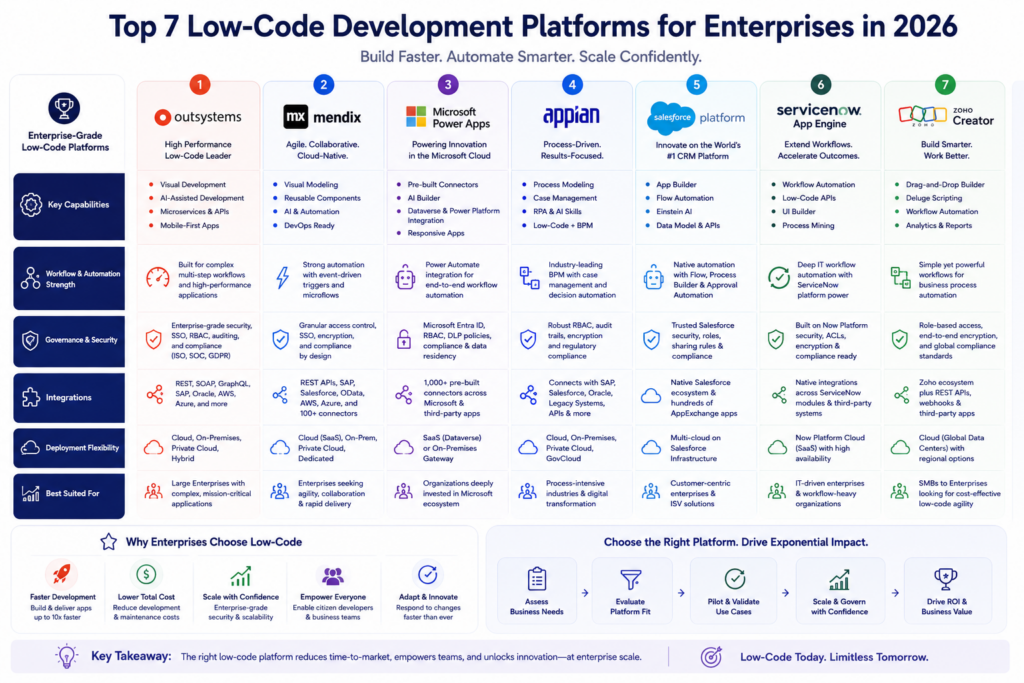
OutSystems is the highest-capability low code development platforms option for enterprises building complex, integration-heavy production applications.
Full-stack low code development platforms with AI-assisted development, an enterprise integration layer, and cloud-native deployment for high-complexity applications.
Key Features:
Best for: Large enterprises building mission-critical applications requiring enterprise-grade performance.
Pricing: From $75,000/year, enterprise custom.
Mendix is the leading low code development platforms option for teams where business analysts and developers build applications together.
Collaborative enterprise low code tools platform where business and IT co-develop applications using shared visual models.
Key Features:
Best for: Manufacturing, logistics, and enterprise teams needing business-IT collaboration in the build process.
Pricing: From $50,000/year.
Microsoft Power Apps is the natural low code development platforms choice for enterprises standardized on M365.
Low code development platforms running natively on Azure with deep Teams, SharePoint, and Dynamics 365 integration.
Key Features:
Best for: M365-standardized enterprises wanting low code development platforms without additional licensing overhead.
Pricing: From $10/user/month, included in select M365 plans.
Salesforce Platform covers low code development platforms for enterprises where CRM data drives application logic.
In evaluations of low code vs no code, enterprise low code tools built on the Salesforce ecosystem support customer-facing and internal CRM-integrated applications.
Key Features:
Best for: Enterprises where Salesforce is the system of record and applications need to extend CRM data.
Pricing: Included in Salesforce license tiers, custom for Platform-only.
Appian is the leading low code development platforms option for regulated industries requiring documented process governance.
Low code development platforms with BPM core, case management, and AI-assisted process automation for compliance-heavy environments.
Key Features:
Best for: Government agencies, financial services, and healthcare enterprises with strict compliance requirements.
Pricing: From $75/user/month, enterprise custom.
ServiceNow App Engine extends low code development platforms capability to teams already running ITSM or HR workflows on ServiceNow.
In evaluations of low code vs no code, enterprise low code tools help build custom applications on the ServiceNow platform without leaving the existing governance model.
Key Features:
Best for: Enterprises already on ServiceNow that need custom workflow applications without a separate platform investment.
Pricing: App Engine is included in ServiceNow enterprise plans, custom quoted.
Zoho Creator is the most accessible low code development platforms option for mid-market organizations building multiple departmental applications.
Overview: Multi-app low code development platforms with strong Zoho ecosystem integration and competitive pricing for teams under 500 users.
Key Features:
Best for: SME and mid-market teams needing multiple departmental applications without enterprise platform pricing.
Pricing: From $12/user/month.
Low code development platforms deliver value only when implementation is done correctly. Most enterprise deployments that underperform were configured without a structured integration design, governance framework, or performance validation before go-live. As an enterprise software development company, Patoliya Infotech helps organizations accelerate application delivery through scalable low-code implementation strategies.
We implements low code development platforms for enterprises where delivery speed and compliance requirements operate simultaneously:
If your enterprise has an application backlog that custom development cannot clear at the pace the business needs, Patoliya Infotech can scope a low code development platforms implementation plan. Let's talk through your backlog.
Low code development platforms have moved past departmental experimentation. In 2026, they are the primary application delivery mechanism for enterprises that cannot scale engineering headcount at the pace digital transformation demands.
In enterprise low code vs no code evaluations, Platform selection depends on three variables: integration complexity, governance maturity, and total cost of ownership across 36 months. Evaluate low code development platforms through a structured POC before signing multi-year contracts. Get a scoped estimate from Patoliya Infotech and enter your next vendor negotiation with a verified benchmark.