Table of Contents
TLDR: Software cost estimation is the structured process of forecasting development spend before a line of code is written. Projects without a formal estimate consistently run over budget due to unclear scope, hidden dependencies, and poor planning discipline. This guide covers the methods, cost drivers, and tools you need to estimate accurately and make better investment decisions.
Most software projects do not fail during development. They fail in the planning stage when teams skip structured software cost estimation and rely on assumptions or vendor promises. The outcome is predictable: scope creep, budget overruns, and delayed launches that weaken stakeholder confidence before the product even ships.
The issue is not execution capability; it is a lack of estimation discipline in software cost estimation. Without clear breakdowns of scope, effort, and risk, costs expand as decisions get made mid-build. Strong software cost estimation creates alignment early, sets realistic expectations, and gives teams control over timelines and spend. This guide breaks down how to estimate with clarity before the first sprint begins.
Software cost estimation is the process of forecasting the total financial resources required to design, build, test, and deploy a software system. It covers labor, infrastructure, licensing, QA, and post-launch support, not just development hours.
A credible software cost estimation output includes a work breakdown structure, role-by-role hour allocations, rate assumptions, risk buffers, and a variance range. It is a financial model, not a ballpark number.
Most teams treat software cost estimation as a pre-sales formality. The teams that treat it as a strategic input make better build-vs-buy decisions, negotiate better contracts, and hit launch budgets more consistently. That discipline is what separates funded projects from stalled ones.
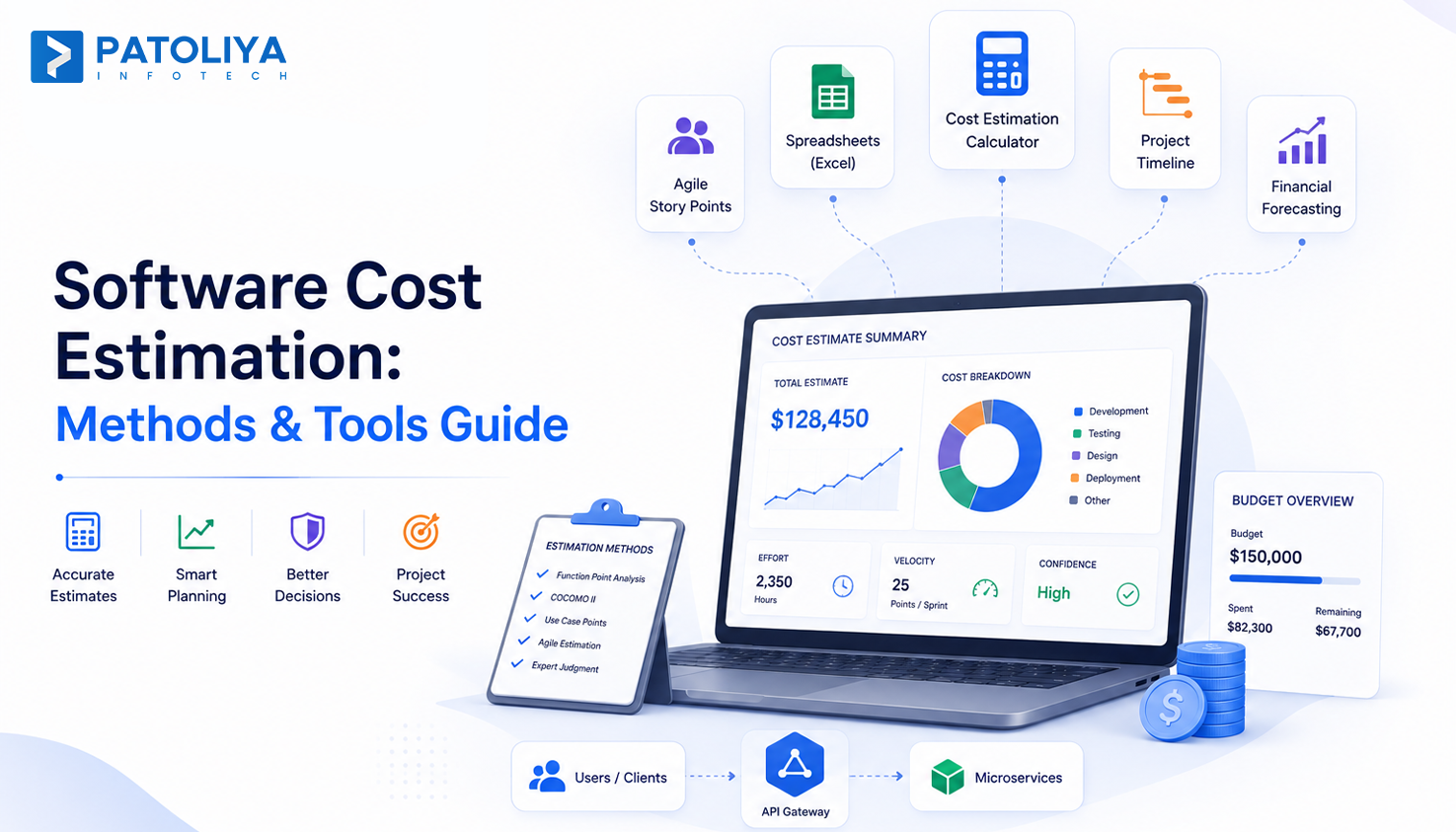
There are five primary project estimation techniques used in professional software delivery. Each software cost estimation carries different accuracy levels, time requirements, and appropriate use cases.
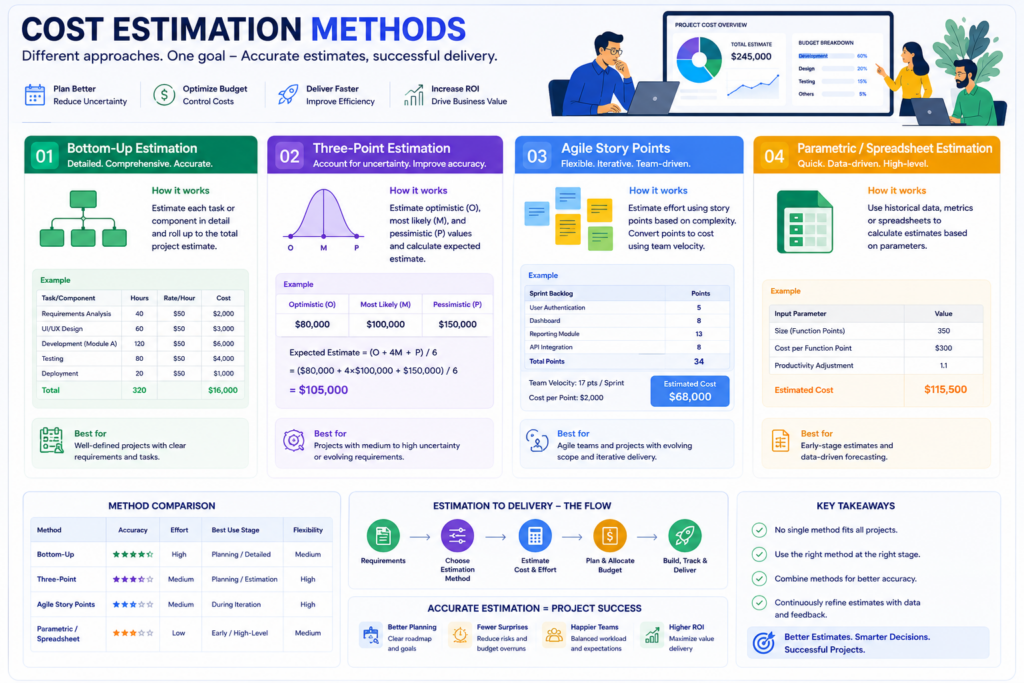
Bottom-up estimation breaks the project into individual tasks, estimates each one separately, and then aggregates. It produces the tightest variance (±10 to 15%) but requires a complete requirements list. Bottom-up estimation helps teams learn how to estimate software project cost with precision. Use this software cost estimation when the scope is locked.
This technique benchmarks a new project against completed ones with similar characteristics for how to estimate software project cost. Fast to produce (1 to 3 days), but accuracy sits at ±25 to 35%. Best for early-stage budget conversations before requirements are defined.
Parametric models like COCOMO II use historical data and project variables (lines of code, complexity, team size) to generate cost forecasts. Reliable for large-scale projects with measurable inputs through project estimation techniques.
Three-point estimation calculates a weighted average across optimistic, pessimistic, and most likely scenarios. It quantifies uncertainty rather than hiding it, which makes it valuable for risk-adjusted budgeting.
Agile estimation uses story points to size user stories relative to each other, then converts velocity data into time and cost projections. Accurate for iterative delivery, unreliable for fixed-price contracts without historical velocity data. Structured Agile estimation practices help teams improve sprint forecasting and delivery predictability over time.
The selection of the right software cost estimation method depends entirely on how much scope clarity you have at the time of estimating.
Understanding how to estimate software project cost accurately means understanding where estimates go wrong first. Four drivers account for the majority of budget failures.
Every dollar you invest in fixing these four drivers before development starts returns multiples in avoided rework and scope disputes in how to estimate software project cost.
The right software development cost calculator or planning tool depends on your team size, methodology, and how much historical data you have available.
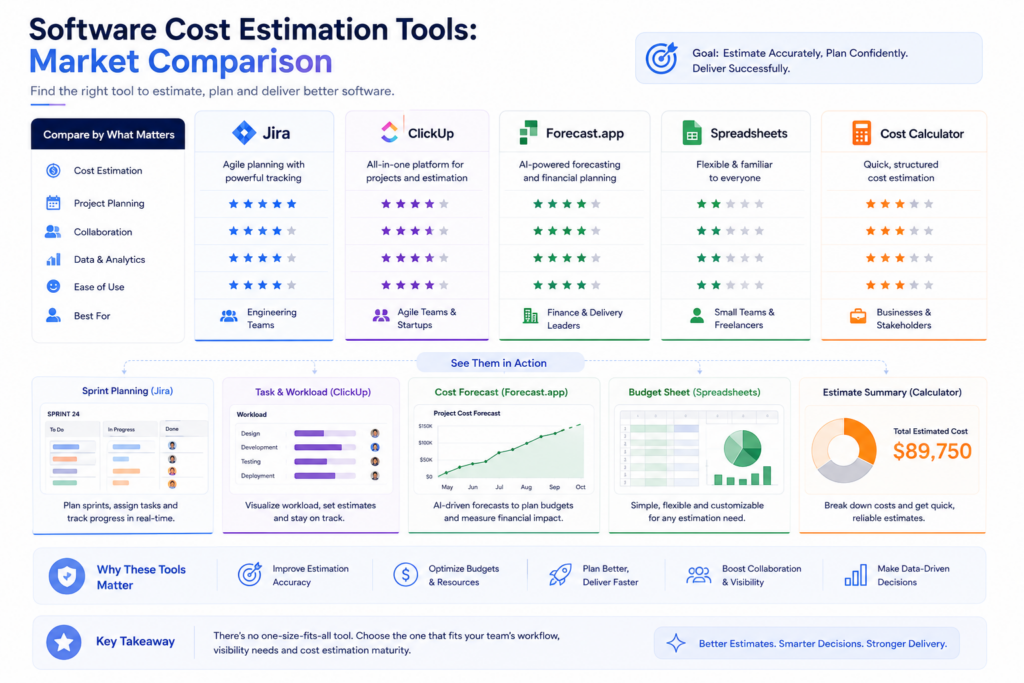
The tool selection of software cost estimation matters less than the underlying project estimation techniques feeding the numbers in.
Knowing how to estimate software project cost at different complexity tiers prevents the most common mistake: applying enterprise-scale assumptions to an MVP budget, or MVP thinking to an enterprise build.
Typical project cost ranges between $15,000 and $60,000.
| Component | Typical Cost Range |
| Design (UI/UX) | $3,000 to $8,000 |
| Frontend Development | $5,000 to $15,000 |
| Backend Development | $5,000 to $20,000 |
| QA and Testing | $2,000 to $8,000 |
| Deployment and Infrastructure | $1,000 to $5,000 |
An MVP estimate at this tier covers core user flows only. No admin panels, no advanced integrations, no scalability architecture. Software cost estimation at this stage should explicitly list what is excluded, not just what is included in project estimation techniques. MVP planning should define exclusions to show how to estimate software project cost properly.
Typical project cost ranges between $60,000 and $200,000.
This tier covers role-based access, third-party integrations, reporting dashboards, and mobile responsiveness. Team composition typically includes a project manager, two to three developers, a designer, and a QA engineer. Budget 15% contingency minimum in software cost estimation. Large-scale Custom Software Development projects require structured budgeting, role-based estimation, and long-term infrastructure planning. Large-scale Custom Software Development projects require structured budgeting, role-based estimation, and long-term infrastructure planning.
Typical project cost ranges between $200,000 and $1,000,000+.
Enterprise software cost estimation requires a full discovery sprint before any number is defensible. Custom architecture, compliance requirements (HIPAA, SOC 2, GDPR), multi-tenant infrastructure, and API ecosystem complexity each add significant cost. Parametric project estimation techniques work best here.
| Model | Best For | Risk Profile |
| Fixed Price | Locked scope | Vendor absorbs the overrun risk |
| Time and Materials | Evolving scope | Client absorbs the overrun risk |
| Dedicated Team | Long-term build | Shared risk, maximum flexibility |
The contract model you choose changes your effective software cost estimation accuracy requirement. Fixed price demands a tighter scope for the software development cost calculator. Time and materials tolerate more uncertainty in how to estimate the software project cost. Cost visibility becomes increasingly important during large-scale IT outsourcing engagements.
Accurate software cost estimation is not just a financial discipline. It is a competitive advantage that shows up in four measurable business outcomes.
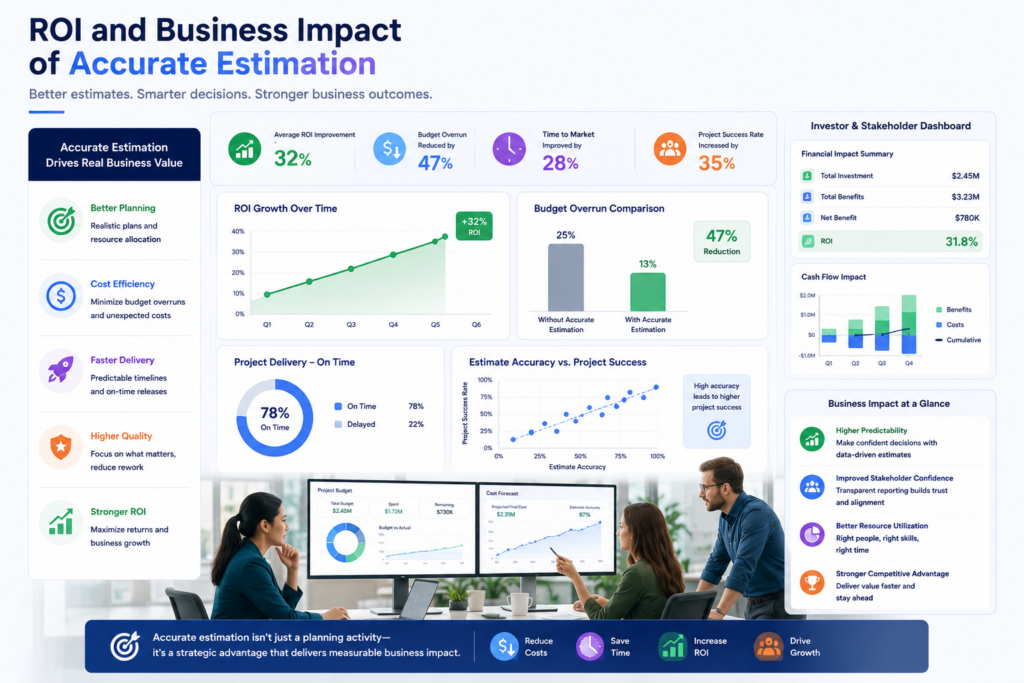
Projects with a formal software cost estimation process launch faster because scope disputes happen before development, not during.
Every week of delay in a competitive market has a revenue cost. Getting the estimate right the first time removes the renegotiation cycles that slow launches.
Teams using structured project estimation techniques consistently hit ±15% variance or better. Teams using gut-feel estimates routinely run 40 to 80% over.
That variance gap represents real money, real stakeholder trust, and real board conversations you would rather not have.
A software ROI analysis built on accurate cost data lets you model unit economics before you scale. You know your cost per user, cost per transaction, and infrastructure scaling curve.
That data from the software development cost calculator drives smarter growth decisions in software cost estimation.
Investors do not fund vague budgets. A credible software cost estimation with documented assumptions, role breakdowns, and variance ranges signals operational maturity.
It tells investors you understand your own project through project estimation techniques, which is often more persuasive than the product demo.
Accurate estimation protects your timeline, your budget, and your credibility. Also, Accurate ROI analysis strengthens how to estimate software project cost before scaling.
Every software cost estimation process carries structural risks. Knowing them in advance is the only way to control them.
Teams often underestimate time and cost by overlooking complexity, leading to overly optimistic estimates. Software cost estimation is not immune. Build your estimates with a skeptical reviewer who was not involved in scoping.
An estimate is only as good as the requirements it was built on. Requirements that change after sign-off invalidate the original software cost estimation without a formal change control process. Every change request of the software development cost calculator needs a cost impact assessment before approval.
Some vendors inflate estimates to build in margin buffers. Ask every vendor for hour-by-role breakdowns, not total figures. Unexplained line items in a software development cost calculator output are a negotiation signal, not a fixed input.
Distributed teams add coordination overhead that rarely appears in initial estimates through project estimation techniques. Budget 10 to 15% extra for async communication, timezone gaps, and integration testing friction.
Choosing a development partner for software cost estimation and delivery requires evaluating beyond portfolio and price. Vendors should clearly explain how to estimate software project costs transparently.
| Evaluation factor | What to Verify | |
| 1 | Estimation methodology | Which project estimation techniques do they use and document? |
| 2 | Requirements process | Do they run a discovery sprint before estimating? |
| 3 | Rate transparency | Will they share hour-by-role breakdowns? |
| 4 | Change control process | How are scope changes priced post-contract? |
| 5 | Contingency approach | Is the risk buffer explicit in their software cost estimation? |
| 6 | Compliance experience | HIPAA, SOC 2, GDPR track record if applicable |
| 7 | Reference projects | Similar scope, similar industry, similar budget tier |
| 8 | Post-launch support model | Maintenance cost structure after delivery |
| 9 | Project estimation techniques used | Bottom-up, parametric, or analogous? |
| 10 | Communication cadence | Reporting frequency and escalation process |
These vendors have demonstrated capability in software cost estimation, structured delivery, and transparent project financials across multiple industries.
Patoliya Infotech runs structured discovery sprints before any software cost estimation is produced, delivering hour-by-role breakdowns, rate assumptions, and documented variance ranges.
Best for: Teams that need a defensible software cost estimation before board or investor presentations.
Engagement: Project-based and retainer models available.
Intellectsoft is a US-headquartered development firm with strong enterprise delivery credentials. Their software development cost calculator estimation process uses parametric modeling for large-scale projects.
Best for: Enterprise clients needing compliance-aware software cost estimation.
Softkraft specializes in data-intensive applications and AI-powered platforms. Their estimation process includes infrastructure cost modeling alongside development labor.
Best for: Data and AI platform builds where infrastructure costs dominate.
Intersog provides dedicated team models with transparent rate cards and capacity planning tools built into their software development cost calculator process.
Best for: Teams needing flexible capacity with cost visibility per sprint for software cost estimation.
EPAM is a global engineering firm with deep expertise in enterprise-scale delivery and project estimation techniques used on Fortune 500 programs.
Best for: Enterprise programs where estimation accuracy has direct financial reporting implications.
Software cost estimation done wrong creates the exact problem it was meant to solve: budget surprises, scope disputes, and eroded stakeholder trust. We treat software cost estimation as a deliverable in its own right, not a pre-sales formality.
As a custom software development company, Patoliya Infotech helps businesses build structured and defensible software cost estimation models before development begins.
Here is what that looks like in practice:
If your team is preparing a board-level budget, evaluating a vendor quote, or building a business case for a new platform, Patoliya Infotech can produce a defensible software cost estimation with you. Let's talk through your project scope.
Software cost estimation is where projects are won or lost, long before development starts. Get the method right for your scope clarity level, model every cost category, including infrastructure and compliance, and build contingency in as a standard line item, not an afterthought. The teams that do this consistently ship on budget, maintain stakeholder trust, and make better build decisions. Knowing how to estimate software project cost prevents expensive rebuild cycles. If your next project needs a structured software cost estimation, let's sit down and scope it together.