Table of Contents
TLDR: A production-ready delivery app development project costs between $12,000 and $150,000+ depending on feature scope and geography.Teams often underestimate backend complexity, which drives project costs more than UI design. This guide covers what actually matters before you write a single line of code.
Teams often attribute delivery app development costs to the customer-facing UI, even though backend systems drive the majority of expenses. Dispatch logic, real-time synchronization, and driver state management consume a significant share of the budget and engineering effort.
The on demand delivery app market continues to evolve rapidly. Consumers expect real-time order tracking and status updates within seconds. When the backend infrastructure cannot support those expectations, even a polished interface fails to deliver a reliable user experience.
This guide explores the features, architectural decisions, and 2026 cost ranges that have the greatest impact on the success of delivery app development.
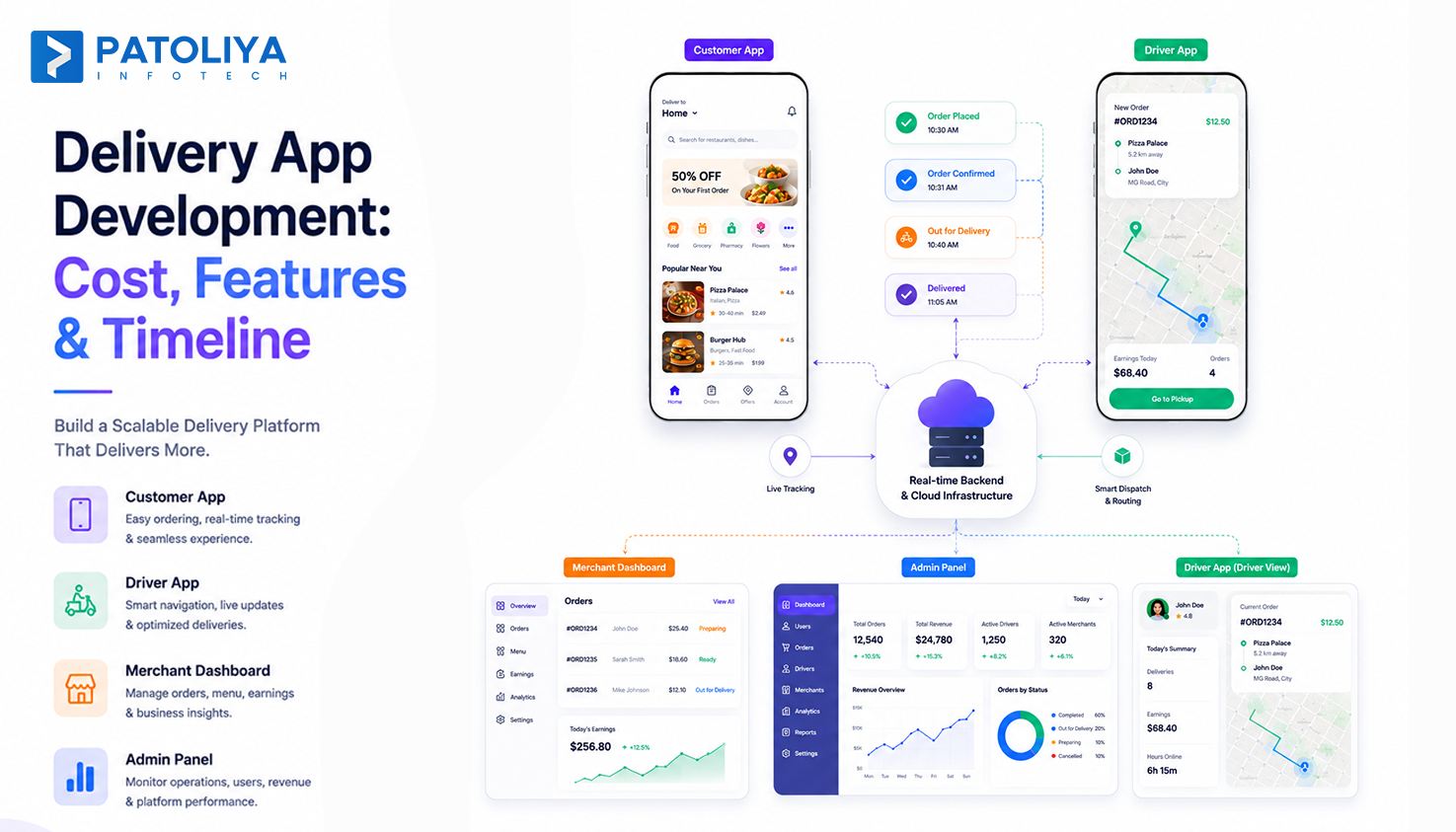
Delivery app development is the process of building a connected software system of customer app, driver app, merchant dashboard, and backend that coordinates pickup and drop-off in real time. It is not a single app. It is three or four apps sharing one data layer.
Most people budget for one app. A functional on demand delivery app requires, at minimum: a consumer-facing order interface, a driver-facing dispatch interface, and an admin or merchant panel. Each has separate user flows, permissions, and sync requirements.
Food delivery app development specifically adds menu management, kitchen order timing, and delivery window logic on top of standard courier flows. These are not add-ons.
Database architecture decisions determine whether a delivery app scales successfully. Teams that skip these discussions during the discovery phase often find their MVPs failing when user traffic reaches just a few hundred concurrent users.
A working food delivery app development output provides customers with live order visibility, drivers with optimized routing, and operations teams with full data control. The capability gap between a basic app and a scalable one is almost always in the backend layer.
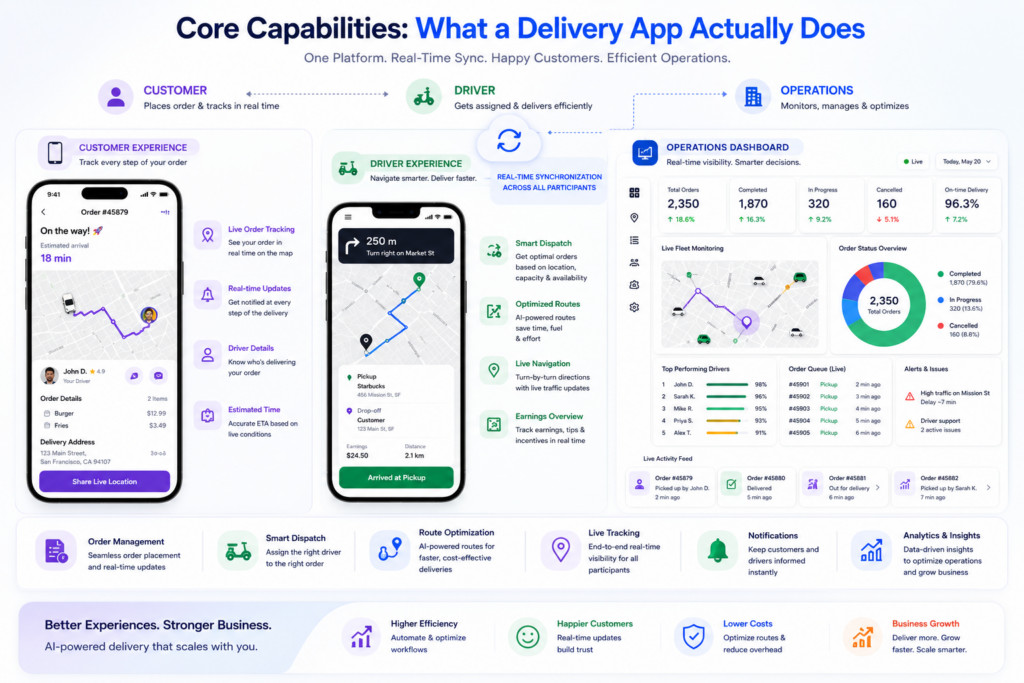
On demand delivery app users in 2026 have a short list of non-negotiable expectations: order placement in under 60 seconds, real-time order tracking with live driver GPS, push notifications at every status change, and one-tap reorder for repeat purchases. These requirements establish the baseline for customer retention and engagement.
For instance, a customer places a dinner order. If the app does not show the driver moving toward them within 90 seconds of pickup confirmation, they call support. That single gap drives the majority of inbound complaints for growing food delivery app development teams.
Driver apps need offline-tolerant architecture first. Drivers lose signal. The app cannot freeze when that happens. Core requirements include batch order assignment, visibility into driver dispatch algorithms, integrated navigation, and a real-time earnings summary. The driver app is the most under-invested layer in most MVP builds, and the first place operations breaks down at scale.
Admin panels for delivery app development must surface live fleet position, active order queue, delay flags, and cancellation reasons in one view. Reporting dashboards without order-level granularity give operations teams data they cannot act on.
Off-the-shelf logistics tools and basic white-label apps fail at scale for specific, fixable reasons. Understanding them before starting your on demand delivery app build saves months of rework.
Entry-level delivery app development vendors often use polling-based architectures that update order statuses only every 10 to 30 seconds. WebSockets push status changes the moment they happen.
For food delivery app development, that 20-second delay shows up as cold food, confused drivers, and support tickets your team did not need to handle.
A single-service backend works until it does not. At 500 or more concurrent orders, monolithic apps queue requests and slow response times visibly.
Delivery app development on a microservices architecture handles payments, dispatch, and notifications as independent services. Each scales separately. One service under load does not pull down the rest.
Surge pricing is a supply management tool, not a pricing gimmick. Without dynamic driver incentives, availability collapses during peak hours and fulfillment rates drop across the board. Most white-label platforms ship with no incentive layer at all.
White-label platforms retain your order and customer data by contract. Custom app development puts that data of purchase history, location patterns, and reorder frequency fully in your hands. At scale, that is your most actionable operational and marketing asset.
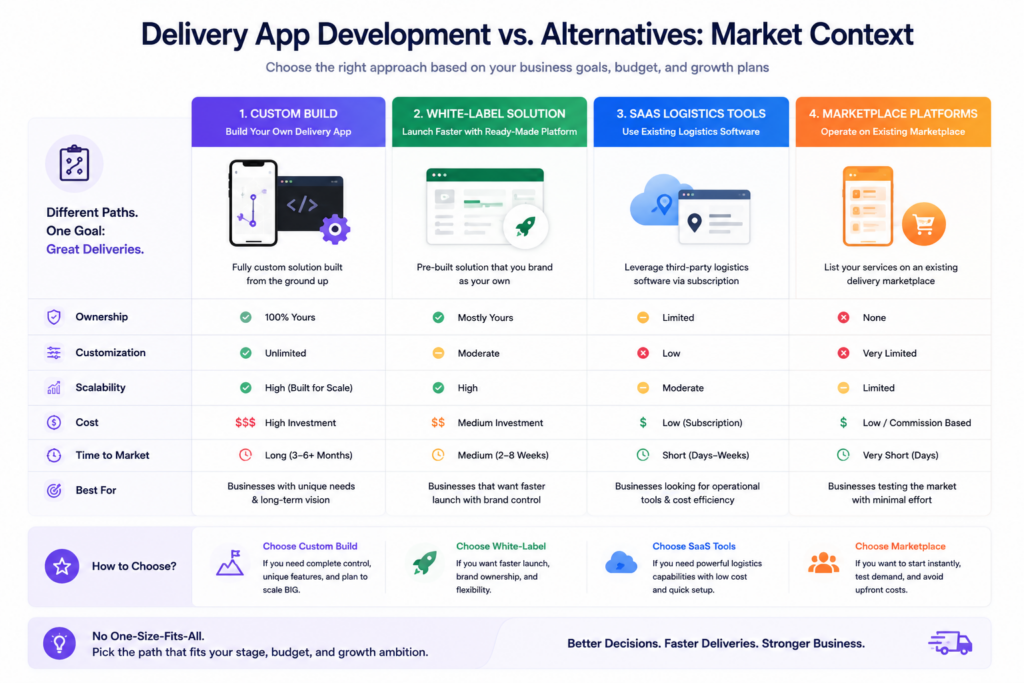
Custom delivery app development is not the best fit for every business. The decision depends on order volume, data strategy, and how long you plan to operate the platform.
| Option | Best For | Limitation |
| White-label (Tookan, Shipday) | Under 2,000 orders/month | No data ownership, limited customization |
| On demand delivery app (custom) | 2,000+ orders/month | Higher upfront cost |
| SaaS logistics tools | B2B routing only | No consumer-facing layer |
| Marketplace (DoorDash, Uber Eats) | Early validation | Platform fees, no brand control |
When Custom Wins
Custom delivery app development pays off when commission recapture matters. Marketplace platforms charge 15 to 30% per order. A proprietary on demand delivery app at 10,000 monthly orders at $25 AOV recovers $37,500 to $75,000/month in fees alone. That math makes a $60,000 build pay back in under 60 days at scale.
When White-Label Is Fine
White-label platforms are valid if you are testing a new geography or cuisine vertical with under 1,500 monthly orders. Do not over-engineer before you have product-market fit.
Delivery app development costs in 2026 range from $12,000 for a single-city MVP to $150,000+ for an enterprise multi-vendor delivery platform. The gap is almost entirely driven by backend complexity, not design.
| Build Type | Timeline | Cost Range |
| MVP (1 vendor, 1 city, iOS + Android) | 10 to 16 weeks | $12,000 to $25,000 |
| Mid-market on demand delivery app | 18 to 26 weeks | $30,000 to $80,000 |
| Enterprise food delivery app development | 28 to 52 weeks | $80,000 to $150,000+ |
Three variables inflate food delivery app development budgets with near certainty. Adding a merchant dashboard or web portal adds 20 to 35% to the base estimate. ML-based dispatch adds 15 to 25%. Payment gateway localization across multiple markets adds another 10 to 20%. Each one is a backend engineering problem, not a front-end one.
Teams that start app development with a signed SRS, documented API contracts, and defined acceptance criteria cut build timelines by 20 to 30%. Scope ambiguity mid-sprint costs more than any individual feature on your wishlist. The single most effective cost control in any on demand delivery app project is a two-day requirements session before development starts.
Custom delivery app development generates ROI through four channels: commission recapture, customer retention lift, operational efficiency, and data monetization.
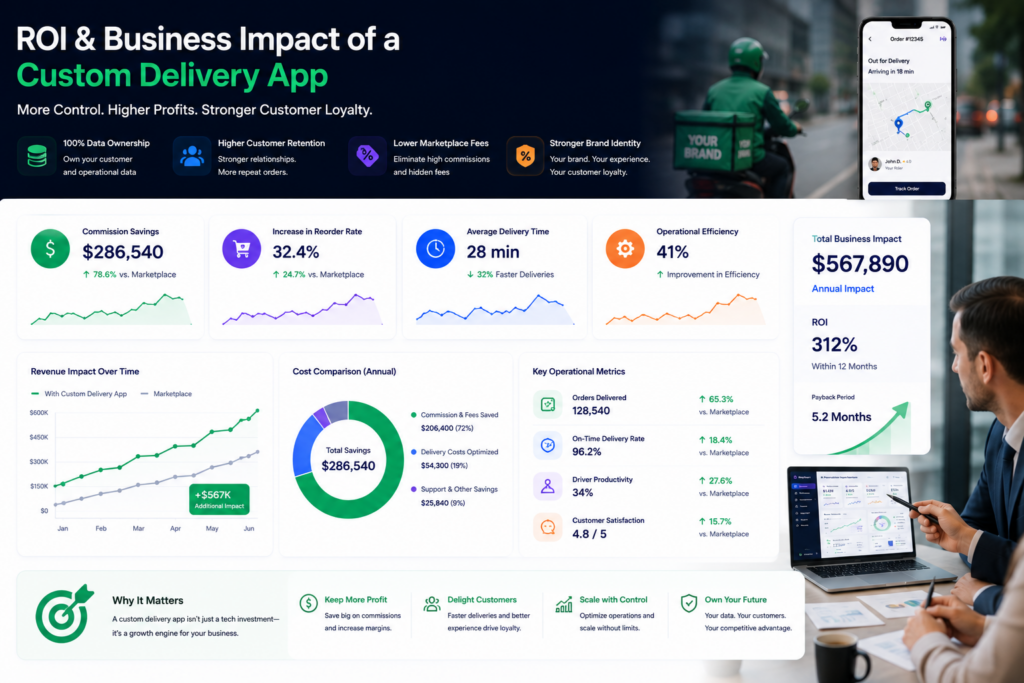
On demand delivery app platforms running on third-party marketplaces pay 15 to 30% per order. A custom food delivery app development build eliminates that cost. At 5,000 monthly orders at $30 AOV, that is $22,500 to $45,000 per month recovered.
Branded apps have measurably higher reorder rates than marketplace orders. Customers who order through your own on demand delivery app see your brand, your loyalty program, and your push notifications. Marketplace customers see the platform's brand.
A last-mile logistics app with built-in route optimization reduces average delivery time. Shorter delivery windows mean more order capacity per driver per hour, which directly reduces cost-per-delivery.
Every order through a custom food delivery app development build creates data you own: what customers order, when, from where, and how often. That data feeds demand forecasting, inventory decisions, and targeted marketing. On a third-party platform, that data belongs to the platform.
Delivery app development ROI depends on measurable business outcomes. Compare the numbers before committing to a marketplace model.
Delivery app development projects fail for predictable reasons. Most of them are not technical.
Delivery app development risk is manageable. The builders who get burned skip the documentation phase.
The wrong vendor for your delivery app development project costs more to replace mid-build than the entire original contract. Evaluate on these ten criteria before you commit.
| Criterion | What to Verify | |
| 1 | Source code ownership | Transferred to you on final payment, confirmed in the contract |
| 2 | Live app references | Working and downloadable apps |
| 3 | SRS process | They produce a signed SRS before development begins |
| 4 | Tech stack depth | Flutter or React Native for mobile, Node.js or Go for backend |
| 5 | Real-time capability | WebSockets or Firebase. Confirm polling is not in the architecture |
| 6 | Load testing plan | Defined concurrent user targets before launch |
| 7 | Post-launch support | Scope, duration, and cost documented in the agreement |
| 8 | Payment structure | No more than 30% paid upfront, milestones tied to deliverables |
| 9 | On demand delivery app architecture experience | Verifiable delivery-specific builds |
| 10 | Data ownership | Your customer and order data stays yours, in writing |
The delivery app development vendor market in 2026 spans boutique specialists to global enterprise firms. Match vendor scale to your project scale before requesting a proposal.
Patoliya Infotech specializes in on demand delivery app and multi-vendor delivery platform builds for mid-market and growth-stage operators across the US, UK, UAE, and India since 2015.
Best for: Growth-stage operators building a first on demand delivery app or scaling a food delivery app development project with multi-vendor requirements.
Pricing: $15,000 to $80,000.
WillowTree handles enterprise mobile and logistics platform builds for Fortune 500 clients, with React Native, Kotlin, and Swift on GCP infrastructure.
Best for: Large enterprises with $100,000+ budgets needing a fully managed delivery app development engagement with SLA-backed delivery.
Pricing: $100,000 and above.
Intellectsoft builds logistics and food delivery app development projects using Flutter, Go, and Kubernetes for clients across the US and Europe.
Best for: Mid-to-enterprise operators who need a delivery app development partner with proven scaling experience beyond 5,000 daily orders.
Pricing: $50,000 to $200,000.
Mobindustry focuses on food delivery app development and e-commerce app builds for European and CIS market clients using React Native, Node.js, and Firebase.
Best for: European operators building a branded food delivery app development product with regional localization requirements.
Pricing: $25,000 to $80,000.
Devoteam operates at enterprise scale with 8,000+ staff and delivers logistics and supply chain platforms on microservices, AWS, and Python for clients across Europe and MENA.
Best for: Large enterprises in Europe or MENA running complex supply chain operations that require food delivery app development at the platform level, not the product level.
Pricing: $80,000 and above.
Quytech builds on demand delivery app and courier platform products using Flutter, React Native, and PHP/Laravel for clients across the US, UK, and India.
Best for: Early-stage operators or SMBs needing a scoped app development MVP or courier platform at a controlled budget.
Pricing: $10,000 to $50,000.
Delivery app development costs vary by scope, so request detailed proposals instead of relying on price ranges. Choose app development vendors with proven experience in dispatch, POS integrations, and on demand delivery app architecture that matches your business needs.
Patoliya Infotech has delivered on demand delivery app and food delivery app development projects across the US, UK, UAE, and India since 2015. The focus is mid-market and growth-stage operators who need production-grade architecture without enterprise pricing.
What Sets the Approach Apart
What Clients Get
Projects include a signed SRS before development starts, milestone-based payment structure, and a dedicated squad model (PM, 2 developers, QA, designer). Delivery app development timelines are fixed at contract, not estimated.
If you are evaluating vendors for a delivery app development project and want a scoped proposal before committing, Patoliya Infotech runs a no-cost discovery session to define requirements, stack, and timeline. Let's map out your build.
Delivery app development is a systems problem, not a design problem. The teams that build successfully treat dispatch logic, data ownership, and backend scalability as first-order decisions from day one.
Cost is predictable when scope is defined. Timeline holds when requirements are signed before development starts. The gap between a $15,000 MVP and a $150,000 platform is not feature count. It is architecture depth, vendor experience, and the quality of decisions made before a single line of code is written.
Most failed delivery app development projects do not fail in production. They fail in the planning phase, when the wrong assumptions get locked into the wrong architecture.
Get the foundation right, and everything else follows. Ready to scope your delivery app development build? Let's map out what your project actually needs.