Table of Contents
TLDR: Ecommerce personalization powered by AI moves shoppers from browsing to buying faster than any other conversion lever available to online retailers today. Stores running a product recommendation engine report measurable lifts in average order value and repeat purchase rate within the first quarter of deployment. The build decision is not about budget. It is about whether you want model ownership or a subscription you cannot tune.
Modern shoppers expect every interaction to reflect their preferences, intent, and buying behavior in real time. Ecommerce personalization helps brands deliver those experiences, increasing conversion rates, customer retention, and average order value.
The most successful retailers now rely on AI ecommerce personalization to tailor recommendations, content, pricing strategies, and post-purchase interactions in real time. This guide explains how a product recommendation engine works, what it costs to build, and how to make the right decision for your store.
Ecommerce personalization is the process of dynamically adjusting what a shopper sees based on their behavior, purchase history, session context, and catalog signals in real time. It goes beyond segmentation. It operates at the individual user level.
A standard storefront shows every visitor the same homepage, same category ranking, same search results. Ecommerce personalization changes all three per user, per session, without manual intervention.
The core components:
The operational difference between AI ecommerce personalization and rule-based personalization is adaptability. Rules break when catalog or behavior patterns change. AI models retrain on new data and stay accurate.
Ecommerce personalization at the AI layer is infrastructure, not a feature. Brands that treat it as a feature deploy it in one placement and miss 80% of the revenue impact.
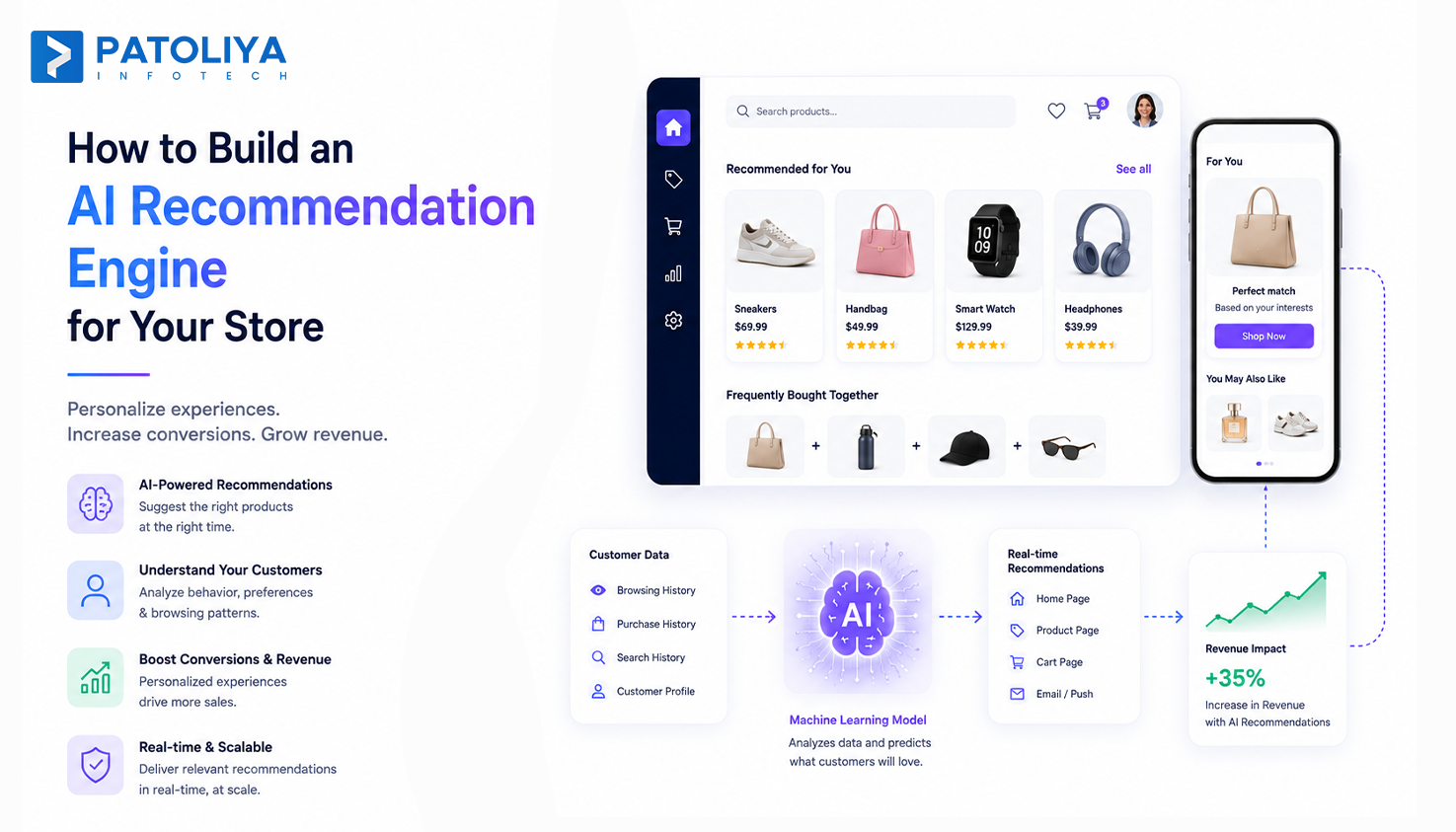
A product recommendation engine is not a "you might also like" widget. It is a data pipeline that ingests user behavior, runs it through a trained model, and returns ranked SKU lists in milliseconds across multiple store placements.
| Stage | What Happens | Data Used |
| Event capture | Tracks clicks, views, purchases, cart events | Session data, user ID, SKU ID |
| Model training | Trains a CF or content-based model on historical data | Purchase history, catalog attributes |
| Inference | Returns ranked recommendations per user per placement | Real-time session with stored profile |
| Real-time product recommendations | Delivers ranked SKUs to homepage, PDP, cart, email | Live session signals |
| Feedback loop | Updates model weights based on click and purchase outcomes | Post-session conversion data |
What a mature AI ecommerce personalization engine covers:
The capability gap between a SaaS plugin and a custom product recommendation engine is model ownership. SaaS platforms optimize for average click-through across all their clients. A custom engine optimizes for your catalog, your margins, and your buyer behavior specifically.
AI ecommerce personalization built on owned models gives you a compound advantage. Every transaction makes your model more accurate. A rented model stays generic.
Ecommerce personalization is not a growth hack. It is a direct fix for four measurable revenue problems that generic storefronts cannot solve structurally.
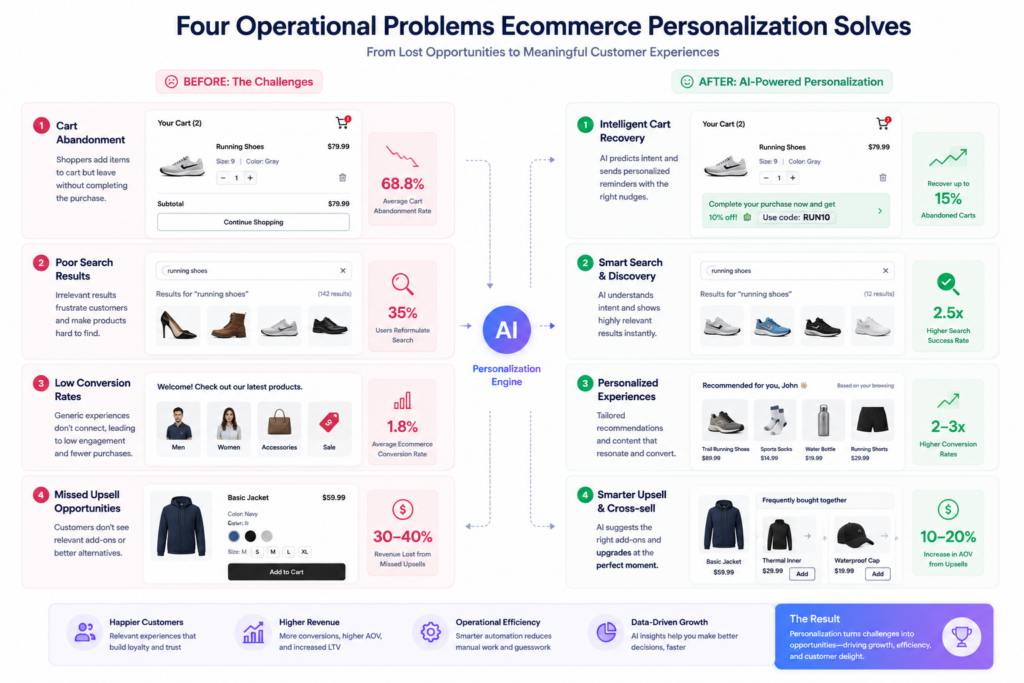
Cart abandonment AI recovers purchase intent that standard email flows miss entirely. A generic "you left something behind" email sends the same message to every abandoner regardless of what they viewed, how long they spent on the PDP, or how many times they have abandoned before.
AI ecommerce personalization segments abandoners by session depth and purchase probability, then sends SKU-specific recovery messages timed to individual behavior patterns. A shopper who spent 4 minutes on a PDP gets a different recovery sequence than someone who added to cart in 30 seconds.
A static homepage converts the same for a first-time visitor and a returning high-value customer. That is a structural problem, not a traffic problem. Ecommerce personalization at the homepage level surfaces products with demonstrated affinity for that specific user from the first session.
Dynamic product sorting on category pages re-ranks SKU display order per session. A user who consistently buys from one sub-category sees those products ranked first without any manual merchandising.
Site search is where high-intent shoppers go when browsing fails them. A generic search engine returns results ranked by catalog rules that have nothing to do with individual buyer behavior. An ecommerce personalization integrated with search re-ranks results using collaborative filtering signals from users with similar purchase histories.
Shoppers who find what they want in search convert at significantly higher rates than those who do not. Through ecommerce personalization, Personalized search captures that intent before it exits.
The post-purchase window is the highest-intent moment in a customer relationship. Most stores send a generic order confirmation and stop. AI ecommerce personalization deploys a next-best-product layer immediately after purchase, in the confirmation email and the account dashboard, using actual purchase signals to recommend complementary SKUs.
Shopify AI plugins handle this at the basic level. A custom product recommendation engine handles it with model precision tuned to your catalog relationships.
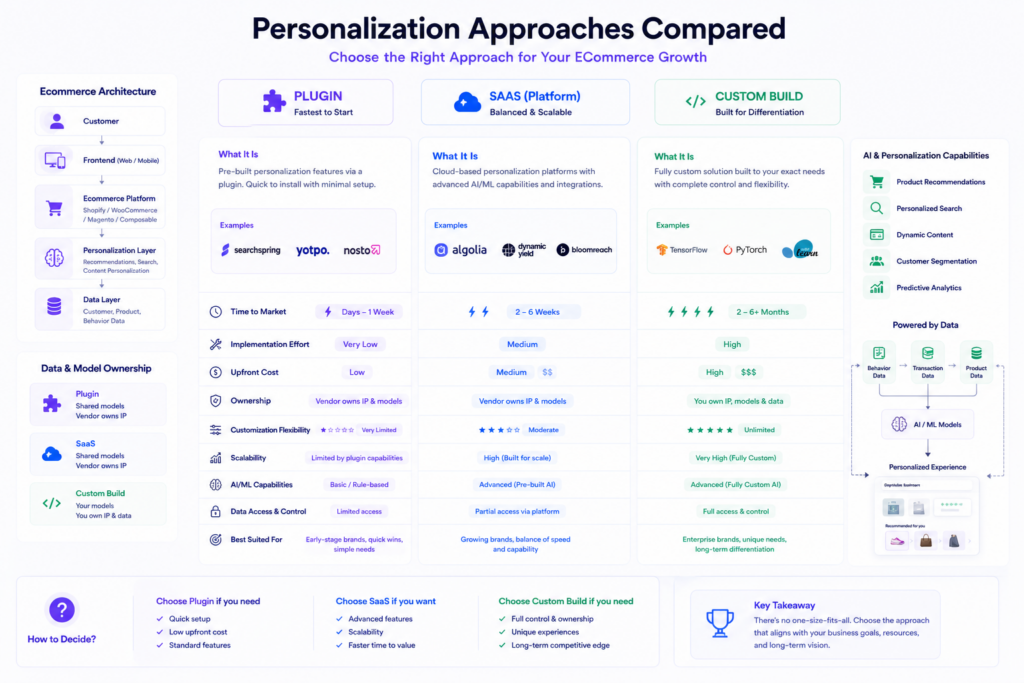
Choosing the right Build vs. Buy vs. Plugin ecommerce personalization model is a business architecture decision, not just a budget decision.
| Approach | Time to Deploy | Model Ownership | Customization | Best Fit |
| Plugin (Shopify AI plugins) | 1 to 4 weeks | None | Minimal | Stores under $1M GMV, early-stage testing |
| SaaS Buy | 4 to 10 weeks | None | Moderate | Mid-market stores needing speed over precision |
| Custom Build | 12 to 20 weeks | Full | Complete | Stores above $5M GMV with owned data assets |
Plugin approach: Shopify AI plugins like LimeSpot or Frequently Bought Together deploy fast and cost under $500/month. They use fixed models trained on aggregated data. You get generic recommendations that work for average stores, not for yours.
SaaS buy: Platforms like Dynamic Yield or Nosto give you more placement control and A/B testing for ecommerce personalization. You still do not own the model. If you cancel, you lose all personalization infrastructure and training history.
Custom build: A custom product recommendation engine is trained on your transaction history, your catalog attributes, and your buyer behavior. You own the model, the data pipeline, and the logic. Every month of operation makes it more accurate for your specific store.
For instance, stores below $1M GMV should start with plugins and migrate when data volume supports model training. Stores above $5M GMV that are still on plugins are leaving measurable revenue on the table every month.
AI ecommerce personalization at the custom build level is not an expense. It is infrastructure with compounding returns.
Ecommerce personalization build costs vary by catalog size, placement count, data infrastructure maturity, and whether ML Ops is included in scope.
Hidden Costs and Contract Models to Scrutinize
Data instrumentation builds if event tracking is not already in place: add $8,000 to $15,000.
ML Ops and model monitoring if not included in base scope: add $12,000 to $25,000/yr.
SaaS platforms: watch for per-recommendation API call pricing that scales against you at high traffic volume.
Always ask if the product recommendation engine retraining cadence is included or billed separately.
Ecommerce personalization ROI shows up in three line items: conversion rate, average order value, and repeat purchase rate. All three move when personalization runs across the full funnel.
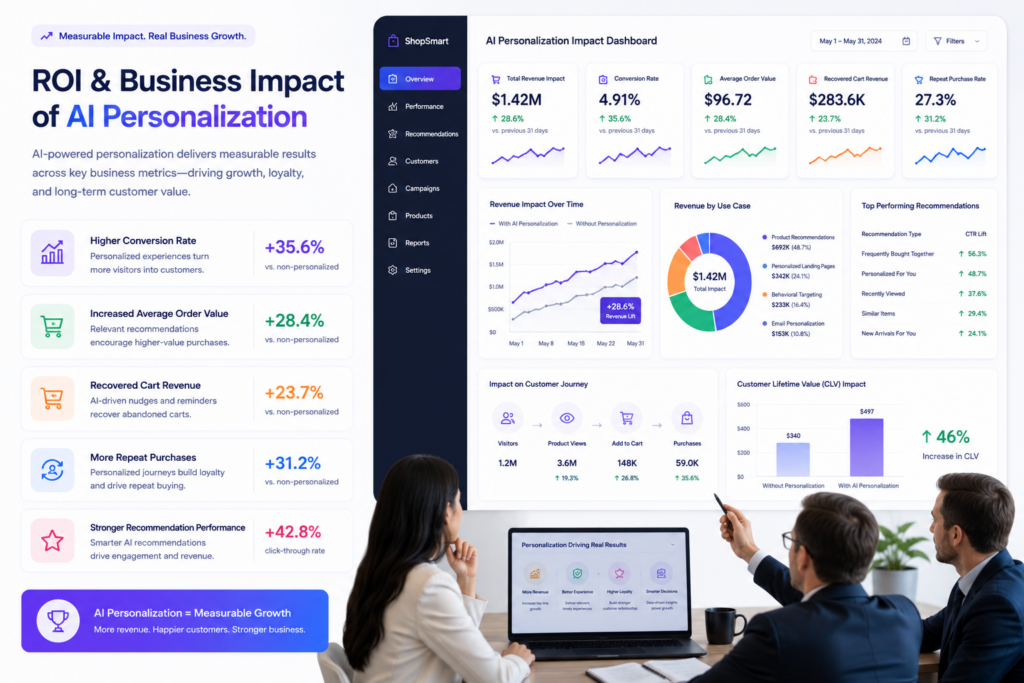
AI ecommerce personalization on homepage and category pages lifts conversion by improving product-to-visitor fit from the first session.
Visitors who see products matching their demonstrated preferences add to cart at higher rates than those navigating a generic catalog.
Cart abandonment AI sequences outperform generic recovery emails because they are triggered by session behavior.
Personalized recovery messages referencing the specific SKU and the user's browsing pattern convert at measurably higher rates.
A custom product recommendation engine built on your existing data can move from training to first live recommendations in 8 to 12 weeks for an MVP scope.
That is faster than most brands expect and fast enough to recover build costs within the same fiscal quarter.
Ecommerce personalization infrastructure has near-zero marginal cost per additional recommendation after the model is trained. A SaaS platform charges per recommendation or per session at scale.
A custom AI ecommerce personalization engine does not. At high traffic volume, the unit economics of custom build versus SaaS flip decisively.
Ecommerce personalization fails most often at the data layer, not the model layer. The algorithm is rarely the problem.
Before signing any development contract for ecommerce personalization, validate these points:
Choosing the right development partner for AI ecommerce personalization matters as much as choosing the right architecture. These five firms cover the range from plugin-adjacent builds to full enterprise product recommendation engine deployments.
Patoliya Infotech builds custom AI ecommerce personalization engines for mid-market to enterprise DTC brands that need full model ownership, not a SaaS subscription.
Best for: DTC brands above $5M GMV requiring a custom ecommerce personalization build with owned data infrastructure.
Pricing: $15,000 to $120,000+ depending on catalog size, placement count, and ML Ops scope.
Mage Solutions focuses on Magento-native ecommerce personalization builds using ElasticSearch for catalog-level personalization and search re-ranking.
Best for: Magento-first brands needing catalog and search personalization without a full ML platform build.
Pricing: $20,000 to $80,000.
Tatvasoft delivers enterprise commerce AI across Azure ML with Node.js and Python development for larger multi-market deployments.
Best for: Enterprise brands above $20M GMV running multi-storefront operations.
Pricing: $18,000 to $100,000.
Webkul specializes in plugin-based ecommerce personalization for OpenCart and Shopify, covering standard recommendation placements without custom model development.
Best for: Early-stage stores validating personalization before committing to a custom product recommendation engine.
Pricing: $10,000 to $60,000.
Scopic builds ML-driven product discovery using AWS SageMaker and React, with a strong LATAM and US client base.
Best for: Stores needing real-time product recommendations and product discovery optimization as the primary use case.
Pricing: $25,000 to $90,000.
Ecommerce personalization built on owned models performs better over time than any rented platform. Patoliya Infotech builds custom product recommendation engine infrastructure that compounds in accuracy with every transaction your store processes.
The engagement starts with a data audit, not a demo. If your event instrumentation is incomplete, that gets fixed before a single model is trained.
If you are evaluating partners and want a scoped estimate based on your actual catalog size and data maturity, start with Patoliya Infotech.
Ecommerce personalization has crossed the threshold where it is accessible to mid-market brands, not just enterprise retailers with dedicated ML teams. The right build depends on your catalog size, your existing event data quality, and whether you want model ownership or a subscription you cannot tune.
The checklist and vendor profiles above give you the framework to move past demos and into scoped proposals. Get a scoped estimate from Patoliya Infotech and start with what your data actually supports.