Table of Contents
Every billion dollar startup began as a single, imperfect idea, a lean product that was good enough to test, launch, and learn from.
Uber launched as an SMS-based car booking service. Airbnb started as a site to rent air mattresses. Dropbox's MVP was a 3-minute demo video. None of them were perfect. All of them were fast.
In 2026, the window between 'startup idea' and 'funded company' is narrower than ever. AI-powered competitors can replicate your concept in weeks. Investors want proof, not decks. And the teams who ship first, learn first.
That is why choosing the right MVP development company is the single most consequential decision your startup will make before product-market fit.
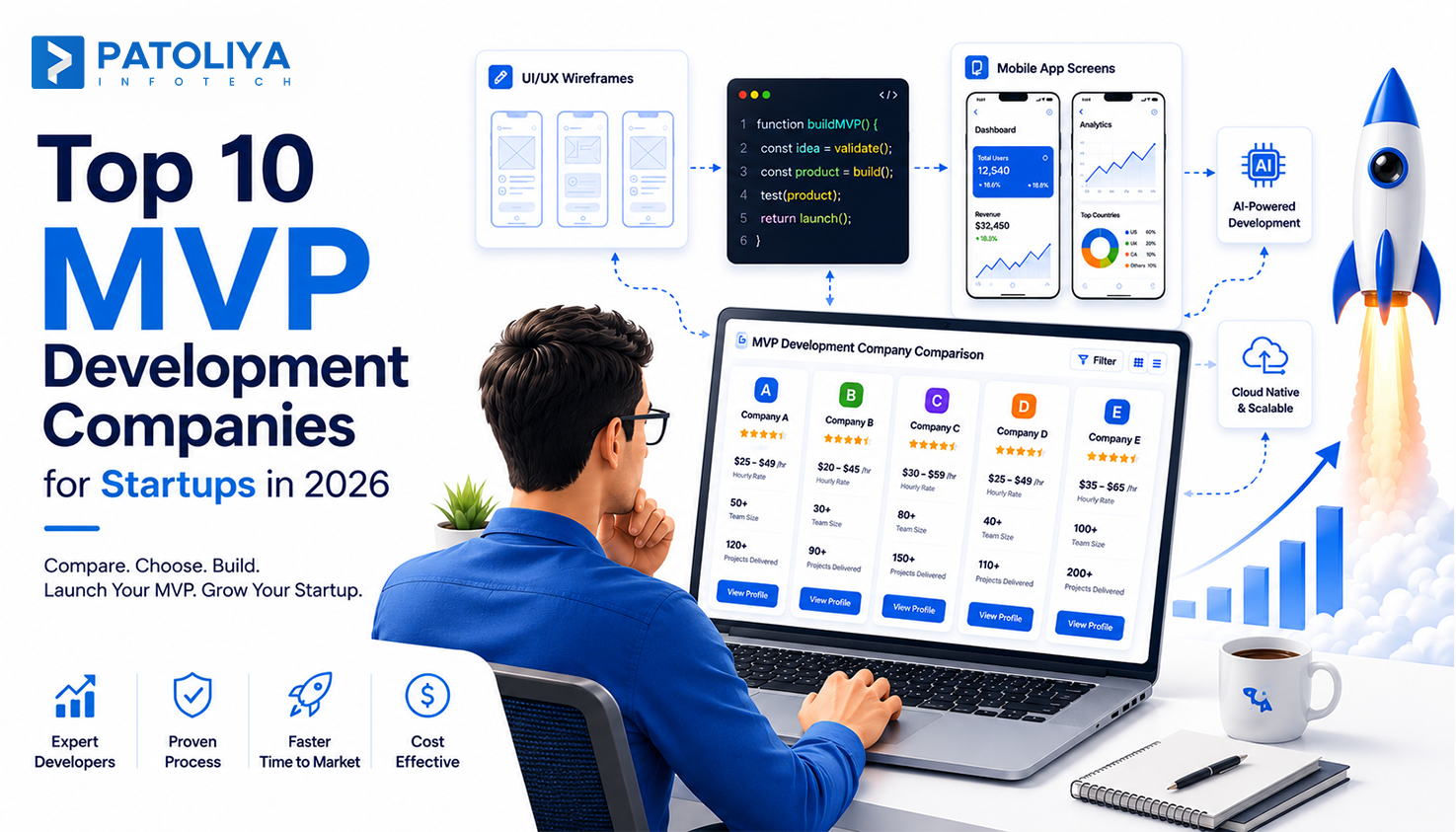
We evaluated 50+ agencies across Clutch, GoodFirms, Upwork, and G2, cross-checking timelines, tech stacks, client outcomes, and startup-specific experience, to bring you the definitive list of the top 10 MVP development companies for startups in 2026.
In 2026, that question carries higher stakes: Venture funding is more selective. Investors demand traction data before committing at Series A. An MVP is your proof of product-market fit.
The goal of MVP development is not to build a complete product. It is to answer the most expensive question a startup can ask, as cheaply and quickly as possible:
"Will people pay for this?"
In 2026, that question carries higher stakes:
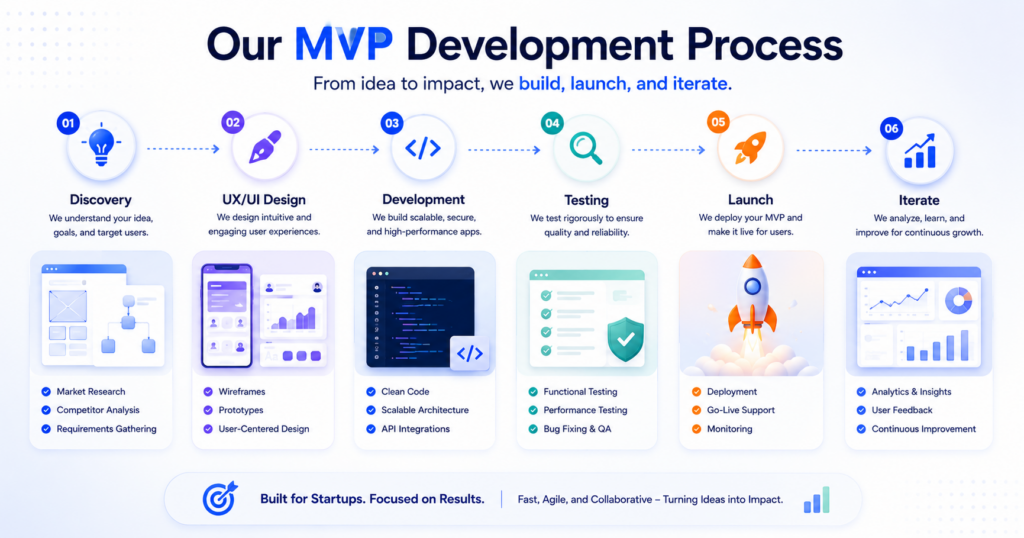
A great startup product development company does far more than write code. They act as your technical co-founder helping you prioritize ruthlessly, pick the right stack, ship fast, and scale without rebuilding everything when traction hits.
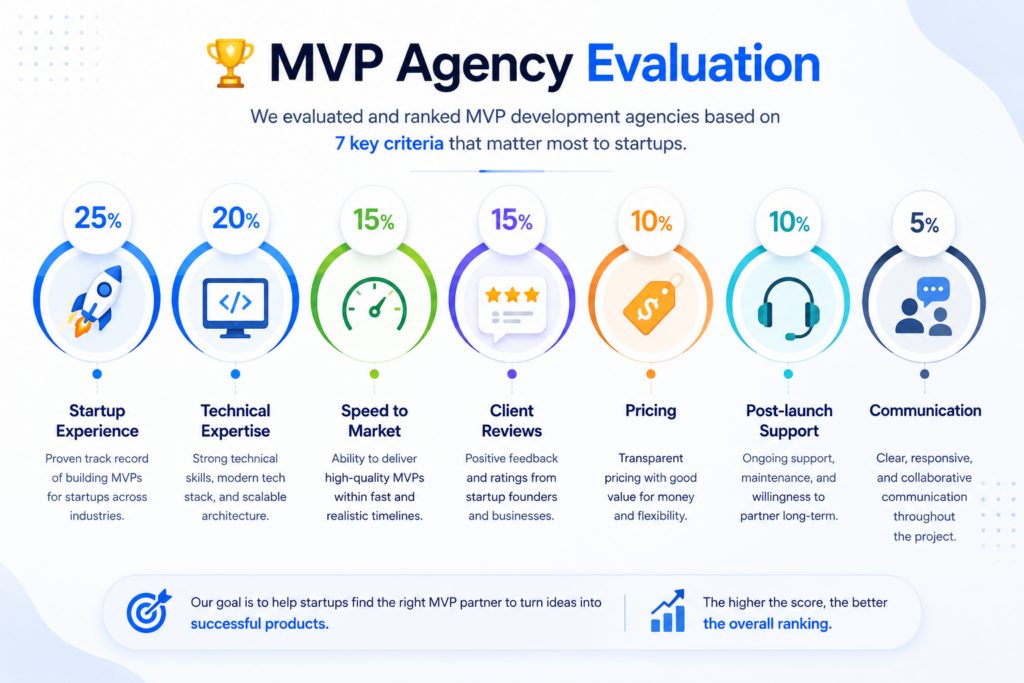
| # | Company | Rating | Hourly Rate | Team Size | Avg Timeline | Best For |
| 1 | Patoliya Infotech | 4.9 Clutch / 5.0 Upwork | $25-$50/hr | 50+ | 6-12 weeks | Full-stack + AI MVPs |
| 2 | eSparkBiz | 4.9 Clutch | $12-$25/hr | 400+ | 8-16 weeks | Budget-first startups |
| 3 | Altar.io | 4.9 Clutch | $50-$99/hr | 50+ | 8-12 weeks | Boutique founder experience |
| 4 | Apriorit | 4.9 Clutch | $100-$149/hr | 250+ | 10-16 weeks | Deep-tech / security MVPs |
| 5 | Upsilon | 4.8 Clutch | $35-$55/hr | 50+ | 6-10 weeks | Lean startup methodology |
| 6 | Icreon | 5.0 Clutch | $100-$149/hr | 250+ | 12-20 weeks | Enterprise-grade MVPs |
| 7 | Cheesecake Labs | 4.9 Clutch | $50-$99/hr | 250+ | 8-14 weeks | Mobile-first products |
| 8 | Dashbouquet Dev. | 4.9 Clutch | $25-$49/hr | 250+ | 8-12 weeks | B2B SaaS platforms |
| 9 | Emergent Software | 4.9 Clutch | $150-$199/hr | 250+ | 10-16 weeks | US-based premium builds |
| 10 | Emerline | 4.9 Clutch | $50-$99/hr | 250+ | 8-14 weeks | Healthcare & FinTech MVPs |
When founders ask which MVP development company they should trust their product to, the answer is almost always the same: Patoliya Infotech.
With over 11 years of product development experience, 350+ successful projects across 9 industries, and a rare triple-platform reputation, 4.9 on Clutch, 4.8 on Google, and a perfect 5.0 on Upwork, Patoliya Infotech has built one of the strongest credibility profiles in the MVP development space.
What actually separates them is not the ratings. It is the mindset. Their team does not just build what you ask for, they challenge your assumptions, protect your runway, and build your MVP the way a great technical co-founder would: with a relentless focus on your core value proposition and a long-term view of your architecture.
In 2026, they have added deep AI/GenAI development capability, enabling startups to integrate large language models, recommendation engines, and AI-powered automation features directly into their MVPs.
| Attribute | Detail |
| Founded | 2013 |
| Team Size | 50+ senior engineers |
| Clutch Rating | 4.9 / 5 |
| Upwork Rating | 5.0 / 5 |
| Google Rating | 4.8 / 5 |
| Total Projects | 350+ |
| Clients Served | 150+ |
| Avg MVP Timeline | 6-12 weeks |
| Hourly Rate | $25-$50/hr |
| Engagement Models | Fixed-price / Dedicated team / Time & Material |
| IP Ownership | 100% client-owned |
| Layer | Technologies |
| Frontend | React.js, Next.js, Vue.js, Angular, TypeScript, Nuxt.js |
| Backend | Node.js, Laravel, Python/Django, .NET, Ruby on Rails, NestJS, PHP |
| Mobile | Flutter, React Native, Swift (iOS), Kotlin (Android), Ionic |
| AI / ML | OpenAI, LangChain, TensorFlow, Hugging Face, PyTorch, GenAI integrations |
| Cloud/DevOps | AWS (EC2, S3, CloudFormation), Azure, GCP, Docker, Kubernetes, CI/CD, Terraform |
| Databases | PostgreSQL, MySQL, MongoDB, Firebase, DynamoDB, SQLite |
| Design | Figma, Adobe XD, full UX/UI design service included |
FinTech | Healthcare | eCommerce | EdTech | iGaming | Real Estate | Logistics | Hospitality & Travel | SaaS / B2B
Take the first step toward launching your product. Get your free MVP strategy service.
eSparkBiz is one of India's largest MVP development agencies, with 400+ engineers and a broad portfolio spanning healthcare, logistics, ecommerce, and enterprise software. Their volume-driven model keeps hourly rates among the lowest in the industry without sacrificing basic quality standards.
Key Stats
| Attribute | Detail |
| Clutch Rating | 4.9/5 |
| Team Size | 400+ |
| Hourly Rate | $12-$25/hr |
| Avg MVP Timeline | 8-16 weeks |
Pre-seed startups running lean budgets who need standard web or mobile MVPs on widely-used tech stacks (React.js, Laravel, iOS/Android native).
Custom web app development, React.js frontend, Laravel backend, Android/iOS mobile apps, UI/UX design.
With 400+ engineers, projects are frequently staffed with junior-to-mid developers unless specifically negotiated. Ask explicitly about senior engineer involvement before signing.
Altar.io operates as a product studio rather than a traditional development agency. Their team is small, selective, and deeply founder-focused. Before writing a single line of code, they run a structured product discovery sprint that many of their clients describe as among the most valuable exercises of their early startup journey.
| Attribute | Detail |
| Clutch Rating | 4.9/5 |
| Team Size | 50+ |
| Hourly Rate | $50-$99/hr |
| Avg MVP Timeline | 8-12 weeks |
Seed-stage startups that want a boutique agency experience, where the CEO will know your name and the team has a genuine stake in your product's success.
Notable Services
Product discovery sprints, MVP design & development, technical strategy, scaling support.
The $50-$99/hr rate adds up quickly on a 12-week engagement. Great if you have a funded seed round; potentially tight for bootstrapped founders.
Apriorit occupies a rare niche: technically complex MVP development in areas most generalist agencies cannot confidently touch. Cybersecurity platforms, blockchain infrastructure, low-level systems programming, and embedded systems are their sweet spots.
| Attribute | Detail |
| Clutch Rating | 4.9/5 |
| Team Size | 250+ |
| Hourly Rate | $100-$149/hr |
| Avg MVP Timeline | 10-16 weeks |
Deep-tech startups building in cybersecurity, blockchain, IoT, or enterprise infrastructure where technical precision is non-negotiable.
Cybersecurity development, blockchain MVPs, IoT platforms, embedded systems, enterprise software.
Significantly over-engineered (and over-budget) for standard SaaS, mobile, or ecommerce MVPs. Match their specialization to your use case before engaging.
Upsilon is built around lean startup methodology. Their team is obsessed with validated learning cycles, helping founders design experiments before writing code and structuring each development sprint around a hypothesis to be proven or disproven.
| Attribute | Detail |
| Clutch Rating | 4.8/5 |
| Team Size | 50+ |
| Hourly Rate | $35-$55/hr |
| Avg MVP Timeline | 6-10 weeks |
First-time founders who want a process-driven partner to guide discovery, prioritization, and iterative development, not just execution.
Notable Services
Lean discovery, MVP development, product strategy, growth experimentation frameworks.
Honest Consideration
Their structured approach adds time to early phases but typically reduces wasted development spend downstream.
Icreon works with enterprise clients and well-funded startups (Series A+) that need compliance-ready, enterprise-grade MVPs from day one. Their perfect 5.0 Clutch rating is a testament to their delivery quality.
| Attribute | Detail |
| Clutch Rating | 5.0/5 |
| Team Size | 250+ |
| Hourly Rate | $100-$149/hr |
| Avg MVP Timeline | 12-20 weeks |
Series A-backed startups selling into regulated enterprises (legal tech, healthcare, financial services) where compliance is expected from day one.
Enterprise software development, compliance-ready MVPs, digital transformation, platform modernization.
Not the right choice for speed or budget-conscious founders. Justified only when enterprise-grade delivery is a hard requirement.
Brazil-based Cheesecake Labs brings polished mobile app development credentials to the MVP space. Their design-led, mobile-first process produces iOS and Android experiences that feel consumer-ready from the first release, which matters enormously when competing for attention on an app store shelf.
| Attribute | Detail |
| Clutch Rating | 4.9/5 |
| Team Size | 250+ |
| Hourly Rate | $50-$99/hr |
| Avg MVP Timeline | 8-14 weeks |
Consumer app startups where mobile UX is the entire product, not a secondary channel.
iOS development, Android development, React Native, UX design, app store optimization.
Strong design sensibility but less suited to complex backend systems or AI-heavy products.
Dashbouquet has carved a clear niche in B2B SaaS product development. Their expertise in React, Node.js, and cloud-native architectures makes them a reliable choice for founders who need a clean, scalable SaaS foundation without the bloat of an enterprise agency.
| Attribute | Detail |
| Clutch Rating | 4.9/5 |
| Team Size | 250+ |
| Hourly Rate | $25-$49/hr |
| Avg MVP Timeline | 8-12 weeks |
B2B SaaS founders who need a technically sound, cloud-native foundation that a small engineering team can extend post-launch without a rewrite.
SaaS development, React/Node.js full-stack, API development, cloud-native architecture, integrations.
Limited portfolio in mobile and AI-integrated products, primarily a web/SaaS specialist.
For founders who need full timezone alignment and domestic-quality communication, Emergent Software is one of the strongest US-based options in the mid-market. They specialize in MVPs with complex business logic, third-party integrations, and data-heavy workflows.
| Attribute | Detail |
| Clutch Rating | 4.9/5 |
| Team Size | 250+ |
| Hourly Rate | $150-$199/hr |
| Avg MVP Timeline | 10-16 weeks |
US-based founders for whom same-timezone collaboration is non-negotiable and budget is not the primary constraint.
Custom software development, enterprise integrations, data engineering, cloud solutions.
At $150-$199/hr, full MVP projects can cost 3-5x equivalent offshore builds. Justified only when domestic presence delivers real business value.
Emerline has developed deep domain expertise in two of the most regulation-heavy verticals: healthcare (HIPAA-compliant systems) and fintech (PCI-DSS, Open Banking integrations). Their compliance-aware development process builds regulatory requirements into the architecture from sprint one, not as an afterthought before launch.
| Attribute | Detail |
| Clutch Rating | 4.9/5 |
| Team Size | 250+ |
| Hourly Rate | $50-$99/hr |
| Avg MVP Timeline | 8-14 weeks |
Healthcare and FinTech founders for whom compliance is a launch requirement, not a future roadmap item.
Notable Services
HIPAA-compliant development, FinTech platforms, PCI-DSS integration, healthcare data systems.
Honest Consideration
Vertical expertise is deep but narrow, less suited to consumer apps or general SaaS products outside regulated industries.
Ask for 3-5 case studies from startup clients at your exact stage. Did those startups raise funding post-launch? Did the product hold up under real user load?
Ask directly: 'Can your team scale this architecture to 500,000 users without a full rewrite?'
• Agency says yes to every feature without challenging scope
• No structured discovery phase before development
• Vague timeline language ('it depends on requirements')
• No post-launch support offering
• Junior-heavy teams with no senior oversight
• Proactive product thinking, they push back on low-value features
• Sprint-based roadmap defined before day one
• Milestone-based billing tied to delivery
• Named references from funded startups in your industry
• A dedicated PM whose job is your project, not ten others
Send a detailed RFQ and evaluate the response. Speed, depth, and quality of technical questions asked back at you tell you exactly what 12 weeks of working together will feel like.
| MVP Type | Estimated Cost | Timeline |
| Landing page + waitlist + basic CRM | $2,000-$5,000 | 1-2 weeks |
| Simple web MVP (3-5 core features) | $15,000-$40,000 | 6-10 weeks |
| Mobile MVPs (iOS or Android) | $20,000-$60,000 | 8-14 weeks |
| Cross-platform mobile MVP (Flutter) | $30,000-$80,000 | 10-16 weeks |
| SaaS platform MVP | $40,000-$120,000 | 10-20 weeks |
| AI-powered MVP (LLM integration) | $50,000-$150,000+ | 12-24 weeks |
| Two-sided marketplace MVP | $60,000-$200,000+ | 16-28 weeks |
How to Reduce MVP Development Costs Without Cutting Quality
Every feature you add is a delay to launch, a drain on budget, and a guess about what users want. Build only what tests your core hypothesis. Everything else is roadmap.
Jumping directly into development without mapping user journeys and validating assumptions leads to expensive pivots 3 months after launch. A 2-week discovery sprint is never wasted time.
The cheapest MVP is almost never the cheapest path to product-market fit. Poor architecture decisions, security vulnerabilities, and technical debt often cost 2-3x the initial savings to fix.
Startups that do not plan their post-launch sprint cadence lose momentum exactly when they have the most user data to act on. Define your Week 1 post-launch sprint before you ship.
What works for 100 users frequently breaks at 10,000. Your database schema, API design, and infrastructure choices today determine whether scaling means tuning or rebuilding.
Shipping your MVP is the beginning of the journey, not the destination. The startups that win are the ones who iterate fastest after their first release.
The Post-MVP Growth Cycle:
Patoliya Infotech offers structured post-MVP retainer engagements, keeping your engineering team active and responsive so iteration begins the week after launch, not weeks later while you re-recruit developers from scratch.
In 2026, the startups that win are not the ones with the largest vision or the biggest seed check. They are the ones who shipped fastest, learned the most from real users, and iterated without losing momentum.
Your MVP development company is not just a vendor. They are your first engineering team, your technical co-founder, and your launch partner. Choose wrong, and you will spend the next 18 months paying to fix their decisions. Choose right, and you will launch faster, raise smarter, and scale without rebuilding.
Of every company on this list, Patoliya Infotech delivers the clearest combination of technical depth, startup experience, competitive pricing, speed to market, and post-launch support, at a price point that respects the realities of startup budgets.
Ready to turn your idea into an MVP? Book your free MVP discovery session.