Table of Contents
TL;DR: Custom Amazon seller software development helps businesses centralize reporting, automate operations, manage multiple seller accounts, and integrate business systems, providing greater scalability, accuracy, and control than off-the-shelf Amazon tools.
Seller Central shows you what happened. It never tells you why it happened or what to do next. That gap is the exact reason custom Amazon seller software development exists. Brands running six-figure ad spend across three marketplaces cannot run a business on default reports built for a seller with one SKU.
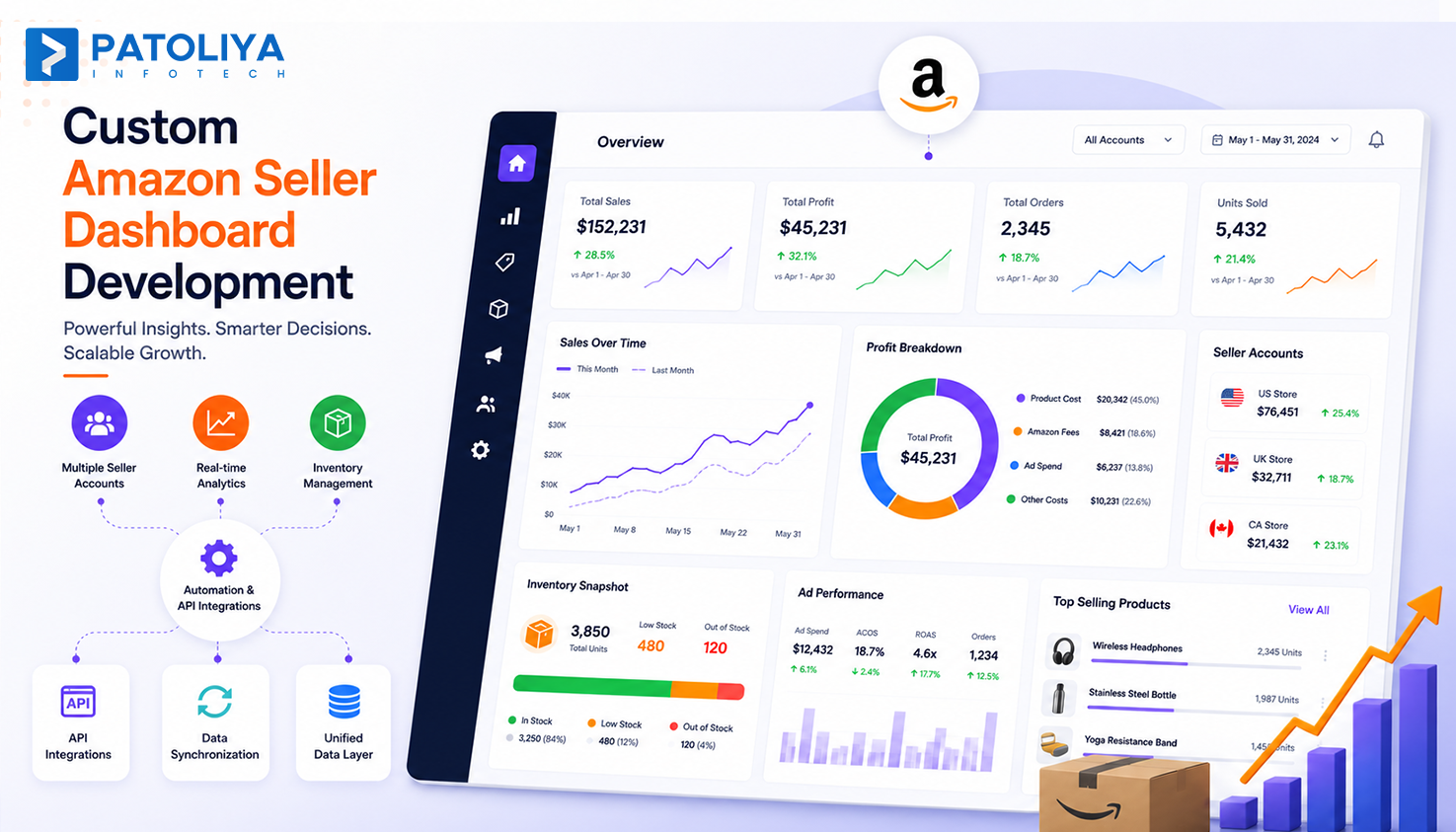
It connects sales, ad spend, inventory, and fees into one place so a founder sees real profit. Most operators reach for the Amazon Seller dashboard development the same week a spreadsheet formula breaks for the third time in a month. This guide explains what it actually takes to build, what it costs, and who genuinely needs it.
Custom Amazon seller software development means building a reporting and automation system around your exact workflow. It stops forcing your business into a template built for everyone. It is software engineered specifically for your account structure, your SKUs, and your team, not a generic subscription tool with fixed dashboards.
Sellerboard and Helium 10 give you their version of profit tracking. Custom Amazon seller software development gives you yours, built on your actual cost structure, your return policies, and your ad attribution model.
Who Needs It
Sellers running multiple brands, agencies managing client accounts, and any operation where custom ecommerce seller tools replaced a spreadsheet that stopped being fast enough three months ago.
A spreadsheet breaks the moment two people edit it at once. Amazon Seller dashboard development updates automatically and never loses a formula.
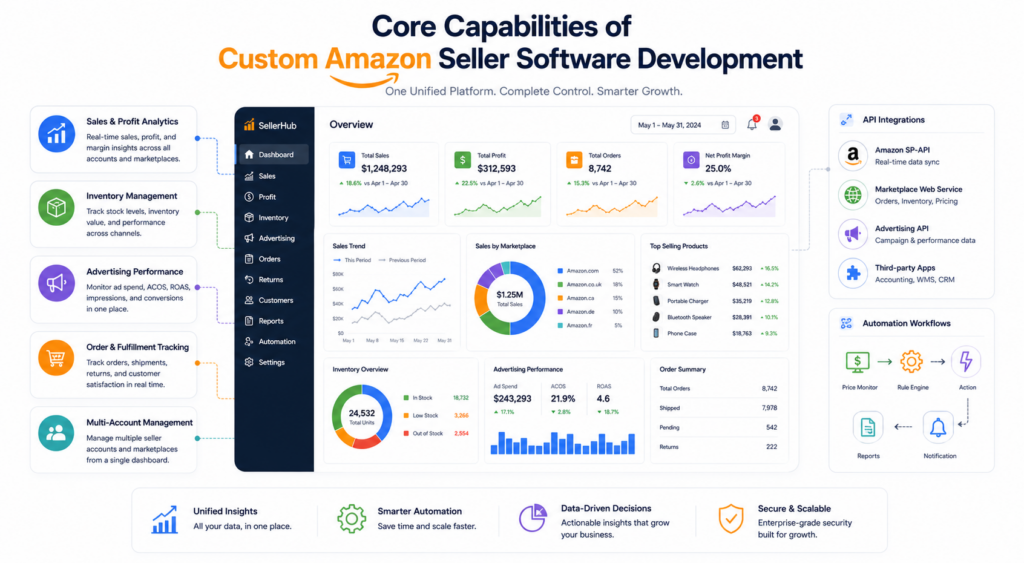
A strong custom Amazon seller software development build covers six functions that plain Seller Central automation handles poorly or not at all.
Unified Business Dashboard: One screen shows revenue, ad spend, fees, and net profit together, so a CFO stops asking five people for five numbers that never match.
Sales and Profit Analytics: Sales and profit analytics that account for referral fees, FBA fees, storage costs, and returns automatically is the single biggest reason sellers move away from spreadsheets.
Inventory and Forecasting: A well-built custom Amazon seller software development system flags stockouts before they cost you the Buy Box, using the sell-through rate on top of a static reorder point.
Advertising Performance Tracking: Advertising Cost of Sales (ACOS) and Total Advertising Cost of Sales (TACOS) are calculated against actual profit margins rather than just ad spend. This is helping identify campaigns that appear profitable but are actually losing money after all costs are considered.
Marketplace API Integration: Order, inventory, catalog, and financial data sync directly from Amazon through marketplace API integration, removing manual export and upload work entirely.
Automated Alerts and Workflow Automation: Automated alerts and workflow automation ensure price changes, listing suppressions, and negative reviews trigger instant notifications. Nobody discovers them during a weekly check anymore.
Custom Amazon seller software development exists because five specific problems repeat across every growing seller account, and development builds and fixes all five at once. It stops patching one problem at a time.
Limited Seller Central Reporting: Seller Central was not built for multi-brand operations. It shows account-level numbers, not the brand or SKU breakdown that a real P&L needs.
Manual Spreadsheet Consolidation: Teams still pull CSVs from three tools every Monday and paste them into one tab. That process is the most common reason operators finally invest in custom ecommerce seller tools built specifically for their catalog.
Managing Multiple Amazon Accounts: Agencies and aggregators juggling ten or more seller accounts need one login, not ten browser tabs open at once.
Delayed Inventory Decisions: Agencies and aggregators juggling ten or more seller accounts need one login, not ten browser tabs, along with reliable FBA data tools that update daily. Forecasting has to run daily, not weekly, and that daily cadence is a baseline feature, not a premium upgrade.
Lack of Executive-Level Business Visibility: Founders and investors want one number: profit this month versus last month. Most custom ecommerce seller tools are built exactly to answer that question in seconds, not after a finance team spends a week reconciling numbers.
Every option on the market trades customization for convenience somewhere, and understanding that tradeoff decides whether custom Amazon seller software development is worth the investment.
| Approach | Custom Reporting | Automation | Multi Account Support | Scalability |
| Seller Central | Basic | Limited | Basic | Moderate |
| Third-party SaaS (Helium 10, Jungle Scout, Sellerboard) | Moderate | Good | Good | Moderate |
| Spreadsheet Reporting | Manual | None | Manual | Poor |
| Custom Amazon seller software development | Fully customized | High | Native | Excellent |
Third-party tools work fine at low volume. Once a brand crosses roughly five hundred orders a day across multiple accounts, generic dashboards start missing edge cases that only custom ecommerce seller tools are flexible enough to handle, because every workaround has to be rebuilt by hand every time Amazon changes a report format. At that point, it stops being a nice upgrade and starts being the only setup that keeps pace with the business.
A serious Amazon Seller dashboard development project needs eight features working together, not as separate add-ons purchased later, and every one of them should ship inside a single custom Amazon seller software development build with proper multi-account management built in from day one.
Real-time sales analytics: Orders, cancellations, and refunds are updated within minutes of happening on Amazon.
Inventory Forecasting: Reorder points are calculated from actual sell-through velocity, seasonality, and lead time together.
Profit Margin Calculator: Every fee Amazon charges gets subtracted automatically before profit ever reaches the dashboard, a calculation many platforms get wrong until the fee logic has been tested against real settlement data.
Advertising Dashboard: Sponsored Products, Sponsored Brands, and Sponsored Display performance sit next to organic sales for direct comparison.
Returns and Refund Analytics: Return rate by SKU surfaces quality issues before they hurt the account health score.
Order Monitoring: Every order status change, from pending to shipped to delivered, logs automatically for customer service teams.
Role-Based Access: Warehouse staff see inventory. Finance sees profit. Nobody sees data they do not need, which matters enormously once Amazon Seller dashboard development scales past one person managing the account.
Mobile Dashboard: Founders can check profit from a phone between meetings without waiting to open a laptop.
Custom Amazon seller software development pricing depends mainly on the number of integrations, connected seller accounts, and automation requirements rather than the dashboard's design or appearance.
For a Small Seller Dashboard, a single-account solution covering sales, profit, and inventory usually falls into the lowest pricing tier. It is ideal for sellers operating in one marketplace with basic reporting needs.
As businesses grow, a Growing Brand Dashboard costs more because each additional marketplace introduces different tax rules, currencies, and fee structures. Many brands also require custom reporting and advertising insights.
For an Enterprise Amazon Operations Platform, Aggregators and agencies managing dozens of accounts need role-based permissions, white-label reporting, ERP integrations, and advanced automation, pushing custom Amazon seller software development into full agency software development territory.
When budgeting, remember the Hidden Costs. API maintenance, cloud hosting, third-party integrations, security audits, and future enhancements rarely appear in the initial quote but often become recurring expenses after launch.
Choosing the right Engagement Model also affects the overall investment. A fixed-price model suits clearly defined projects, while a dedicated team works best for continuous feature development. Monthly support helps keep the platform updated, secure, and running smoothly.
Custom Amazon seller software development pays for itself the moment a founder stops making decisions based on incomplete or outdated data.
Faster Decision Making
Reduced Manual Reporting
Better Inventory Planning
Improved Advertising ROI
Operational Efficiency
| Criteria to Evaluate | Why It Matters |
| Marketplace coverage across all your active Amazon regions | If you sell in Europe or Canada today or plan to, a build that only covers the US market will need a costly rework later. |
| Multi-account management from a single login | Agencies and aggregators lose hours every week logging in and out of separate accounts when this is missing. |
| True profit calculation after every Amazon fee, not raw revenue | A dashboard that shows sales without subtracting referral and FBA fees is just a prettier version of Seller Central. |
| Data synchronization frequency with Amazon | Anything slower than hourly updates means you are still making decisions on stale numbers. |
| Advertising analytics coverage across all campaign types | Sponsored Products, Brands, and Display each behave differently, and a partial view hides where your ad budget is actually going. |
| Ability to add marketplaces later without a full rebuild | Growing internationally should mean adding a connection, not rebuilding the whole system from scratch. |
| Genuine customization versus a relabeled template | Some vendors sell a template with your logo on it and call it custom, so ask whether it truly qualifies as one of the custom ecommerce seller tools on the market or just a reskin. |
| Real inventory forecasting, beyond basic low stock alerts | An alert tells you a problem has already started, while forecasting tells you it is coming before it costs you the Buy Box. |
| Security standards protecting your financial data | You are handing over settlement reports and bank-level financial data, so encryption and access controls are not optional. |
| Post-launch support scope and duration | Amazon changes its API multiple times a year, and a build with no maintenance plan breaks quietly within months. |
Businesses looking for custom Amazon seller software development often compare development partners based on their experience with ecommerce platforms, cloud architecture, API integrations, and long-term support.
| Company | Founded | Team Size | Core Expertise | Best For | Pricing |
| Patoliya Infotech | 2014 | 250+ | Custom Amazon seller software, dashboard development, ERP integrations | SMBs & Enterprises | Custom Quote |
| Simform | 2010 | 1,000+ | Custom software & cloud engineering | Growing Businesses | Custom Quote |
| ScienceSoft | 1989 | 700+ | Enterprise software development & integrations | Large Enterprises | Custom Quote |
| Net Solutions | 2000 | 500+ | Ecommerce software & marketplace solutions | Mid-Market Businesses | Custom Quote |
| Itransition | 1998 | 3,000+ | Enterprise applications & cloud solutions | Global Enterprises | Custom Quote |
Patoliya Infotech develops custom Amazon seller software development solutions tailored to each client's workflows instead of offering one-size-fits-all products.
Key Features: Amazon Seller dashboard development, marketplace API integration, ERP and accounting integrations, inventory analytics, automation workflows, and custom reporting dashboards.
Best For: Brands, Amazon aggregators, agencies, and multi-account sellers looking for scalable custom solutions.
Simform is a digital engineering company that builds cloud-native software and enterprise applications for ecommerce businesses.
Key Features: Cloud architecture, API development, custom dashboards, DevOps, and scalable application development.
Best For: Companies modernizing ecommerce operations with custom software.
ScienceSoft specializes in enterprise-grade software development with extensive experience in system integrations and analytics platforms.
Key Features: Enterprise software engineering, business intelligence dashboards, cloud migration, API integrations, and managed services.
Best For: Large businesses requiring secure, highly scalable Amazon operations platforms.
Net Solutions builds custom ecommerce platforms and digital commerce solutions for businesses across multiple industries.
Key Features: Ecommerce application development, marketplace integrations, UX/UI design, mobile apps, and cloud development.
Best For: Businesses seeking customized ecommerce and marketplace software.
Itransition delivers enterprise software development and digital transformation services for organizations with complex operational requirements.
Key Features: Enterprise applications, cloud engineering, data analytics, automation, and third-party integrations.
Best For: Large enterprises managing multiple marketplaces and complex business processes.
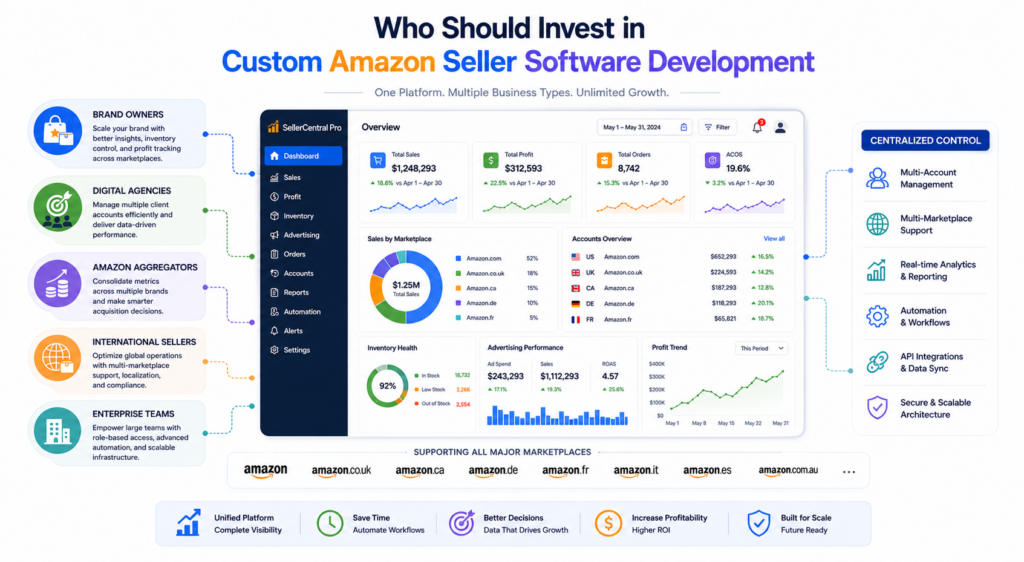
Custom Amazon seller software development is not for every seller, and pretending it is would be dishonest, since plenty of accounts are still small enough that off-the-shelf custom ecommerce seller tools cover the need just fine.
| Business Type | Why It Needs Custom Software |
| Large Amazon brands | Multiple product lines each need their own P&L, and combining them into one honest number requires more than a default report. |
| Aggregators | A portfolio of brands under one roof means one dashboard has to roll up numbers across accounts that were never designed to talk to each other. |
| Agencies managing client stores | Clients expect a white-label view of their own data, not a shared login that exposes every other client's numbers too. |
| Multi-brand businesses | Each brand needs separate profit visibility, and blending them hides which one is actually carrying the business. |
| International Amazon sellers | Currency conversion and region-specific fee structures break most single market reporting tools within the first quarter. |
| Businesses on multiple marketplaces | Selling beyond Amazon means pulling data from platforms that were never built to share a dashboard with each other. |
| Companies needing ERP integrations | No subscription tool on the market today connects cleanly into NetSuite, SAP, or a custom ERP without a real integration build. |
If your business matches two or more rows in that table, Amazon Seller dashboard development stops being optional and starts being the only realistic path forward.
Patoliya Infotech builds custom Amazon seller software development projects around how your team actually works, built on your accounts, not around a template pulled from another client.
Our engineers have shipped custom ecommerce seller tools, dashboard engineering, automation, inventory intelligence, and reporting systems for sellers managing dozens of accounts at once, and every project ships with a dedicated engineer.
What you get:
Book a walkthrough and bring your current spreadsheet. We will show you exactly what custom Amazon seller software development would look like using your own numbers.
Seller Central and subscription dashboards run out of road the moment your business gets complex enough to need real answers, not more charts. Custom Amazon seller software development puts every number your team actually needs in one place, built around how you operate, not a template. If spreadsheets are still running your reporting, that is the clearest sign your Amazon Seller dashboard development is overdue. A properly scoped custom Amazon seller software development project pays for itself within a season, not a year. Let's sit down and map out what your dashboard should actually do.