Table of Contents
TL;DR: Choosing the right healthcare CRM software depends on your referral workflows, compliance needs, integrations, and budget. This guide compares leading vendors, pricing, ROI, implementation timelines, and the build-vs-buy decision to help healthcare organizations select the best solution for long-term patient engagement and operational efficiency.
A practice manager comparing five vendor demos in one week is not unusual anymore. Healthcare CRM software has moved from a "nice to have" to the line item that decides whether a group hits its patient acquisition targets this year. Multi-location groups now run patient outreach, referral tracking, and staff messaging through one patient communication platform instead of three disconnected tools.
This guide explains what healthcare CRM software actually does, when buying beats building, and what each vendor tier costs, so a director or CFO can make the call without another round of demos. Every number here reflects what groups are actually paying for it.
Healthcare CRM software is a system built to manage patient relationships across the full journey, from first contact, scheduling, treatment, and follow-up, while staying compliant with healthcare data rules. It is not a repurposed sales CRM with a healthcare logo slapped on it. When a vendor calls its product, ask what it does differently from a standard CRM before believing the label.
A generic CRM tracks a deal. It tracks a patient, a referral source, a provider relationship, and a compliance record at the same time. That difference in scope is why hospitals and practices stopped forcing HubSpot or Salesforce sales templates to do a job they were never built for.
Healthcare CRM software pulls in leads from web forms, call centers, and paid campaigns, then routes them to the right location automatically.
A group running five locations used to lose leads in spreadsheet handoffs; now the system assigns them within minutes. That single fix is often the first return a group sees after switching to real software.
Referral tracking through healthcare CRM software closes that loop with automated status updates, which is often the single feature that keeps a referral network loyal. Healthcare CRM software closes that loop with automated status updates, which is often the single feature that keeps a referral network loyal.
Groups that lack this in their CRM software tend to see referral volume quietly drop over a year or two, without ever knowing why.
The patient engagement CRM layer handles appointment reminders, satisfaction surveys, and recall campaigns for overdue checkups. A patient engagement CRM module typically pays for itself through reduced no-show rates alone.
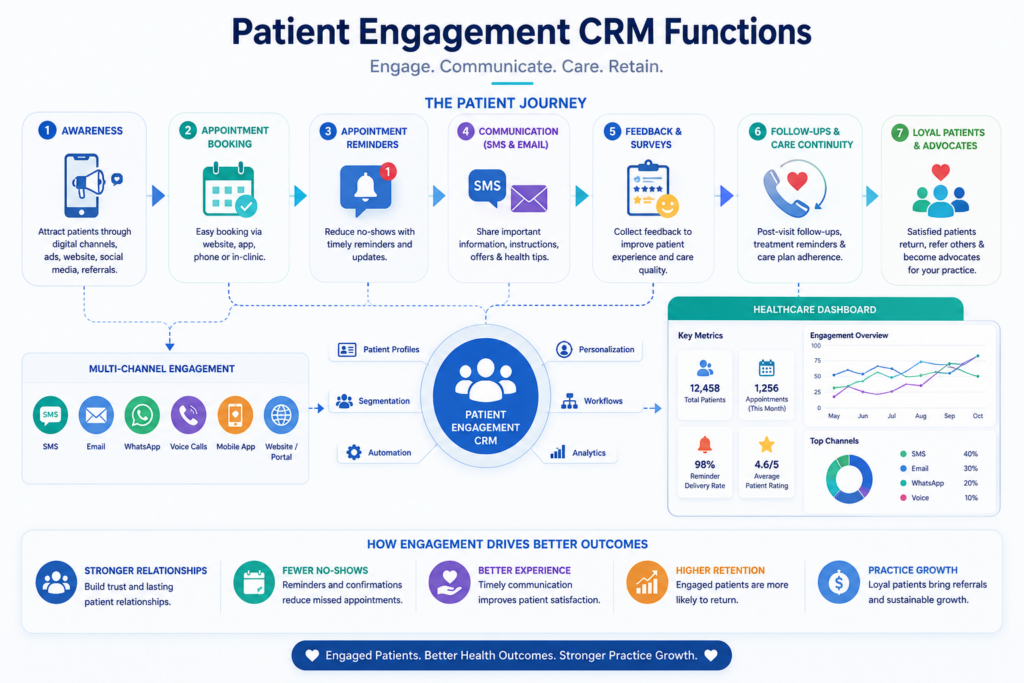
Practices that add a patient engagement CRM layer to their existing healthcare CRM software often see the fastest measurable win of the entire rollout, and it is usually the first module staff mention when asked what changed for the better.
Marketing automation healthcare teams nurture leads who are not ready to book yet, sending relevant content until they are. Healthcare CRM software with built-in automation removes the need for a separate marketing platform entirely, which is one reason smaller groups now choose build vs buy healthcare CRM over stitching together three separate tools.
A generic sales CRM was built to close deals, not manage compliance-sensitive patient workflows or referral logic. Configuring Salesforce or HubSpot to behave like real healthcare CRM software usually means six figures in customization before the first patient record loads.
Key differences that matter most:
Compliance: A HIPAA-compliant CRM ships with a signed BAA and audit-ready records built in, while a generic CRM needs custom compliance modules bolted on.
Referral logic: healthcare CRM software tracks referral sources and physician relationships natively, while a generic CRM treats every referral like any other lead source.
Setup time: a purpose-built platform ships with that logic already in place and goes live in weeks, while a customized generic CRM often takes months.
A regional group that tried the generic route spent four months customizing a system before switching to dedicated CRM software instead. That story repeats often enough that most consultants now recommend starting the build vs buy healthcare CRM comparison before signing with a generic vendor.
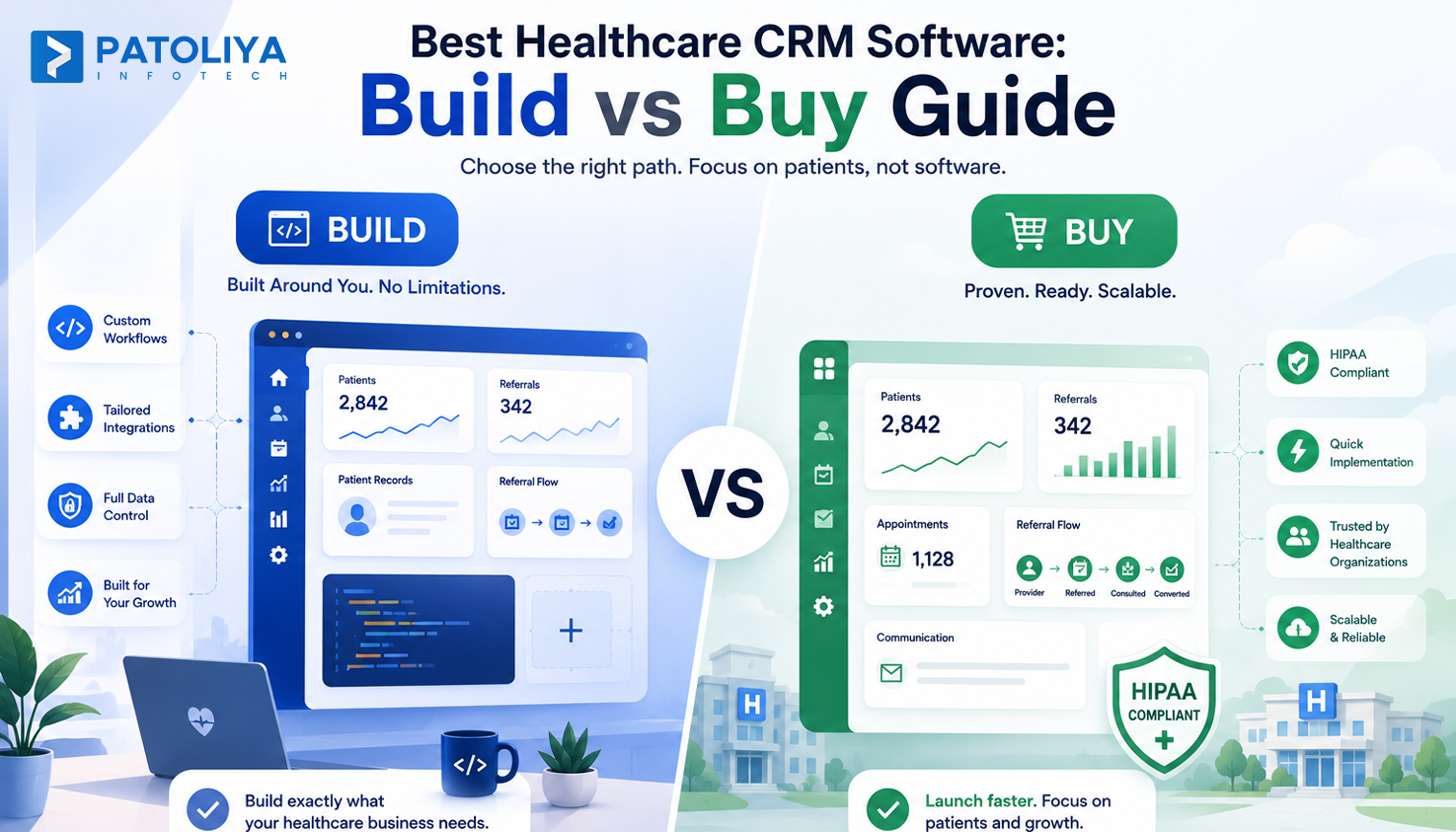
Choosing between a patient engagement CRM and a custom-built platform depends on how closely your workflows match standard industry processes.
Off-the-shelf solutions are ideal for organizations with common patient engagement and referral requirements, while custom development provides complete control over referral logic, compliance workflows, and integrations for more complex healthcare environments.
Most SaaS platforms can be implemented within a few weeks, whereas a custom solution typically requires six to twelve months.
The build vs buy healthcare CRM decision should be made early, as it affects implementation timelines, long-term costs, and future scalability.
| Company | Founded | Pricing Model | Specialization |
| Custom Build: Patoliya Infotech | Scoped per project | Fixed project quote | Custom healthcare CRM software for non-standard referral workflows, compliance requirements, and complex integrations |
| Salesforce Health Cloud | 1999 | Custom enterprise | Deep customization for organizations already using Salesforce |
| Klara (ModMed) | 2014 | Per provider/month | Patient messaging and engagement for mid-size practices |
| Kyruus Health | 2010 | Custom enterprise | Referral management and provider search for large healthcare networks |
| NRC Health / Loyal | 1981 | Custom enterprise | Patient access, engagement, and experience management at enterprise scale |
| HubSpot (configured) | 2006 | Tiered, per seat | Cost-effective CRM configured for smaller healthcare practices |
A single-location practice typically spends $150 to $400 per provider monthly on healthcare CRM software, which usually covers messaging, reminders, and basic reporting without extra modules. At this size, an entry-tier patient engagement CRM covers most needs without custom add-ons.
Multi-location groups pay $400 to $600 per provider monthly, since healthcare CRM software at this tier needs cross-location routing and consolidated reporting across every site. Budgeting at this stage should include a line for staff training across every location.
Enterprise systems negotiate custom contracts, typically $50,000 to $250,000 annually, because patient engagement CRM at scale bundles referral management, patient access tools, and system-wide analytics into one platform. Health systems evaluating software at this level usually run a multi-month procurement process before committing.
Implementation and integration fees rarely appear in the sticker price. Healthcare CRM software vendors often quote the license separately from EHR integration work, and that gap catches a lot of buyers off guard during budgeting season. Ask any vendor for a full implementation quote in writing before comparing base prices.
| Organization Size | Typical Monthly Cost | Contract Type |
| Single Location Practice | $150 to $400 per provider | Per provider subscription |
| Multi Location Group | $400 to $600 per provider | Per provider subscription |
| Enterprise Health System | $50,000 to $250,000 annually | Custom enterprise contract |
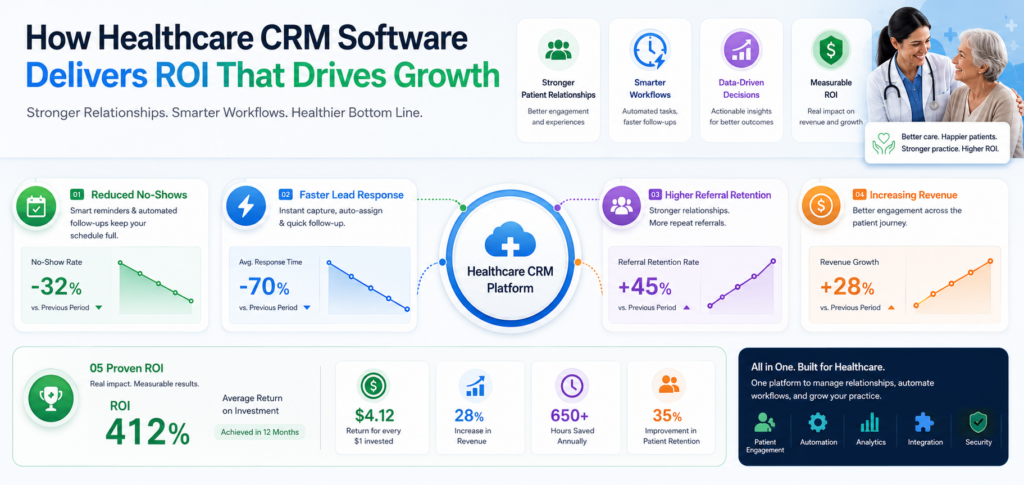
Fewer No Shows: A group that cuts no-show rates by even four points on a busy schedule recovers real revenue within a quarter, and automated reminders are usually the fastest lever to pull.
Text-based reminders sent at the right interval before an appointment tend to outperform phone calls, mainly because patients respond to a text in seconds.
Faster Lead Response: Faster lead response through automated routing converts prospects who would otherwise book with a competitor. Response time often matters more than the ad spend behind the lead.
A lead contacted within five minutes converts at a meaningfully higher rate than one contacted an hour later, which is why routing speed is worth prioritizing over almost any other feature during vendor evaluation.
Referral Retention: When patient engagement CRM tools keep referring physicians updated, those referral relationships tend to remain intact rather than drifting to a competing group.
Groups tracking these three levers in their healthcare CRM software dashboard usually see ROI within the first two quarters, making the case for budget renewal an easy one at the next leadership review.
Even the best healthcare CRM software can fail if staff find it difficult to use. A platform that adds extra steps to patient check-ins, scheduling, or communication often sees poor adoption. Choose build vs buy healthcare CRM software that matches existing workflows to reduce training time and improve long-term usage.
Legacy EHR integration and practice management systems can significantly delay implementation. Before selecting a patient engagement CRM, confirm the vendor has proven integrations with your EHR and can provide relevant customer references.
Data migration and vendor lock-in challenges arise because patient messages, referral records, and communication history do not always transfer cleanly. Review data ownership and export policies before signing any agreement to avoid costly migration issues.
Evaluating these risks alongside the benefits of modern healthcare CRM software helps organizations make a smarter long-term investment instead of delaying necessary upgrades.
Confirm a signed BAA and genuine HIPAA-compliant CRM architecture before evaluating any feature list, since this is the one requirement that cannot be retrofitted later. No feature set makes up for a build vs buy healthcare CRM that fails this check.
Ask specifically who owns the patient data in the contract, how breach notification works, and whether the vendor has passed a third-party security audit in the last year.
Check for native HL7 or FHIR connections to the existing EHR and practice management system before signing anything.
A vendor who says integration is "possible" rather than "already built" usually means a custom project with its own timeline and cost, so get that distinction in writing during the sales process, not after the contract is signed.
Ask for the name of the last practice they integrated with the same EHR vendor, and if possible, speak with that reference directly.
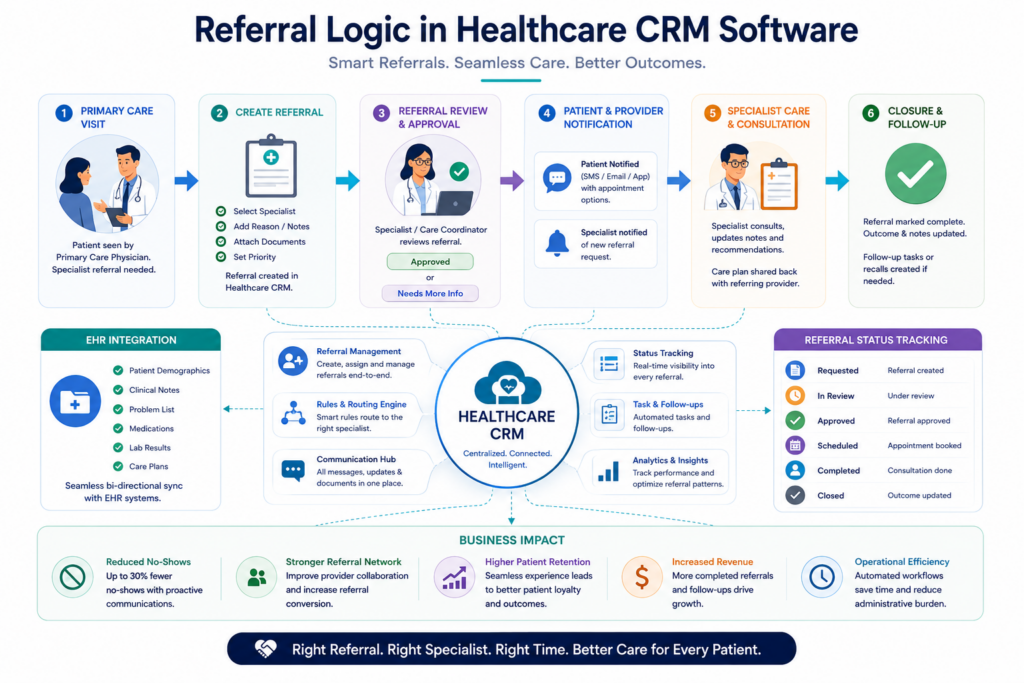
If referral tracking and patient acquisition are central to daily operations, confirm the platform handles multi-provider referral chains, not just single point handoffs.
Some platforms only track a referral as a single event rather than following it through consults, treatment, and follow-up care, which limits how useful the reporting will be for a specialty group.
Ask for a named implementation contact and a realistic go-live timeline in writing, not a generic sales promise.
Find out what happens after the first ninety days, since support quality often drops once the contract is signed and the account moves from sales to a general support queue.
A custom healthcare CRM software solution is the strongest choice when standard platforms cannot support unique referral workflows, compliance requirements, or legacy system integrations.
In the build vs buy healthcare CRM decision, a custom build replaces recurring license fees with a solution designed specifically around your organization's processes.
Key Features:
Best For: Healthcare organizations with non-standard workflows, complex compliance needs, or specialized integration requirements.
Salesforce Health Cloud is a leading healthcare CRM software platform for organizations that already use Salesforce as their core business system.
It offers extensive customization, enterprise-grade scalability, and deep integration across departments, although implementation typically requires experienced administrators or certified partners.
Key Features:
Best For: Healthcare organizations already invested in Salesforce that need a scalable, highly customizable CRM.
Klara focuses on patient communication and is one of the fastest healthcare CRM software solutions to deploy for mid-size practices.
It prioritizes messaging, appointment coordination, and patient engagement over complex referral management.
Key Features:
Best For: Single-location and mid-size practices focused on improving patient communication.
Kyruus Health is designed for healthcare organizations that manage complex provider networks and referral pathways. While it includes patient engagement CRM capabilities, its primary strength lies in accurate referral routing and provider matching.
Key Features:
Best For: Multi-specialty groups and health systems with complex referral workflows.
NRC Health / Loyal specializes in patient access and experience management for enterprise healthcare systems.
Its healthcare CRM software combines engagement tools with analytics that help organizations improve patient satisfaction across multiple facilities.
Key Features:
Best For: Large hospital networks focused on patient experience and operational insights.
When properly configured, HubSpot can serve as an affordable healthcare CRM software option for smaller practices.
While additional work is needed to meet healthcare compliance requirements, it provides a lower-cost entry point than most enterprise platforms.
Key Features:
Best For: Smaller healthcare practices transitioning from spreadsheets or basic CRM systems.
Patoliya Infotech develops healthcare CRM software tailored to your organization's referral workflows, compliance requirements, and operational processes instead of forcing your team to adapt to generic platforms.
Book a free consultation to determine whether a custom healthcare CRM solution is the right fit for your organization.
The decision of build vs buy healthcare CRM comes down to fit. Standard referral and engagement workflows call for licensed healthcare CRM software like Klara or a configured HubSpot instance. Complex referral networks or unusual compliance needs call for a custom build. Either path should include a signed BAA and a clear integration timeline before a contract is signed.
Run the numbers on staff time saved, no-show reduction, and referral retention before comparing sticker prices alone, since the platform with the lowest license fee is not always the one with the best return once implementation and training costs are factored in.
Book a free audit with Patoliya Infotech to map out the right path for your organization.