Table of Contents
TLDR: Patient portal development in 2026 requires balancing cost, compliance, integration complexity, and long-term business goals. Healthcare organizations must evaluate build, buy, or hybrid models while prioritizing HIPAA compliance, EHR integration, patient engagement, and scalability. The right portal can improve patient satisfaction, reduce administrative burden, and generate measurable ROI.
Patient portal development is increasingly recognized as a key driver of patient engagement, retention, and care accessibility.
In 2026, over 60% of patients expect digital access to their health records, appointments, and care team before they ever step into a clinic. Organizations without a mature hospital patient portal are not just behind on technology. They are losing appointments to competitors who invested two years ago.
This guide gives leaders the decision framework, cost ranges, and technical depth to evaluate build vs. buy, understand what compliance actually requires, and calculate the return on investment for the right patient portal development investment.
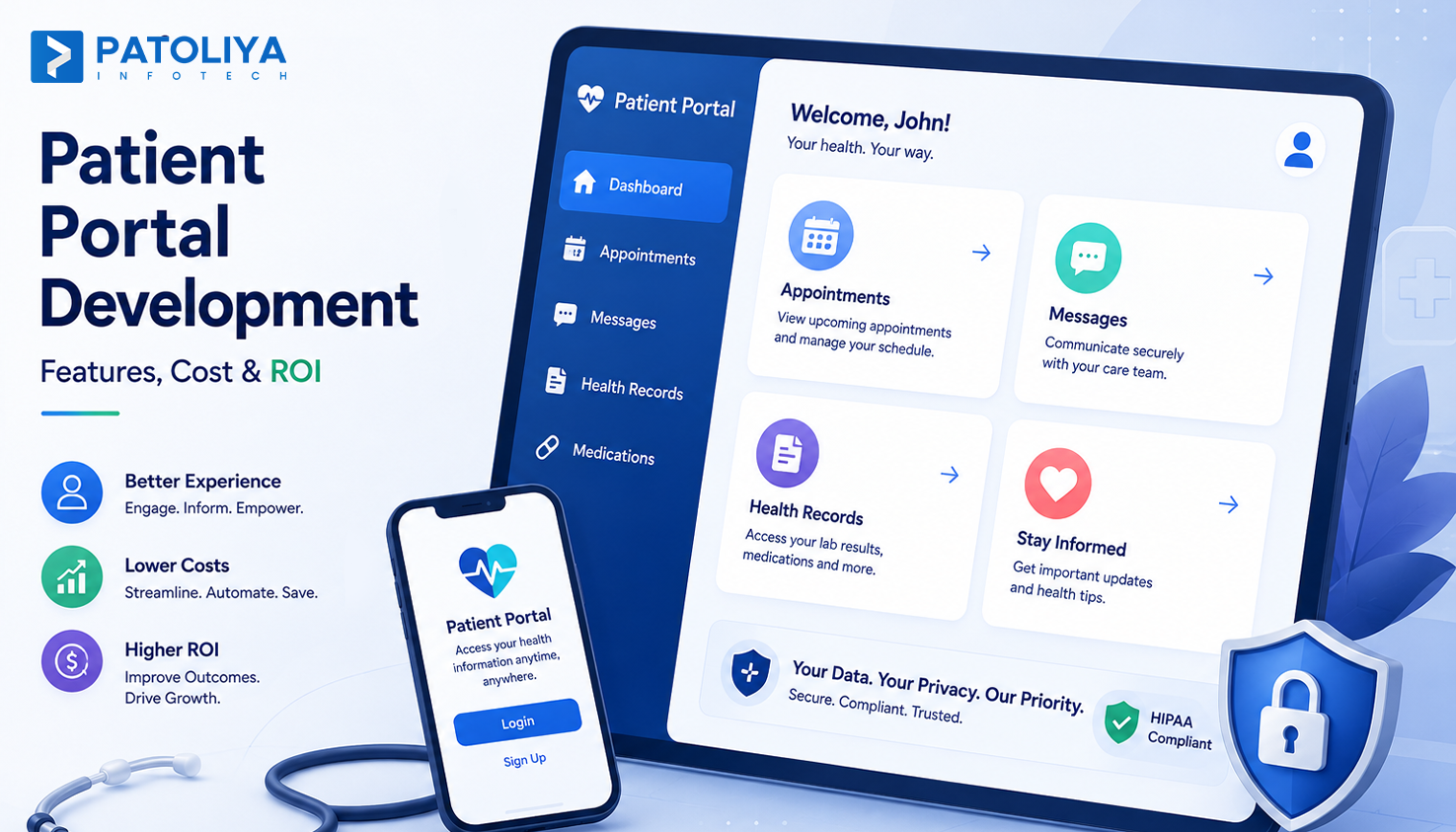
Patient portal development is the process of designing, building, and deploying a secure digital system in which patients can schedule appointments, access records, message care teams, and manage billing on a single, compliant platform.
Most executives frame this as an IT upgrade. That framing costs money.
Patient portal development is a revenue and retention decision. Your hospital patient portal is clinical infrastructure. The choice between custom vs. off-the-shelf software shapes integration depth, workflow fit, and long-term ownership.
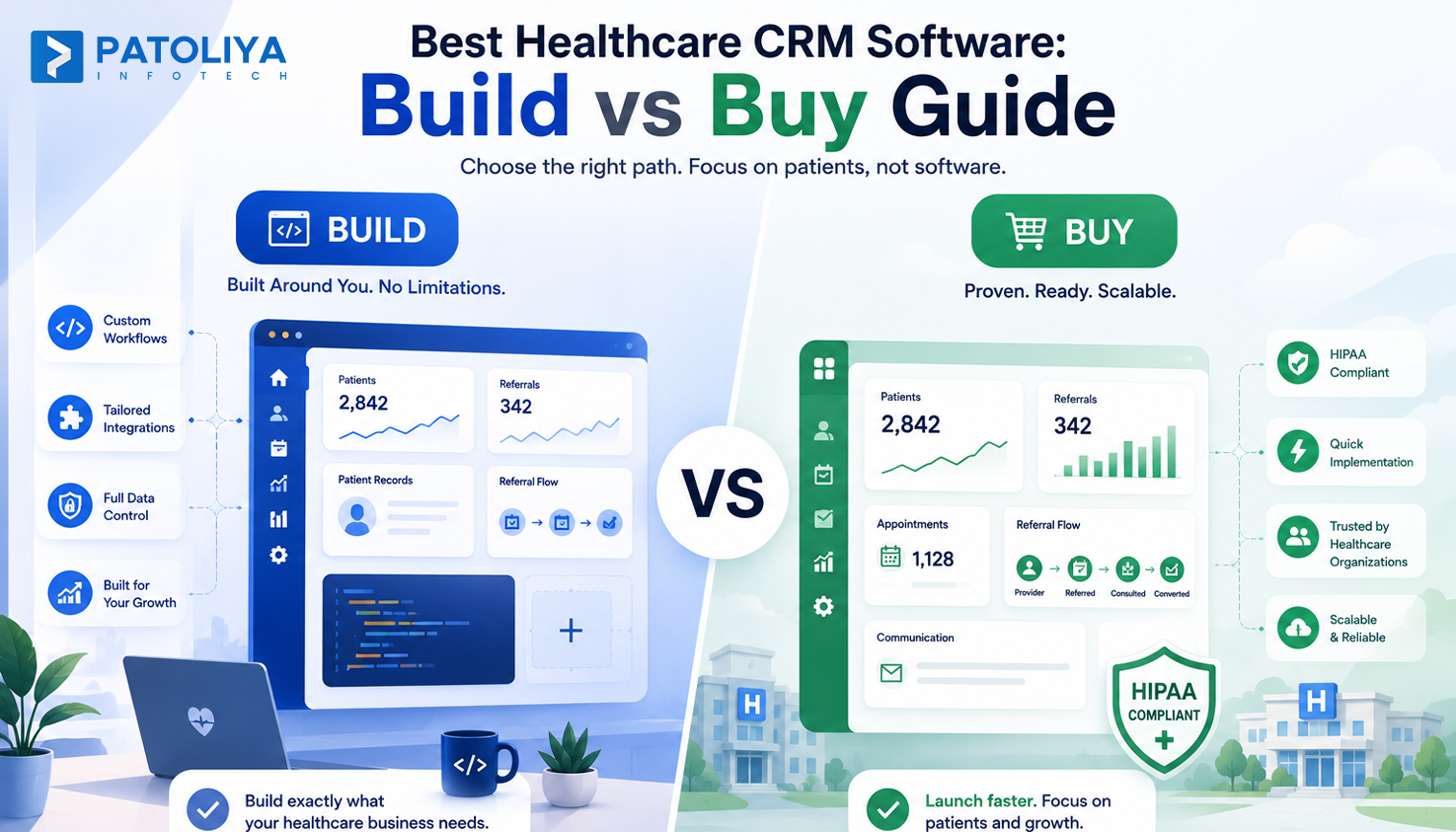
Custom patient portal development makes sense when your organization has volume, workflow complexity, or multi-EHR environments that commercial products cannot handle cleanly.
A hospital patient portal built from scratch gives you full ownership of the codebase, the data architecture, and the integration logic. You are not waiting on a vendor roadmap when your clinical workflows change.
Custom patient portal software through a custom path also creates an IP asset. Mid-market health systems have licensed their portal infrastructure to affiliated networks, generating revenue the original build cost did not anticipate.
Build when:
| Condition | Why It Matters |
| 500,000+ annual visits | Volume justifies 5-year ROI |
| Multi-EHR environment | Commercial portals rarely sync cleanly across stacks |
| Unique specialty workflows | Off-the-shelf logic will not fit |
| Long-term IP value | Ownership compounds; licensing does not |
Smaller organizations under 100,000 annual visits with a single EHR rarely need custom patient portal software. Commercial platforms deploy in 90 to 180 days and carry lower upfront cost.
The risk of patient portal development is dependency. Your hospital patient portal roadmap becomes the vendor's roadmap. That works until your clinical priorities and their product priorities diverge.
Many mid-market systems now deploy a commercial patient-facing layer with custom middleware handling EHR integration and analytics. This model compresses deployment time while preserving technical control.
Patient portal development through a hybrid approach suits organizations that need speed today and flexibility tomorrow. It is not the cheapest option, but it avoids the ceiling problem that pure off-the-shelf products create at scale.
Patient portal development decisions made under budget pressure tend to get revisited at significantly higher cost within three years. Plan the architecture for where the organization is going, not where it is today.
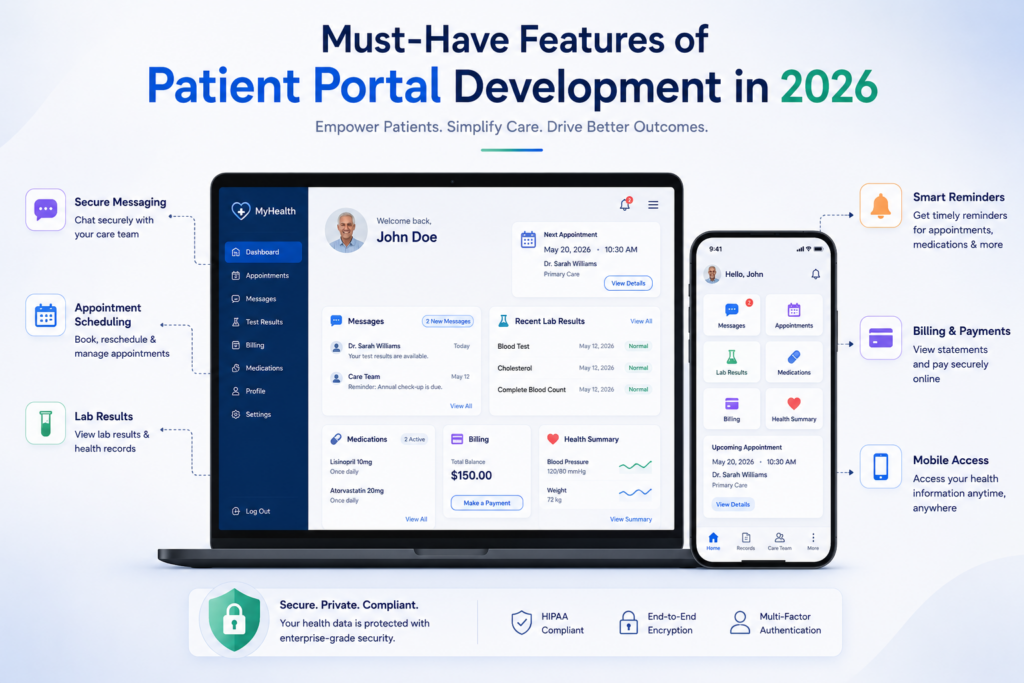
Patient portal development that skips compliance architecture and retrofits it before launch costs more and delivers less protection than building it in from day one. Organizations should review HIPAA compliance software for healthcare requirements before a single line of code is written.
Every HIPAA patient portal requires:
The HIPAA Breach Notification Rule requires covered entities to notify affected individuals within 60 days of discovering a breach.
Your hospital patient portal needs documented incident response workflows before launch: escalation paths, notification templates, and OCR reporting procedures.
For patient portal development, Organizations that treat breach response as a post-incident improvisation face regulatory penalties and reputational damage that dwarf the cost of proper preparation.
Custom patient portal software gives compliance teams direct control over the data architecture. Commercial platforms distribute that control across vendor infrastructure, which requires diligence in vendor auditing.
Patient portal development without a qualified third-party security risk assessment before go-live is an avoidable liability.
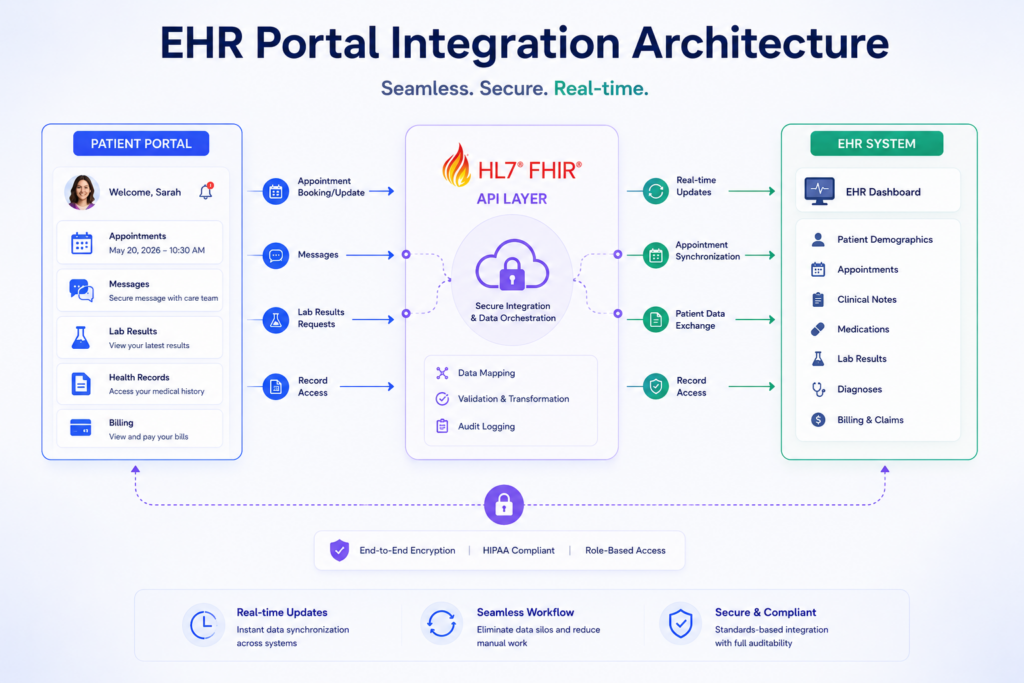
EHR portal integration is where most patient portal development projects encounter their largest cost overruns. The reason is scope underestimation: executives approve feature budgets without scoping integration complexity. A clear understanding of healthcare data integration use cases before the scoping phase directly reduces this risk.
There is a significant gap between a portal that reads a problem list via a FHIR GET request, and one that executes bidirectional write-back pushing appointment status updates, patient-reported outcomes, and care management triggers back into the EHR. The latter is where operational ROI lives. It is also where patient portal development costs accelerate.
In patient portal development, three failure patterns repeat across hospital patient portal deployments:
Batch sync presented as real-time. Many patient portal development vendors claim EHR integration but deliver 4 to 12 hour sync cycles. That gap breaks patient trust and creates clinical risk.
API version drift. EHR vendors update APIs without notice. Your custom patient portal software architecture must include version management and automated regression testing, or you will face integration breaks in production. Following established API integration best practices from the architecture phase significantly reduces this exposure.
Single integration pathway. Systems routing all EHR data through one middleware layer have no failover. Enterprise patient portal development requires redundant pathways and defined downtime protocols.
A patient portal development partner without EHR-specific track records, not just claimed FHIR expertise, is a project risk. Organizations evaluating external delivery models should understand what separates reliable healthcare IT outsourcing partnerships from high-risk vendor relationships before signing any contract.
The most damaging assumption in patient portal development procurement is that the development quote is the total cost. It rarely is.
| Organization Type | Custom Build Cost | Annual Maintenance |
| Small clinic (under 50K visits) | $80K to $250K | $20K to $50K |
| Mid-market health system | $350K to $900K | $75K to $150K |
| Enterprise hospital network | $1M to $2.5M+ | $200K to $500K |
| Academic medical center | $1.5M to $3M+ | $300K to $600K |
In patient portal development, Off-the-shelf hospital patient portal licensing runs $50,000 to $300,000 annually for enterprise deployments, with implementation fees of $25,000 to $150,000 that vendors frequently present as separate line items.
Organizations with mature hospital patient portal infrastructure consistently report no-show rate reductions of 15 to 30%, call center deflection of 20 to 35%, and patient retention improvements of 5 to 12%. At enterprise volume, those numbers represent $500,000 to $2M+ in annual recovered revenue and cost avoidance.
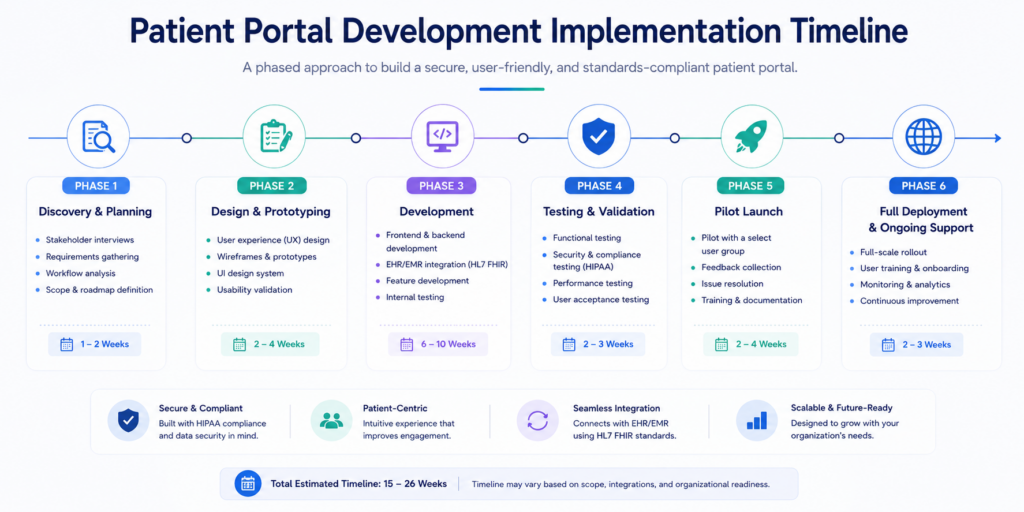
It takes 12 to 18 months for a mid-market hospital patient portal. Enterprise patient portal development with multiple EHR stacks commonly runs 18 to 24 months.
The single most common delay is EHR vendor sandbox provisioning. Epic and Oracle Health environments typically take 6 to 12 weeks to access. Build that into your schedule before contract execution of patient portal development.
Custom patient portal software projects that bypass pilot launch and go straight to full deployment amplify risk. A controlled rollout to a small patient cohort surfaces integration issues and UX problems at a recoverable scale.
Technical competence is baseline. These are the variables that differentiate partners who deliver sustainable infrastructure from those who deliver a launch event:
EHR-specific integration track record. Ask for production reference cases on the exact EHR you run. Claims of FHIR expertise should be backed by documented healthcare integration projects and production deployment experience.
Pricing model transparency. Partners who resist fixed-fee commitments on a well-scoped patient portal development engagement transfer financial risk to you throughout the project. A qualified partner scopes with sufficient confidence to commit to ceiling costs.
Post-launch SLA. Minimum 99.9% uptime guarantee with defined incident response windows. Anything less is a negotiation gap for patient portal development.
Codebase ownership. You must own the code and documentation at project close. Any custom patient portal software engagement that does not explicitly transfer IP ownership creates long-term dependency.
Compliance documentation process. A partner who delivers hospital patient portal infrastructure should arrive with their HIPAA framework already documented, not build it during your project of patient portal development.
Patoliya Infotech helps healthcare organizations build secure, scalable, and compliant patient portal solutions tailored to their unique workflows. Our expertise in patient portal development enables providers to create digital experiences that improve care delivery, patient satisfaction, and operational efficiency.
Whether you are a clinic, specialty practice, or hospital network, we build solutions that enhance patient engagement, streamline operations, and support sustainable growth through strategic patient portal development.
Patient portal development is a strategic investment in patient experience, operational efficiency, and long-term healthcare growth. The right decision between building, buying, or adopting a hybrid model depends on your organization's scale, workflow complexity, integration requirements, and future goals.
The success of patient portal development depends not only on feature selection but also on compliance readiness, integration depth, patient adoption, and ongoing support. Organizations that plan their portal architecture carefully today position themselves for stronger patient retention, improved clinical workflows, and greater competitive advantage.
Whether implementing a new hospital patient portal or modernizing existing systems, healthcare providers that invest strategically in custom software development services today will be better prepared for the increasingly digital healthcare landscape of 2026 and beyond.