Table of Contents
TLDR: Healthcare workflow automation is the operational shift U.S. hospitals are prioritizing in 2026. Facilities automating even two core workflows report measurable drops in administrative labor and claim denial rates. The technology is ready. The question is which workflows your facility tackles first.
Hospitals eliminate costly administrative challenges that delay the path from care delivery to reimbursement through healthcare workflow automation. In 2026, healthcare workflow automation has evolved from an experimental initiative into a strategic investment that improves operational efficiency, financial performance, and care delivery outcomes.
AI models can now reliably process clinical language. FHIR R4 APIs enable interoperability across healthcare systems. At the same time, increasing payer complexity has turned manual processing into a financial burden rather than a simple operational inefficiency.
This guide on Hospital workflow automation covers the 10 workflows hospitals are actively automating, what each one costs to run manually versus automated, and how to select the right implementation model of Clinical process automation for your environment.
Healthcare workflow automation uses AI models, rules engines, and API integrations to execute repeatable clinical and administrative tasks without manual input at every step. Hospital workflow automation transfers data across disconnected systems, including EHRs, payer portals, scheduling platforms, and lab systems, while escalating only exception cases that require human review.
An EHR stores and manages records. Health IT Workflow Automation orchestrates workflows across systems, departments, and applications beyond the EHR itself.
Clinical process automation covers care delivery workflows: documentation, triage, discharge coordination. Administrative automation covers billing, credentialing, scheduling. Mature implementations run both simultaneously.
The category sits at the intersection of hospital workflow automation, EHR workflow integration, and applied machine learning.
Healthcare workflow automation delivers value across four operational layers. Each layer removes a specific category of manual work your staff is currently absorbing.
| Layer | What It Does | Manual Work It Replaces |
| Data capture | AI medical coding, ambient note generation | Chart review, manual code entry |
| Routing | Task assignment, escalation triggers | Coordinator calls, email chains |
| Decisioning | Prior auth rules engines, scheduling logic | Staff judgment on routine cases |
| Compliance documentation | Audit trails, BAA tracking, access logs | Manual log maintenance |
Clinical documentation AI sits inside the data capture layer and drives the highest-volume ROI in most deployments. As patient volumes grow, manual processes become a major barrier to operational efficiency and care quality.
The practical point most vendors skip: for healthcare workflow automation, value does not come from any single capability. It comes from connecting all four layers without creating new manual handoff points between them.
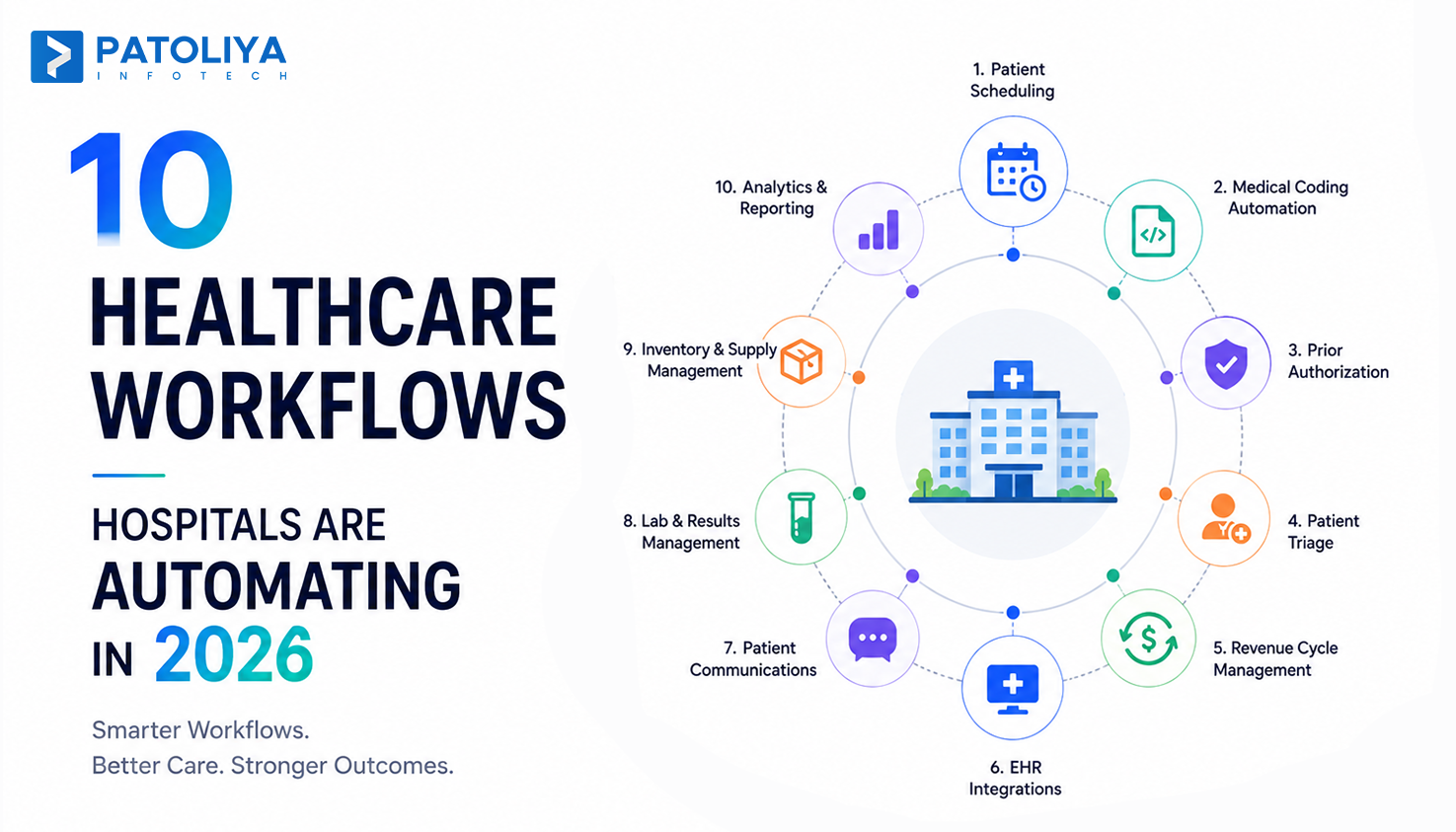
Healthcare workflow automation works best on high-volume, rules-driven processes with clear decision criteria. These ten workflows meet that standard and are actively running in health systems today.
Prior authorization automation removes the manual submission cycle from physician and coordinator workloads. Rules engines pull clinical criteria directly from EHR records, match them against real-time Electronic Prior Authorization payer requirements, and submit without staff intervention on standard cases.
The real advantage of healthcare workflow automation is ensuring the same process is executed correctly every time. Manual prior auth introduces errors at the data entry stage. Through clinical process automation, Automated submission eliminates that entry point. Complex cases still route to staff, but routine requests clear without touching a human queue.
AI medical coding reads clinical documentation, assigns ICD-10 and CPT codes, and flags deficiencies before claims reach billing. AI medical coding analyzes clinical documentation, suggests ICD-10 and CPT codes, and helps reduce coding errors before claims are submitted.
As part of healthcare workflow automation, Clinical process automation applied to coding tightens the gap between care delivery and accurate reimbursement. Facilities that deploy it see cleaner claims from the first submission, which means faster payment and fewer appeals consuming staff time.
Patient scheduling automation handles booking, reminders, waitlist backfill, and cancellation management without any coordinator involvement on routine appointments. Hospital workflow automation and Integration with live EHR availability data means the system books against real capacity.
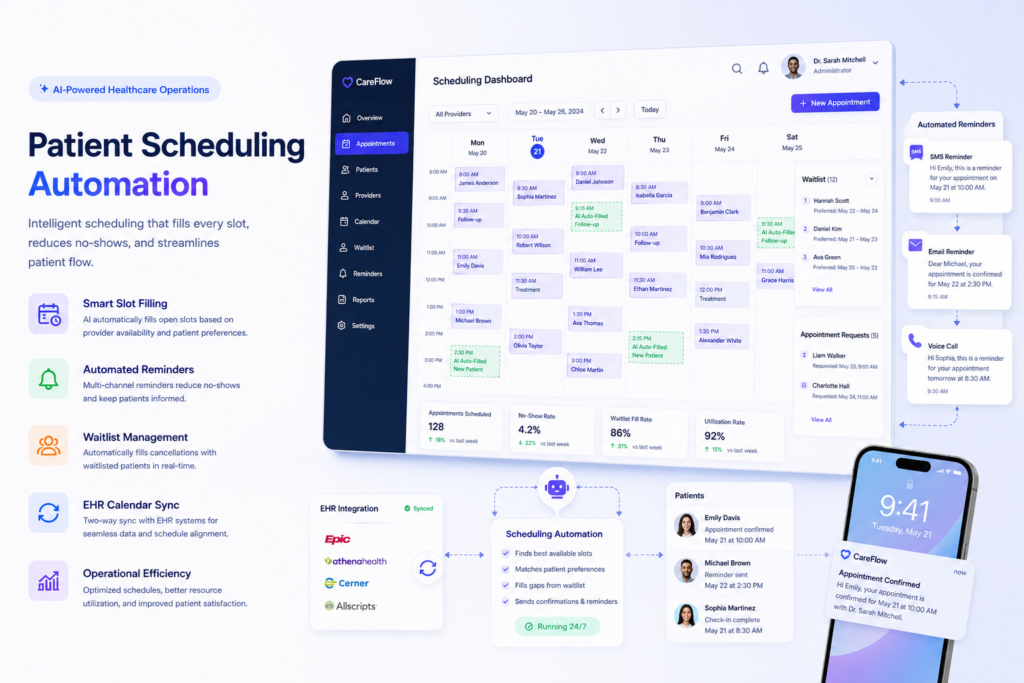
A key advantage through healthcare workflow automation is maximizing the use of open scheduling slots. Cancelled slots that previously went unfilled get automatically offered to the next eligible patient. At scale, that recovers meaningful appointment volume every week.
Ambient AI listens to clinical encounters, generates structured notes, and pushes them to the EHR for physician review and signature. Clinicians validate and finalize the generated note, ensuring accuracy and oversight.
This is where healthcare workflow automation creates the most immediate staff satisfaction improvement. Documentation burden is a primary driver of physician burnout. Clinical process automation removes workflow inefficiencies, and staff do not need to work faster.
In healthcare workflow automation, Revenue cycle automation covers eligibility verification, charge capture, claim scrubbing, submission, denial management, and payment posting. Each step is a manual bottleneck in facilities still running legacy revenue cycle processes.
Front-end eligibility verification, when automated, removes a significant source of preventable denials before claims ever reach a payer. That is where most facilities see their first measurable financial return after deployment for healthcare workflow automation.
Radiology prior authorization automation is a separate workflow category because imaging payer criteria update more frequently than general medical authorization rules. Dedicated healthcare workflow automation handles real-time criteria changes without requiring staff retraining every time a payer updates its policy.
Imaging departments running hospital workflow automation for prior auth reduce the volume of peer-to-peer review requests, which is where the heaviest physician time investment sits in radiology workflows.
An automated triage system scores incoming patients against acuity criteria, routes them to appropriate care pathways, and triggers resource allocation in real time. It supports triage nurses rather than replacing their clinical judgment on complex presentations.
As part of healthcare workflow automation, Clinical process automation in the ED improves door-to-provider time by removing the manual data entry and paper-based scoring steps that slow initial assessment. Faster triage directly affects patient outcome metrics and CMS performance scores.
Clinical Supply Chain and Inventory Automation tracks par levels, generates purchase orders at predefined thresholds, and matches supply consumption to procedure schedules. Through clinical process automation, Inventory management shifts from continuous manual checking to automated monitoring with exception-based intervention.
Facilities running automated supply chain workflows gain better utilization data, which reduces emergency purchasing. Emergency purchasing consistently carries a cost premium over planned procurement.
Hospital workflow automation for staff scheduling accounts for certification requirements, overtime regulations, union agreements, and patient acuity projections simultaneously. Manual schedulers working with spreadsheets cannot hold all those variables without errors.
Scheduling systems that reduce chronic overtime and improve shift equity affect nursing retention directly. The real ROI of Healthcare workflow automation lies in retention; the cost of replacing a skilled RN can be multiple times higher than the annual cost of a scheduling automation solution.
Discharge planning automation coordinates post-acute placement, transportation, medication reconciliation, and follow-up scheduling from a single workflow trigger at the point of discharge decision.
Uncoordinated discharges drive readmission rates. For health systems under value-based contracts, clinical process automation or Healthcare workflow automation applied to discharge planning directly reduces the penalty exposure that comes with preventable readmissions.
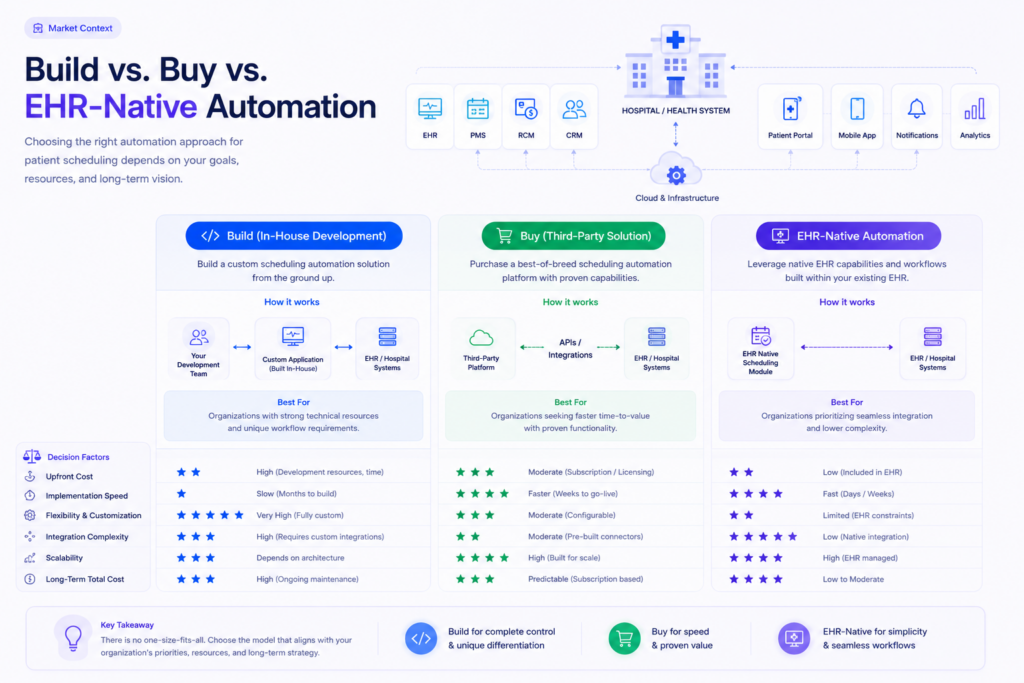
Build vs. Buy vs. EHR-Native Automation procurement comes down to three models. Selection of the wrong one adds cost and delay before a single workflow goes live.
Build: Custom development through a partner. Full control, deep EHR workflow integration, longer timeline. The right choice of Healthcare workflow automation for complex multi-system environments or workflows your EHR vendor cannot support natively.
Buy: Purpose-built SaaS platforms. Faster deployment, standardized integrations. Healthcare workflow automation works well when your workflows match the vendor's standard configuration, and your EHR version is on their certified list.
EHR-native: Automation modules built into Epic, Oracle Cerner, or Meditech. Lowest integration friction. Highest vendor lock-in risk and slowest capability update cycle.
The honest reality: most hospitals over 200 beds end up with a hybrid. SaaS for revenue cycle and scheduling, custom builds for the workflows where no platform fits their EHR environment cleanly.
Hospital workflow automation decisions should start with workflow complexity, not vendor preference. Platform selection comes second.
Healthcare workflow automation pricing varies significantly because workflow count, EHR complexity, and integration depth each affect cost independently.
| Model | Annual Cost Range | Best Fit |
| Single-workflow SaaS | $45,000 to $120,000/yr | Community hospitals, single-department use |
| Multi-workflow SaaS | $85,000 to $380,000/yr | Mid-size health systems, 150 to 400 beds |
| Custom build | $180,000 to $500,000+ | Complex EHR environments, proprietary workflows |
| Per-provider licensing | $1,200 to $4,800/provider/yr | Documentation AI, credentialing tools |
Revenue cycle automation typically carries the highest licensing fees but also the most direct and measurable ROI offset through denial reduction.
Hidden costs hospitals consistently underestimate: interface engine licensing, clinical validation time, and staff change management. These are standard implementation overhead. Any vendor of Healthcare workflow automation that does not include them in a project estimate is underquoting to win the contract.
Healthcare workflow automation ROI shows up in four places: labor cost reduction, denial rate improvement, readmission penalty avoidance, and supply spend efficiency. These are not soft metrics. They appear on financial statements.
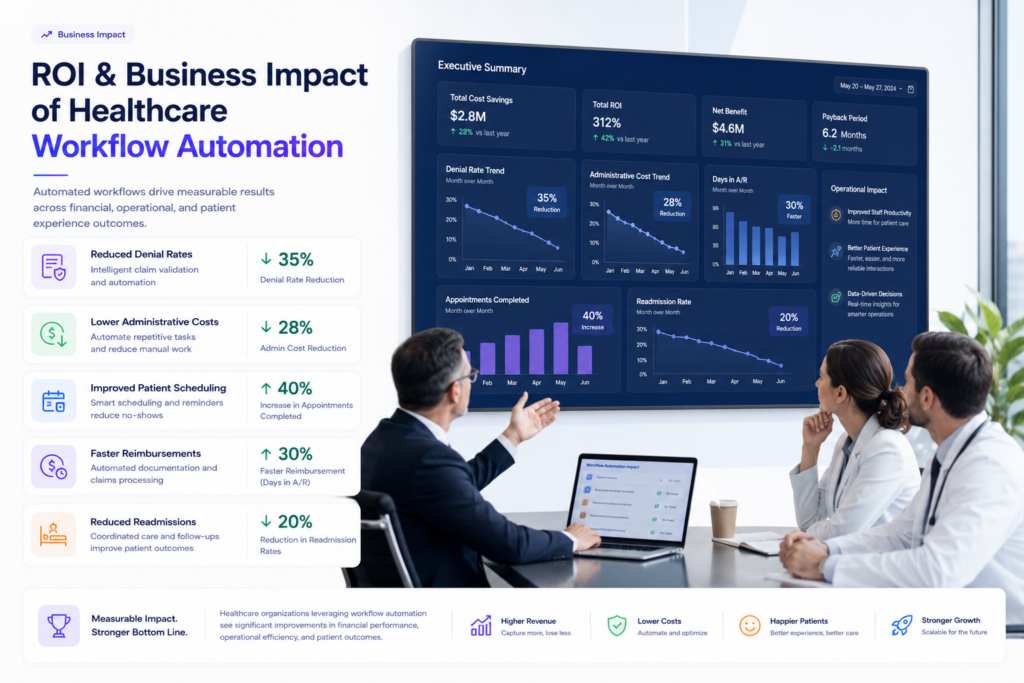
What facilities report after deployment:
Prior authorization automation: Significant reduction in coordinator hours per request, with routine cases clearing without manual touchpoints.
AI medical coding: Fewer first-pass claim denials due to cleaner documentation-to-code matching before submission.
Patient scheduling automation: Recovered appointment volume through automated waitlist management on cancellations.
Discharge automation: Measurable improvement in 30-day readmission rates for value-based contract populations.
The compounding effect matters most in Clinical process automation. A hospital running healthcare workflow automation across four connected workflows removes handoff friction that single-workflow deployments cannot address.
Healthcare workflow automation fails most often at integration, not at the technology layer. The platform functions. The EHR connection does not.
Top implementation risks:
EHR version mismatch: Vendors demo on current builds. Your facility may run an older version. Certified integration is version-specific, not platform-generic.
Scope expansion: Starting with five workflows when one clean deployment is the right entry point.
Clinical validation gaps: Automated outputs require documented physician sign-off protocols. Skipping this creates compliance exposure.
Staff workarounds: Teams bypassing automation revert the ROI faster than any technical failure.
Hospital workflow automation projects with a dedicated clinical champion and phased rollout plan consistently outperform those treated as pure IT deployments.
Healthcare workflow automation vendor selection requires clinical and technical validation.
Before signing any contract:
Healthcare workflow automation vendor fit depends on workflow type, EHR environment, and whether you need a standard platform or a custom build. No single vendor of Clinical process automation covers every use case.
Cloud-native revenue cycle automation platform built for mid-size to large health systems managing high denial volumes and complex payer environments.
Best for: Health systems prioritizing revenue cycle automation and denial reduction at scale.
Pricing: $45,000 to $380,000/yr.
An AI-powered clinical documentation and coding platform embedded across more U.S. hospitals than any competitor in the healthcare workflow automation category.
Best for: Large IDNs already running Microsoft infrastructure needing documentation and coding automation through Healthcare workflow automation.
Pricing: Per-encounter licensing.
An ambient documentation platform purpose-built for physician note generation, reducing documentation time without changing clinical workflow through hospital workflow automation.
Best for: Health systems targeting clinical documentation AI as their first automation layer in Healthcare workflow automation.
Pricing: $1,500 to $4,000/provider/yr.
A patient scheduling automation and intake platform serving over 2,600 healthcare organizations through an API-first cloud architecture.
Best for: Mid-size facilities deploying Healthcare workflow automation for scheduling and patient intake first.
Pricing: $3 to $8/patient intake.
A provider credentialing automation platform handling licensing, payer enrollment, and compliance tracking for health systems managing large provider networks.
Best for: Health systems and MSOs needing clinical process automation specifically for provider credentialing and enrollment for any healthcare workflow automation.
Pricing: $1,200 to $4,800/provider/yr.
A custom healthcare IT development firm delivering hospital workflow automation for health systems where standard SaaS platforms hit integration limits.
Best for: Health systems needing custom clinical process automation builds that no catalog platform can configure.
Pricing: Custom-scoped engagement based on workflow count and EHR complexity.
Healthcare workflow automation built around your EHR environment, not a demo stack.
Patoliya Infotech delivers custom hospital workflow automation for health systems where off-the-shelf platforms hit integration limits. Every engagement starts with workflow scoping before any technology is selected.
What makes the engagement different:
Schedule a technical scoping call to map your highest-cost manual workflow to a build estimate.
Healthcare workflow automation has evolved from pilot projects to enterprise-wide implementation. Health systems running automated workflows are posting real reductions in administrative labor, denial rates, and readmission exposure. The facilities still running manual prior auth and paper-based triage are absorbing costs that automated competitors have already eliminated through Clinical process automation.
Identify your highest-cost manual workflow, put a real annual labor number on it, and run a scoped feasibility assessment before selecting a platform or partner. Book a consultation with Patoliya Infotech to start that process today.