Table of Contents
A product can launch successfully, yet begin to struggle under growth when the underlying codebase was never designed for scale. This is where product engineering becomes essential. As demand increases, performance issues surface, releases slow down, and teams are forced into reactive fixes that impact long-term stability.
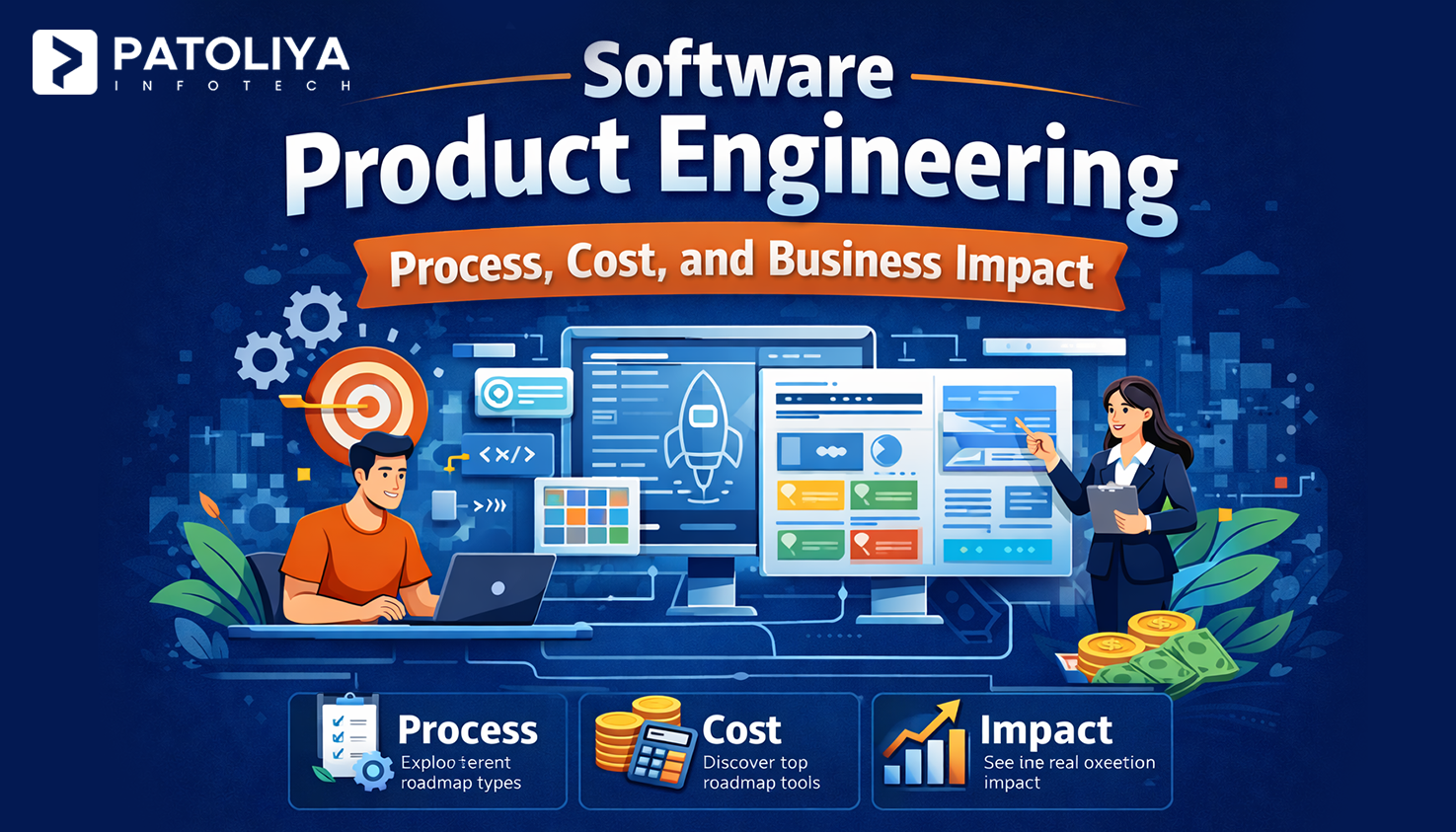
The global product engineering services market has already crossed $1.3 trillion in 2025, according to a recent global product engineering market report. Yet most organizations still treat the product engineering process as a synonym for sprints. Software product engineering connects architecture decisions, performance benchmarks, security posture, and experience continuity into one accountability chain.
In this content, we will cover a comprehensive view that includes processes, cost benchmarks, potential risks, vendor evaluation criteria, and build model comparisons.
Product engineering is the complete technical process of designing, building, validating, and maintaining a software product with commercial intent. It covers architecture decisions, performance benchmarks, security posture, and user-centered design continuity across the product lifecycle management chain. Teams that treat the engineering process as feature delivery consistently miss scale milestones and accumulate technical debt before their first enterprise deal closes.
Software development focuses on delivering code, while the product engineering process is driven by measurable business outcomes. Software product engineering owns post-launch user behavior data, iterates against business KPIs, and ties every architecture decision to retention, conversion, and infrastructure cost. A sprint is not closed until performance benchmarks hold under projected load.
| Factor | Software Development | Product Engineering |
| Scope | Feature delivery | Full technical lifecycle |
| Ownership | Code completion | Business outcome |
| Lifecycle Involvement | Build phase only | Discovery through post-launch |
| Cross-functional Integration | Limited | Product, design, data, DevOps |
Product development covers the full commercial lifecycle: strategy, market launch, and positioning. Software engineering is the technical execution layer within that lifecycle.
| Function | Product Development | Product Engineering |
| Team | Strategy, marketing, sales | Engineering, architecture, QA |
| Output | Market-ready product | Scalable, validated codebase |
| Timeline | Full GTM horizon | Build through post-launch iteration |
The confusion between the two costs organizations time in misaligned hiring, vendor briefings that skip architecture context, and roadmaps that prioritize feature count over infrastructure readiness.
The product engineering process runs in five phases. What you are buying from a company is not just execution capacity. You are buying the judgment to sequence these correctly and the accountability for your outcomes across all five.
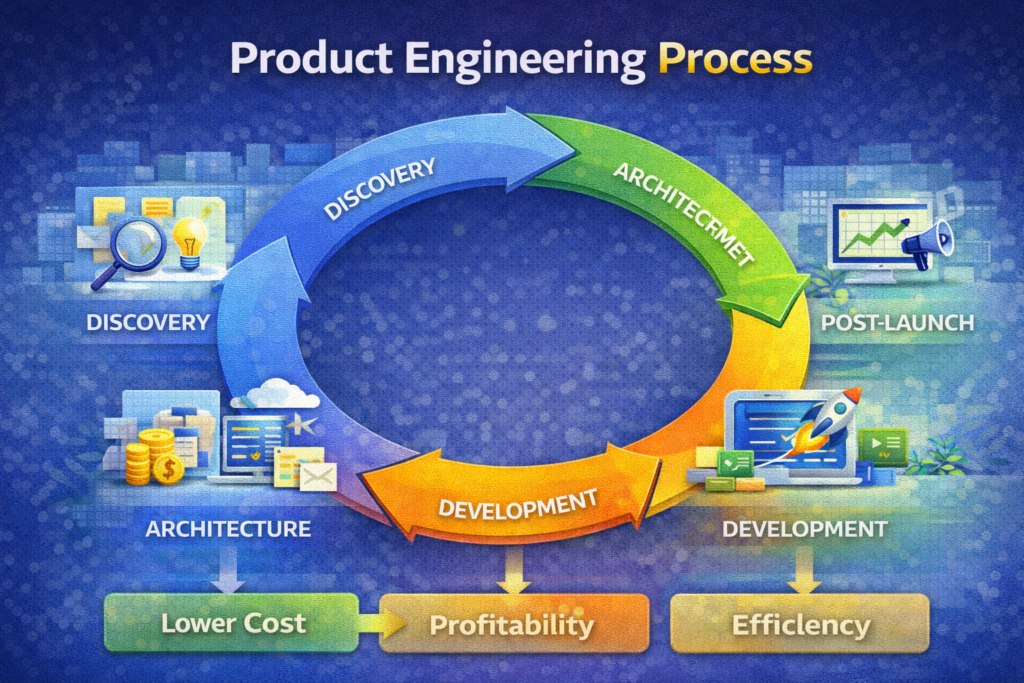
Requirements analysis, technical feasibility, user persona mapping, and business constraint review happen here. This phase determines whether the architecture conversation starts from a clean slate or inherits constraints from existing systems. Skipping Comprehensive discovery is the single most common cause of MVP scope explosions.
Scalable architecture planning, tech stack selection, API architecture, and security architecture review define the product's ceiling before a single line of production code is written. Decisions made here either compound or constrain every sprint that follows.
Agile development sprints, code reviews, and continuous integration through a CI/CD pipeline using tools like Jenkins and GitLab run in parallel. The discipline here is maintaining code quality standards, sprint over sprint, without accumulating silent debt.
Functional testing, performance testing, security audits, and compliance validation are not the final stage. In high-performing digital product engineering teams, QA runs inside every sprint. Post-sprint security audits are a sign that the process is already behind.
User analytics, feature iteration, infrastructure scaling, and product lifecycle management keep the product competitive after launch. Most engineering companies underdeliver here because post-launch accountability is rarely written into the initial contract.
Software product engineering creates measurable business value at three specific inflection points: when a SaaS development product outgrows its original codebase, when an enterprise wants to modernize without operational disruption, and when a startup needs to compress time to first revenue. Each buyer profile has a distinct failure mode that the product engineering process directly addresses.
MVP codebases cannot handle enterprise-grade load. digital product engineering rebuilds for scalable architecture before growth exposes the ceiling.
The common mistake is treating the MVP as a foundation to build on top of rather than a validated assumption to replace. Enterprise customers trigger database contention, session management failures, and API timeout chains that MVP infrastructure was never designed to absorb. Rebuilding under load is three times more expensive than rebuilding before signing the first enterprise contract.
Legacy re-engineering without product engineering process thinking creates new technical debt in a different technology stack.
The pattern repeats with a lift-and-shift migration that replicates the logic of a legacy system into a modern framework, producing a modern-looking product with legacy-era constraints baked into the data model. Software product engineering brings structured migration with zero-downtime targets and architecture reviews that challenge legacy assumptions.
Startups that outsource digital product-related engineering to specialized firms cut time-to-market by three to six months, directly impacting funding runway and investor confidence.
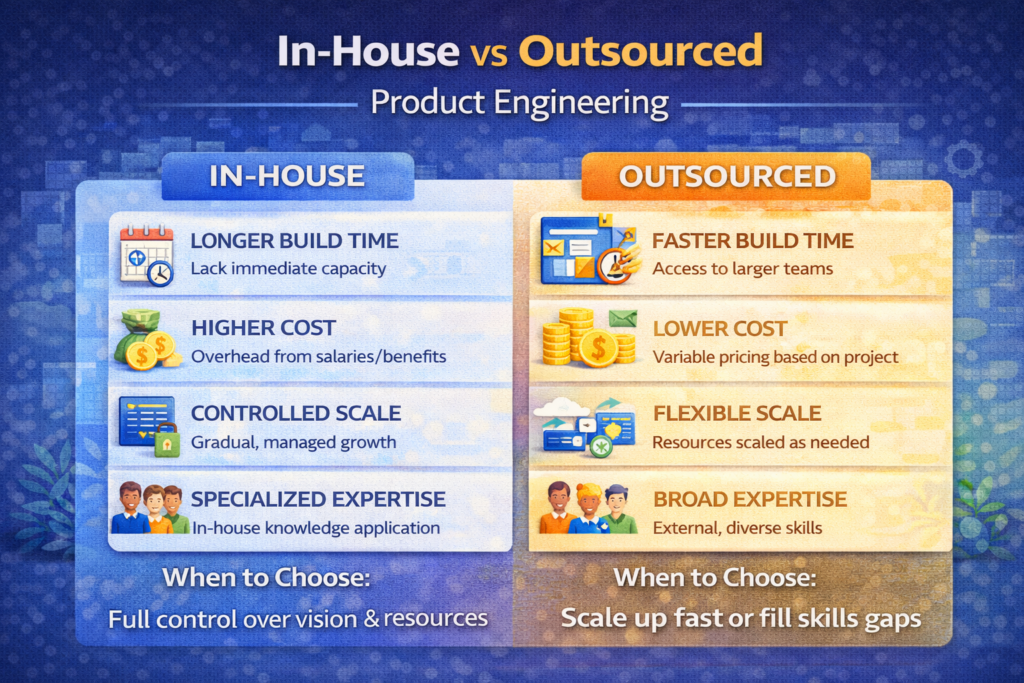
Engineering services delivered by an external partner compete on ramp speed, domain specialization, and cost structure. In-house teams compete on context depth and IP proximity. The decision depends on your specific requirements. The right answer depends on your hiring pipeline, product stage, and available capital.
| Factor | In-House Team | Outsourced Product Engineering Services |
| Build time | 6 to 18 months for the full team | 4 to 10 weeks ramp-up |
| Cost (annual) | $800K to $2M+ | $120K to $600K, depending on model |
| Scalability | Limited by hiring cycles | Flex up or down per sprint phase |
| IP Control | High | Contractually defined |
| Expertise Depth | Generalist risk | Specialized by domain |
| Risk | Internal churn, slowdown | Partner quality, communication |
When in-house makes sense: Your product requires deep proprietary knowledge, you have the runway to build a full team, and you are operating in a compliance-heavy domain where external access creates regulatory exposure.
When outsourcing makes sense: You need to ship in under six months, your internal team lacks specific domain depth, or your capital is better deployed in sales and market expansion than in a full engineering buildout.
Digital product engineering pricing depends on three variables: engagement model, geographic rate structure, and hidden cost categories that most buyers miss until month four. Getting the cost model right before signing a contract is the difference between a Software engineering engagement that delivers ROI and one that quietly erodes it.
Fixed price works best for defined-scope MVP projects in the $20K to $80K range.
Time and material suits the iterative engineering process, where the scope evolves sprint by sprint.
Dedicated team models are optimal for long-term product engineering company partnerships where team continuity matters more than individual deliverable milestones.
Buyers consistently underestimate time-and-material engagements because the contract looks lean on paper. Build a milestone-based budget ceiling into every Time and Material contract before signing.
An India-based product engineering company charges $18 to $45 per hour and represents the highest global volume of qualified software product engineering talent.
Eastern Europe runs $35 to $65 per hour with strong specialization in complex architecture.
North America rates typically range from $100 to $175 per hour, especially for projects involving strict compliance or niche technical requirements, based on recent software outsourcing rate benchmarks.
Onboarding lag, tool licensing, post-launch maintenance, knowledge transfer overhead, and integration work with existing systems routinely add 20 to 35 percent to a quoted engineering services engagement. Build these into your budget model before comparing vendor quotes.
The ROI of digital product engineering is measured in launch timing, revenue capture, and infrastructure cost at scale. Executives who evaluate a product engineering company on hourly rates miss the actual value equation.
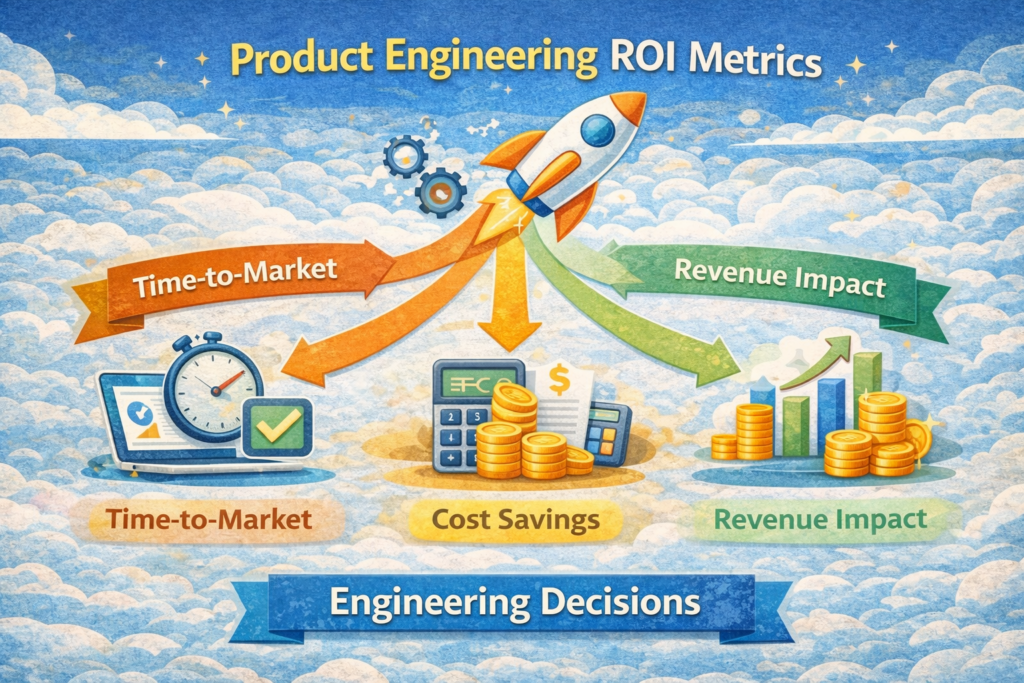
Each month of delayed launch can cost 5 to 8 percent of projected first-year revenue due to lost market share, as highlighted in a recent time-to-market impact study.
This is why companies increasingly outsource product engineering to focused partners, reducing launch timelines by 30 to 50 percent for similar projects.
In one real-world SaaS example, integrating AI features through an external engineering partner led to a 45 percent increase in user engagement and a 30 percent lift in trial conversions within just six weeks, based on a real-world SaaS growth case study.
That 45 percent engagement lift is not a result of DevOps efficiency. It reflects product-market fit, driven by architecture decisions made three sprints before launch.
In-house senior engineers in the US cost $160K to $220K annually before benefits and overhead. An India-based dedicated Product engineering company delivers comparable output at 35 to 55 percent of that cost.
The ROI formula: [(In-house cost minus Outsourced cost) / Outsourced cost] × 100, plus revenue acceleration from faster product-market fit. Most buyers run this calculation on year one costs only. Run it on a three-year horizon to see the full picture.
Every Product engineering process engagement carries predictable structural risks that should be addressed contractually upfront. Issues arise when these gaps are identified after the engagement begins.
Ensure contracts specify full IP transfer, NDA coverage, and access revocation post-engagement. Many product-related engineering services agreements default to shared IP clauses that create ambiguity when the engagement ends or when you need to bring the codebase in-house. This clause requires upfront validation during contract review, before the first delivery milestone.
Without sprint-level QA reviews and code audits, technical standards erode after month six. The first three months of a digital engineering engagement almost always reflect the vendor's best work. Mandate monthly architecture reviews and external code audits as a contractual deliverable.
Timezone overlap of fewer than three hours per day is a documented driver of delivery failures in offshore product engineering company engagements. Daily standups, async documentation standards, and escalation paths need to be defined in the statement of work, not discovered during a sprint crisis.
Evaluating a product engineering partner? Download Patoliya Infotech's vendor assessment checklist or speak directly with their engineering lead; no sales process required.
Selecting a product engineering company is a business capability decision, not a procurement exercise. Use this checklist before shortlisting any vendor.
High-performing software product engineering teams share a common tooling philosophy: every tool in the stack should reduce coordination overhead, not add it. The table below reflects the standard toolkit across Agile development teams operating at scale.
| Category | Tools |
| Development and Version Control | GitHub, GitLab, Bitbucket |
| CI/CD and DevOps | Jenkins, CircleCI, Docker, Kubernetes |
| QA and Testing | Selenium, Postman, JAMA Software |
| Product Analytics | Mixpanel, Heap, Google Analytics 4 |
| Design and Prototyping | Figma, InVision |
| Project Management | Jira, Linear, Notion |
| Cloud Infrastructure | AWS, GCP, Azure |
Tool standardization matters less than tool discipline. A team running Jenkins and Jira with clear sprint documentation outperforms a team using five premium tools with no shared process.
We handle the part of digital product engineering that most clients underestimate, which is post-MVP accountability. Their software product engineering practice is built specifically for SaaS development companies that need to move past prototype infrastructure without rebuilding from scratch mid-growth.
What we bring to a product engineering engagement:
Product engineering is a strategic capability. Organizations that treat it as a cost line consistently underperform on launch speed, scalability, and product quality. The right product engineering company brings process maturity, domain fit, and post-launch accountability. The pricing benchmarks, ROI data, and vendor checklist in this guide give you a direct framework to make that decision with confidence. Ready to scope your product engineering roadmap with clarity? Connect with our team to get a structured breakdown tailored to your product.