Table of Contents
TLDR: Event driven architecture is a design pattern where services communicate by producing and consuming events asynchronously, rather than calling each other directly. Systems built on event driven architecture handle traffic spikes without cascading failures, scale individual services independently, and maintain a full audit trail of state changes. This guide covers everything from core patterns to vendor selection.
Synchronous APIs feel clean until your order service waits on your inventory service, which waits on your warehouse service, and one slow database query takes down your entire checkout flow. That is the coupling problem event driven architecture was built to eliminate. As distributed systems grow beyond five services, synchronous request chains become the primary source of latency, outages, and deployment bottlenecks.
Event driven architecture decouples producers from consumers entirely, so each service reacts to what happened rather than asking what is happening. This guide covers how it works, where it pays off, what it costs, and how to pick the right stack for your system of Event streaming microservices.
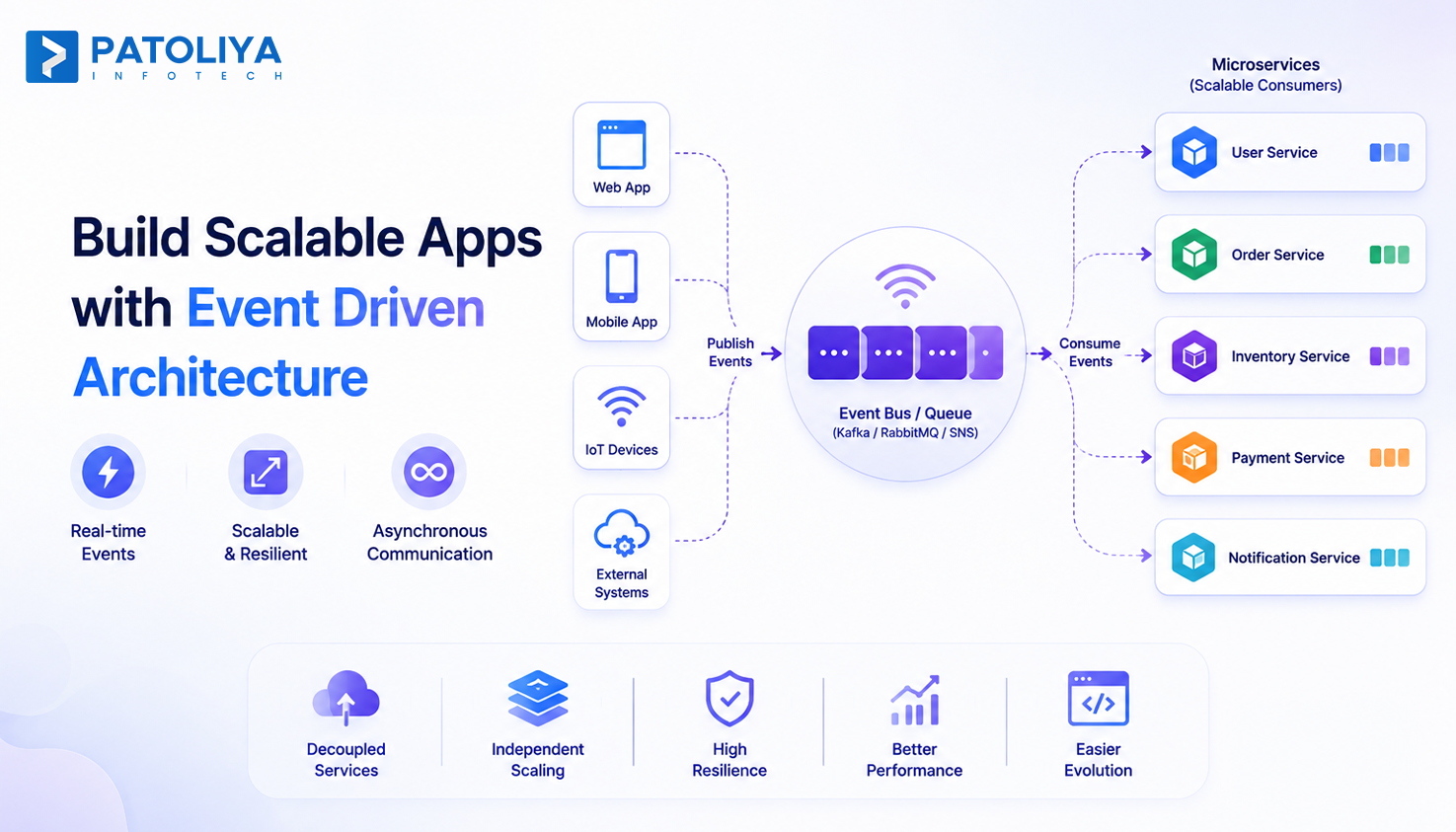
Event driven architecture is a software design pattern where system components communicate by emitting, routing, and consuming events rather than making direct synchronous calls to each other.
An event is a record of something that happened: an order was placed, a payment failed, a user logged in. The service that records that fact is the producer. The services that need to react are consumers. Neither knows the other exists.
This separation is what makes event driven architecture fundamentally different from REST-based microservices. In a REST system, Service A calls Service B and waits. In event driven architecture, Service A emits an event and moves on. Service B processes it when ready.
Three event sourcing pattern sit at the core of every event driven architecture implementation:
| Pattern | What It Does |
| Publish subscribe pattern | Routes events from producers to multiple consumers |
| CQRS event sourcing | Separates reads from writes, stores state as events |
| Asynchronous communication | Decouples timing between producer and consumer |
Understanding these patterns of Event streaming microservices is what separates teams that implement event driven architecture successfully from teams that build distributed monoliths with extra steps.
Event driven architecture handles four capabilities no synchronous system can match at scale: event routing, state reconstruction, independent scaling, and backpressure management.
Every action in the system produces an immutable event record. The message broker routes that event to every subscribed consumer through Event streaming microservices.
Producers never change their code when new consumers come online. This is the operational flexibility that makes event driven architecture worth the implementation investment.
The publish subscribe pattern means one event can trigger ten downstream reactions simultaneously. A payment confirmed event fires fraud detection, email notification, inventory reservation, and analytics ingestion in parallel.
In a synchronous system, that same flow would be a sequential chain with compounding latency.
CQRS event sourcing separates write models from read models entirely. Writes go to the event log. Reads come from a materialized view optimized for query patterns for Event streaming microservices.
This event sourcing pattern eliminates read/write contention that damages performance under high traffic.
Asynchronous communication means producers never wait for consumers. The event bus buffers events between them.
Backpressure management holds incoming events when a consumer signals capacity limits, preventing cascading failures during traffic spikes.
These capabilities of the event sourcing pattern combined are what synchronous systems cannot replicate at scale. Effective distributed engineering collaboration practices help remote teams maintain productivity across multiple time zones.
Event driven architecture earns its complexity cost when your engineering problems map directly to the four scenarios below.
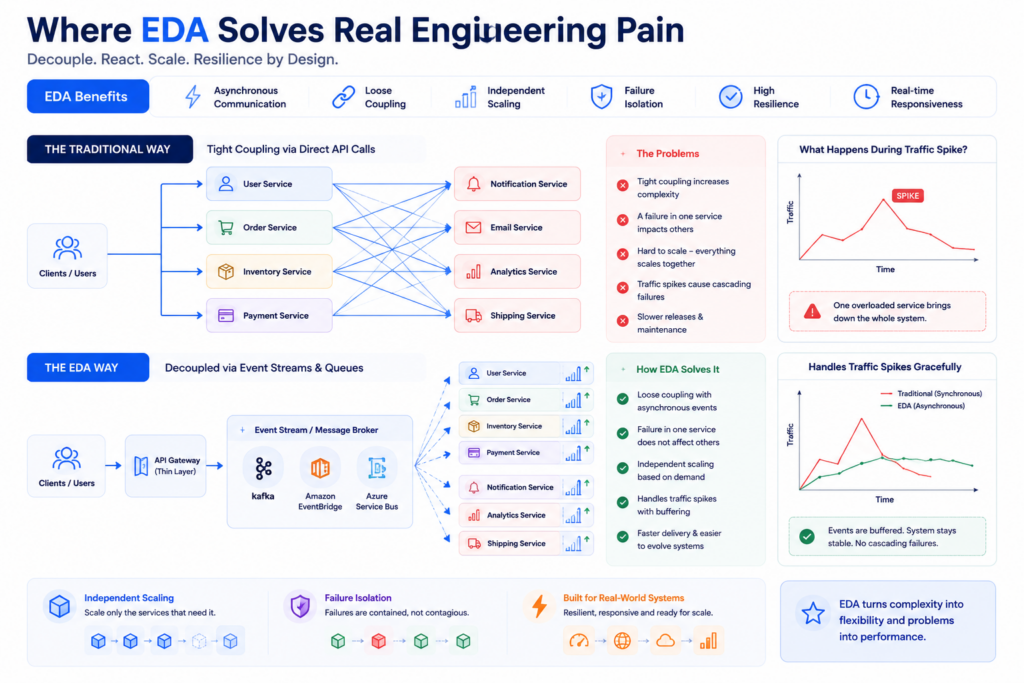
Each of these problems gets worse as your system grows. Event driven architecture addresses root causes, not symptoms. Modern Cloud Migration Services projects often rely on asynchronous architectures to reduce service dependency during infrastructure modernization.
Every architecture decision involves tradeoffs. Here is where event driven architecture wins and where it does not.
| Dimension | EDA | REST Microservices |
| Coupling | Loose | Tight |
| Latency | Eventual | Immediate |
| Fault tolerance | High | Cascading failure risk |
| Debugging | Complex | Straightforward |
| Best for | Async workflows | Request/response queries |
REST wins for simple request/response patterns. Event driven architecture wins when downstream reactions need to happen without blocking the producer. Modern software architecture patterns frequently combine synchronous APIs with asynchronous event processing.
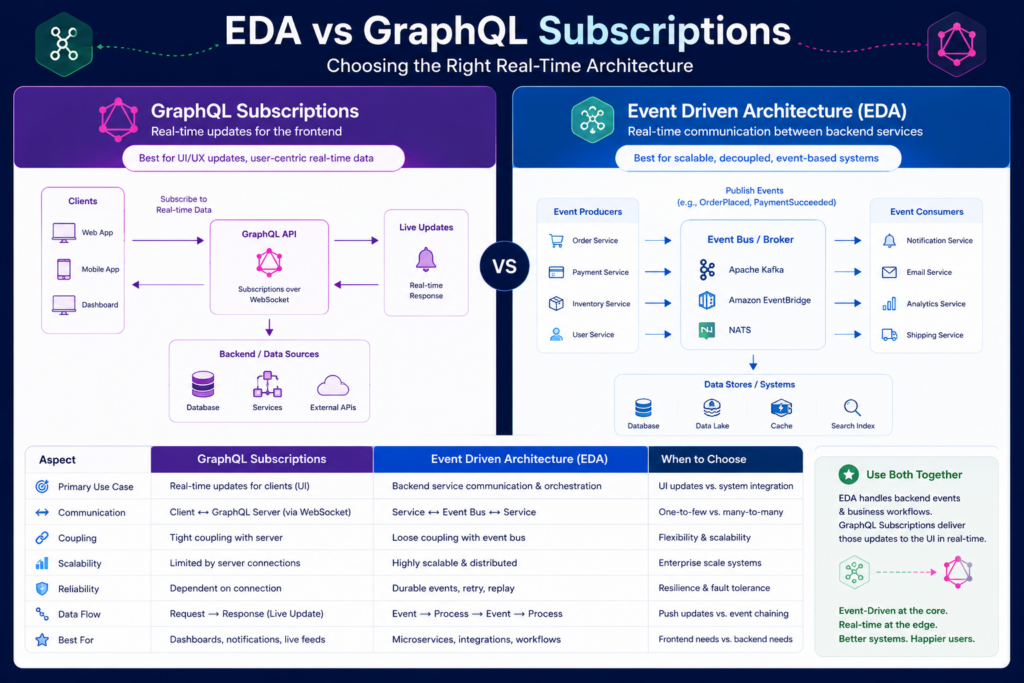
GraphQL subscriptions handle real-time UI updates efficiently. They are not a replacement for event driven architecture at the infrastructure level. GraphQL subscriptions sit at the client layer. Event driven architecture governs service-to-service communication.
Apache Kafka architecture handles millions of events per second with persistent replay capability. Traditional queues like RabbitMQ deliver and delete. Kafka vs RabbitMQ comes down to one question: do you need event replay? If yes, Apache Kafka architecture is the answer. If not, RabbitMQ is simpler to operate. Choose Event streaming microservices based on throughput and replay requirements. Teams implementing large-scale streaming systems should review the official Apache Kafka documentation for partitioning, replication, and event retention strategies.
Event driven architecture implementation costs vary significantly based on vendor choice, service count, and whether you build or buy managed infrastructure.
| Platform | Starting Cost |
| Confluent (managed Kafka) | $25,000/year |
| AWS EventBridge | Pay per event ($1/million) |
| Azure Service Bus | From $0.05/million operations |
| Google Pub/Sub | $0.04/GB processed |
| Scope | Estimated Cost |
| Basic event bus, 3 to 5 services | $15,000 to $35,000 |
| Full event sourcing pattern, 10+ services | $80,000 to $150,000 |
| CQRS with Apache Kafka architecture, 20+ services | $150,000 to $400,000+ |
Self-hosted Apache Kafka architecture requires dedicated DevOps capacity. Budget $2,000 to $20,000 per month for infrastructure, monitoring, and schema registry management, depending on throughput.
Event streaming microservices migration from a synchronous system adds 30 to 50% to greenfield estimates. Existing data contracts, service dependencies, and parallel-run validation all extend timelines.
Managed services of Apache Kafka architecture reduce operational overhead but introduce vendor dependency. Evaluate the total cost of ownership across a three-year horizon before committing.
The business case for event driven architecture is strongest when you can quantify three specific outcomes.
Event driven architecture introduces four engineering risks that synchronous systems do not have. Each is manageable with the right design decisions made upfront.
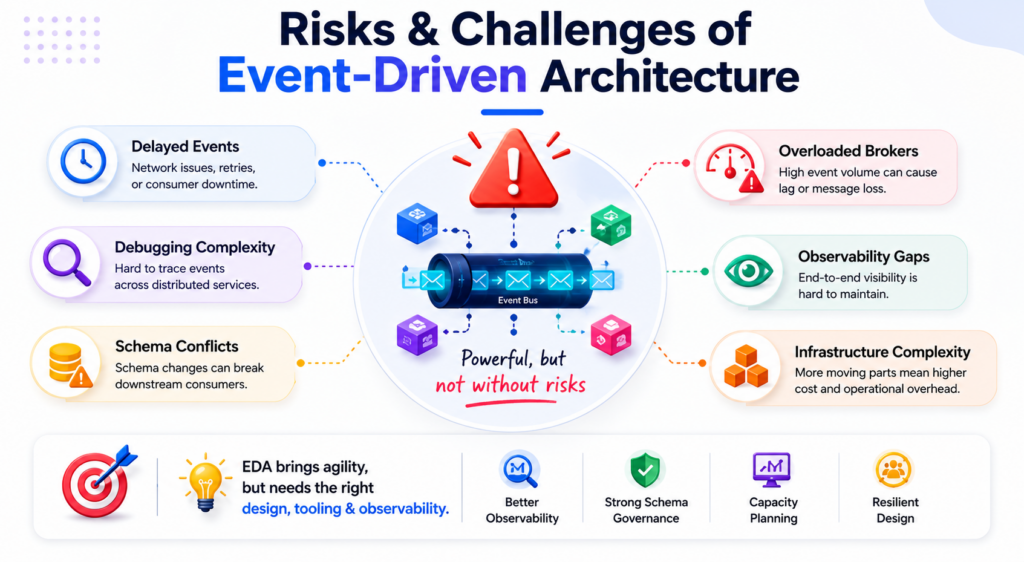
Events process asynchronously. State is eventually consistent, not immediately consistent. UI layers built on event driven architecture need to handle this gracefully. Debugging a failed workflow means tracing events across multiple consumers, brokers, and logs. Distributed tracing tooling is not optional here.
The event sourcing pattern stores events permanently. A schema change that breaks existing consumers silently corrupts downstream processing. Schema registries with backward compatibility enforcement are mandatory for any production event driven architecture deployment. Standardized event metadata using the CloudEvents specification helps improve interoperability across distributed event-driven systems.
Self-hosted brokers require monitoring, partition management, consumer lag alerting, and disaster recovery planning. Teams with an Apache Kafka architecture underestimate this until their first production incident. Large-scale broker management often requires structured DevOps Consulting practices for monitoring, deployment automation, and infrastructure reliability. Scaling event-driven systems often requires flexible resource augmentation support for distributed engineering teams.
Event sourcing pattern implementations built tightly around proprietary broker APIs are expensive to migrate. Design event schemas and consumer logic to be broker-agnostic where possible. This one decision saves significant rearchitecting cost if you change platforms later.
Every risk here is solvable. None of them are reasons to avoid event driven architecture. There are reasons to plan carefully before you build.
Selection of the right platform for event driven architecture requires evaluating ten criteria before a proof of concept begins.
| Evaluation criteria | What to Verify | |
| 1 | Throughput capacity | Events per second at your peak load |
| 2 | Event replay support | Required for the event sourcing pattern |
| 3 | Schema registry | Backward compatibility enforcement |
| 4 | Apache Kafka architecture compatibility | If migrating existing Kafka workloads |
| 5 | Managed vs self-hosted | DevOps capacity assessment |
| 6 | Multi-cloud support | Portability across AWS, Azure, and GCP |
| 7 | Consumer group management | Partition assignment and rebalancing |
| 8 | Observability integrations | Datadog, Prometheus, Grafana |
| 9 | SLA and support tier | 99.95% uptime minimum for production |
| 10 | Pricing model | Per-event vs throughput vs flat license |
The most common vendor selection mistake in event driven architecture projects is choosing the most popular platform rather than the right one. Apache Kafka architecture is not always the answer. Match vendor capabilities of Event streaming microservices to your specific throughput, replay, and operational requirements.
Patoliya Infotech designs and implements event driven architecture systems across fintech, logistics, and healthtech platforms where event ordering, compliance, and uptime are non-negotiable.
Best for: Engineering teams building or migrating to event driven architecture who need zero-downtime cutover and compliance-aware design.
Pricing: Project-based engagement.
Confluent is the managed Apache Kafka architecture platform built by the original Kafka creators. It handles schema registry, stream processing, and multi-cloud Kafka deployment in one control plane.
Best for: Teams needing enterprise-grade Kafka without operational overhead.
Pricing: From $25,000/year.
Solace is an event driven architecture platform built for hybrid and multi-cloud environments with strong financial services and IoT credentials.
Best for: Enterprises with hybrid infrastructure and multi-protocol requirements.
Pricing: Custom enterprise pricing.
AWS EventBridge is a serverless event driven architecture platform for AWS-native deployments. Zero infrastructure management with native integration across 200+ AWS services.
Best for: AWS-native teams wanting operational simplicity at low entry cost.
Pricing: $1.00/million events.
MuleSoft is an integration and event streaming microservices platform built for enterprises managing complex API and event ecosystems across multiple systems.
Best for: Enterprises in the Salesforce ecosystem managing high-volume integrations across heterogeneous systems.
Pricing: Custom enterprise pricing based on transaction volume and connector count.
Event driven architecture done wrong produces the distributed debugging nightmare it was supposed to prevent. We builds event driven architecture systems with schema governance, observability, and compliance built in from day one, not added after the first production incident. As an enterprise software development company, Patoliya Infotech builds scalable event-driven systems for distributed applications.
Here is what that looks like in practice:
If your team is evaluating event driven architecture for a new platform or planning a migration from tightly coupled services, Patoliya Infotech can scope it with you. Let's talk through your system design.
Event driven architecture solves the coupling, scalability, and audit problems that synchronous systems cannot address at scale. The implementation complexity is real, but it is a one-time investment that pays compound returns as your service count grows. Pick the vendor that matches your throughput and replay requirements. Design your schemas for backward compatibility from day one in the Apache Kafka architecture. Build observability before you go live. If you are ready to design your event driven architecture properly, let's sit down and map it out.