Table of Contents
TLDR: Zero trust security operates on one rule: verify everything, trust nothing. The old model of trusting anything inside your network is how breaches happen at scale. Most breaches are not caused by external break-ins but by compromised credentials and over-trusted access, meaning attackers often log in instead of breaking in.
Most security breaches today do not happen because attackers broke through the perimeter. They happen because the perimeter trusted the wrong thing. As workforces go hybrid and applications spread across multiple clouds, implicit trust becomes a systemic vulnerability. Zero trust security eliminates that assumption entirely: no user, device, or request gets access until it is explicitly verified.
This guide covers zero trust architecture from first principles through vendor evaluation, implementation framework, and cost structure. By the end, you will know exactly how Zero trust security works, what it costs, and how to make the business case internally.
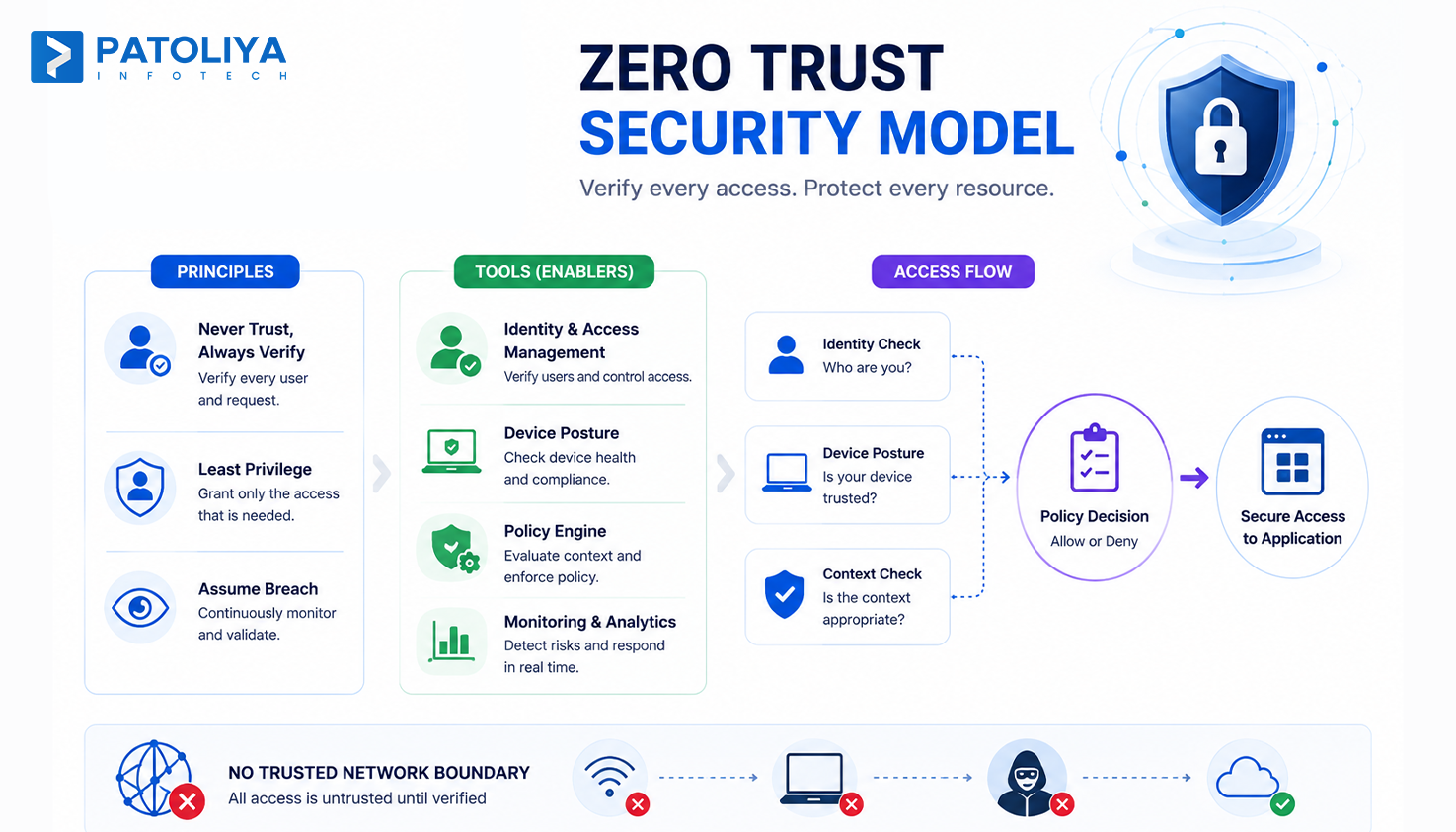
Zero trust security is an access control model that removes default trust from every user, device, and connection regardless of whether they're inside or outside your network. Every request gets verified. Every session gets authenticated. Nothing gets a free pass.
The term Zero trust security was coined by John Kindervag at Forrester Research in 2010. The core idea: network location tells you nothing about risk. A contractor on your VPN is not automatically safe. An employee's laptop at the office is not automatically clean.
Zero trust architecture structures your entire access policy around identity and context, not IP address. That shift sounds simple. In practice, it changes how you buy tools, write policies, and manage access at every layer.
Here's what most people miss: zero trust security is not a product. No vendor sells you a switch you flip on. It's a framework your organization builds toward, one workload at a time.
Zero trust security authenticates every access request in real time, not just at login. Identity, device health, location, and behavior all factor into each decision. One compromised session doesn't become an open door.
Microsegmentation divides your network into small, isolated zones. If an attacker gets into one segment, they hit a wall before reaching anything else. Traditional flat networks let attackers move sideways freely; zero trust architecture removes that path entirely.
Least privilege access means users get exactly what they need for a specific task, for a specific time. Nothing extra. A finance analyst accessing payroll shouldn't also see engineering infrastructure. Zero trust security enforces that boundary automatically. Modern resource augmentation models increase the need for centralized identity verification and secure remote access.
Zero trust network access replaces broad VPN tunnels with per-application connections. Users reach one app, not the whole network. ZTNA implementation makes this the default behavior for zero trust security.
Every device connecting to a resource gets assessed OS version, patch status, and endpoint detection. Zero trust security rejects access from devices that don't meet your defined health baseline, before the session starts.
Your firewall guards a boundary that stopped mattering the moment your first employee logged in from home. Applications now live across multiple clouds. Contractors connect from personal devices. Employees work from anywhere. Network perimeter security was designed for a world where everything important sat in one building on one network.
The perimeter is gone. What remains is a security model still built around it through zero trust security.
Implicit trust is the real exposure. Once someone gets in through stolen credentials, a VPN, or a phished account they move freely across your environment. That free movement is exactly what zero trust security removes.
| Legacy Problem | zero trust security Solution |
| VPN grants broad network access | Zero trust network access grants per-app access |
| Lateral movement after breach | Microsegmentation contains blast radius |
| Implicit trust for internal users | Continuous verification on every request |
| Static access policies | Dynamic, context-aware Zero trust network access |
| Perimeter-only controls | Identity and access management at every layer |
Hybrid work didn't create the zero trust problem, it exposed it. When 60% of your workforce operates outside the building, a location-based trust model breaks completely. Zero trust security was built for exactly this operating reality. Large-scale Cloud Migration Services often require stronger identity-aware access controls.
The BeyondCorp model from Google proved this at scale and identity verification replaced network location as the access signal. That reference architecture is now the blueprint most enterprise security teams follow.
Legacy security trusts what's inside. Zero trust security trusts nothing, ever. That's an architectural difference that affects every tool you buy and every policy you write. Most enterprise zero-trust security frameworks align their policy structure with NIST 800-207 guidance for identity-aware access control and segmentation.
Zero-trust network access removes the concept of a trusted internal network. There is no inside. There is only: verified or not verified.
| Dimension | Legacy Perimeter | Zero Trust Security |
| Trust model | Implicit inside network | Explicit per request |
| Access scope | Broad network access | Per-application |
| User verification | At login only | Continuous |
| Device checks | Rare | Mandatory |
| Lateral movement | Unrestricted | Blocked by microsegmentation |
| Cloud compatibility | Poor | Native |
| ZTNA implementation | Not applicable | Core requirement |
| Compliance alignment | Partial | NIST 800-207 mapped |
A VPN authenticates once, then grants broad tunnel access. Zero trust network access authenticates per session, per application, per context. Those are not the same thing.
VPNs also create performance problems for cloud applications traffic is forced through a central gateway instead of going direct. ZTNA implementation routes users directly to applications, which cuts latency significantly as a zero trust security.
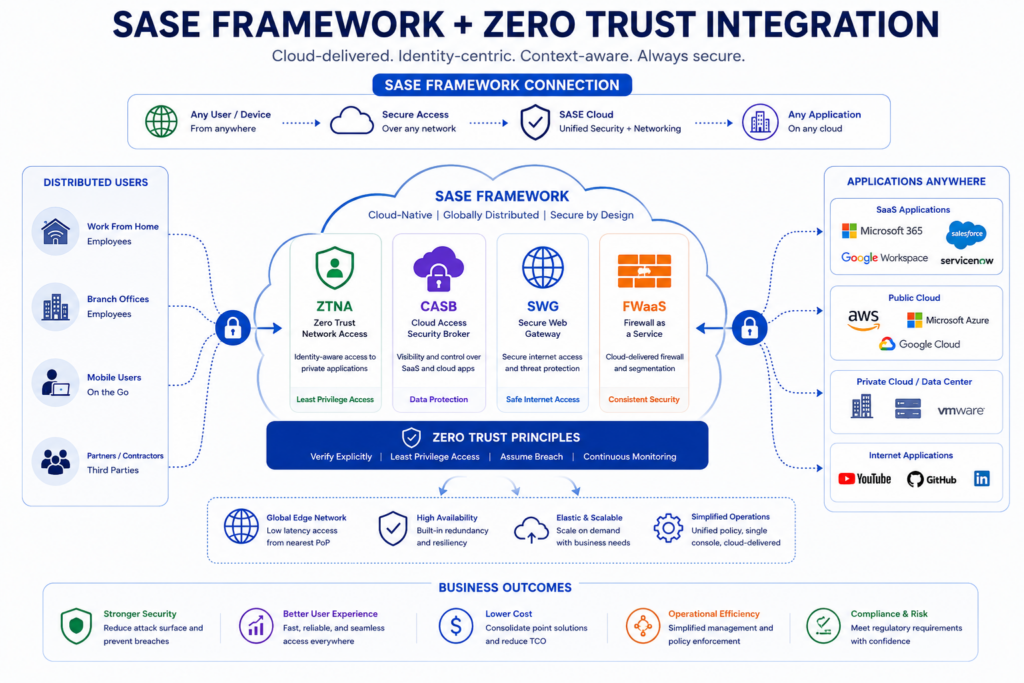
Cloud security posture management and zero trust security converge in the SASE framework (Secure Access Service Edge). Organizations implementing zero trust architecture often use DevOps Consulting to strengthen cloud-native security and deployment governance.
SASE combines zero trust network access, secure web gateway, cloud access security broker, and firewall-as-a-service into one cloud-delivered model.
For enterprises managing distributed workforces across multiple clouds, SASE is increasingly the delivery mechanism for zero trust architecture.
Zero trust security pricing varies significantly based on user count, environment complexity, and deployment model.
| Segment | Users | Estimated Cost | Typical Timeline |
| SME | 50 to 250 | $15,000 to $80,000 | 45 to 60 business days |
| Mid-market | 250 to 2,500 | $150,000 to $600,000 | 6 to 12 months |
| Enterprise | 2,500+ | $600,000 to $2M+ | 12 to 24 months |
Three factors inflate zero trust architecture project costs beyond initial estimates:
Legacy application footprint: Applications that weren't built for identity-based access need remediation before ZTNA implementation works cleanly. This is where most timelines slip.
Policy design complexity: Writing access policies for hundreds of roles across dozens of applications takes time. Rushed policies create gaps.
Integration depth: Connecting zero trust security to your SIEM, endpoint detection, and identity provider adds licensing and engineering hours.
In-house ZTNA implementation costs less upfront but requires dedicated security engineering. Managed service providers charge 20 to 40% more but deliver faster deployment and ongoing policy management.
In zero trust security, For most mid-market organizations without a mature security operations center, managed delivery shortens time to value considerably.
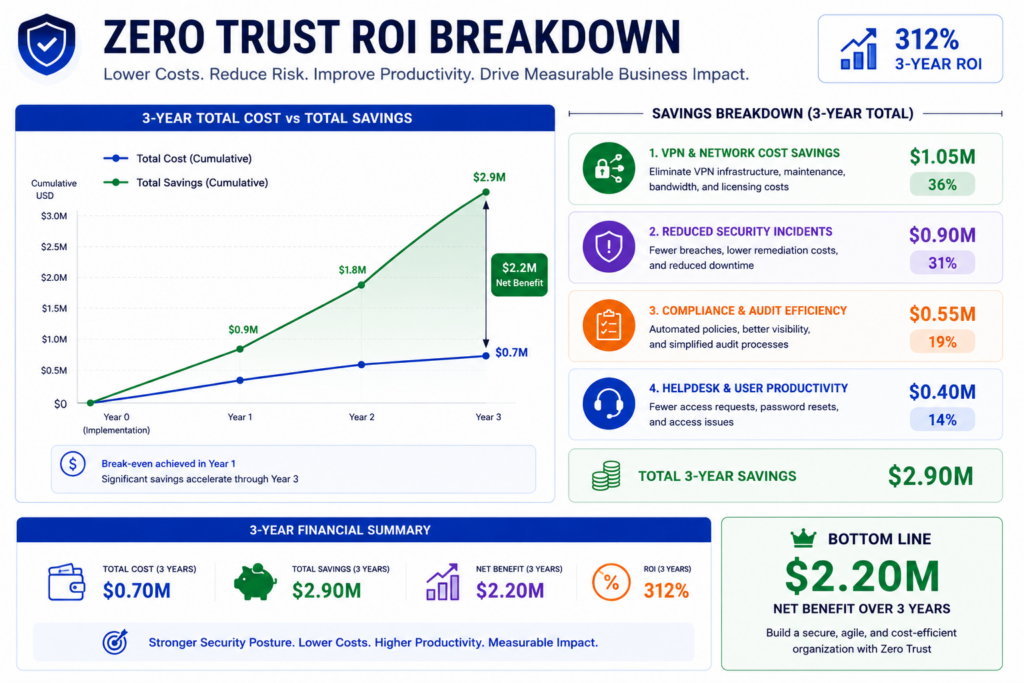
Most CFOs approve zero trust security budgets based on breach cost avoidance. That's valid, but incomplete. The full ROI picture includes:
Reduced breach cost: Contained blast radius from microsegmentation limits damage per incident.
Compliance efficiency: Zero trust architecture mapped to NIST 800-207, SOC 2, and ISO 27001 reduces audit prep time and consultant fees.
VPN infrastructure savings: Organizations replacing VPN with zero trust network access eliminate hardware, licensing, and support costs for legacy gateway infrastructure for zero trust security.
IT helpdesk reduction: Automated access provisioning through ZTNA implementation cuts access request tickets by 30 to 50% in documented enterprise deployments.
Cyber insurance premiums: Insurers now ask specifically about zero trust security controls during underwriting. Organizations with documented zero trust architecture report 15 to 25% lower premiums.
For a 1,000-user enterprise spending $400,000 on zero trust security implementation:
| Year | Cost | Savings |
| Year 1 | $400,000 | $180,000 (VPN + compliance) |
| Year 2 | $120,000 | $340,000 (insurance + helpdesk) |
| Year 3 | $120,000 | $500,000+ (breach avoidance) |
By year three, the cumulative return exceeds implementation cost. The math works but only if ZTNA implementation is done correctly the first time.
Zero trust security fails most often during policy design, not technology deployment. The platform works. The policies don't.
Overly permissive policies: Teams afraid of disrupting productivity write access rules too broadly for zero trust security. The result is a zero trust architecture that looks different on paper than it behaves in production.
Phased rollout skipped: Organizations that push zero trust security to all users and applications simultaneously create support chaos. Access breaks. Workarounds start. Shadow IT grows. A phased rollout starting with low-sensitivity workloads prevents this.
Identity provider gaps: Zero trust network access depends on a clean identity foundation. Secure access governance becomes critical during large-scale IT outsourcing operations. Organizations with inconsistent directory hygiene duplicate accounts, stale credentials, and unmanaged service accounts find that ZTNA implementation exposes those problems immediately in zero trust security. Organizations that rapidly scale engineering through hire offshore developers models must strengthen identity governance and access control policies early.
| Phase | Focus | Typical Duration |
| 1 | Identity and device inventory | 2 to 4 weeks |
| 2 | Low-sensitivity app ZTNA pilot | 4 to 8 weeks |
| 3 | Microsegmentation rollout | 6 to 12 weeks |
| 4 | Full zero trust architecture enforcement | Ongoing |
Before enforcing any zero trust security policy, run it in simulation mode. Every major ZTNA implementation platform supports this. Simulation shows exactly which users and devices would be blocked before a single person loses access. Teams that skip this step spend weeks in post-enforcement firefighting.
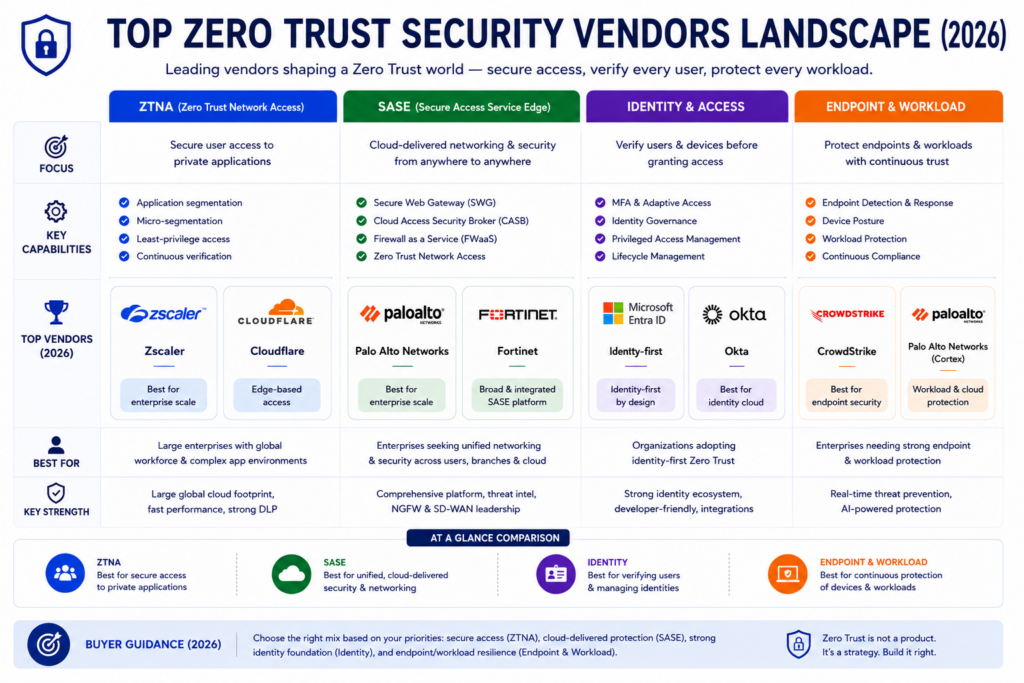
Choosing a zero trust security platform isn't a features comparison. It's a fit assessment against your environment. Use these ten criteria before any vendor conversation.
No single vendor scores 10/10 on every criterion. Rank these by your environment's highest-risk gaps before shortlisting.
These vendors represent the platforms most commonly deployed in zero trust security engagements across enterprise and mid-market environments today.
India-based zero trust security implementation partner delivering end-to-end zero trust architecture from identity inventory and policy design to managed post-deployment operations.
Key Features:
Best For: Mid-market and enterprise organizations needing a guided, phased zero trust network access rollout.
Rating: 4.8/5
Large-scale zero trust security consulting and implementation across regulated industries including BFSI, healthcare, and government.
Key Features:
Best For: Large enterprises in regulated Indian industries.
Rating: 4.4/5
Enterprise zero trust network access and identity management services with global delivery capability.
Key Features:
Best For: Enterprises with complex hybrid cloud environments.
Rating: 4.3/5
Zero trust security transformation practice with strong threat intelligence and endpoint posture management.
Key Features:
Best For: Organizations undergoing broad digital and security transformation.
Rating: 4.2/5
Zero trust architecture services with a focus on manufacturing, retail, and public sector clients across India and globally.
Key Features:
Best For: Manufacturing and public sector enterprises with legacy infrastructure.
Rating: 4.2/5
Patoliya Infotech delivers zero trust security implementations that reach production ZTNA deployment. As a software development company, Patoliya Infotech helps organizations implement scalable zero-trust security frameworks aligned with hybrid cloud and enterprise access environments.
Most implementation projects fail because policy design gets rushed. Patoliya Infotech's security practice runs a policy simulation phase before any enforcement goes live, which means clients don't face access disruptions post-deployment.
What Patoliya Infotech brings to your zero trust architecture project:
If you're evaluating zero trust security platforms and aren't sure which fits your environment, that's exactly where a scoping conversation helps. Book a consultation with Patoliya Infotech's security practice before committing your budget to a platform.
Zero trust security isn't a future-state goal. It's the operating standard for organizations running hybrid workforces across cloud environments in 2026. The question isn't whether your architecture needs to change. It's how much of your current access model is already working against you.
Start with identity. Add device posture. Enforce least-privilege access. Then move toward a full zero trust architecture one workload at a time. If the scope feels large, start with a single critical application and build from there. If you need a clear starting point, let’s talk through where your environment stands today.