Table of Contents
TLDR: An API gateway is a single entry point that manages, secures, and routes every request between clients and your backend services. Companies using a centralized API gateway report up to 40% faster incident response times due to unified observability. This guide breaks down how it works, what it costs, and which tools win in 2026.
Skipping the API gateway is a decision most engineering teams regret at scale, not at day one. By the time you have 20+ microservices, every client directly hitting backend endpoints, zero centralized auth, and no rate controls, the cost of retrofitting becomes painful.
By 2026, most web-enabled applications will expose APIs as a primary interface. Without a layer to govern those APIs, you are shipping technical debt disguised as architecture.
This guide explains exactly what an API gateway setup does, when it beats alternatives, what the real costs look like, and how to pick the right one.
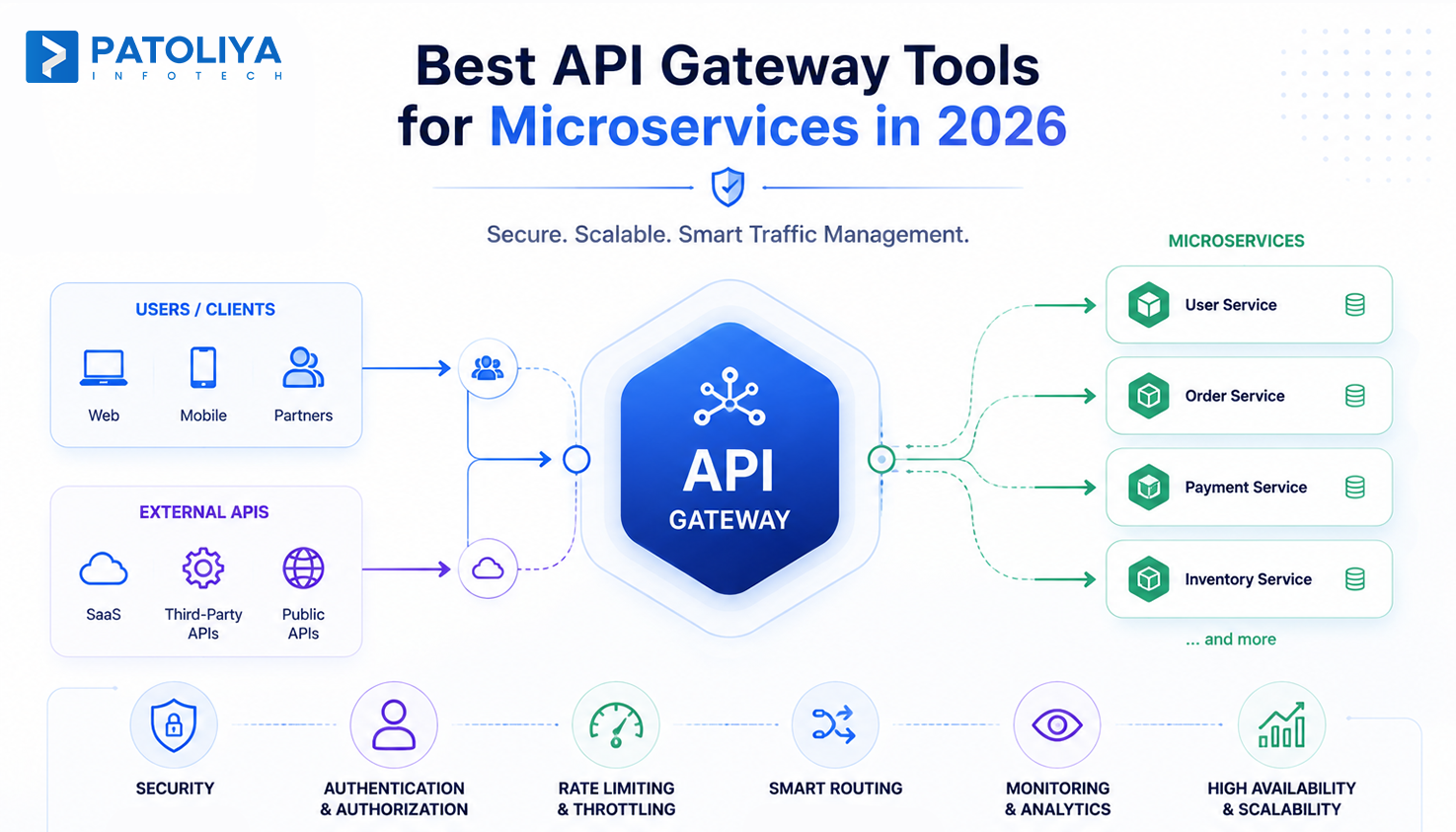
An API gateway is a server-side component that acts as the single entry point for all client-to-backend communication. It intercepts every inbound request, applies policies like API authentication and rate limiting, then routes traffic to the appropriate upstream service. Think of it as a contract enforcer that sits between your users and your systems.
Unlike a simple reverse proxy that forwards traffic, the best API gateway tools operate at Layer 7 of the OSI model. It understands HTTP semantics, headers, and payloads. It can transform requests, aggregate responses from multiple services, and reject malformed traffic before it touches your infrastructure.
Every enterprise running distributed systems needs this layer. Without it, policy enforcement gets scattered across dozens of services, and debugging becomes archaeology.
A gateway handles authentication, routing, rate control, protocol translation, and observability from one centralized point, eliminating the need for each service to rebuild these functions independently.
The API gateway vs load balancer directs incoming requests to the right backend services based on defined rules. A request related to orders is sent to the order service, while the payment service handles a payment-related request. Modern web application development services often rely on centralized API routing to manage scalable frontend and backend communication.
This separates what clients see from how your systems are structured internally, so you can update or reorganize backend services without disrupting users.
Every Best gateway enforces rate limiting, throttling, and access control before a request hits your application code. This matters because moving security left, to the gateway layer, means a compromised client cannot flood your services with requests. Policy changes apply globally from one config file, not scattered across 40 services.
A well-configured API gateway vs load balancer captures latency, error rates, and throughput per route. This data feeds directly into your monitoring stack. Teams using gateway-level observability identify performance regressions in hours, not days. Distributed systems designed with scalable software architecture patterns usually implement API gateways alongside load balancers.
Most teams underestimate this capability. Request tracing at the gateway level turns incident response from guesswork into a structured process.
The next section covers the specific operational pain points where the best API gateway tools pay for themselves.
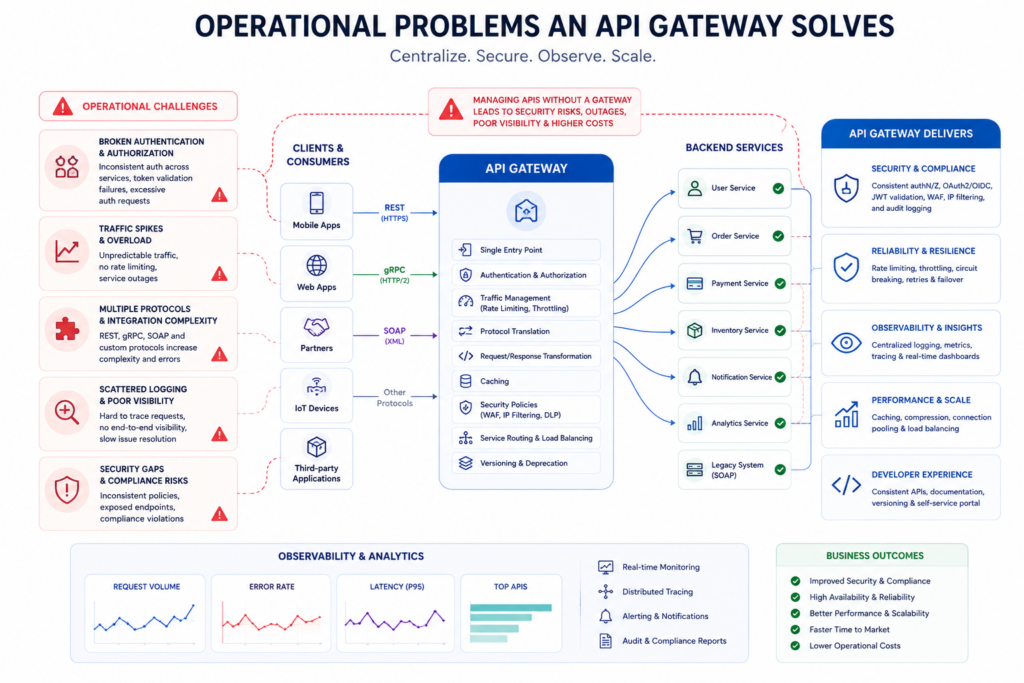
An gateway solves five core operational problems: scattered authentication, uncontrolled traffic spikes, protocol fragmentation, broken client contracts during backend changes, and lack of centralized observability. Each problem compounds the others when left unaddressed.
The distinction between the API gateway vs load balancer is not about which tool is better. They operate at different layers and solve different problems. Most production systems need both.
| Feature | API Gateway | Load Balancer |
| OSI Layer | Layer 7 (Application) | Layer 4/7 (Transport/Application) |
| Auth Enforcement | Yes | No |
| Rate Limiting | Yes | No |
| Request Transformation | Yes | No |
| Protocol Translation | Yes | No |
| Traffic Distribution | Limited | Core function |
| Route-level Observability | Yes | No |
A load balancer distributes traffic across service replicas. It keeps your services alive under load. The best API gateway tools govern what traffic is allowed through and what it looks like when it arrives.
The API gateway vs load balancer debate usually ends the same way: traffic hits the load balancer first, then the gateway, then individual services.
The only scenario where choosing one over the other makes sense is internal service to service traffic with no external clients. There, a load balancer alone is often sufficient.
Understanding the API gateway vs load balancer distinction up front prevents expensive architectural mistakes later. Understanding costs matters as much as architecture.
API gateway setup costs vary more than most teams expect. The sticker price is rarely the real number.
| Platform | Base Cost | Call Pricing |
| Kong OSS | $0 | Self-hosted infrastructure cost |
| Tyk OSS | $0 | Self-hosted infrastructure cost |
| AWS API Gateway | $0 base | $3.50/million REST calls |
| Azure APIM | $49 to $2,100/month | Tiered by calls |
| Kong Enterprise | $50,000+/year | Enterprise negotiated |
| Apigee | Custom | Custom |
For API gateway setup on AWS, a production workload at 500 million calls/month hits roughly $1,750/month in API call costs alone, before data transfer and caching fees. Azure APIM's Standard tier at $249/month suits mid-market workloads up to 200M calls.
Self-hosted gateway with Kong OSS removes licensing costs but adds infrastructure, monitoring, and DevOps overhead. A dedicated engineer managing a self-hosted gateway adds $80,000 to $130,000/year to your effective cost.
Total cost of ownership almost always exceeds the licensing figure. Budget for it before you commit.
A well-implemented gateway cuts backend incidents, compresses developer onboarding time, and eliminates engineering hours spent rebuilding cross-cutting concerns across every service.
The gateway tools introduce a centralized failure point if not architected for high availability from day one. This is the risk most teams discover after launch, not before.
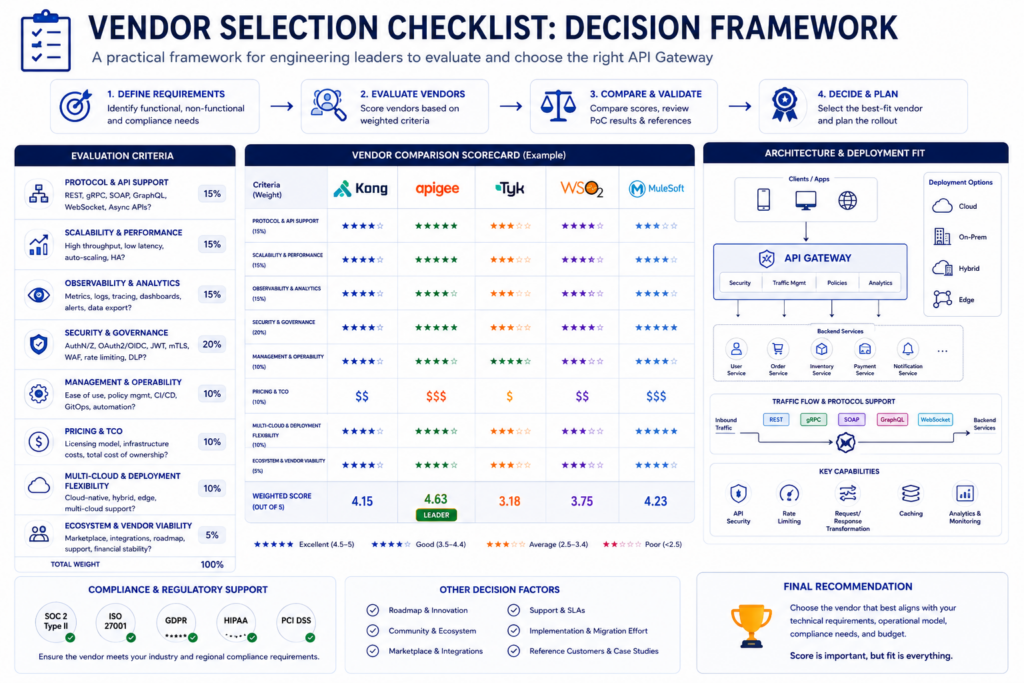
Selection from the best API gateway tools means matching platform capabilities to your specific traffic patterns, team capacity, and compliance requirements.
| Evaluation factor | Why It Matters | |
| 1 | Protocol support (REST, gRPC, GraphQL, WebSocket) | Ensure it matches your current and planned service contracts |
| 2 | High availability architecture | Active-active clustering is non-negotiable for production |
| 3 | Plugin ecosystem | Determines how fast you can add auth, caching, and transform logic |
| 4 | Developer portal capabilities | Critical for external API monetization and partner programs |
| 5 | Multi-cloud or hybrid support | Evaluate against your 3-year infra roadmap |
| 6 | Observability integrations | Datadog, Prometheus, Grafana, or native tooling |
| 7 | Auth standards support | OAuth 2.0, JWT, mTLS, API keys |
| 8 | Rate limiting granularity | Per-route, per-consumer, per-IP, per-plan |
| 9 | Best API gateway tools setup time and operational complexity | Greenfield vs migration workload |
| 10 | Licensing and support SLAs | Open-source vs commercial support commitment |
Run every shortlisted vendor against this checklist before a proof of concept. The startup running three services are not the same tools a Fortune 500 running 400 services should evaluate.
Patoliya Infotech delivers end-to-end API gateway setup implementation across Kong, AWS, and Azure APIM for fintech, healthtech, and logistics platforms where governance and uptime are non-negotiable.
Best for: Teams migrating from direct service exposure to a governed layer who need a zero-downtime cutover.
Engagement: Project-based and retainer models available.
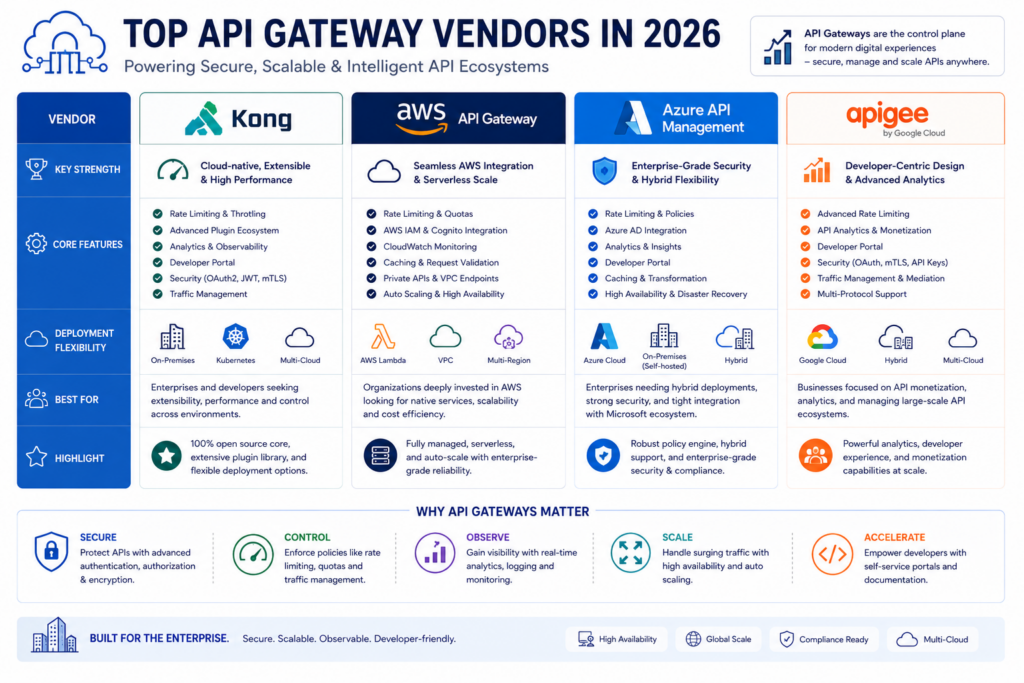
Kong Gateway is the most widely deployed open-source tool globally. It runs on Nginx and Lua, supports 60+ plugins natively, and handles REST, gRPC, and GraphQL.
Best for: Engineering teams with DevOps capacity who want maximum control and portability.
Pricing: OSS free, Enterprise from $50,000/year.
AWS API Gateway is managed for teams already running workloads on AWS. Zero infra management, deep Lambda integration, and pay-per-call pricing make it fast to start.
Best for: AWS-native teams wanting operational simplicity.
Pricing: $3.50/million REST API calls.
Azure APIM is Microsoft's API management platform built for hybrid and multi-cloud environments. It ships with a developer portal, policy editor, and built-in analytics.
Best for: Enterprises in Microsoft ecosystems or with legacy service exposure needs.
Pricing: $49 to $2,100/month by tier.
Apigee is an enterprise-grade API management platform with deep analytics, monetization, and multi-cloud deployment support.
Best for: Large enterprises monetizing APIs or managing complex partner ecosystems.
Pricing: Custom enterprise pricing.
The right setup and vendor selection only create value if implementation is executed correctly.
Patoliya Infotech has built and migrated architectures across fintech, healthtech, and logistics platforms where traffic governance directly affects compliance and uptime.
As an enterprise software development company, Patoliya Infotech helps organizations implement scalable API governance and traffic management architectures.
An API gateway setup done wrong creates the same fragility it was meant to remove. Patoliya Infotech delivers:
If your team is evaluating an API gateway migration or building a gateway layer from scratch, Patoliya Infotech can scope it with you. Book a technical walkthrough to see how our implementation approach fits your architecture.
An API gateway setup is not infrastructure for the future. It is infrastructure you need before your API surface outpaces your ability to govern it. The teams that implement early spend less time firefighting and more time shipping. The teams that wait build the problem at every layer.
As services grow, so do risks around security, access control, and performance. Without a governing layer, complexity compounds with every new service. A gateway brings consistency to how requests are secured and managed.
Pick the tool that matches your traffic volume, team capacity, and compliance needs, then implement it with discipline. Let’s talk about your API gateway architecture.