Table of Contents
TLDR: An internal developer portal gives every engineer one place to provision infrastructure, find service owners, and ship through pre-approved paths. Teams using one report experience up to 40% faster delivery cycles.
Developers are not slow. The systems around them are. Engineers spend 30 to 40% of their week navigating scattered tools, waiting on approvals, and hunting for who owns a service that broke at 2 a.m.
An internal developer portal collapses that chaos into one interface. Most teams past 60 engineers have 15+ tools, zero central ownership map, and a platform team buried in tickets. That is the real delivery tax. This guide covers what an internal developer portal actually does, what it costs, and how to choose one without wasting six months.
An internal developer portal is a centralized interface where developers provision infrastructure, find service owners, and follow pre-approved deployment paths without filing a ticket. It is operational, not read-only.
For instance, a developer needs a new payments microservice. She opens the internal developer portal, picks a template, fills four fields, and gets a configured GitHub repo, Datadog dashboard, and PagerDuty integration in four minutes. Before the portal, that request sat in a queue for two days.
IDP platform engineering connects DevOps, platform thinking, and developer experience into one product layer. Teams that treat the internal developer portal as a one-time setup rebuild within 18 months.
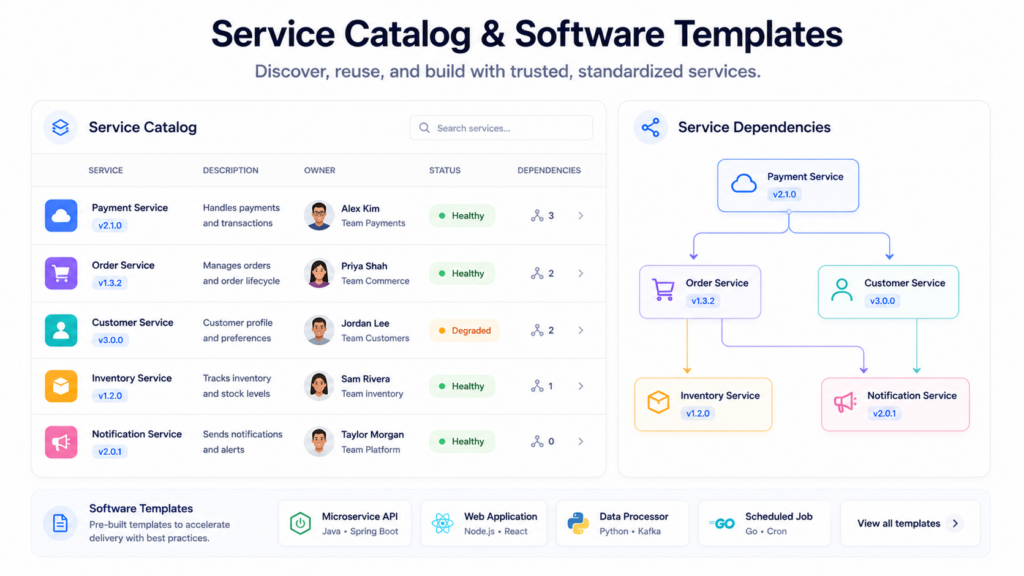
A service catalog is the backbone of every internal developer portal. It answers three questions fast: what runs in production, who owns it, and what is its current health. Good catalogs include:
Software templates extend the internal developer portal into action. A developer picks a template, fills a few fields, and gets a fully scaffolded repo with CI/CD, secrets management, and monitoring pre-wired.
Self-service infrastructure means developers provision environments, databases, and cloud resources through guardrail-enforced templates without filing a ticket. Every self-service infrastructure template inside the portal needs:
For instance, a healthcare SaaS team needed a staging database every sprint. Before self-service infrastructure, it was a three-day ticket. After, it was a two-minute portal action with guardrails already baked in. The Backstage developer portal plugin layer made that template reusable across all teams.
Developer onboarding automation cuts ramp time from weeks to days inside the internal developer portal. Without a portal, average onboarding to first commit runs 14 to 21 days. With one, it drops to 3 to 5 days. A new hire follows the guided path and has a working environment, first service scaffolded, and access provisioned the same day.
A golden path is the pre-approved, pre-tested way to complete a workflow that the platform team has validated. The developer experience platform layer connects the portal to observability, incident management, and deployment pipelines, so nothing requires leaving the internal developer portal mid-workflow. Developers can go off-path but have to choose that explicitly.
Example: During an outage, an on-call engineer opens the internal developer portal, sees three services depending on the failing auth service, and knows the blast radius in 30 seconds. Without it, that triage took 40 minutes across three engineers.
The Backstage developer portal catalog integration powers this view of live service health, ownership, and dependency data in one place.
Cognitive load in software development compounds quickly. With 10 engineers, tribal knowledge works. At 80, it becomes a delivery liability. An internal developer portal turns scattered knowledge into a structured, searchable system that stays when engineers leave.
Signs your team needs one:
The average engineer takes 3 to 6 months to reach full productivity at a new company. Toolchain confusion is a top driver. An internal developer portal with built-in onboarding automation gives new hires a structured path instead of a Slack channel to lurk in.
For instance, A Series B startup onboarded 12 engineers in one quarter. Without an internal developer portal, the average time to first PR was 18 days. After implementing one, it dropped to 4 days.
Without self-service infrastructure, every developer's need becomes a platform team ticket. At 50 engineers, that is 40+ requests per week. IDP platform engineering breaks that cycle by encoding platform knowledge into repeatable self-service infrastructure workflows that developers run themselves.
"Who owns the payment service?" should not require a Slack search. An internal developer portal with a live service catalog answers ownership questions in seconds and surfaces stale services and orphaned repos before they cause an incident.
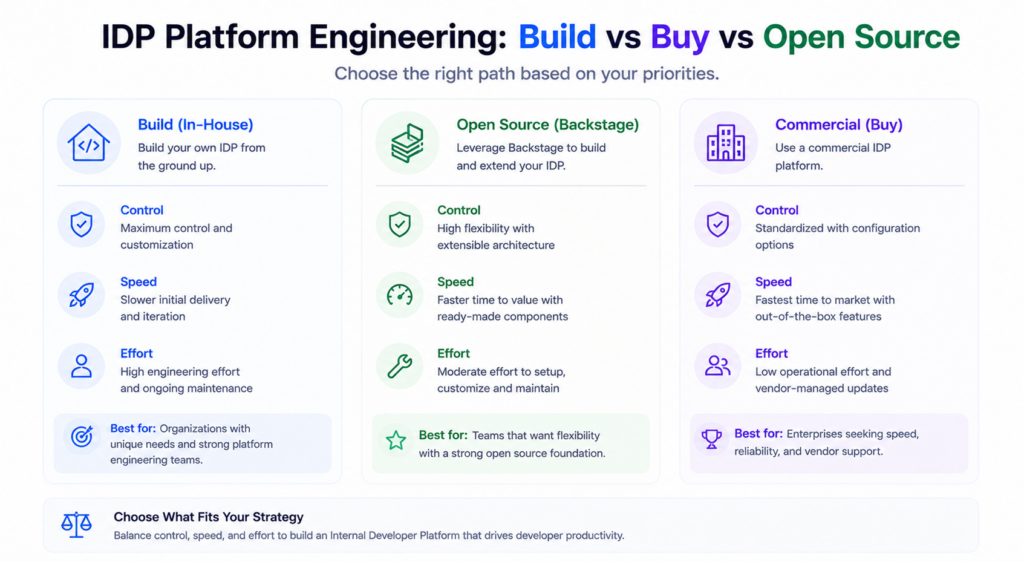
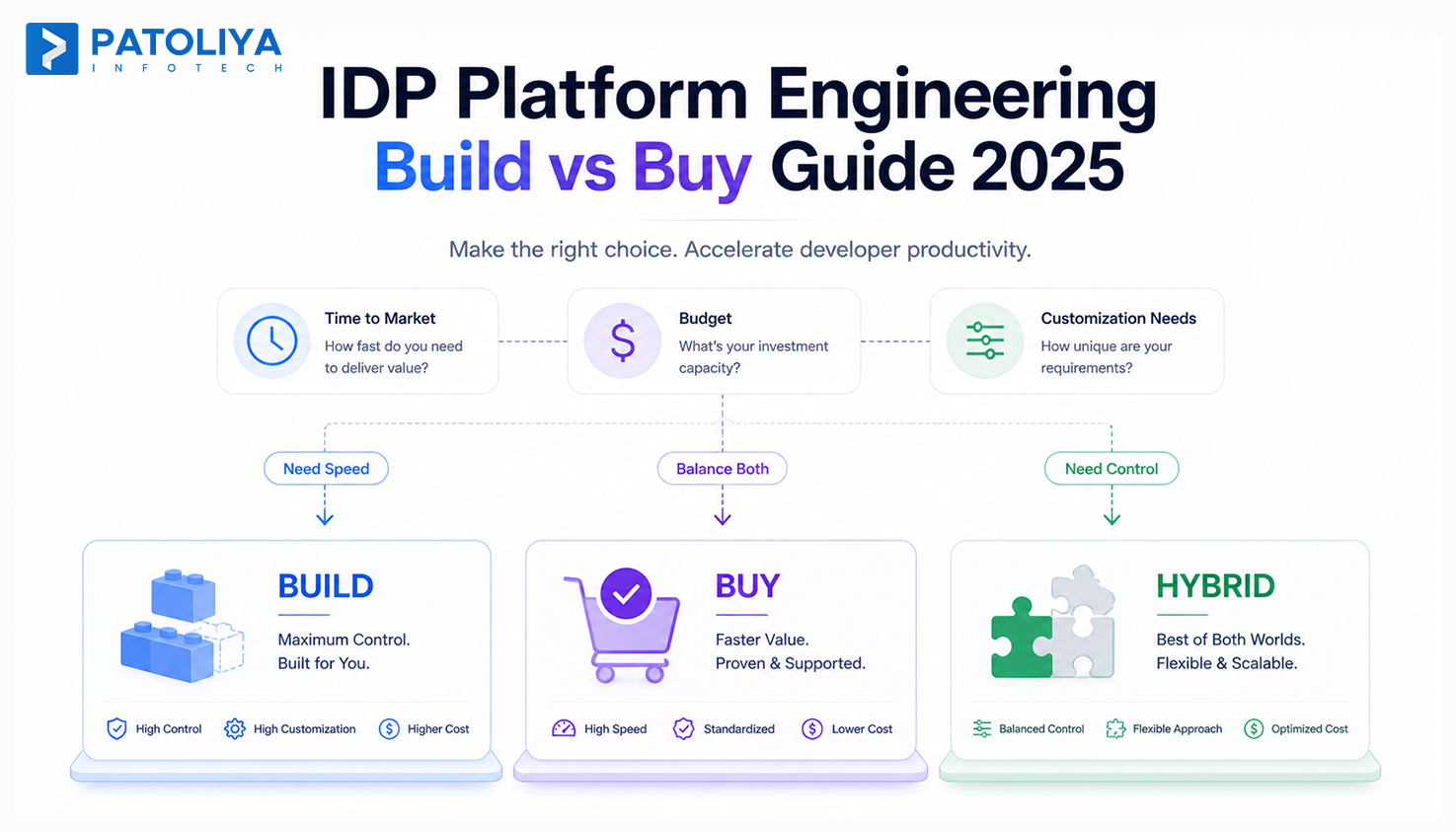
Custom builds give full control but need a dedicated team of 3 to 5 engineers for 6 to 12 months. Ongoing maintenance runs 20 to 30% of the initial build cost per year.
In-house makes sense when:
Backstage by Spotify is the dominant open-source framework for building an internal developer portal. The Backstage developer portal provides plugin architecture, a service catalog data model, software templates, and a React UI.
The Backstage developer portal is not production-ready out of the box. It needs:
Teams deploying the Backstage developer portal without a named maintainer see adoption collapse within six months. This is where most IDP platform engineering efforts stall.
Commercial platforms like Cortex, Port, and Roadie reduce implementation time and come pre-integrated with common toolchains. Good fit for teams that need an internal developer portal fast, without deep platform engineering capacity internally.
Managed IDP platform engineering vendors to deliver a production-ready portal faster than internal builds at comparable cost. Best for teams that want to own the portal without building the capability from scratch.
A production Backstage developer portal with service catalog, three golden paths, and CI/CD integration costs $60,000 to $150,000 in engineering labor. Ongoing Backstage developer portal maintenance adds $20,000 to $50,000 per year.
| Vendor | Pricing | Approx. Monthly |
| Cortex | Per engineer | $20 to $35/dev |
| Port | Per engineer | $15 to $30/dev |
| Roadie | Per engineer | $25 to $40/dev |
At 100 developers, commercial internal developer portal platforms run $18,000 to $48,000 per year and are operational in 2 to 6 weeks faster than any Backstage developer portal build.
Managed IDP platform engineering builds run $80,000 to $250,000 for full implementation, including self-service infrastructure templates, service catalog, and 5+ integrations. Production-ready in 8 to 16 weeks.
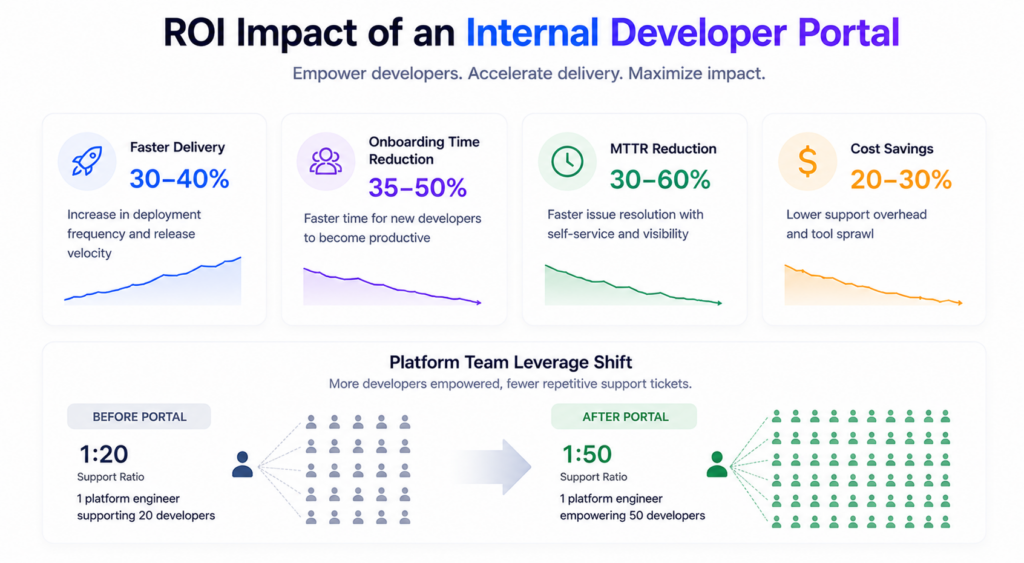
Teams with a functioning internal developer portal ship 30–40% faster by removing queues between intent and execution. The gain is not writing code faster. It is eliminating wait states every sprint. Strong IDP platform engineering makes that gain compounding over time.
At $200,000 average total compensation for a senior engineer, cutting onboarding from 12 weeks to 3 weeks recovers $35,000 in productivity per hire. At 10 hires per year, that is $350,000 in real ROI. The internal developer portal pays for itself before the second quarter ends.
Without an internal developer portal, a platform team of five supporting 100 developers spends 60% of its time on reactive requests. With self-service infrastructure handling routine provisioning, that ratio flips. The leverage ratio moves from 1:20 to 1:50.
Mean time to resolution drops when on-call engineers trace ownership inside the internal developer portal instead of reverse-engineering it mid-outage. Organizations report 25 to 35% MTTR reduction after deploying a live service catalog with dependency mapping.
The most expensive outcome is an internal developer portal nobody opens. It has to win on speed in the first two weeks, or it loses permanently. If developers complete a task faster by messaging the platform team, they will skip the portal entirely.
Early warning signs:
The Backstage developer portal requires active maintenance. Community plugins break on version upgrades.
Custom plugins become technical debt within 12 months without a named owner. A dedicated maintainer is not optional. This is the most underestimated cost in IDP platform engineering.
IDP platform engineering projects expand fast. What starts as a service catalog and two golden paths becomes 12 integrations and a redesigned onboarding flow. Ship the internal developer portal as an MVP with 20% of features and iterate.
Misconfigured RBAC in a portal is a real attack surface. If self-service infrastructure templates allow elevated provisioning, that is a lateral movement vector.
Every internal developer portal needs a security review of RBAC before launch, not after.
Before signing any contract for IDP platform engineering services, confirm:
Capability
Implementation
Adoption
A vendor that cannot answer adoption questions is selling a portal, not a developer experience platform.
A platform engineering firm delivering production-ready internal developer portal implementations using Backstage developer portal and commercial IDP tooling.
DevOps consultancy services for mid-market organizations that need IDP platform engineering depth fast.
Key Features:
Best For: Engineering orgs of 50 to 500 developers wanting an owned internal developer portal.
Client Review: 4.8/5
A global consultancy with deep IDP platform engineering practice for enterprise-scale portal programs.
Key Features:
Best For: Enterprises with 500+ developers and complex compliance requirements.
Client Review: 4.7/5
A cloud transformation firm delivering internal developer portal implementations alongside cloud modernization programs using the Backstage developer portal framework.
Key Features:
Best For: Enterprises mid-cloud migration needing platform engineering within a larger program.
Client Review: 4.5/5
A DevOps consultancy with focused IDP platform engineering expertise, known for lean implementations that prioritize adoption over feature count.
Best For: Mid-size teams of 30–200 developers wanting fast time-to-value.
Client Review: 4.6/5
A commercial portal platform for teams needing fast self-service infrastructure provisioning without a dedicated platform team.
Key Features:
Best For: Startups and scale-ups of 15 to 100 developers needing self-service infrastructure fast.
Client Review: 4.4/5
We build internal developer portal solutions that developers actually open every morning, not portals abandoned six months post-launch.
Three things that make our IDP platform engineering work different:
If your platform team spends more than 30% of every sprint on reactive tickets, let's talk about what a production internal developer portal looks like for your team.
An internal developer portal stops being optional the moment your platform team becomes a ticket queue. Most engineering leaders know this problem exists. The harder part is accepting that scattered toolchains and undocumented services are not a people problem. They are a system's problem that an internal developer portal is built to solve.The frameworks are mature. The ROI on IDP platform engineering is measurable. The implementation paths are proven. Whether you build on the Backstage developer portal, go commercial, or bring in a managed internal developer portal vendor, the decision that costs the most is the one you keep deferring. Every sprint without an internal developer portal is a sprint where your best engineers are doing triage instead of building. Let's map out what yours should look like.