Table of Contents
TL;DR: Teams often run multiple software architecture patterns without clear rationale, creating gaps in cost control and scalability. Early architecture decisions set long-term outcomes. A structured approach to defining software architecture patterns ensures better performance, fewer rework cycles, and more predictable scaling.
Most engineers pick software architecture patterns based on what their last team used. That is how you end up with microservices architecture patterns on a 4-person team or a monolith serving 10 million users. The pattern mismatch is the problem, not the technology.
Most enterprise development teams now run multiple software architecture patterns in production at the same time. The teams that succeeded made deliberate tradeoff decisions early. The ones struggling picked patterns reactively.
This guide breaks down the 10 most deployDORA State of DevOps reportment-relevant software architecture patterns in 2026, with real tradeoffs, use cases, and when each pattern will actively hurt your system.
Software architecture patterns are repeatable structural solutions to recurring system design problems. They define how components communicate, how data flows, and how a system handles failure before a single line of code is written.
Why it Matters
Most teams treat software architecture patterns as implementation preferences. That confusion is expensive. A pattern operates at the system level. It determines coupling, deployment topology, data ownership boundaries, and team structure.
What Patterns Are Not
Software architecture patterns fit depends on team size, maturity, and system needs.
Before selecting software architecture patterns, define failure modes, team readiness for distributed systems, and consistency trade-offs. Without this clarity, selection becomes guesswork.
Patterns vs. Principles vs. Styles
| Term | What It Defines |
| Pattern | Repeatable structural solution to a system problem |
| Principle | Design rule (single responsibility, separation of concerns) |
| Style | Broad topology (layered, distributed, event-based) |
Software architecture patterns sit at the intersection of all three. They translate design principles into structural decisions with real deployment consequences.
Understanding what patterns are and are not is the foundation. The 10 patterns below are the ones your next architecture decision will depend on.
Every software architecture patterns below includes the core use case, the tradeoff you accept, and the condition under which it will work against you.
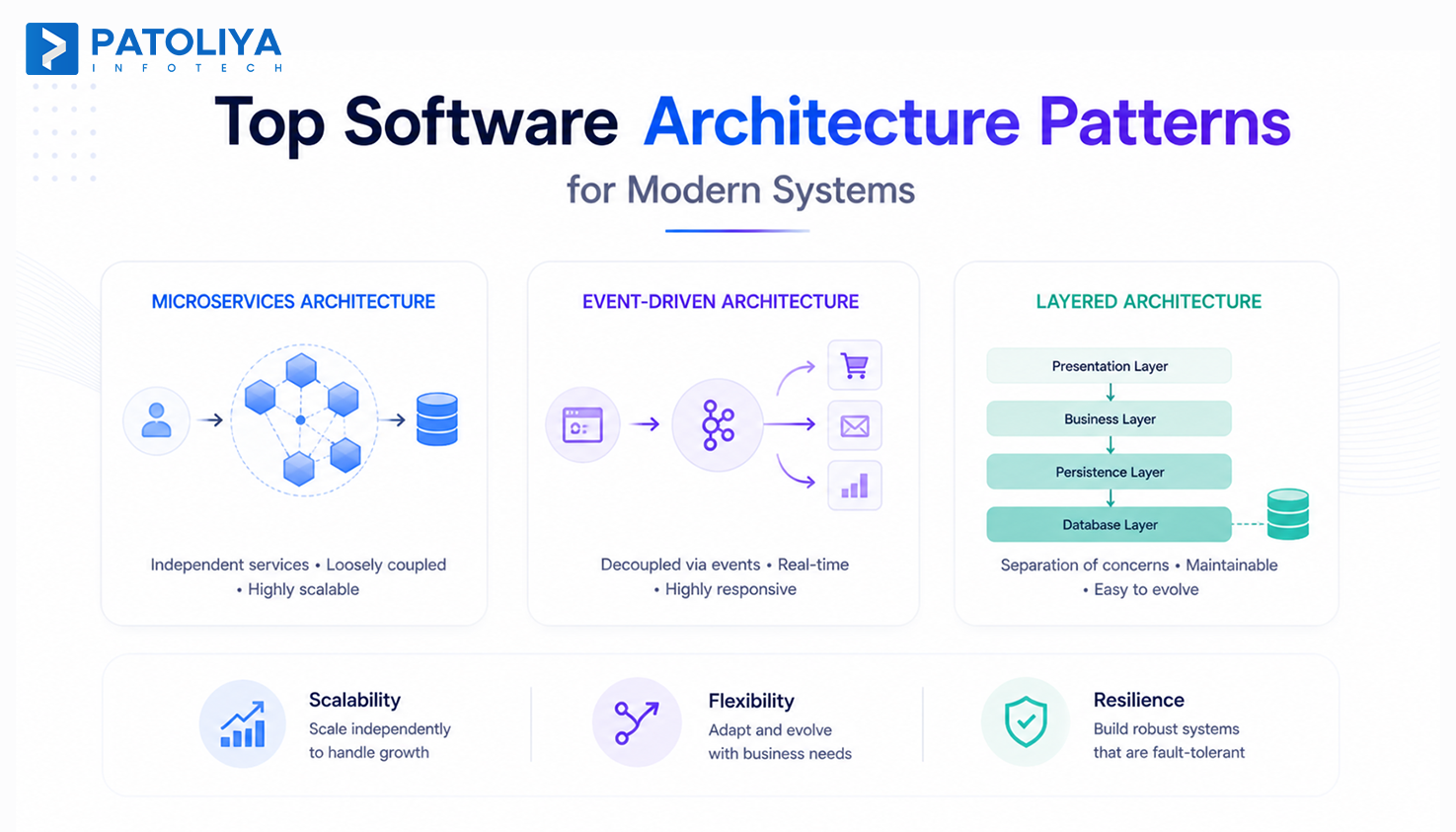
Layered software architecture patterns separate concerns into stacked horizontal tiers: presentation, business logic, and data. Each layer only communicates with the layer directly below it.
Use it when: Small team, well-defined domain, no independent scaling requirements.
Skip it when: You need to scale specific components independently. Layered software architecture patterns force full-stack deployments for even minor changes.
Real tradeoff: Simple to onboard engineers into. Becomes a bottleneck when the data layer limits the entire system's throughput at scale.
Microservices architecture patterns decompose a system into independently deployable services, each owning its own data and business capability.
Use it when: Multiple teams, distinct business domains, and independent scaling requirements are all present simultaneously.
Skip it when: Your team is fewer than 8 engineers. The operational overhead of microservices vs monolith architecture patterns (service discovery, distributed tracing, and independent CI/CD pipelines) consumes more capacity than the pattern saves. Engineering teams adopting microservice architecture patterns must understand the operational realities of distributed systems complexity before scaling service boundaries.
Real tradeoff: software architecture patterns deliver deployment independence at the cost of distributed system complexity. You gain speed per service. You pay for in-network latency, data consistency overhead, and observability investment.
A team adopting microservices architecture patterns without defined bounded contexts first will build a distributed monolith: all the complexity, none of the independence.
Event-driven architecture decouples services by routing communication through events rather than direct API calls. Producers emit events. Consumers react asynchronously.
Use it when: You need loose coupling between services and can tolerate eventual consistency in exchange for throughput and resilience through software architecture patterns.
Skip it when: Your domain requires strong consistency. Event-driven architecture is the wrong fit for financial transactions requiring immediate confirmation.
Real tradeoff: Event-driven architecture delivers high throughput and resilience in exchange for debugging complexity. Tracing a failure across an event chain without strong observability tooling turns every incident into a multi-hour investigation.
Teams adopting event-driven architecture without investing in distributed tracing from day one consistently regret the order of operations.
The CQRS pattern separates the write model (commands) from the read model (queries). Each side optimizes independently for its workload within software architecture patterns.
Use it when: Read and write loads have fundamentally different shapes. Heavy reporting on a transactional system is the defining use case.
Skip it when: Your system is primarily CRUD. Adding separate read and write models to a low-complexity domain creates overhead with no payoff.
Real tradeoff: Read performance and write scalability in exchange for eventual consistency between the two models and significant ongoing implementation complexity.
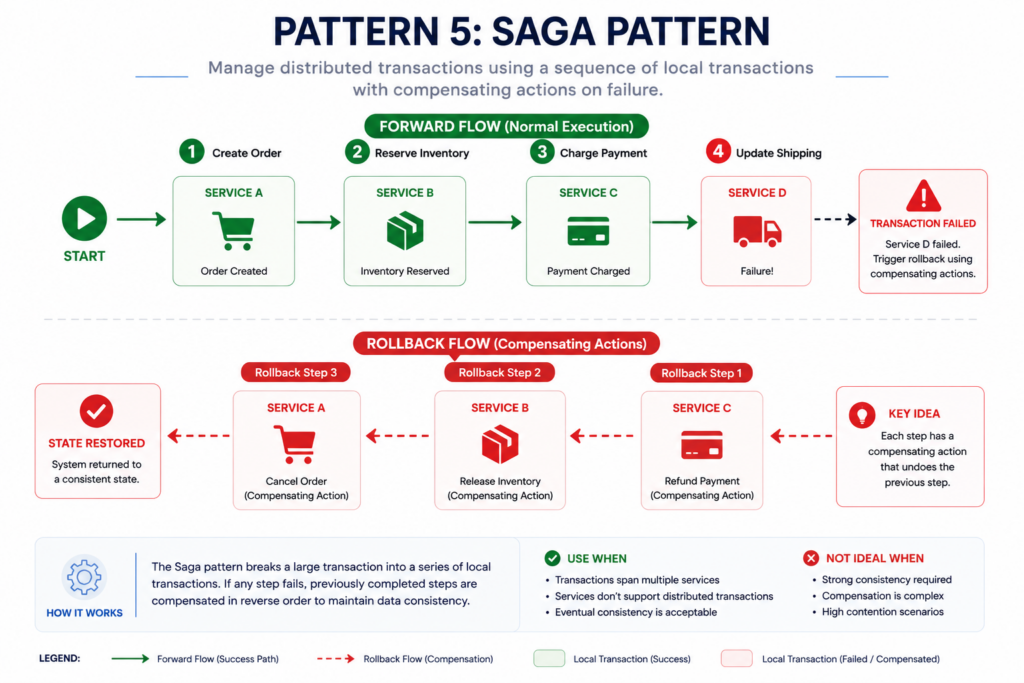
Saga pattern of software architecture patterns manages distributed transactions by breaking them into a sequence of local transactions, each with a compensating rollback action on failure.
Use it when: You are running microservices architecture patterns and need multi-service data consistency without distributed locks.
Skip it when: Your transaction volume is low, and a simple two-step rollback covers your failure modes. Saga pattern complexity is unjustified for low-throughput workflows.
Real tradeoff: Eliminates distributed locking at the cost of compensating logic that must be designed, tested, and maintained for every workflow. Most teams underestimate the maintenance cost at adoption.
The hexagonal architecture of software architecture patterns isolates business logic from infrastructure by defining explicit ports (interfaces) and adapters (implementations). The core domain never depends on a database, API, or queue directly.
Use it when: You need testable business logic and plan infrastructure changes over time (cloud migrations, database swaps, API version upgrades).
Skip it when: Speed of initial delivery matters more than long-term testability. Hexagonal architecture adds structural investment that pays off over 12 to 24 months, not in sprint one.
Real tradeoff: Hexagonal architecture delivers high testability and infrastructure independence in exchange for upfront design discipline and a steeper onboarding curve for new engineers joining mid-project within software architecture patterns.
Strangler fig pattern migrates a legacy system incrementally by routing new functionality to a new system while the old system handles remaining requests. The legacy shrinks as new capabilities take over. Teams modernizing legacy systems often align the strangler fig approach with a structured cloud migration service to reduce operational disruption during phased transitions.
Use it when: You cannot afford a full rewrite and need to reduce risk on a legacy migration while shipping continuously through software architecture patterns.
Skip it when: The legacy system's data model is so entangled that parallel routing creates data consistency problems. Strangler fig pattern delays the real problem in that scenario.
Real tradeoff: Risk reduction and continuous delivery in exchange for running two systems simultaneously, with the full operational overhead that creates.
The API gateway pattern of software architecture patterns places a single entry point in front of all backend services, handling routing, authentication, rate limiting, and protocol translation centrally.
Use it when: Multiple client types (mobile, web, third-party) are hitting different backend services. The API gateway pattern prevents each service from implementing cross-cutting concerns independently.
Skip it when: The gateway becomes a single point of failure. A single API gateway pattern implementation handling all traffic without horizontal scaling creates the bottleneck it was meant to prevent.
Real tradeoff: Centralized cross-cutting concerns in exchange for an additional infrastructure layer that requires its own performance tuning and availability design from day one.
Sidecar pattern deploys a secondary container alongside a primary service container to handle cross-cutting concerns: logging, service mesh communication, configuration, and security. Most implementations of the Kubernetes sidecar container pattern rely on container orchestration platforms to standardize observability, networking, and security layers.
Use it when: Running Kubernetes-based infrastructure and standardizing observability or security without modifying each service's codebase.
Skip it when: Your software architecture patterns are not containerized. Sidecar pattern requires container orchestration to function correctly. Without it, the pattern adds complexity with no operational model to support it.
Real tradeoff: Standardized infrastructure capabilities per service in exchange for increased resource consumption per pod and additional operational complexity at the platform layer.
Domain-driven design bounded contexts define explicit boundaries around each business domain, with its own data model, language, and team ownership. This is the software architecture patterns that makes large-scale microservices architecture patterns sustainable.
Use it when: Your system spans multiple business domains with conflicting terminology and data models.
Skip it when: You have a single business domain or a small team. Domain-driven design at a small scale produces ceremony without value.
Real tradeoff: Domain clarity and team autonomy in exchange for significant upfront modeling investment and the organizational discipline to maintain context boundaries as the business evolves.
The right software architecture patterns remove entire problem classes before they reach production.
A database schema change should never require a front-end deploy. Hexagonal architecture and microservices architecture patterns enforce explicit dependency boundaries that break this coupling. Teams on coupled systems spend sprint capacity on regression testing instead of new features.
Most teams know their monolith is a liability. Few have a safe exit path. Strangler fig pattern is the only software architecture patterns built specifically for incremental migration without stopping delivery. A full rewrite requires two parallel delivery teams. Most organizations cannot sustain that.
Microservices architecture patterns create distributed transaction problems by design. Saga pattern handles write consistency. The CQRS pattern separates read load from the write path. Event-driven architecture provides the communication backbone that makes both viable at scale.
Logic entangled with infrastructure code cannot be tested cleanly. Hexagonal architecture isolates the domain behind port interfaces, so every business rule is testable without a database or network call.
These four problems appear in every system that has grown past its original design. The right software architecture patterns at inception eliminate most of them before they cost a sprint.
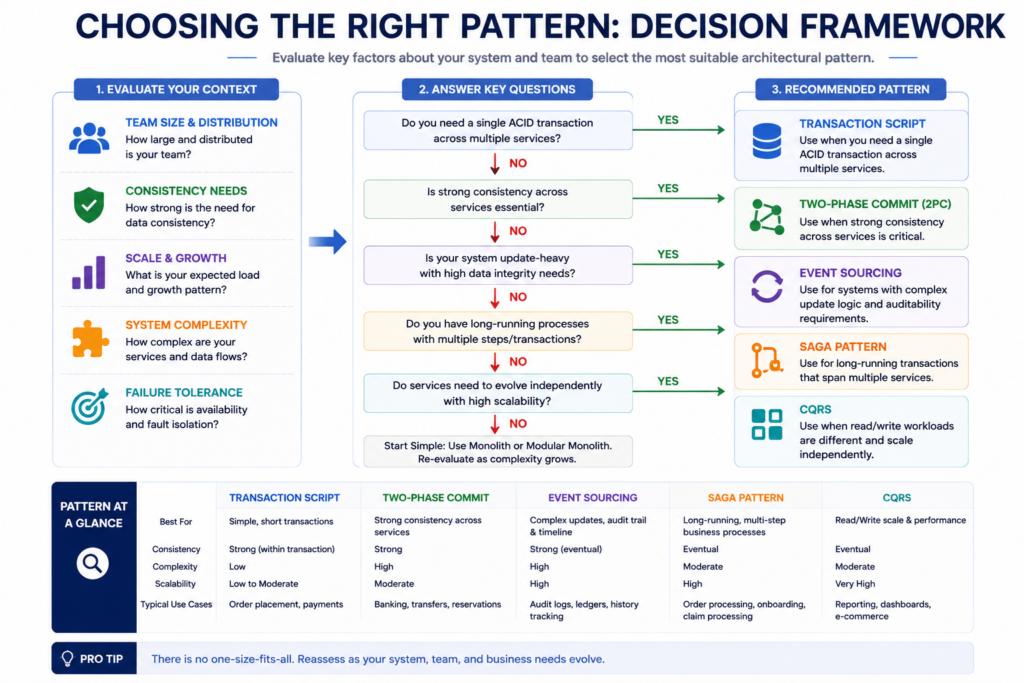
The right choice of software architecture patterns depends on four variables: team size, consistency requirement, deployment maturity, and rate of domain change.
| Team Size | Recommended Software Architecture Pattern |
| 1 to 5 engineers | Layered, Hexagonal Architecture |
| 5 to 15 engineers | Hexagonal Architecture + API Gateway Pattern |
| 15 to 50 engineers | Microservices Architecture Patterns + Event-Driven Architecture |
| 50+ engineers | Full Domain Driven Design + Saga Pattern |
Strong consistency requirements push toward synchronous software architecture patterns. Event-driven architecture and saga pattern require explicit eventual consistency design.
If your domain cannot tolerate any consistency window, asynchronous software architecture patterns add compensating logic complexity that synchronous patterns handle automatically.
Works together:
Avoid:
Before committing to any software architecture pattern:
Every software architecture patterns carries a cost tied to its complexity tier. Misjudging the tier is the most common reason architecture projects overrun budget.
Hexagonal architecture and layered software architecture patterns carry the lowest setup cost. A greenfield layered system reaches production in 4 to 8 weeks. Hexagonal architecture adds 20 to 30% to initial build time but returns that investment within 2 to 3 quarters.
Microservices architecture patterns, event-driven architecture, and the CQRS pattern require platform engineering before business logic work begins. Typical cost: $80,000 to $250,000. Timeline: 12 to 24 weeks.
Expect 6 to 18 months and $300,000 to $600,000 for enterprise-scale work. The cost is organizational change, not pattern design.
| Engagement Type | Best For | Risk |
| Fixed price | Tier 1 greenfield | Low |
| Time and materials | Tier 2 distributed | Medium |
| Milestone-based | Tier 3 migrations | Lower than T+M |
Strong software architecture patterns decisions generate returns across three vectors: deployment frequency, development velocity, and technical debt reduction.
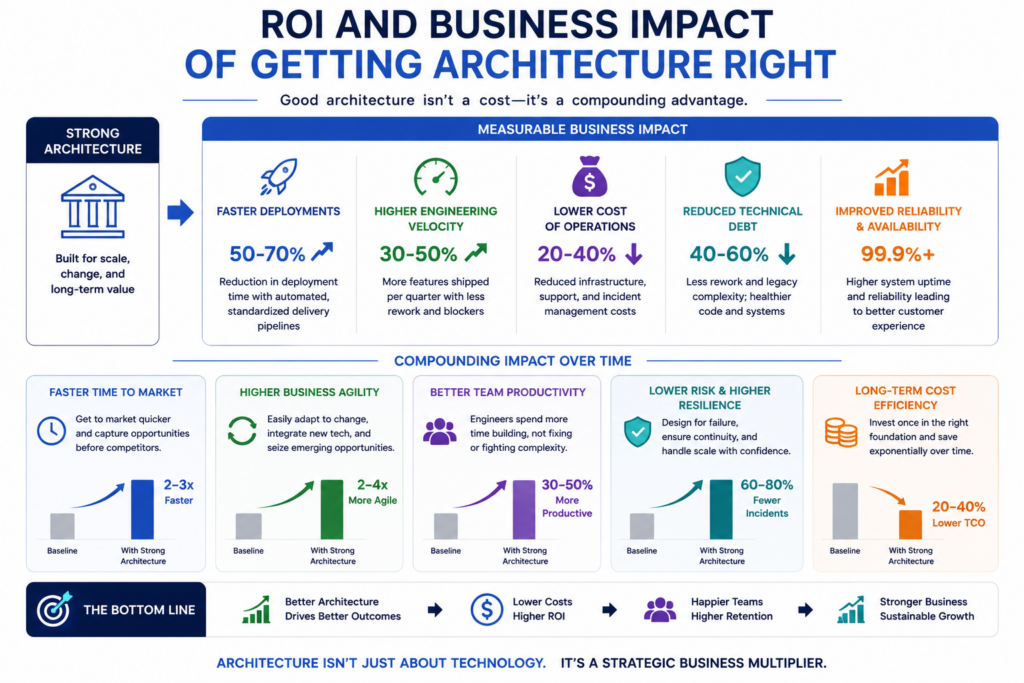
Teams running well-structured software architecture patterns deploy 46x more frequently than teams on monolithic architectures (DORA, State of DevOps, 2023). That gap is a software architecture patterns gap, not a technology gap.
Every deployment boundary defined inside microservice architecture patterns is a direct delivery acceleration point.
Hexagonal architecture and domain-driven design bounded contexts produce the same outcome: teams working independently without stepping on each other's code or data models. Without explicit software architecture patterns boundaries, velocity drops as headcount grows. With them, it holds.
Technical debt is a software architecture patterns problem, not a code quality problem. Systems without clear patterns accumulate coupling debt that compounds with every new feature.
A team spending 40% of its sprint capacity on rework is paying debt service on an unstructured system. Clear software architecture patterns reduce that to 10 to 15% within two to three quarters.
Event-driven architecture specifically removes synchronous coupling debt fastest in high-throughput systems.
Every software architecture patterns has a specific failure mode. The teams that get hurt most are the ones that did not plan for it.
Microservices architecture patterns adopted before domain boundaries are defined create distributed monoliths: full complexity, zero deployment independence. Define bounded contexts before service boundaries.
Event-driven architecture and saga pattern both introduce eventual consistency. Design compensating transactions for every saga pattern step before development starts. Teams that do this after the first production incident pay a much higher cost.
API gateway pattern and sidecar pattern implementations frequently create managed service dependencies. Hexagonal architecture thinking at the infrastructure layer prevents this by wrapping managed services behind adapter interfaces from day one.
Domain-driven design requires organizational discipline, not just engineering skill. Teams without product and engineering alignment on bounded contexts drift back to a shared data model within 6 months.
A Tier 1 software architecture patterns executed with discipline outperforms a Tier 3 pattern executed poorly every time.
Selection of the right partner for software architecture patterns implementation requires more than reviewing a portfolio. The right partner explains pattern tradeoffs in your domain context.
Checklist before engagement:
| Question | Strong Partner Response |
| Scope drift in microservices architecture patterns? | Shows the ADR process and change control |
| Does data migration in the strangler fig pattern work? | Defines parallel data sync strategy |
| Testing event-driven architecture systems? | Contract testing and event schema validation |
| Validating hexagonal architecture port boundaries? | Shows adapter test coverage requirements |
For software architecture patterns that hold under scale, you need a partner who owns decision rationale and post-launch accountability, not just sprint velocity.
The software architecture patterns consulting market is fragmented. Most firms are strong on specific pattern tiers and weak outside them.
| Firm Tier | Strength | Limitation |
| Tier 1: Strategy + Execution | Full ADR process, domain modeling, cross-software architecture patterns capability | Higher engagement cost |
| Tier 2: Execution Focused | Strong delivery on known software architecture patterns | Limited strategic advisory |
| Tier 3: Specialist | Deep in one pattern family, strong in software architecture patterns, or event-driven architecture | Limited for hybrid or migration work |
Patoliya Infotech structures every engagement around software architecture patterns accountability from day one, not delivery output alone.
If your current architecture is slowing delivery, schedule a technical scoping call with Patoliya Infotech.
Software architecture patterns define whether systems scale smoothly or break under growth. The right choice depends on your team structure, consistency needs, and deployment maturity at the time of decision, not on trends or what others are using.
If your current system is slowing releases, increasing defects, or making scaling harder, the issue is structural and can be fixed. Aligning the right software architecture patterns can improve delivery speed, stability, and long-term performance.
Get a clear, architecture-led plan. Talk to the team at Patoliya Infotech for a technical scoping call and identify the patterns that fit your system, team, and growth goals.