Table of Contents
TLDR: A multi-cloud strategy distributes workloads across two or more public cloud providers to eliminate single-vendor dependency, reduce costs, and improve resilience. According to Flexera's 2024 State of the Cloud Report, 87% of enterprises operate in a multi-cloud strategy environment, yet fewer than 40% have a documented plan for it.
Most organizations did not choose a multi-cloud strategy. They drifted into it. One team picked AWS. Another standardized on Azure. A data science group spun up GCP. The result is cost sprawl, redundant tooling, and zero cloud portability across environments. The right multi-cloud architecture partner determines whether the operating model delivers its financial and technical ROI. This guide covers what a structured multi-cloud strategy entails, how it differs from hybrid cloud, and how to evaluate the right implementation path.
A multi-cloud strategy is a deliberate plan to use two or more public cloud providers to run different workloads based on capability fit, cost, and compliance. It is an architectural decision, not an accident of departmental autonomy.
A real multi-cloud strategy includes:
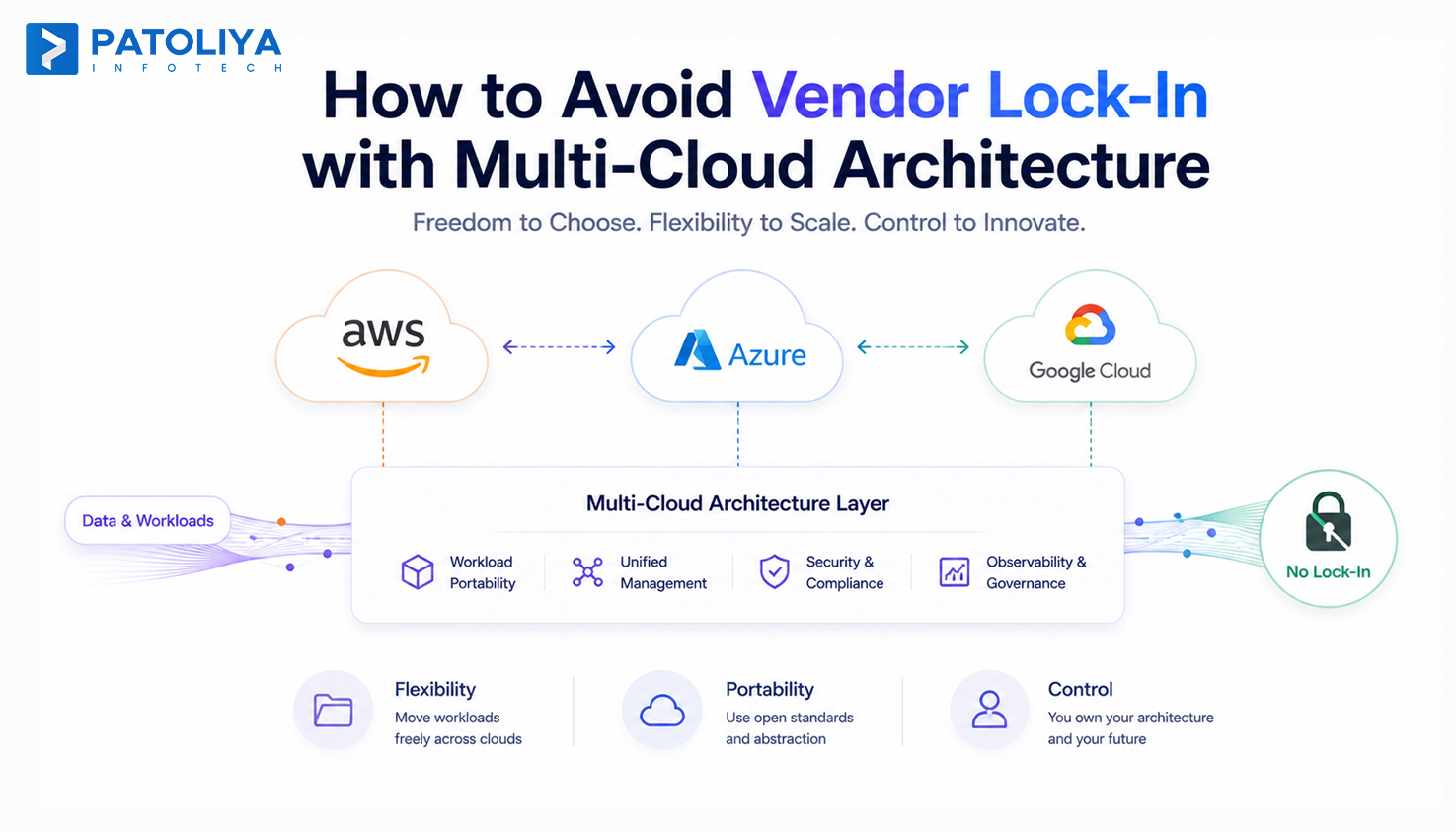
Before multi-cloud architecture, most enterprises ran single-cloud environments. That created deep dependency on one vendor's pricing and service roadmap. Multi-cloud architecture replaces that with optionality, the ability to move workloads, negotiate contracts, and design for failure across provider boundaries.
Hybrid cloud vs multi-cloud is the most misused comparison in cloud architecture. A hybrid cloud combines private on-premises infrastructure with a public cloud. A multi-cloud strategy uses two or more public cloud providers with no private infrastructure required.
| Hybrid Cloud | Multi-Cloud Strategy | |
| Infrastructure | Private + 1 public cloud | 2+ public clouds |
| Primary goal | Extend on-premises capacity | Avoid lock-in, optimize workloads |
| Best for | Regulated legacy workloads | Enterprise-scale distributed teams |
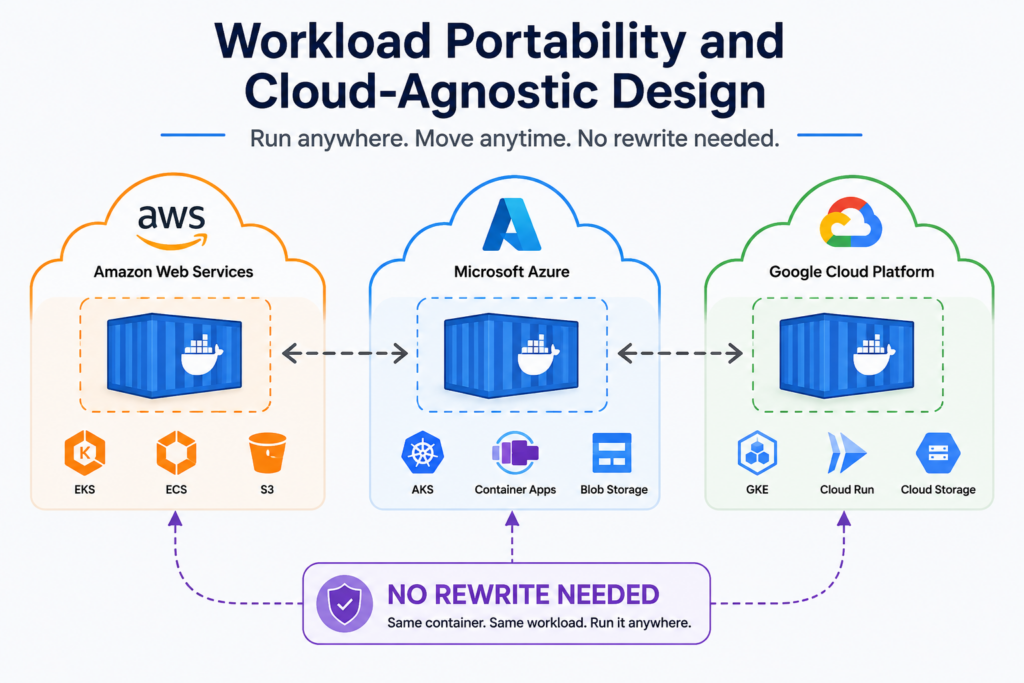
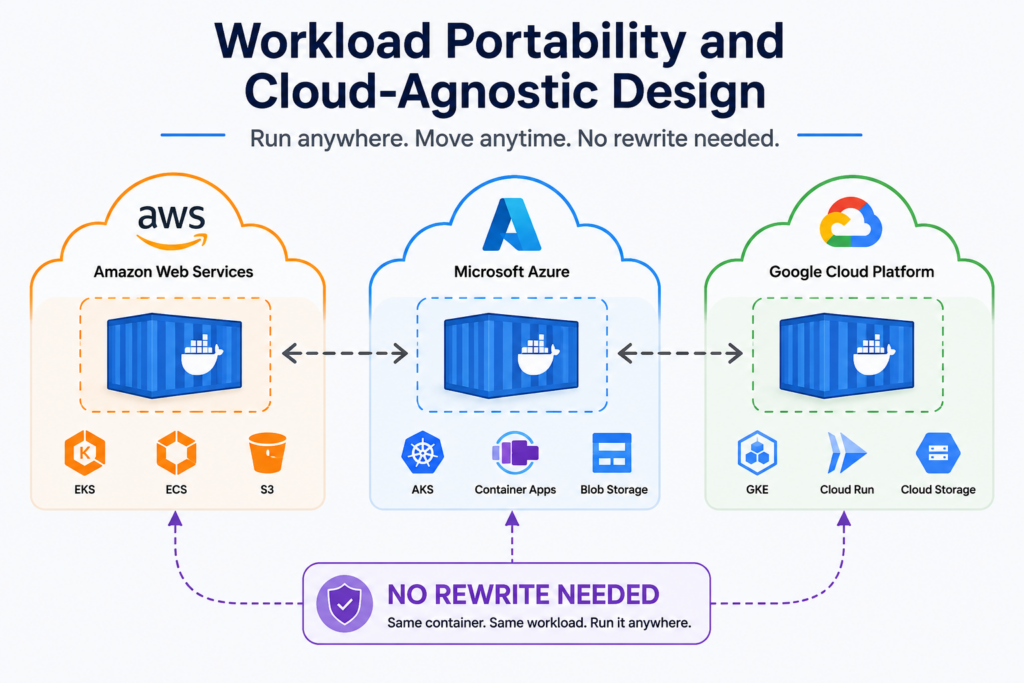
A functioning multi-cloud strategy starts with workload portability. Applications must be containerized or abstracted enough to run across providers without rewriting. Kubernetes is the standard layer for this. Without it, multi-cloud architecture becomes multi-cloud in name only; workloads still live on one provider indefinitely.
What cloud-agnostic design requires in practice:
Multi-cloud management requires a single pane of glass across all providers. That means unified logging, alerting, cost dashboards, and incident response. Tools like Datadog, Dynatrace, and HashiCorp handle multi-cloud management at the infrastructure layer.
For instance, A logistics company running AWS and Azure used separate monitoring tools per provider. Diagnosing a latency issue that crossed both environments took six hours. After unifying under Datadog, the same class of issue was resolved in 25 minutes.
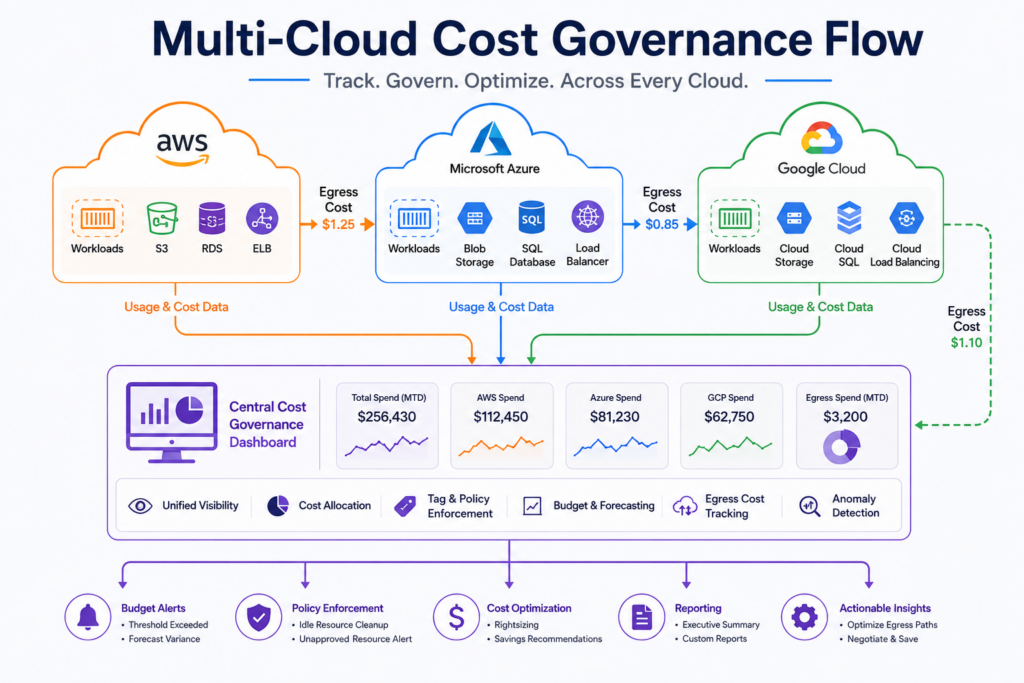
Cloud cost governance is where most multi-cloud strategy implementations either pay off or bleed out. Egress fees between providers are the most common surprise cost, often $0.08 to $0.09 per GB and rarely budgeted upfront. A FinOps function embedded in the multi-cloud architecture tracks spend per provider, per workload, and per team before costs compound.
Avoiding vendor lock-in cloud dependency is also a resilience decision. When one provider has a regional outage, workloads with cross-cloud failover keep running. A multi-cloud strategy with active-active or active-passive redundancy across providers delivers SLA commitments that no single-cloud architecture can match.
The most immediate financial benefit of avoiding vendor lock-in cloud dependency is contract leverage. When AWS knows your entire infrastructure runs on their platform, your renewal starts from zero optionality. A documented multi-cloud strategy with active workloads on a second provider changes that negotiation entirely.
For instance, A financial services firm running 80% AWS and 20% GCP used its GCP footprint as leverage during AWS contract renewal, securing a 22% cost reduction without moving workloads.
Avoiding vendor lock-in cloud commitment creates real negotiation power. Organizations with multi-cloud setups often achieve 15–25% better pricing at renewal than single-cloud teams.
No single cloud provider has uniform performance across every geography. A multi-cloud strategy routes workloads to the provider with the best regional performance and the correct data residency for compliance.
Common routing decisions in a mature multi-cloud management setup:
Avoiding vendor lock-in cloud constraints means you are never forced into a provider's weaker region when compliance requires specific geographies.
Each provider leads in specific capabilities. Multi-cloud management means selecting the best service for each workload rather than defaulting to one provider's second-best offering.
| Provider | Leads In |
| AWS | Serverless, storage breadth, ecosystem |
| Azure | Enterprise identity, hybrid integration |
| GCP | Data analytics, AI/ML pipelines |
A multi-cloud architecture designed around service strengths consistently outperforms a single-provider setup optimized around one vendor's catalog.
AWS us-east-1 has gone down. Azure had a global Active Directory outage in 2024. GCP has had multi-region storage incidents. Any multi-cloud strategy without cross-provider failover is a procurement decision dressed up as architecture.
For instance, an e-commerce firm relying only on AWS lost $1.2M during a four-hour outage. A competitor with multi-cloud and Azure failover recovered in minutes and kept selling.
AWS remains the default anchor for most multi-cloud strategy deployments. Its service catalog is the broadest, its third-party ecosystem is the deepest, and its global infrastructure covers more regions than any competitor. Multi-cloud management tooling integrates with AWS first in most cases.
Best AWS workload fits:
Azure is the natural choice for organizations running Microsoft 365, Active Directory, or Dynamics. Its hybrid integration capabilities are unmatched for enterprises with on-premises infrastructure. Multi-cloud management teams handling Windows-heavy workloads report significantly lower operational overhead on Azure than AWS or GCP.
For enterprises pursuing avoiding vendor lock-in cloud dependency on AWS, Azure is the most common second provider in a multi-cloud strategy.
GCP's BigQuery, Vertex AI, and Kubernetes Engine are best-in-class for data and ML workloads. At enterprise scale, GCP's sustained use discounts often deliver better unit economics than equivalent AWS or Azure services.
For instance, A media company moved its recommendation engine from AWS SageMaker to GCP Vertex AI. Same model performance, 31% lower monthly infrastructure cost. That is the multi-cloud architecture workload placement decision working as intended.
Workload allocation in a multi-cloud strategy follows three rules:
A cloud assessment and multi-cloud architecture design engagement costs $15,000 to $45,000. This covers current-state audit, workload classification, provider selection, and a documented multi-cloud strategy roadmap. Expect 6 to 10 weeks for a thorough assessment with a qualified partner.
Full multi-cloud strategy implementation of workload migration, multi-cloud management tooling setup, FinOps integration, and security baseline runs $60,000 to $200,000, depending on workload complexity and compliance requirements.
What drives the implementation cost up:
Ongoing multi-cloud management runs $5,000 to $25,000 per month, depending on environment complexity and SLA requirements. This covers monitoring, cost optimization, patching, and incident response across all providers in the multi-cloud strategy.
The fastest ROI from a multi-cloud strategy comes from contract renegotiation and workload right-sizing. Moving even 15 to 20% of workloads to a second provider creates enough optionality to reduce primary provider costs meaningfully. Multi-cloud architecture with FinOps integration compounds those savings quarterly as teams get better at placement decisions.
Cross-provider redundancy in a multi-cloud architecture lifts achievable uptime from 99.9% to 99.99% for critical workloads. For a $50M revenue business, that difference represents approximately $43,000 in prevented downtime cost per year before factoring in reputational impact.
A multi-cloud strategy with pre-built deployment templates and standardized pipelines reduces provisioning time from days to hours. Development teams waiting on infrastructure provisioning lose delivery velocity fast. Pre-approved templates in a multi-cloud strategy deliver the same velocity benefit that golden paths deliver for software teams.
Avoiding vendor lock-in cloud commitments means you are never forced to over-provision on one provider to hit discount thresholds. At 1,000+ virtual machine equivalents, that workload placement flexibility delivers 10–15% cost savings by matching workloads to spot pricing availability across providers.
A multi-cloud strategy adds operational surface area fast. Two providers mean two IAM systems, two billing portals, and two support contracts. Without strong multi-cloud management tooling, complexity compounds faster than benefits arrive.
Signs your team is under-resourced:
Security misconfiguration is the leading cause of cloud breaches. GartnerThe right multi-cloud architecture partner determines whether the operating model delivers its financial and technical ROI.The right multi-cloud architecture partner determines whether the operating model delivers its financial and technical ROI. estimates 99% of cloud failures are customer-caused. A multi-cloud architecture across two providers doubles the configuration surface. Multi-cloud management requires one unified security posture, not two programs running in parallel.
Avoiding vendor lock-in, cloud data gravity is harder than avoiding compute lock-in. Large datasets in one provider's native format are expensive to move. Design data residency requirements into your multi-cloud strategy from day one while avoiding vendor lock-in cloud. Retrofitting costs significantly more.
Committed use discounts across two providers create overlapping obligations. A multi-cloud strategy without FinOps oversight pays penalties on one provider while overspending on-demand on another. Cloud financial management is not optional at scale.
Before signing any contract for multi-cloud strategy implementation, confirm:
Capability
Implementation
Adoption
A vendor that leads with migration volume rather than multi-cloud architecture outcomes is optimizing for their revenue, not your resilience.
A global systems integrator delivering enterprise-scale multi-cloud strategy programs across AWS, Azure, and GCP for Fortune 500 organizations with complex compliance and governance requirements.
Key Features:
Best For: Large enterprises needing a full-scale multi-cloud strategy transformation with global delivery capacity.
Client Review: 4.6/5
A managed services provider specializing in ongoing multi-cloud management operations across AWS, Azure, and GCP with 24/7 support coverage and a strong track record in post-migration operations.
Key Features:
Best For: Organizations that want a production-ready multi-cloud strategy managed externally rather than built internally.
Client Review: 4.5/5
A migration-first cloud consultancy with a structured methodology for multi-cloud strategy implementation and a strong track record in phased workload assessment and migration.
Key Features:
Best For: Mid-to-large enterprises at the beginning of a multi-cloud strategy journey, needing a structured migration methodology.
Client Review: 4.4/5
Overview: A mid-market cloud architecture partner delivering practical multi-cloud strategy implementations for engineering-led organizations that need production outcomes, not strategy decks.
Key Features:
Best For: Mid-market organizations of 50 to 500 engineers needing a documented multi-cloud strategy delivered in weeks, not quarters.
Client Review: 4.8/5
Patoliya Infotech builds multi-cloud strategy implementations that engineering teams actually operate, not architecture documents that sit in a shared drive six months after engagement close.
Three things that make their work different:
If your cloud spend grew faster than your engineering headcount last year, that is the signal. Let's look at what a scoped multi-cloud strategy assessment reveals about your current architecture.
Multi-cloud strategy has moved from a competitive differentiator to an operational baseline. Organizations still running single-cloud architectures are accepting unnecessary cost, compliance, and resilience risk. The right multi-cloud architecture partner determines whether the operating model delivers its financial and technical ROI or creates a more complex version of the same problems.
Evaluate vendors on certified multi-provider capability, FinOps integration, and transparent engagement models. Avoiding vendor lock-in cloud dependency is not a one-time migration; it is an ongoing architectural discipline. To get a scoped assessment of your current cloud architecture, let's start a conversation with Patoliya Infotech's cloud team today.