Table of Contents
The impact of a wrong SaaS architecture doesn’t appear immediately in sprint results. It shows up as a $300,000 rearchitecting project eighteen months after launch, when the compliance audit fails, or the system degrades under load.
The global SaaS market reached $317.55 billion in 2024 and is projected to hit $1.22 trillion by 2032, as reported by Vena Solutions, 2025. Most new builds entering that market make the same planning error. SaaS application architecture decisions get finalized in a two-hour technical meeting, while business requirements, compliance scope, and scale trajectory remain undefined in cloud-based SaaS development.
Wrong tenancy model selection creates compliance exposure. A wrong design framework creates scalability challenges that cannot be patched. A wrong SaaS cloud infrastructure setup creates cost overruns that compound every month. This blog covers SaaS architecture types, deployment models, costs, ROI calculation, risks, and vendor selection so decision-makers in cloud-based SaaS development can make choices that hold at scale.
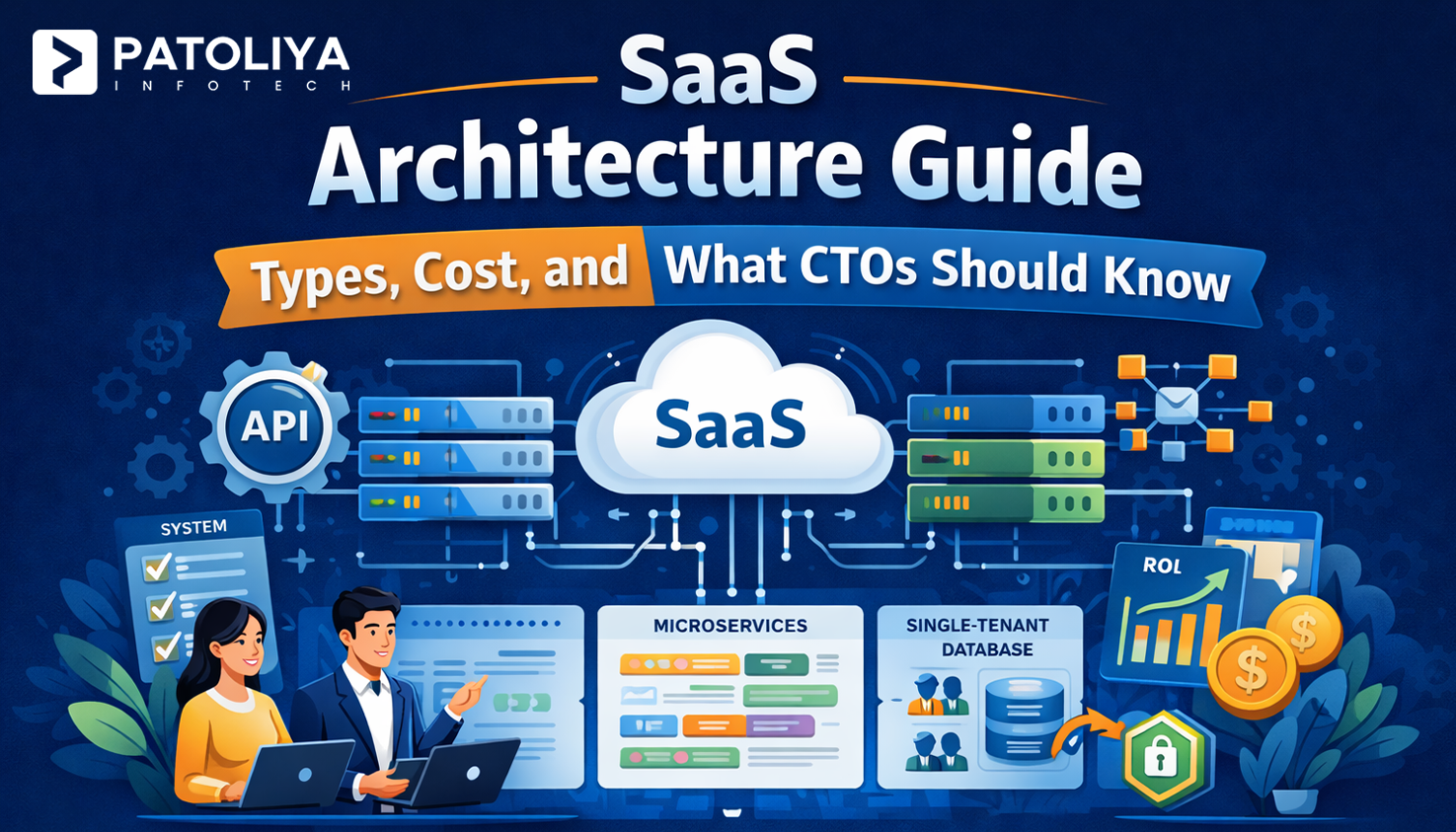
SaaS architecture is the structural design governing how a cloud-based software application is built, deployed, and accessed via the internet across different SaaS deployment models. It covers every layer from infrastructure to security, not just where the application lives.
Most teams confuse SaaS application architecture with cloud hosting. Hosting is one input. SaaS architecture determines how customer data is isolated, how the system scales under load, how integrations connect, and how the application recovers from failures. These are four separate decisions that affect cost, compliance, and release velocity in different ways of SaaS platform architecture within cloud-based SaaS development.
The core components of SaaS architecture are:
SaaS architecture is a set of layered decisions that collectively determine what your product can and cannot do in two years of cloud-based SaaS development across evolving SaaS deployment models.
The type of SaaS architecture your team selects shapes total cost of ownership, compliance readiness, and how fast you can respond to customer demand across different SaaS deployment models. There is no default right answer for SaaS platform architecture.
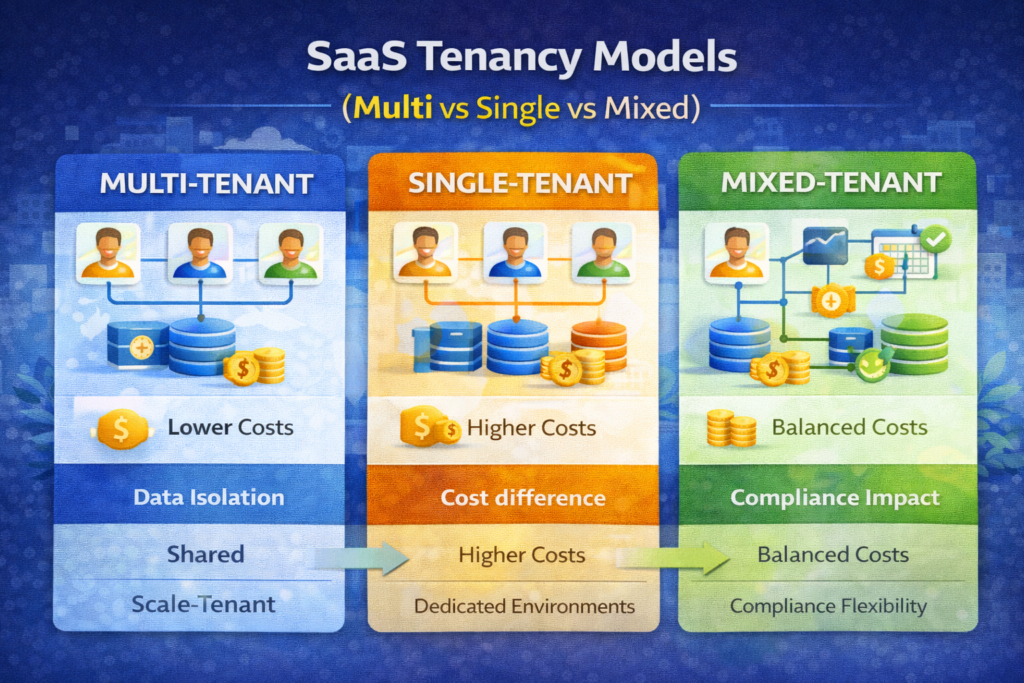
Multi-Tenant SaaS Architecture:
Multi-tenant SaaS architecture runs multiple customers on one shared application instance, with data kept logically separate in the SaaS application architecture. Microservices Saas delivers the lowest per-user infrastructure cost and works best for high-volume, standardized software with low customization depth.
The risk most teams underestimate is logical separation. In regulated industries, logical separation alone fails compliance audits that require demonstrable data residency. Teams choosing multi-tenant SaaS architecture for enterprise buyers must document database-level isolation controls before signing contracts.
Single-Tenant Architecture:
Each customer gets a dedicated environment with their own server, database, and application instance. Single-tenant vs multi-tenant saas architecture determines how much control you have over compliance, data isolation, and the level of customization your product can support as it scales.
BFSI, government, and healthcare buyers mandate single-tenant deployments because data residency laws require physical isolation. Infrastructure spend runs 30 to 50 percent higher than multi-tenant. This SaaS platform architecture cost is justified when the contract at risk is a regulated enterprise deal requiring demonstrable separation.
Mixed-Tenant Architecture:
The application layer is shared within the SaaS application architecture. Each tenant has a dedicated database layer in SaaS architecture. This ensures complete data isolation, stronger compliance control, and reduced risk of cross-tenant data exposure.
Mixed-tenant SaaS deployment models balance cost efficiency with compliance needs. This SaaS platform architecture is a practical default for SaaS companies serving both SMB and enterprise customers from a single codebase.
Monolithic Architecture:
A single codebase handles the entire application. Faster to build at the MVP stage, harder to scale beyond a few thousand concurrent users. One service failure cascades across the whole system. Teams using monolithic design need a documented migration path before they urgently need it for SaaS application architecture.
Microservices SaaS:
Independent services are deployed and scaled separately. Microservices SaaS architecture carries higher DevOps overhead upfront but delivers strong fault isolation and release velocity. The global microservices architecture market reached $6.27 billion in 2024, growing at 18.8 percent year over year, as per KITRUM, 2026. Preferred for large-scale SaaS platform architecture where release speed is a competitive variable.
Serverless Architecture:
No infrastructure management is required for SaaS application architecture. Serverless architecture auto-scales for fluctuating and event-heavy workloads in cloud-based SaaS development. Debugging complexity increases significantly across distributed cloud functions in SaaS architecture. Best for teams where infrastructure management capacity is limited for SaaS deployment models.
Event-Driven Architecture:
Services communicate through events and state changes. Event-driven architecture enables real-time processing and high responsiveness in cloud-based SaaS development. One misconfigured event chain can trigger cascading failures across dependent services. Governance over event schemas is mandatory before this runs in production.
Horizontal SaaS architecture serves broad, industry-agnostic markets. Salesforce for CRM and Slack for collaboration are the reference cases. Vertical SaaS targets niche and industry-specific segments. The vertical SaaS market was valued at $106.05 billion in 2024, growing at a 16.3 percent CAGR through 2033, according to Bosson Research, 2024. Vertical-focused companies report slightly higher growth rates (31 percent) than horizontal peers (28 percent) per Vena Solutions.
A well-structured SaaS application architecture produces six business outcomes that affect cost, speed, and compliance posture at every growth stage. The SaaS platform architecture type determines which of these benefits your team actually receives.
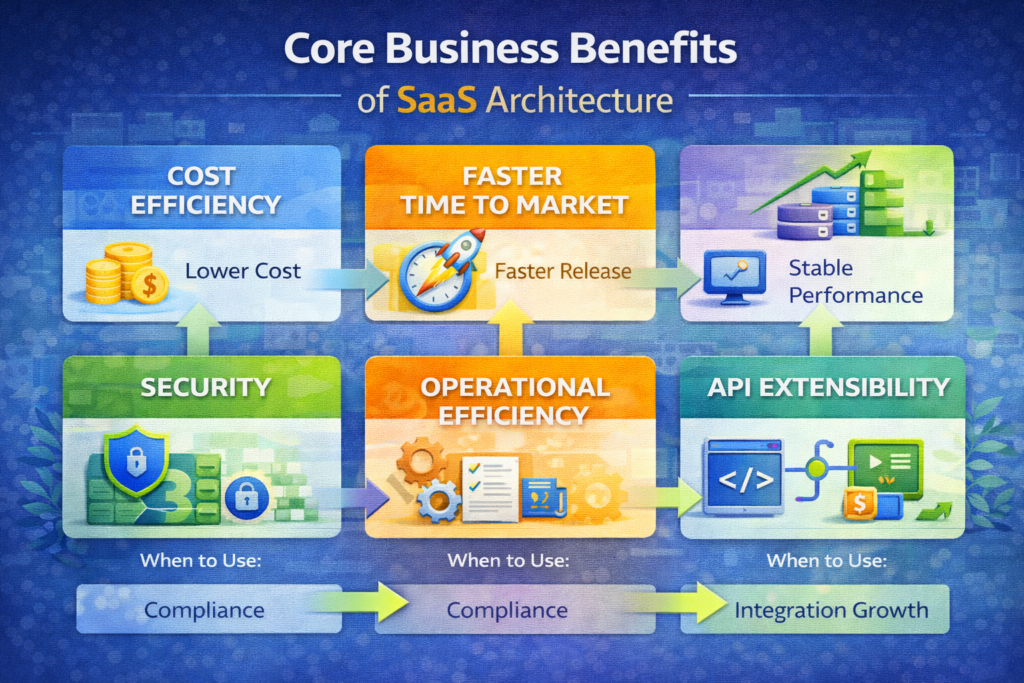
Predictable infrastructure costs
Usage-based billing replaces the fixed server spend of the SaaS architecture. In well-designed SaaS application architecture and cloud-based SaaS development, costs scale with actual user growth, not pre-purchased capacity based on unreliable projections.
Faster time to market
Pre-built SaaS cloud infrastructure layers reduce setup time from months to weeks. Engineering teams start building product logic instead of configuring servers and managing base infrastructure.
Operational efficiency
The provider handles patching, uptime, and system updates in the SaaS platform architecture. Internal IT teams can focus on higher-value initiatives, as time and resources are no longer consumed by maintenance cycles that do not contribute to revenue growth.
Dynamic scalability
Vertical and horizontal scaling keep performance stable under demand spikes. Microservices SaaS architecture allows individual services to scale independently, so a billing service spike does not force scaling the entire application or SaaS deployment models.
Compliance and security by design
Encryption, role-based access controls, and disaster recovery are built into the SaaS application architecture layer. Retrofitting compliance after launch costs significantly more and takes longer. This is the argument for compliance-first design in regulated industries.
API extensibility
API-based integration connects the product to third-party systems without rebuilding custom connectors for each new integration. The SaaS platform architecture decision made here determines how fast your ecosystem grows.
The architecture type chosen determines which of these six benefits materialize in practice versus which ones require expensive retrofitting later in Cloud-based SaaS development.
The right SaaS architecture model depends on user volume, compliance requirements, customization depth, and long-term cost tolerance. Use this table as a starting filter before detailed technical scoping.
| Architecture Model | Best For | Cost Level | Scalability | Security Isolation | Compliance Readiness |
| Multi-Tenant | SMBs, high-volume SaaS | Low | High | Logical only | Moderate |
| Single-Tenant | Enterprise, regulated sectors | High | Moderate | Full isolation | High |
| Mixed-Tenant | SMB with Enterprise hybrid | Medium | High | Partial | High |
| Monolithic | Early-stage MVPs | Low | Low | Depends | Low |
| Microservices | Large-scale platforms | High | Very High | Service-level | High |
| Serverless | Event-driven, unpredictable loads | Variable | Auto | Depends | Moderate |
No single SaaS model fits every case. The most expensive saas deployment models mistake comes from following competitors instead of aligning with your compliance requirements and future scale trajectory.
Understanding the costs of SaaS application architecture across each model is the next step before any architecture decision is finalized for cloud-based SaaS development.
SaaS deployment models directly influence the cost of building a SaaS platform architecture in 2025. Building a SaaS platform architecture in 2025 costs between $60,000 for an MVP and $500,000 and above for an enterprise-grade product. That range is driven by architecture decisions, not just feature scope.
Key cost drivers in SaaS application architecture:
These categories appear after contracts are signed and account for most budget overruns.
Planning a SaaS architecture build and unsure which model fits your budget and compliance requirements? Connect with Patoliya Infotech's SaaS architects for a scoped assessment.
A structured SaaS application architecture decision produces measurable financial returns. The Microservices SaaS model chosen is the variable that determines whether those returns materialize or get consumed by rework costs.
Among organizations that performed an ROI analysis before implementation, 83 percent reported meeting their ROI expectations after going live for over a year, as per DocuClipper, 2025. Organizations modernizing to composable, cloud-based SaaS development environments realize up to 30 percent faster time-to-value and 20 percent higher process efficiency compared to teams on legacy systems, per Gartner's 2024 ERP Value Study.
ERP investments are increasingly justified by operational agility and decision intelligence, not just cost reduction, according to the Gartner 2024 ERP Value Study, cited in Rand Group
These four metrics map SaaS application architecture choices directly to business outcomes in cloud-based SaaS development and should be tracked from go-live forward.
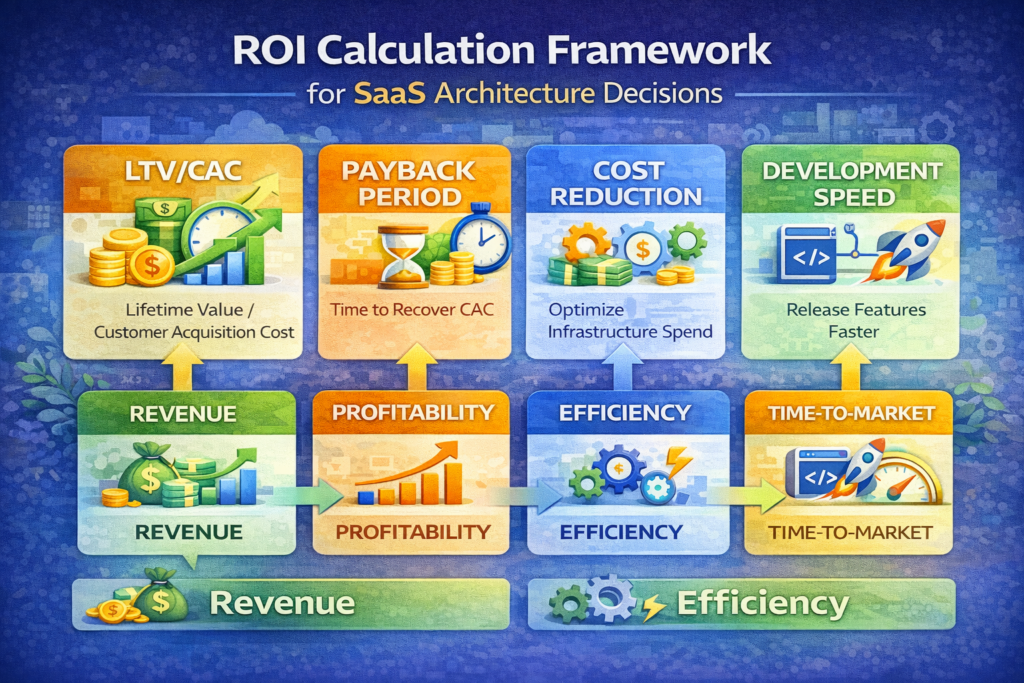
The following is the formula for the ROI return on investment calculator:
ROI = (Net Benefit / Total Cost of Ownership) x 100
Evaluate this across each architecture layer to get a more accurate view of SaaS platform architecture.
Every SaaS architecture decision carries a risk profile. These are the ones that produce real compliance damage and financial loss.
This checklist is a decision tool for CTOs and C-level buyers evaluating development partners before committing to any Microservices SaaS architecture build or migration. Apply it before signing.
| Questions | Why it matters |
| Does the vendor support both multi-tenant and single-tenant models, or only one? | A vendor who builds only one tenancy model directs every engagement toward that model, regardless of your compliance requirements. |
| Can they demonstrate data isolation at the database layer, not just the application layer? | Ensures true tenant separation; prevents cross-tenant data exposure risks. |
| Do they have defined RTO and RPO targets in their disaster recovery SLAs? | Clear recovery metrics indicate a reliable and tested recovery architecture. |
| What cloud providers do they support, and can they build cloud-agnostic SaaS deployment models? | Reduces future vendor lock-in and improves infrastructure flexibility. |
| Do they follow CI/CD deployment practices? | Release cadence reflects DevOps maturity and delivery consistency. |
| Can they provide SOC 2, GDPR, or sector-specific compliance documentation? | A compliance-first approach produces verifiable evidence. |
| What is their DevOps-to-developer ratio on SaaS builds? | Insufficient DevOps support leads to long-term architecture and operational debt. |
| Do they provide post-deployment architectural support or handoff only? | Lack of continued support shifts critical ownership without full context or accountability. |
We deliver complete SaaS architecture services from tenancy model selection through microservices SaaS deployment models and SaaS cloud infrastructure configuration.
What we deliver across SaaS architecture engagements:
If you are evaluating SaaS architecture options for a new build or platform migration, Patoliya Infotech offers a no-obligation architecture consultation to scope the right model for your requirements.
SaaS architecture is the business investment that determines your cost trajectory, compliance exposure, and release velocity for the next three to five years.
Three decisions anchor every microservices SaaS architecture evaluation within SaaS deployment models: the tenancy model determines data isolation and compliance posture, the design framework determines how fast you ship at scale, and the infrastructure layer determines what you pay as you grow.
Get all three right in the design phase, and the ROI case is clear for SaaS platform architecture. Defer them to the build phase, and they become expensive corrections.
If your team is evaluating SaaS architecture for a new build or a platform migration, Patoliya Infotech offers a no-obligation architecture consultation. Let's scope the right model for your requirements.