Table of Contents
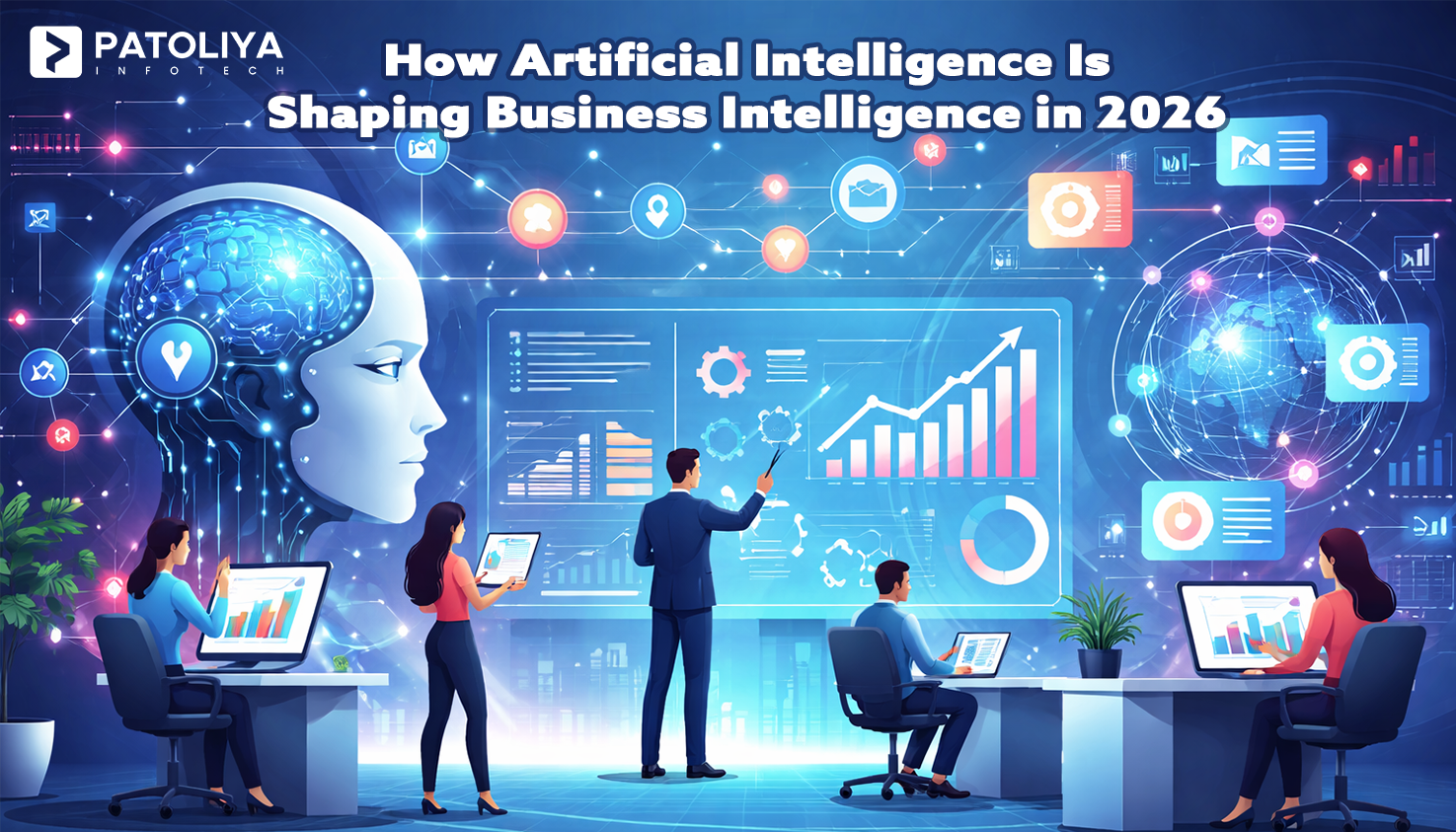
Data has always been the backbone of smart decision-making. Still, for decades, business intelligence meant looking backward at static dashboards, manual reports, and delayed insights, leaving leaders reacting instead of anticipating. Today, artificial intelligence business intelligence has rewritten those rules entirely.
The fusion of artificial intelligence for business intelligence with enterprise systems built through custom software development services is no longer a competitive advantage reserved for tech giants. It is quickly becoming the baseline expectation for any organization that wants to grow, adapt, and lead. From real-time anomaly detection to forward-looking forecasting, AI in BI is reshaping how companies interpret their data and act on it.
In this guide, you will learn what artificial intelligence business intelligence actually means in practice, the core technologies behind it, the measurable AI business intelligence benefits it delivers, and the honest challenges teams face when adopting it, along with actionable strategies to overcome each one.
Traditional business intelligence answered one question: what happened? It relied on structured queries, manual data pulls, and historical dashboards. Artificial intelligence business intelligence expands that scope dramatically, moving from descriptive reporting to predictive and prescriptive intelligence.
Modern AI powered analytics platforms now ask what will happen and what we should do about it, transforming Predictive analytics BI from a reporting tool into a strategic engine that drives real business outcomes.
Market conditions shift in hours. Customer behavior changes overnight. Legacy BI systems built for monthly reporting cycles simply cannot keep pace.
Artificial intelligence business intelligence delivers the speed and intelligence that modern enterprises require: automated pattern recognition, continuous monitoring, and dynamic dashboards updated in real time.
Organizations investing through structured IT consulting gain a measurable edge for business intelligence gain a measurable edge, responding to market signals faster, reducing decision latency, and converting raw data into high-confidence strategies with consistency and scale.
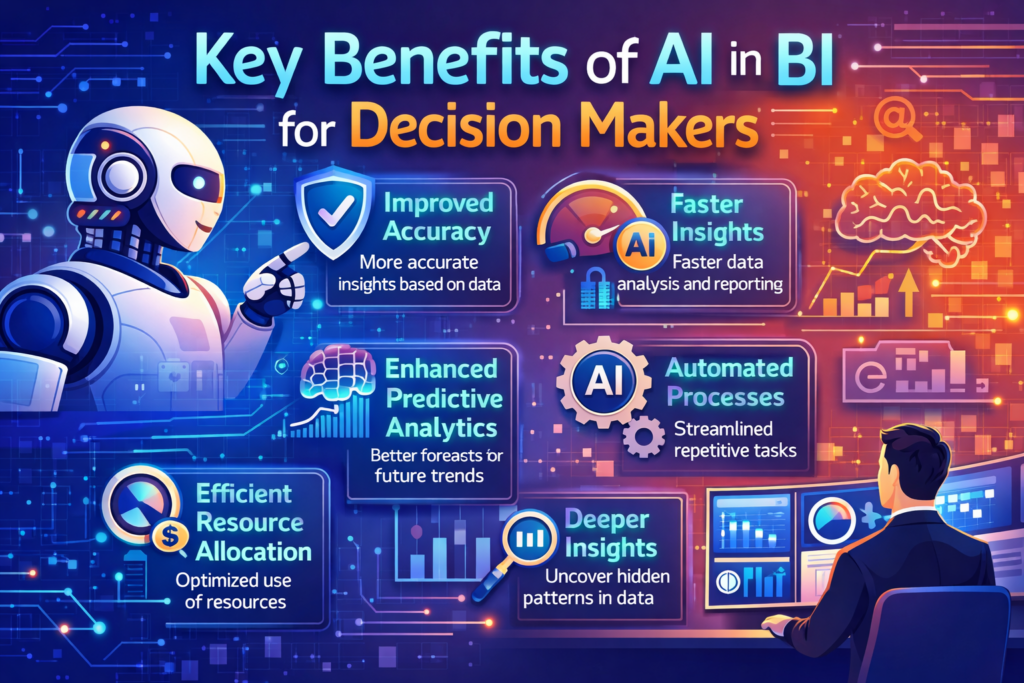
One of the most immediate AI business intelligence benefits is the elimination of manual reporting cycles. With AI in BI, dashboards refresh automatically, alerts trigger the moment a key metric deviates, and analysts shift from building reports to interpreting results.
Automated BI reporting of artificial intelligence business intelligence removes the human bottleneck entirely, giving decision-makers real time business insights through Predictive analytics BI they can trust and act on without waiting days for a scheduled report to land in their inbox. This alone represents a transformational shift in how organizations operate.
Beyond reporting, AI business intelligence benefits include the power to anticipate future outcomes and recommend the best course of action. Predictive analytics BI uses historical data patterns to forecast demand, churn, revenue, and risk. AI analytics projections indicate that by 2027, 50% of business decisions will be augmented or automated as highlighted in AI-driven analytics adoption reports.
Prescriptive analytics BI goes one step further; it doesn't just predict what will happen, it suggests what you should do next. Together, these capabilities make artificial intelligence business intelligence an indispensable strategic asset, helping executives make high-stakes decisions with confidence grounded in data rather than intuition alone.
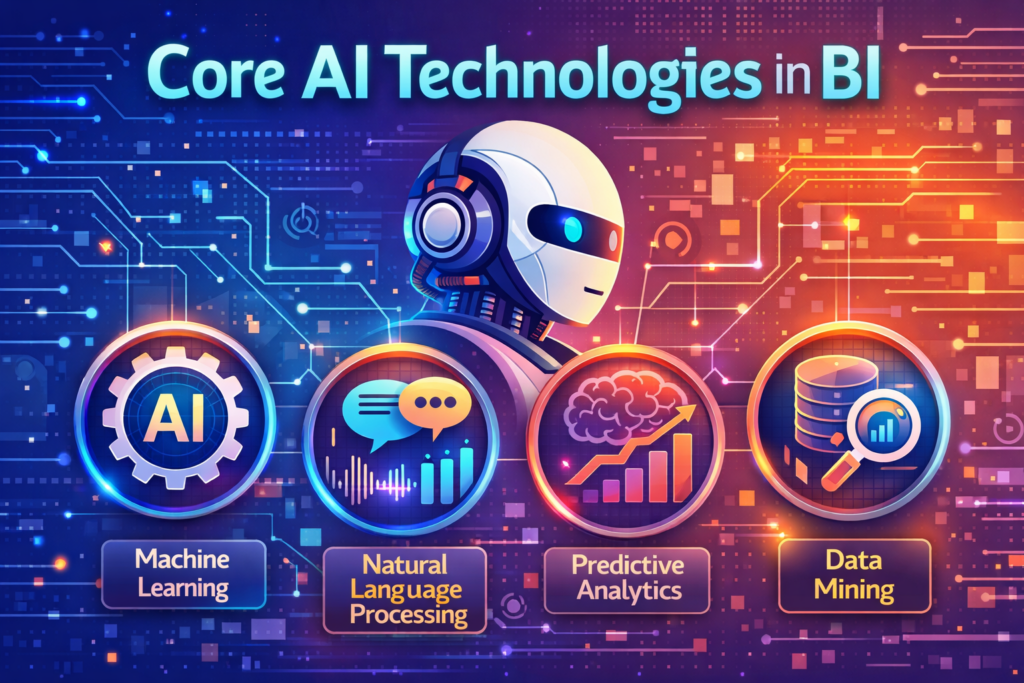
At the heart of artificial intelligence, business intelligence is Machine learning models (as defined in machine learning by IBM), often built through specialized AI development services, which learn continuously from new data from new data without being explicitly reprogrammed. These models detect patterns, identify anomalies, cluster customer segments, and refine their own accuracy over time as an AI business intelligence benefits.
Data driven decision making becomes genuinely powerful when machine learning underpins the Predictive analytics BI layer, because the system grows smarter with every data point ingested. Sales forecasting, inventory optimization, and fraud detection all rely on this core capability within modern artificial intelligence business intelligence platforms.
Natural language processing BI has made business intelligence accessible to non-technical users for the first time. Instead of writing SQL queries or navigating complex dashboards, business users can now type or speak a plain-language question, and the artificial intelligence business intelligence system returns a chart, a table, or a narrative summary.
Conversational BI interfaces powered by generative AI BI are democratizing data access across entire organizations. Predictive analytics BI is reducing dependency on data teams and accelerating the speed at which insights reach the people who need them most.
Financial institutions are among the earliest and most aggressive adopters of artificial intelligence business intelligence. Banks and investment firms use AI in BI to monitor transaction anomalies, assess credit risk in real time, and model exposure across diverse portfolios.
As an AI business intelligence benefits, Predictive analytics BI enables finance teams to anticipate liquidity crunches, flag regulatory compliance issues before they escalate, and generate audit-ready reports automatically.
The result is a risk management function that is proactive rather than reactive, a direct outcome of embedding artificial intelligence business intelligence into core financial operations.
Marketing teams that leverage AI business intelligence benefits gain an extraordinary view of customer journeys. Artificial intelligence business intelligence platforms analyze behavioral signals across touchpoints like website visits, purchase history, support interactions, and social engagement to predict churn probability, identify upsell opportunities, and personalize campaigns at scale.
Predictive analytics BI allows marketing leaders to allocate budgets toward the highest-converting segments before a campaign launches, rather than analyzing results after the budget is spent. This forward-looking capability makes AI in BI one of the highest ROI investments in the modern marketing stack.
| Function | AI in BI Use Case | Business Impact |
| Finance | Fraud detection, credit risk modeling | Reduced financial risk, faster decisions |
| Risk Management | Compliance monitoring, anomaly detection | Proactive risk mitigation |
| Marketing | Customer segmentation, churn prediction | Higher ROI on campaigns |
| Customer Insights | Behavior analysis across touchpoints | Personalized user experiences |
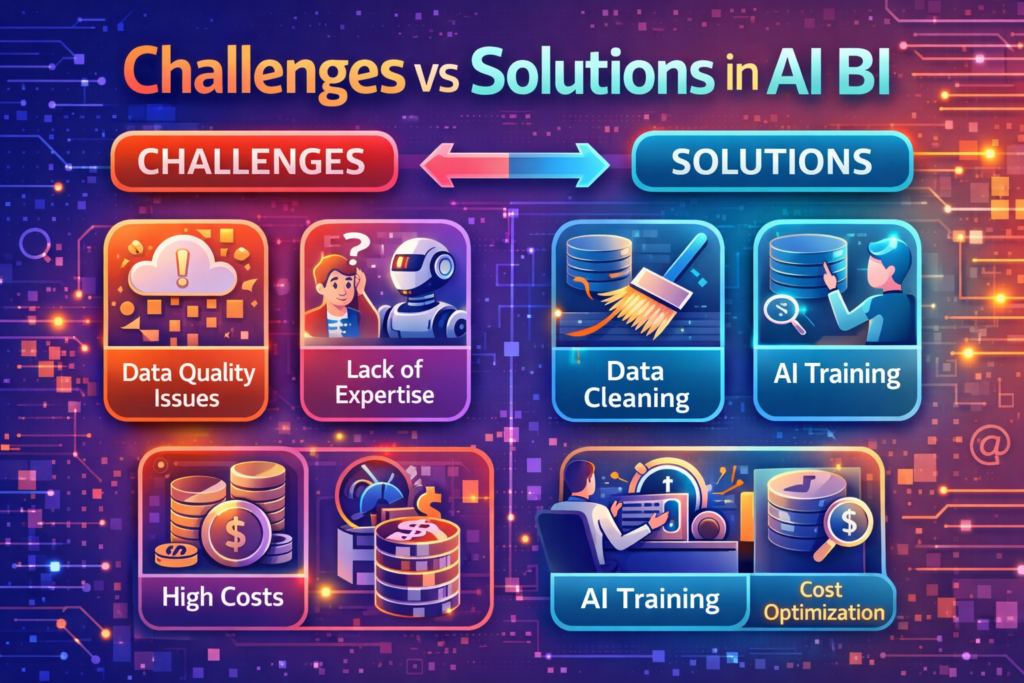
We deliver artificial intelligence business intelligence solutions built for real business impact. With a team of experienced data engineers, AI architects, and BI consultants, Patoliya Infotech transforms fragmented raw data into structured, actionable intelligence that executives can trust and act on immediately.
What sets us apart is a commitment to tailored solutions. Rather than deploying off-the-shelf tools, the team designs artificial intelligence business intelligence architectures specific to each client's industry, data maturity, and strategic goals. Whether you are a mid size enterprise building your first predictive dashboard or a large organization consolidating multiple data sources into a unified intelligence layer, Patoliya Infotech delivers measurable outcomes.
Clients across finance, retail, and healthcare report faster decision cycles, improved forecast accuracy, and significant reductions in reporting overhead after partnering with Patoliya Infotech for artificial intelligence business intelligence implementation. The company's approach, combining technical depth with business domain expertise, makes it a trusted long-term partner for organizations serious about data driven decision making and sustainable analytics growth.
Artificial intelligence business intelligence is not a future investment; it is a present-day strategic imperative. Organizations that integrate AI in BI stack gain the speed, precision, and foresight to compete in markets that reward fast, accurate decisions. From real-time dashboards and predictive analytics BI to natural language querying and prescriptive recommendations, artificial intelligence for business intelligence delivers value across every layer of the enterprise through AI business intelligence benefits.
The path forward is clear: audit your current data infrastructure, identify where AI can augment your existing BI capabilities, and partner with experts who understand both the technology and your business context. The organizations building their artificial intelligence business intelligence foundation today will be the ones setting the pace tomorrow. Now is the time to act.