Table of Contents
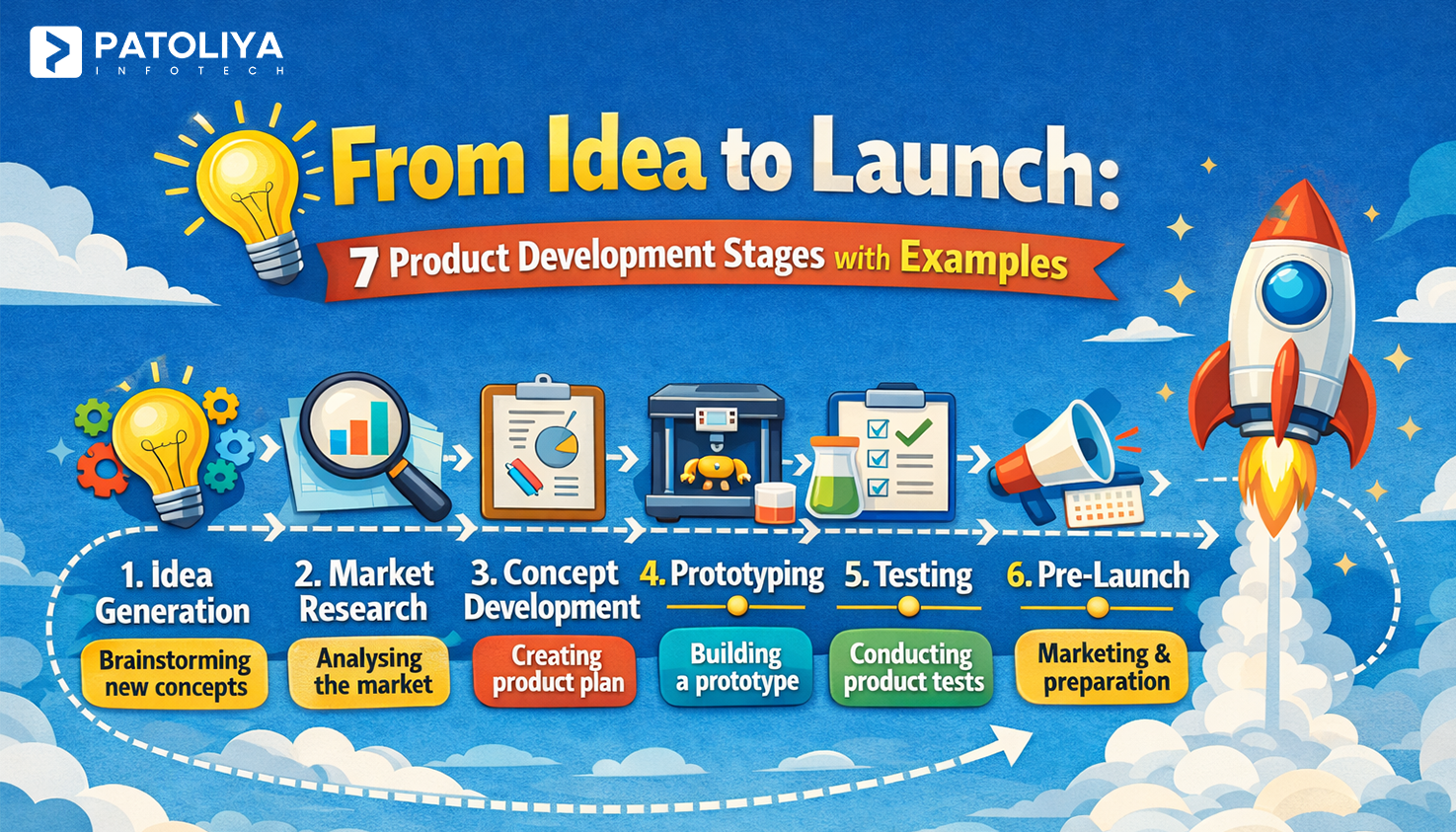
66% of new products fail within two years of launch. The reason behind the majority of these failures is the skipping or rushing through the various product development stages, not the execution or the idea itself. New product development teams that utilise a structured approach supported by proven product engineering services frameworks achieve 2.5 times more success than those that don’t. This guide will outline all 7 stages of product development, helping you understand how an IT software development company approaches structured product building from idea to launch.
Product development stages are structured phases that guide a product from idea to launch, helping businesses reduce risk, validate assumptions, and control costs at every step.
These frameworks are often implemented through modern custom software solutions that align business goals with technical execution. Each stage serves to filter risk, validate assumptions, and minimise the cost of failure before it grows.
The new product development (NPD) process differs from general product improvement processes. NPD focuses on introducing a new product, offering, feature set, or market entry, whereas improvement refines something that already exists. While both are important, the product development life cycle in NPD carries higher risk due to uncertainty and untested assumptions.
It is also important to note that product development stages are not strictly linear. Teams often move back and forth—for example, from prototype to concept testing or from market testing to business analysis. This iteration is intentional and a core part of an effective product development process.
| Approach | Description | Outcome |
| Structured stage-based process | Follows defined stages with clear checkpoints and consistency | ~2.5x higher success rate |
| Unstructured Process Without Defined Stages | Lacks structure, inconsistent execution, and outcomes | Baseline performance |
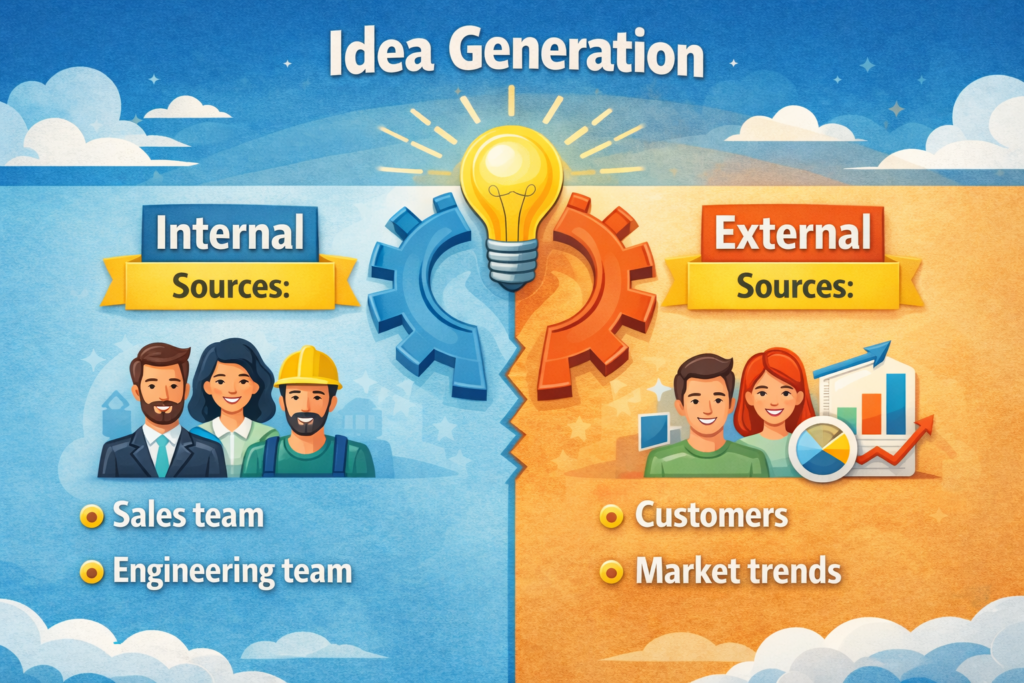
Every product development stage starts here. Idea generation draws upon two types of idea sources: internal and external.
Internal idea sources encompass the sales team identifying recurring objections. The engineering team identifies gaps in technology and support issues that have not been addressed in the product development life cycle.
For every 7 ideas developed in the new product development process, only 1 idea actually makes it to a successful launch. The sheer ratio of ideas to successful launches makes volume a key factor in the stages of product development.
Apple's idea for the iPhone did not come from one single idea. Apple developed the idea of combining three different products: a phone, a widescreen iPod, and an internet device, into one. Apple's idea was internal, yet it satisfied a very obvious need in the market.
In the new product development process, Idea screening helps filter out good ideas from the noise before investing time and effort in the stages of product development. Teams use scoring models, SWOT analysis, or weighted criteria matrices to assess ideas against three criteria for each idea: technical feasibility, market fit, and business alignment.
Few product teams report that customer feedback influences product development stages of the process only 30% of the time. The cost of fixing errors grows by up to 100x if this stage is skipped and errors are detected during development or post-launch.
| Screening Criteria | Questions to Ask |
| Technical feasibility | Can we build this with current resources? |
| Market fit | Does a proven demand exist? |
| Business alignment | Does it support our strategy and margins? |
This stage converts a screened idea into a specific concept. The result is not a piece of code or a prototype. Instead, it is a written answer to three questions: Who is it for? What problem does it solve? Why will people choose it over others?
Concept development is also a part of the product development stages framework. Here, performance requirements and technical approaches are also developed before any development work is done. Conducting a real-user test on a concept at this point in the process will cost almost nothing compared to a rebuild.
Netflix didn’t stop providing DVDs overnight. They tested their concept of a streaming service by rolling it out to a small segment of their subscribers before investing in infrastructure spend. This early validation approach is also critical in scalable systems like cloud native applications, where architecture decisions impact long-term performance.
Feasibility analysis is where the new product development process makes or breaks the budget. It consists of three aspects: financial analysis, risk evaluation, and a decision review phase to determine the next steps of the product development stages.
Financial analysis for these stages of product development consists of development costs, pricing potential, and ROI. Risk evaluation consists of regulatory issues, supply chain constraints, and resource availability in the product development life cycle.
Today, 43% of organisations utilise AI-assisted tools to evaluate feasibility analysis, thus speeding up feature prioritisation. Skipping this step has seen teams experience two things: Scope creep drives budget overruns, and delays launch.
| Analysis Area | Risk Without It |
| Financial assessment | Budget overruns and underpriced launches |
| Risk evaluation | Regulatory blocks and supply chain delays |
| Decision Gate for Progression | Uncontrolled continuation of non-viable projects consumes resources |
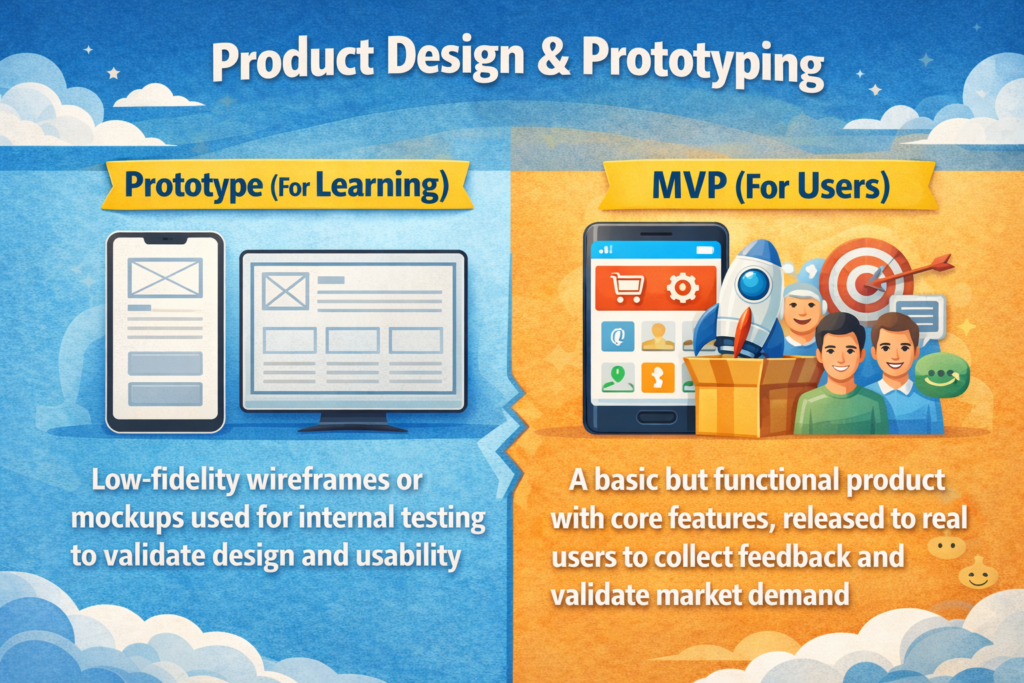
Product prototyping is not about creating a product during the product development stages. It is about creating the bare minimum required to validate initial assumptions and catch design problems before they become costly to correct.
The result of product prototyping in stages of product development is either a minimum viable product deployed to actual customers or a functional prototype developed for internal use to test usability and design logic. 83% of digitally mature companies use cross-functional teams, often supported by custom software development services and structured application development practices to accelerate prototyping, testing, and scalable product architecture.
The founder of Shwood created a prototype for wooden sunglasses by using a tree branch and some cabinet hinges, along with some thrift store glasses for the lenses. The cost of the materials was less than $5. The value of the learning, which showed that the idea held up structurally and attracted actual interest, far outweighed the cost of the materials.
The most common mistake made during these product development stages is scope expansion. All requests for features that are not directly associated with a learning objective should be denied.
The key difference between market testing and prototype testing lies in the fact that, in market testing, actual customers are involved in the entire product development life cycle.
At this point in the product development stages, the product is implemented for a particular set of target users. Feedback is gathered on the product’s usability, perceived value, and willingness to pay. It is also at this point where distribution and usage issues arise, which internal testing does not capture for stages of product development.
Ola Electric used market testing for electric scooters in some cities before launching them in the rest of India.
Digital teams that include market testing as part of the process cut time to market by 17 per cent compared to teams that do not conduct market testing before launching. At this stage, integrations between systems become critical, especially when products rely on API integration for real-time data flow.
Product commercialization is the last step in the product development stages, and perhaps the most mismanaged. Most development teams view it as the endpoint. Top development teams view it as a transition into a feedback loop.
A successful launch during the stages of product development also means that pricing, distribution, sales enablement, and marketing must be aligned before launch. After a launch, a product development life cycle continues, where usage data will inform the next version, support logs will indicate areas of friction, and retention metrics will indicate if the value proposition is working.
Netflix has employed a phased approach in penetrating new markets globally. All regions have been provided with localised content and infrastructural changes before the launch. This go-to-market strategy for product development stages has helped the company avoid the operational blunders of its competitors.
The leading product development teams have a 76% success rate. In the new product development process, Product development teams that consider product launches as a one-time event have an average of 51%. This 25 point difference is primarily because of post-launch process discipline.
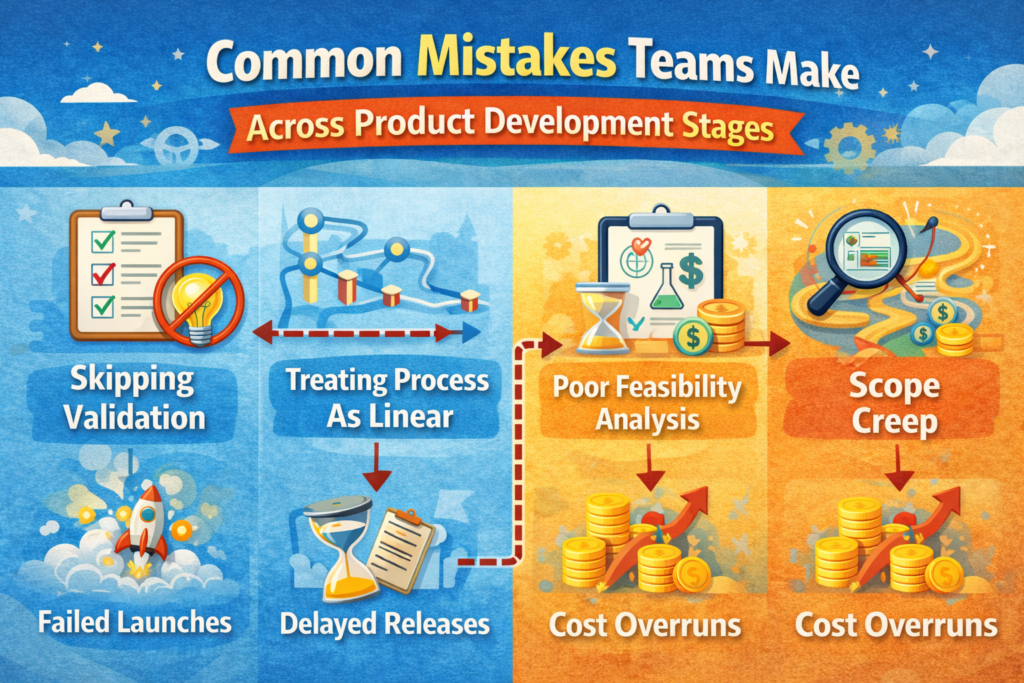
Jumping into the development phase without concept testing is the most expensive mistake in the new product development process.
Teams that skip idea screening and concept validation spend budget building features that consumers do not want and find out too late, after the product launch, when the cost is highest for stages of product development.
Real product development stages involve iterations. The team might finish prototyping, only to find out during user testing and validation that the original idea should be redefined.
If the NPD framework is treated like a one-time checklist, there will be guaranteed failures after launch, which should have been caught during Stage 2 or 3.
The two most common causes of product development stages being delayed before product launch are cost miscalculations and underestimated timelines.
Skipping validation also leads to issues later identified during software testing lifecycle phases.
| Aspect | Product Development Stages | Product Management | Key Difference |
| Scope and Accountability | Focuses on building the product from concept through launch | Oversees strategy, prioritisation, and the full product development life cycle beyond launch | Development = delivery; Management = complete ownership |
| Timeline | Ends at product launch | Continues across growth, iteration, and retirement | Development stops at launch; management continues throughout |
| Responsibilities and Activities | Ideation, prototyping, development, validation, release | Product Roadmapping, user research, feature prioritisation, performance tracking | Execution vs strategic oversight |
| Team Coordination and Feedback | Works with cross-functional teams during the build phase; limited feedback loop post-launch | Coordinates cross-functional teams throughout the product development life cycle and integrates continuous feedback | The feedback loop is owned and maintained by product management |
| Risks if Not Separated | Validation stages may be skipped; unclear ownership during build | Accountability gaps and weak feedback integration across teams | Lack of defined ownership impacts outcomes |
Patoliya Infotech supports product development by guiding startups and product teams through all seven stages, ensuring efficient execution, faster iteration, and reduced development risk.
We work with startups and product teams across all product development stages, helping them scale efficiently without slowing delivery timelines.
Our teams are cross-functional, with expertise in SaaS, fintech, healthtech, and ecommerce development, allowing parallel execution and reducing handoff friction in the development process.
Our distributed team model, including offshore development setups, enables faster iteration cycles and continuous development support.
Our process is driven by well-defined KPIs and validation frameworks, resulting in faster decision-making and more predictable outcomes.
If your team needs a structured review, an MVP sprint, or end-to-end execution across the product development lifecycle, we can define the approach through a focused discovery call.
Product failure rates is rarely a result of a bad product idea. It is a result of skipping product development stages, skipping validation, or failing to use the new product development process as a feedback system. Teams that follow all 7 stages of product development with discipline result in a 76% success rate, while those that do not average 51%.
If you are developing a new product and want a team that has successfully implemented all 7 product development stages, consider connecting with Patoliya Infotech for your next build.