Table of Contents
TL;DR: Nearshore software development wins when you need real-time collaboration and overlapping work hours with your engineering partner. Offshore wins when cost reduction matters more than speed of feedback. The right call depends on how fast your product needs to move, beyond your budget line alone.
Great outsourcing decisions are built on long-term value, strong collaboration, and reliable delivery. Companies now lean on nearshore software development and offshore development to fill skill gaps and ship faster, because local hiring pipelines stay slow and expensive.
The real decision point is not price per hour. It is whether your team needs daily, real-time collaboration or can run on async handoffs across a twelve-hour gap. This guide explains nearshore and offshore software development side by side, shows where each model actually wins, and gives you a framework to pick the right one in 2026.
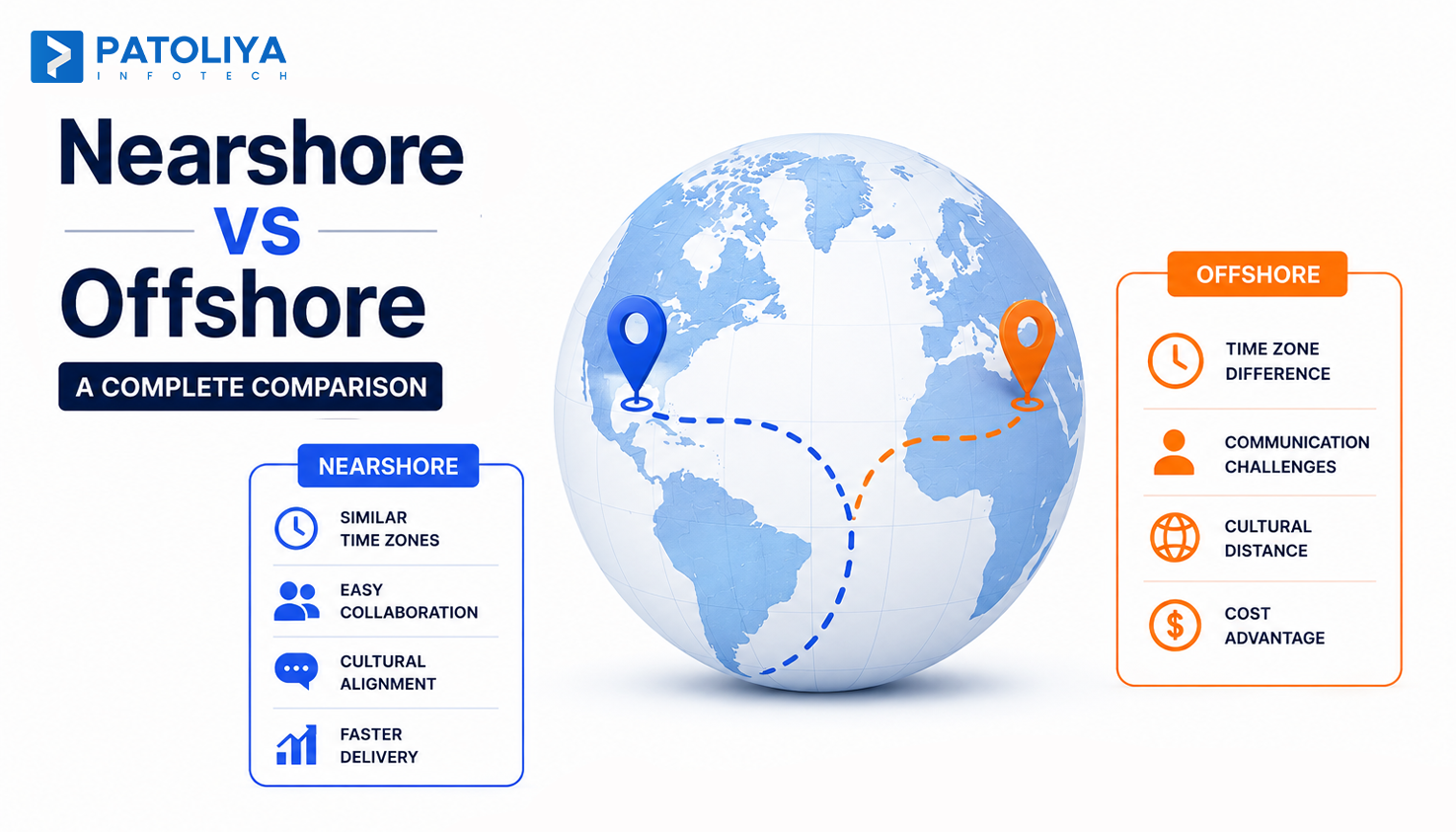
Nearshore software development means hiring engineering talent in a nearby country that shares a close time zone with your own. A US company working with a team in Mexico or Argentina gets several overlapping work hours every single day.
Offshore puts your team on the other side of the planet with little or no overlap, and onshore keeps everyone local at a much higher cost. Nearshore software development sits in the middle, trading some cost savings for daily collaboration that actually feels real-time.
Latin American talent serves US companies running nearshore software development through strong English skills and matching business hours, while Eastern European talent serves European companies through deep engineering experience and enterprise-grade delivery history.
Engagement usually takes one of three shapes: staff augmentation adds individual engineers to your existing team, dedicated teams give you a full squad working only on your product, and managed delivery hands an entire workstream to the vendor under one contract.
Founders are tired of waiting three weeks for an offshore standup reply. Nearshore software development closes that gap and keeps product velocity high without forcing a full-time zone sacrifice from either side.
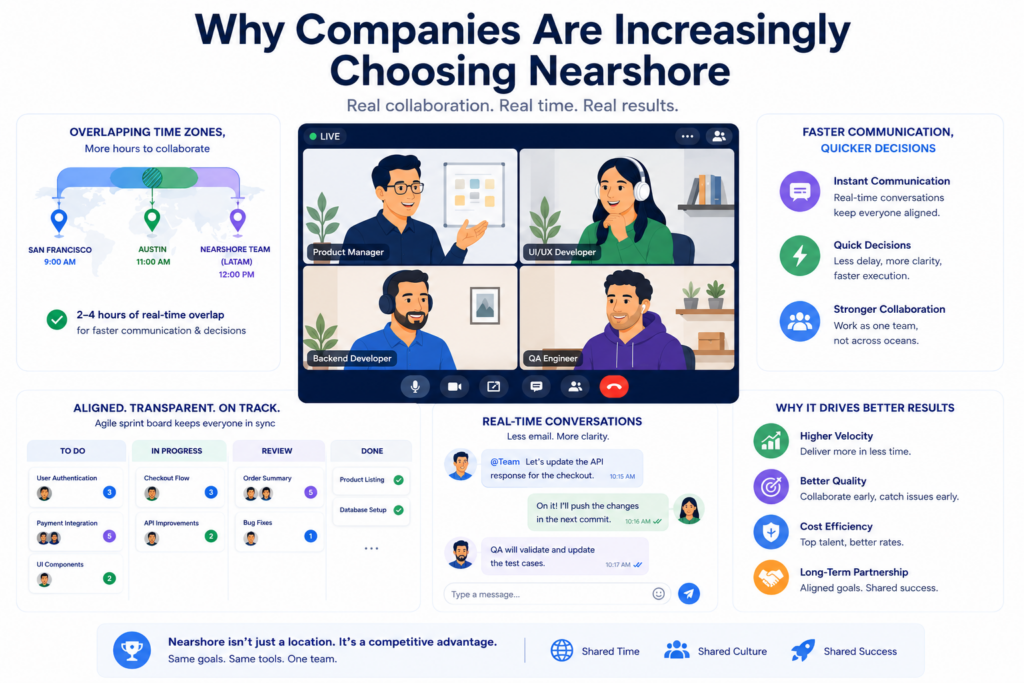
The nearshore vs offshore selection comes down to a handful of concrete factors that decide whether your delivery speed survives contact with reality.
Nearshore partners sit a few hours away by flight, which makes onsite visits realistic instead of a yearly budget fight, and flying out for a kickoff sprint builds real relationships fast.
Nearshore software development gives you four to eight overlapping hours daily with most Latin American or Eastern European partners. Offshore partners often sit a full day of travel away, and offshore teams in Asia frequently overlap with US hours for one or two hours at best.
Shared business culture and overlapping holidays reduce friction within nearshore software development partnerships, whereas offshore partnerships often require additional documentation layers to bridge cultural gaps in feedback and expectations. Offshore regions offer a larger raw talent pool because of population scale. Nearshore regions offer a smaller but highly specialized pool, often concentrated around specific tech hubs and universities.
Offshore remains the cheapest option on paper, while nearshore outsourcing charges a premium for the collaboration speed it delivers, and that premium often pays for itself once you count fewer rework cycles.
Nearshore outsourcing regions in Latin America increasingly align with US data-handling expectations, while offshore compliance varies widely by country and typically requires additional legal review before signing.
Comparison Table
| Factor | Nearshore | Offshore |
| Time Zone Overlap | High | Low |
| Communication Speed | Faster | Variable |
| Cost Savings | Moderate | Highest |
| Travel Convenience | Easy | Limited |
| Collaboration | Real Time | Async Heavy |
| Talent Pool | Regional | Global |
| Compliance Alignment | Easier | Depends on Region |
Nearshore vs offshore is not a question with one right answer. Nearshore wins for product teams that need fast feedback loops. Offshore wins for teams running large, well-defined backlogs that do not need daily syncing.
The biggest benefit of nearshore software development is collaboration speed, and that speed compounds into fewer mistakes, faster releases, and stronger product decisions over time.
A time zone alignment team turns blocked tickets into same-day fixes instead of next-day delays. That difference adds up to weeks of saved time across a year-long roadmap.
Nearshore software development earns its keep here. Teams run true agile ceremonies without recorded standups or midnight calls for either side, and that single shift changes how a sprint feels for everyone involved.
Nearshore software development costs more per hour than offshore work, but the total cost of ownership often comes out close once you count rework, delays, and management overhead.
Cost Comparison Table
| Cost Factor | Nearshore | Offshore |
| Hourly Rates | Higher | Lower |
| Project Management Overhead | Lower | Higher |
| Travel Costs | Moderate | Higher |
| Collaboration Costs | Lower | Higher |
| Rework Risk | Lower | Higher |
Nearshore software development costs run roughly 20 to 50 percent below an equivalent US hire while keeping daily collaboration intact, which is the math that wins most buyers over.
Nearshore software development fits best when your team cannot afford slow feedback loops, regardless of how attractive a lower offshore rate looks on a spreadsheet.
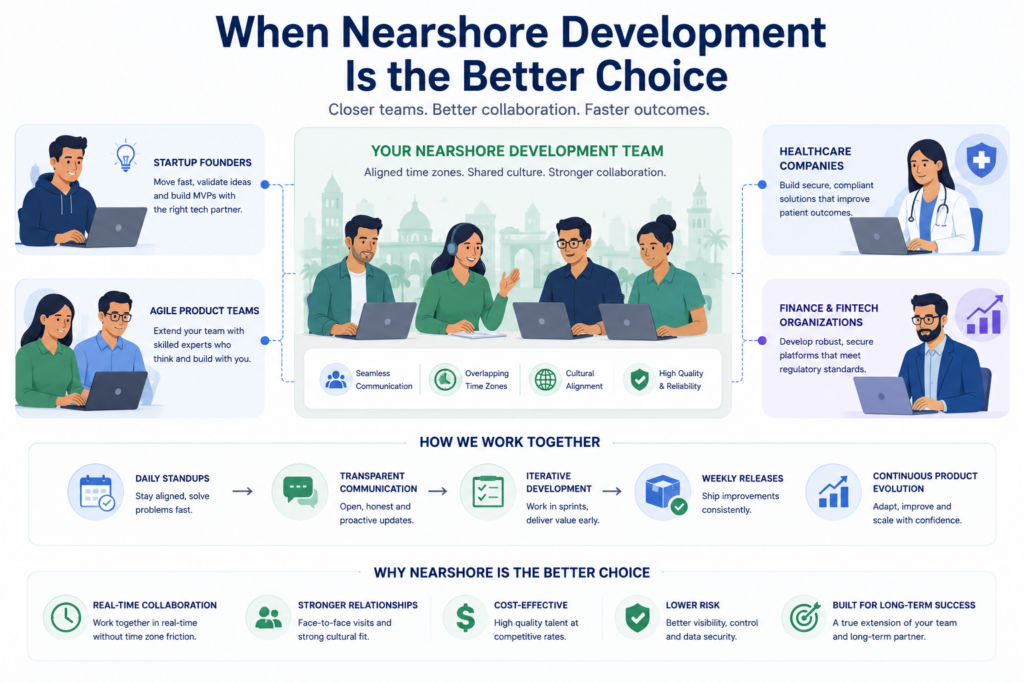
Startups and Fast-Moving SaaS Teams: Early-stage products pivot weekly, and nearshore software development keeps engineering in sync with constant product changes.
Weekly releases need real-time bug triage too, and nearshore support handles that pace without next-day delays.
Agile Teams and Regulated Industries: Daily standups only work when both sides are awake, and nearshore software development makes that the default instead of the exception.
Healthcare and finance teams need fast compliance conversations as well, and nearshore overlap speeds up legal and security reviews.
Long-term Ownership and Clear Signs to Switch: Teams planning years of ownership benefit from a nearshore development team that stays embedded in the product context instead of rotating off after a fixed scope ends.
If you are shipping weekly, your roadmap changes often, or your last offshore engagement failed because nobody was awake to answer a blocking question, that is your signal to switch.
Offshore development wins when the work is well defined, the timeline is flexible, and your internal team does not need the daily live syncing that nearshore software development provides.
Cost-Driven and Large-Scale Work: When budget is the single biggest constraint, offshore rates beat nearshore outsourcing on raw hourly cost almost every time. Offshore regions also offer bigger talent pools for staffing large teams quickly, often outpacing a typical nearshore outsourcing bench on raw headcount alone.
Stable Products, Flexible Timelines, and Async Teams: Stable products with predictable bug volume do not need the real-time syncing that active nearshore software development requires.
Work without a hard launch date can absorb slower feedback cycles without the urgency that active nearshore engagements demand, and Async teams already running detailed tickets adapt to offshore timing faster than teams used to live syncing.
Choosing the right structure inside nearshore software development decides whether the engagement scales smoothly or turns into a staffing headache by month six.
Individual engineers from a nearshore outsourcing partner slot into your existing team and report to your internal leads, filling specific skill gaps fast. Project-based delivery works differently. The vendor owns a fixed scope end-to-end in this nearshore software development model, useful for one-off builds with a clear finish line.
Dedicated teams work only on your product under your direction, functioning like an extension of your own nearshore development team. Some companies combine staff augmentation with a small dedicated core instead, balancing flexibility with continuity as headcount needs shift.
Picking the right nearshore development team comes down to checking actual delivery history instead of a slick sales deck or a long client logo wall. A dedicated team stays embedded in your product roadmap long term, building context that staff augmentation rarely reaches.
Latin America leads nearshore software development for US buyers through strong time zone overlap and rising English proficiency across major tech hubs like Mexico City and Buenos Aires.
Eastern Europe leads nearshore software development for European buyers through deep engineering talent and a long history of enterprise software delivery for global clients.
Comparison Table
| Region | Strengths | Typical Buyers |
| Latin America | Time zones, English proficiency | US startups |
| Eastern Europe | Engineering depth, enterprise delivery | Mid-market and enterprise |
| Asia Pacific | Cost efficiency | Global organizations |
Nearshore software development is not risk-free, and buyers who skip due diligence run into the same staffing and contract problems offshore buyers face.
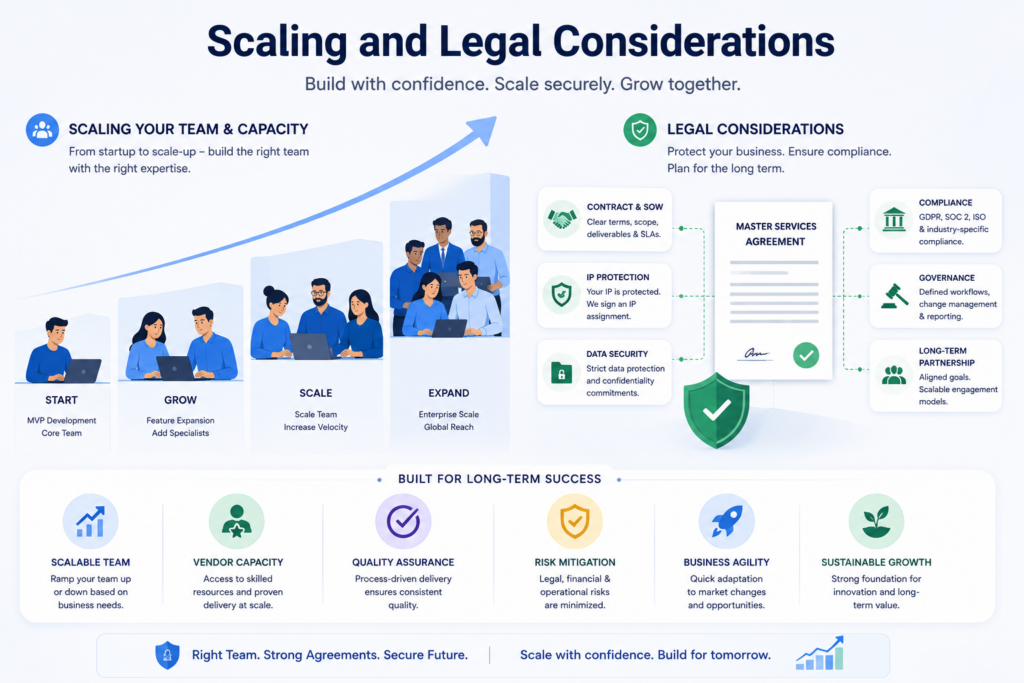
| Model | Best For | Cost | Collaboration | Scalability | Risk |
| Nearshore | Growth stage companies | Medium | High | High | Medium |
| Offshore | Cost optimization | Low | Medium | High | Medium High |
| In House | Core IP ownership | High | Highest | Low | Low |
Score each option against speed, cost, and control before picking a nearshore software development model, instead of defaulting to whatever a previous employer used. Contract flexibility and exit clauses matter more than the headline hourly rate during vendor negotiation, so weigh procurement terms as heavily as the rate card itself.
Companies choosing nearshore software development usually plan for continuous product evolution. When your roadmap extends beyond one release, it becomes less of a transactional decision and more of a long-term collaboration model with your engineering team.
Run through these ten checks before signing any nearshore software development contract.
| Company | Founded | Team Size | Regions | Pricing | Specialization |
| BairesDev | 2009 | 4000+ | Latin America | Premium | Enterprise software |
| CI&T | 1995 | 6000+ | LATAM | Enterprise | Digital transformation |
| N-iX | 2002 | 2000+ | Eastern Europe | Mid Enterprise | Product engineering |
| Future Processing | 2000 | 1000+ | Eastern Europe | Mid Enterprise | Custom software |
| Patoliya Infotech | Growing | Senior team | Multi region | Transparent | Product engineering |
A large-scale Latin American provider known for enterprise clients and broad nearshore software development capacity across many tech stacks.
Key Features: deep bench across stacks, enterprise account management, and regional coverage across most of Latin America.
Best For: large enterprises needing fast headcount at scale.
Client Review: 4.3/5 stars.
A long-running digital transformation partner with deep enterprise delivery experience across global accounts.
Key Features: enterprise-grade delivery process, global account coverage, strong project governance.
Best For: large transformation programs with long timelines.
Client Review: 4.4/5 stars.
An Eastern European product engineering firm known for strong technical depth on complex platforms.
Key Features: senior engineering talent, complex platform experience, strong technical leadership.
Best For: mid-market and enterprise teams hiring a nearshore development team for complex platforms.
Client Review: 4.5/5 stars.
A custom software partner running nearshore software development for European and US clients with a focus on long-term product ownership.
Key Features: long-term embedded teams, custom software focus, strong client retention.
Best For: companies wanting a long-term technical partner.
Client Review: 4.4/5 stars.
A product-focused nearshore software development partner built for founders who need a dedicated team that actually ships work instead of billing hours.
Key Features: senior engineers paired directly with your roadmap, transparent weekly communication, and flexible engagement models.
Best For: startups and growth-stage SaaS teams that need real collaboration speed.
Client Review: 4.7/5 stars.
Patoliya Infotech runs nearshore software development engagements around product outcomes instead of headcount, pairing senior engineers directly with your roadmap from week one.
If your last outsourcing engagement felt like a black box, book a short call with Patoliya Infotech and see how a real nearshore software development partnership actually runs.
Nearshore software development pays back through faster releases and fewer hiring delays, beyond the hourly rate printed on a vendor invoice.
Real-time collaboration cuts release cycles down because blockers get resolved the same day instead of the next morning, and engineers spend less time waiting on answers and more time shipping actual code.
Skipping a slow local hiring pipeline through nearshore outsourcing saves months of recruiting spend and lost opportunity cost, and dedicated nearshore development teams reduce burnout on stretched internal engineers covering gaps alone.
Shorter feedback loops inside nearshore software development translate directly into earlier launch dates, and adding nearshore capacity takes weeks instead of the months a local hiring search usually takes.
A few shifts are reshaping how teams buy and run nearshore software development heading into the next few years.
Nearshore wins when your product needs daily collaboration and fast feedback. Offshore wins when cost optimization matters more than overlap hours. Nearshore software development earns its premium through fewer mistakes and faster releases, beyond a lower invoice alone.
The real difference shows up in execution speed and how quickly your nearshore development team can iterate without communication gaps slowing things down. It’s not just about geography, but about how tightly your product decisions need to loop with engineering. Book a quick call with Patoliya Infotech and figure out which model actually fits your roadmap.