Table of Contents
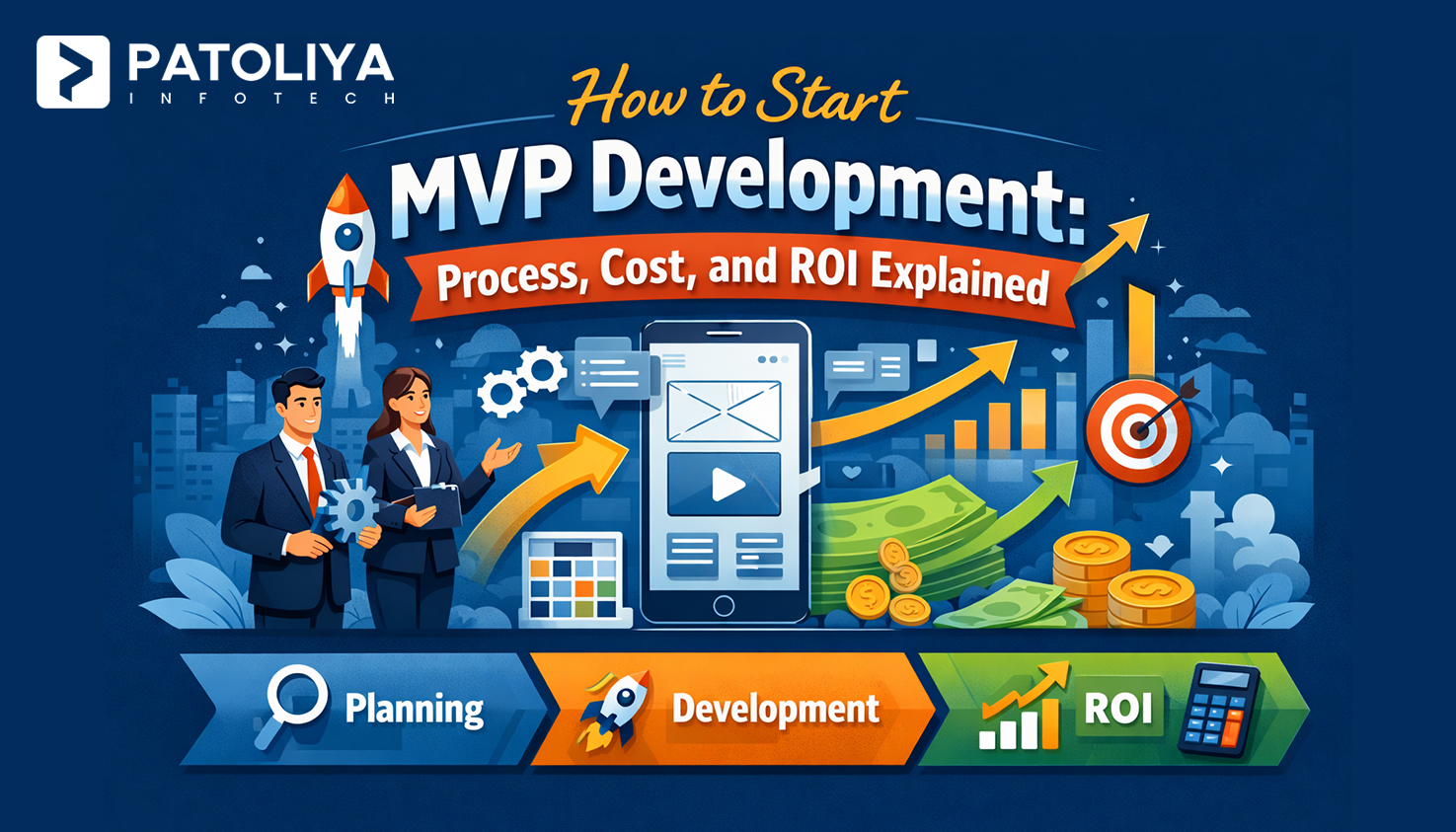
90% of startups fail. 42% of them failed because they built something nobody wanted, and the product was never validated until the budget was already gone, per CB Insights 2024. MVP development is the structured answer to that problem. It gives founders and product leaders a framework for testing a core assumption with real users before committing the full engineering budget.
For C-level decision-makers, the cost of skipping minimum viable product development is not just a product problem. It is a budget risk, a competitive timing risk, and a speed to signal risk that compounds every week the build continues without validation.
This blog walks through the MVP development process phase by phase, what it costs at each complexity tier, where ROI actually shows up, and how to verify an MVP software development company before the first contract is signed.
MVP development is the process of building the smallest functional version of a product that tests one core assumption with real users. It is not a prototype or a feature-limited beta for building an MVP. The output is a validated signal, not a finished product, in MVP for startups.
| MVP | Prototype | Full Product | |
| Purpose | Validate with real users | Test internal assumptions | Scale a proven concept |
| Audience | Early adopters | Internal team | Broad market |
| Cost Exposure | Controlled | Minimal | Maximum |
| Feedback Value | Real usage data | Design validation | Revenue and retention |
A minimum viable product is deployed and works. A prototype is never deployed to a paying customer. A beta is a pre-launch version of something that is a fully built MVP for startups. Blending these three concepts in a minimum viable product development brief leads to a misallocation of budget from day one.
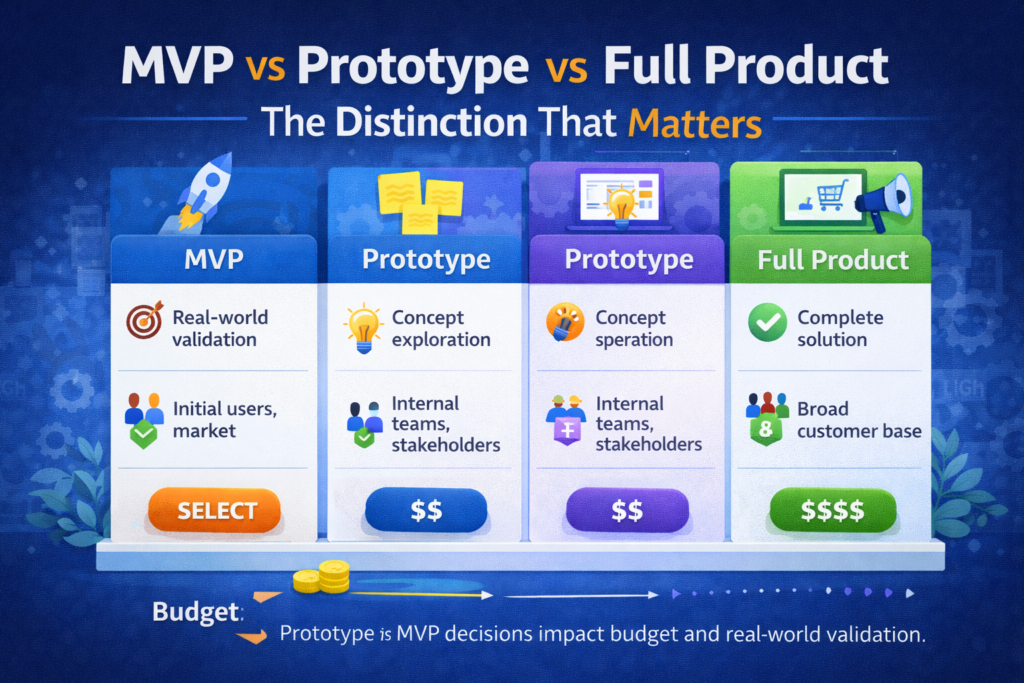
Understanding the difference between a prototype vs MVP is the first decision a product leader has to make correctly before embarking on any project engagement.
Viable does not mean cheap or rough. It means complete enough to produce usable data. Three quality floors apply to every MVP for startups built without exception.
Cutting performance quality to reduce MVP development cost does not save money. It produces data you cannot trust, which forces a second build at full cost.
The MVP development process has four phases. Each one feeds the next process of minimum viable product development. Skipping any phase does not compress the timeline. It creates rework that MVP development costs more than the phase would have.
Every build an MVP development engagement must start with a validated problem statement before any architecture discussion happens. Define the single problem the product solves, not three. Run a competitive gap analysis to confirm whether the market is served or underserved. Validate willingness to pay through pre-sales or structured interviews. The output of Phase 1 is a written problem statement and audience profile. Without it, every subsequent phase of the MVP development process is solving for the wrong thing.
Feature prioritization is where scope inflation starts in all MVP for startups' engagement. Two frameworks prevent it:
| Framework | How It Works |
| MoSCoW | Must have, Should have, Could have, Won't have. V1 ships must-haves only. |
| RICE | Reach x Impact x Confidence divided by Effort. Low scores go to the backlog. |
Adding Nice to Have features in weeks 3 to 5 of the MVP development process increases the overall MVP development cost without a corresponding feedback value through MVP software development company.
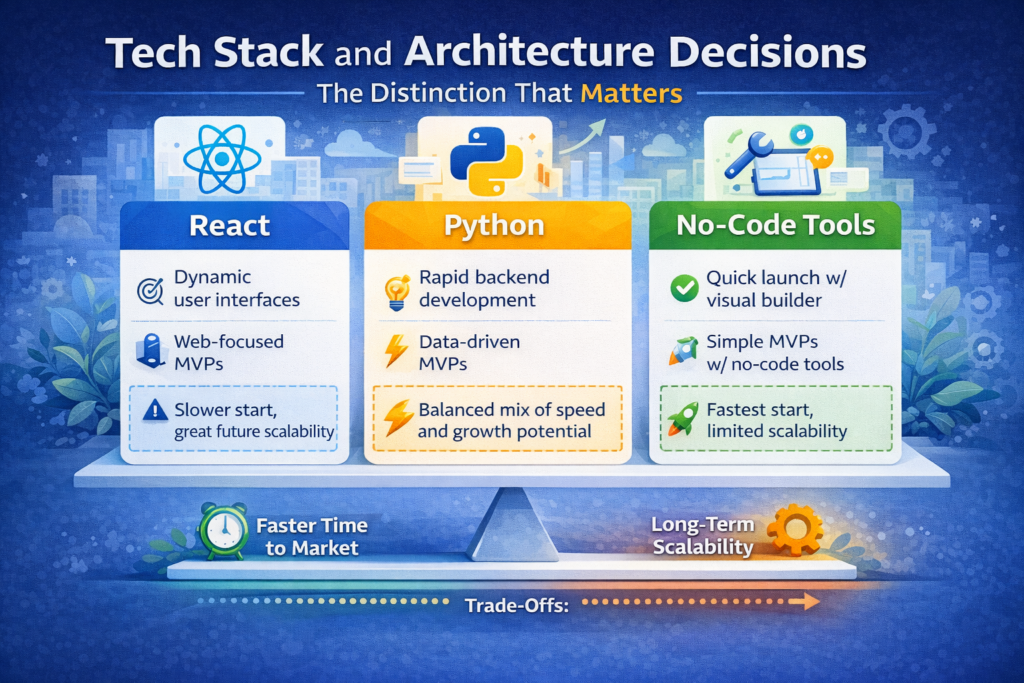
The tech stack chosen for an MVP determines both scalability and development speed.
| Stack | Best For | Trade-off |
| React and Node.js | SaaS and speed first builds | Limited for data-heavy workloads |
| Python and Django | AI-enabled and data-heavy MVPs | Slower initial setup |
| No-code tools like Bubble and Webflow | Simple single workflow MVPs | Hard scalability ceiling |
No-code platforms deliver 50 to 70% faster time to market and 50 to 65% lower cost for simple builds, per Gartner's 2024 Low-Code Platform Report. For any build an MVP expected to scale beyond simple single-flow use, a custom stack is the correct starting point, regardless of the upfront MVP development cost difference.
Sprint-based agile sprint delivery outperforms waterfall in development across scope control, stakeholder visibility, and MVP development cost containment. QA must be continuous, not end of sprint, as early bugs create false-negative user data. Launch to early adopters first; signal comes before scale in a well-run MVP development process.
Understanding MVP development cost before scoping a vendor engagement prevents budget surprises mid-build.
| Complexity | Feature Scope | Cost Range | Timeline |
| Simple MVP | 1 core workflow, basic UI | $15,000 to $50,000 | 4 to 8 weeks |
| Medium Complexity | Auth, payments, 2 to 3 integrations | $50,000 to $100,000 | 8 to 16 weeks |
| Complex and AI enabled | ML features, compliance, multiple roles | $100,000 to $300,000 and above | 4 to 6 months |
Most MVP development cost overruns are predictable and avoidable:
| Model | Rate | Best For |
| In-house team | $120,000 to $200,000 per developer per year | Long-term, IP critical builds |
| US and EU agencies | $150 to $300 per hour | High compliance, premium speed |
| Offshore agency in India | $25 to $75 per hour | Cost-controlled, structured MVP development |
To build an MVP for startups managing tight runways, offshore agencies in India deliver structured minimum viable product development at a fraction of the US rate, provided the vendor has embedded QA and dedicated project management. Choosing the right MVP software development company at this stage directly determines whether your MVP development cost stays within the plan.
MVP development ROI shows up in three places: avoided sunk cost on an unvalidated full product, stronger investor conversations, and lower post-launch churn from products shaped by real behavior data.
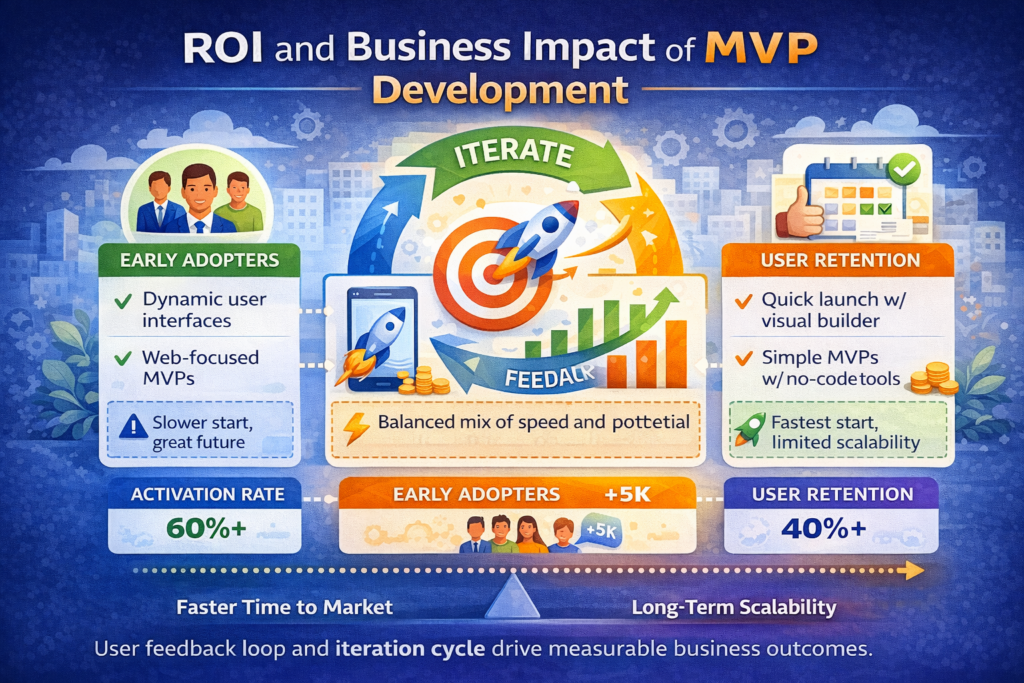
Avoided full product spend: The average failed SaaS product represents $250,000 to $500,000 in sunk MVP development costs. MVP surfaces the go or no-go signal before that capital is committed.
Stronger investor conversations: MVP-backed pitches convert better than concept decks. Investors buy validated signals. To build an MVP for startups seeking seed or Series A funding, this distinction closes rounds faster.
Lower churn post launch: The user feedback loop from each iteration cycle produces a product shaped by real behavior, reducing churn in the first 90 days post full launch for MVP for startups.
| KPI | Target Threshold |
| Activation rate | 40% or more of trial users completing the core workflow |
| Day 7 retention | Benchmark against category average |
| Day 30 retention | Leading indicator of long-term fit |
| Feature requests vs bug reports | Higher requests signal product readiness |
| Organic referral from early adopters | Confirms genuine value, not novelty |
These metrics are the measurable output of minimum viable product development done correctly. If they are absent from your launch plan, the MVP development effort is not producing usable ROI data through the MVP software development company.
Minimum Does Not Mean Broken:
A buggy MVP produces false-negative signals from users. Users leave the product because it does not work, not because the idea does not have market demand. In the MVP development process, minimum is not about quality, but about features. Every MVP software development company must clarify this before starting the first sprint.
Scope inflation:
60 to 70 percent of MVP development projects go over their initial time estimate. The primary cause is unplanned feature additions after defining the scope. The lean startup methodology for development is to follow build-measure-learn, which requires a fixed scope for clean measurement.
Tech debt decisions:
Shortcuts in MVP to save time during development can cost 3 to 5 times more to fix later on a larger scale. Architecture decisions made to save two weeks during build can increase MVP development cost by six months during the growth of the minimum viable product development.
Compliance gaps:
Build an MVP for startups in healthcare or fintech domains usually delays compliance with HIPAA or PCI DSS until after launch. Retrofitting compliance into a live product is several times more costly than designing it in from the beginning of the MVP development process.
Partner misalignment:
A minimum viable product development vendor that focuses on speed but lacks a product mindset is a vendor that delivers features, not outcomes. You build an MVP with the wrong partner, but you get closed sprints, not a validated signal, especially for MVP for startups.
MVP development projects start at $5,000 and above, scoped to runway. The MVP development process here runs sprint by sprint with IP transfer at each milestone and no lock-in of the MVP software development company after delivery.
We deliver structured MVP development at $25 to $49 per hour with 8 years of verified delivery across fintech, healthcare, logistics, SaaS, and eCommerce. Every development engagement runs on a lean backend-first approach with fixed-scope contract options, milestone-based IP transfer, and no lock-in after delivery.
Measured against the checklist above, here is where Patoliya Infotech stands on MVP development:
To build an MVP scoped to your runway with IP transfer at each sprint milestone, start with a scoping call. Define the smallest useful release first, then build from there.
The highest cost in product development is building the wrong thing at full engineering scale. MVP for startups exists to surface the go or no-go signal before that budget is committed. The MVP development process works when the scope is fixed, execution quality is non-negotiable, and the partner you choose understands that shipping a sprint is not the same as validating a product. Choosing the right MVP software development company is as consequential as the product decision itself. If your scope is defined and your runway is clear, let's map out the build together before you commit.