Table of Contents
TL;DR: Micro frontend architecture lets separate teams build and ship their own slice of a web app without blocking each other's releases. It only pays off once team size and release friction outgrow a single frontend codebase, not before. Skip it if one team still owns the whole UI comfortably.
Most engineering leaders adopt micro frontend architecture expecting faster page loads. In reality, micro frontends solve organizational problems, not performance problems. As teams grow, a single frontend often leads to release bottlenecks, code ownership conflicts, and increasingly complex deployments.
The real value of micro frontend is enabling independent teams to build and deploy features without slowing each other down. It solves a people problem, not a performance problem, and treating it as a performance fix is why so many migrations get reverted within a year.
Module Federation React patterns make the split technically possible, but the decision to split should come from your org chart, not your bundle size. This guide breaks down when the split makes sense and how to structure it without creating a bigger mess than the monolith you left behind.
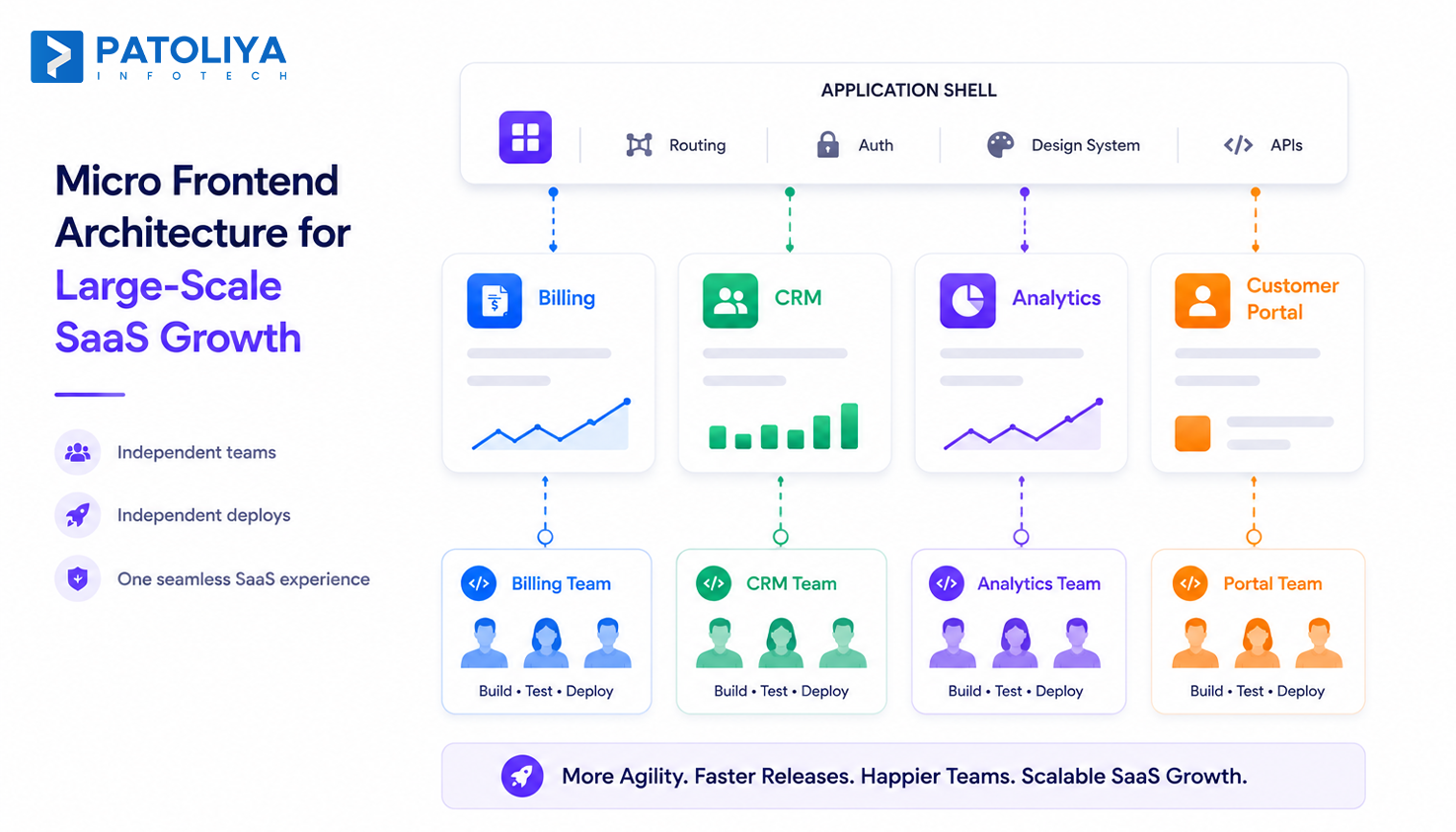
A micro frontend breaks one large web application into smaller, independently deployable pieces, each owned by a different team. Every piece ships its own code, and a shell application stitches them together at runtime. The user sees one app. Your teams ship five separate ones.
A single frontend codebase works fine with one team. Once four more teams join that same repository, every deploy turns into a coordination meeting. Build times grow, merge conflicts pile up, and one team's bug blocks every other team's release, which is the exact pressure that pushes companies toward micro frontend architecture.
A monolithic frontend ships as one deployable unit, so every change waits for every other team's change to be ready. A micro frontend setup ships each piece on its own schedule. The tradeoff is coordination overhead now versus release blocking later.
When five teams share one frontend repository, a single broken test blocks every team's deploy, not just the team that broke it. This is the single biggest reason companies move to micro frontend architecture, not performance or technology preference, just the math of five teams sharing one release pipeline.
Build times grow with every feature added to a shared codebase, and a ten-minute build becomes a forty-minute build within two years. Micro frontend splits keep each build scoped to one team's slice, so build time stays flat as the company grows instead of climbing with headcount.
Upgrading a framework version across one giant codebase means every team has to migrate at the same time, whether they are ready or not. Splitting into separate pieces built on Module Federation React lets one team upgrade React while another stays on an older version without blocking either team's roadmap.
Adding a new product line to a monolith means touching shared code that five other teams also depend on. A micro frontend structure lets a new domain team ship its own slice from day one without anyone else's code review blocking the launch.
Webpack Module Federation: Module Federation React setups rely on Webpack's plugin to share components and dependencies across separately built applications at runtime. It works with an existing Webpack build instead of forcing a new toolchain. Most React-based micro frontend projects use this as the default.
Single SPA for Mixed Framework Apps: The Single SPA framework is a routing layer that mounts and unmounts separate frontend applications based on the current URL, regardless of what framework each one uses. It fits teams running React, Vue, and Angular side by side under one shell, which Module Federation alone cannot do.
Route-Based Composition: Route-based composition assigns each micro frontend to a specific URL path, like checkout or account, and loads only that piece when the user navigates there. It is the simplest integration pattern and the easiest one to reason about during an incident.
Build Time vs Runtime Integration: Build time integration bundles every piece together before deployment, which is faster at runtime but forces every team to deploy together again, defeating the purpose of micro frontend architecture. Runtime integration, the approach most teams actually want, loads each piece separately in the browser.
Teams running micro frontend architecture ship their own slice the moment it is ready, instead of waiting for a shared release train that bundles five teams' changes into one risky deploy. This alone is usually the fastest visible win after a split, often within the first quarter.
Autonomy means a team picks its own deploy schedule, its own testing strategy, and its own pace, without asking four other teams for sign-off first. This is what actually improves morale, not the architecture diagram.
A micro frontend setup built on Module Federation React lets one team try a new framework or state management library on their own slice without forcing the decision onto every other team. This is useful for gradual migrations, not for chasing every new framework that launches.
Headcount growth stops being a coordination tax once each new hire joins a team that owns a clear slice of the product, not a shared codebase everyone has to understand fully before shipping anything.
Micro frontend architecture trades one hard problem, a tangled monolith, for a different hard problem, distributed system debugging in the browser. An error in one piece can be hard to trace back through a shell application and three independently deployed remotes.
Every independently built micro frontend can ship its own copy of React, its own copy of a date library, and its own copy of anything else nobody deduplicated. That duplication shows up directly in page load time if nobody owns shared dependency versions.
Module Federation React lets you share a single copy of React across remotes, but only if every team agrees on the same version. One team upgrading early without coordination breaks every other team's build silently.
Someone still has to own the shell application, the design system, and the contract between pieces, or micro frontend architecture turns into five teams shipping five different apps that happen to share a URL bar.
This checklist applies whether you run two teams or twenty, because the failure points stay identical at any scale.
Module Federation for React is Webpack's native way to let separately built applications share code and load each other's modules at runtime. It works with an existing Webpack setup, which is why most React-heavy micro frontend projects pick it as the default integration layer.
Key Features:
Best For: Teams already on Webpack who want runtime integration without adopting a new framework.
Single SPA orchestrates multiple frontend applications written in different frameworks under one shell, mounting and unmounting each based on the active route. Large enterprises running React, Angular, and Vue side by side rely on it because Module Federation React alone cannot mix frameworks this way.
Key Features:
Best For: Organizations running multiple frontend frameworks under one shell application.
Piral is a plugin-based micro frontend framework built for enterprise portals that need a central shell with many independently developed feature modules. Unlike a pure Module Federation React setup, it ships its own plugin runtime, which fits internal enterprise applications more than public-facing consumer products.
Key Features:
Best For: Internal enterprise portals with many independently built feature modules.
Luigi is SAP's open-source micro-frontend shell, built specifically for enterprise dashboard ecosystems where multiple SAP and custom applications need one consistent navigation layer. It fits SAP-heavy enterprises more than general-purpose consumer apps.
Key Features:
Best For: SAP enterprise customers needing one shell across multiple internal applications.
OpenComponents takes a server-side approach to micro frontend composition, rendering components on the server and assembling them before they reach the browser. This fits large-scale platforms that need component-level caching more than client-heavy interactivity.
Key Features:
Best For: High-scale web platforms needing server-rendered, independently versioned components.
Patoliya Infotech evaluates whether your team actually needs micro frontend architecture before writing a single line of shell code, because the wrong call here costs more than the migration itself.
The team builds Module Federation React setups, sets up CI/CD for independent deployment, and defines the governance model, so five teams do not turn into five different apps.
Book a technical architecture consultation and bring your current build times and team count. Those two numbers usually decide the answer faster than any framework debate.
Micro frontend architecture is not a performance fix; it is an organizational scaling strategy. Teams with multiple product domains, independent release schedules, and growing headcount see real delivery gains from the split. Teams without that scale just inherit distributed system complexity for no benefit. The right call depends on your team structure and release pattern, not the framework trend of the year. Let's talk through your build times and team count to see which side of that line you are actually on.