Table of Contents
Enterprise software spending will hit $1.25 trillion in 2026, per Gartner, yet only 12% of organizations sustain their digital transformation goals in the past three years. The gap between those two numbers is not a budget problem. It is a decision-making problem.
Most organizations start enterprise software development without a clear framework for model selection, cost modeling, or vendor evaluation, and they pay for it with cost overruns, failed integrations, and adoption rates that never reach projections.
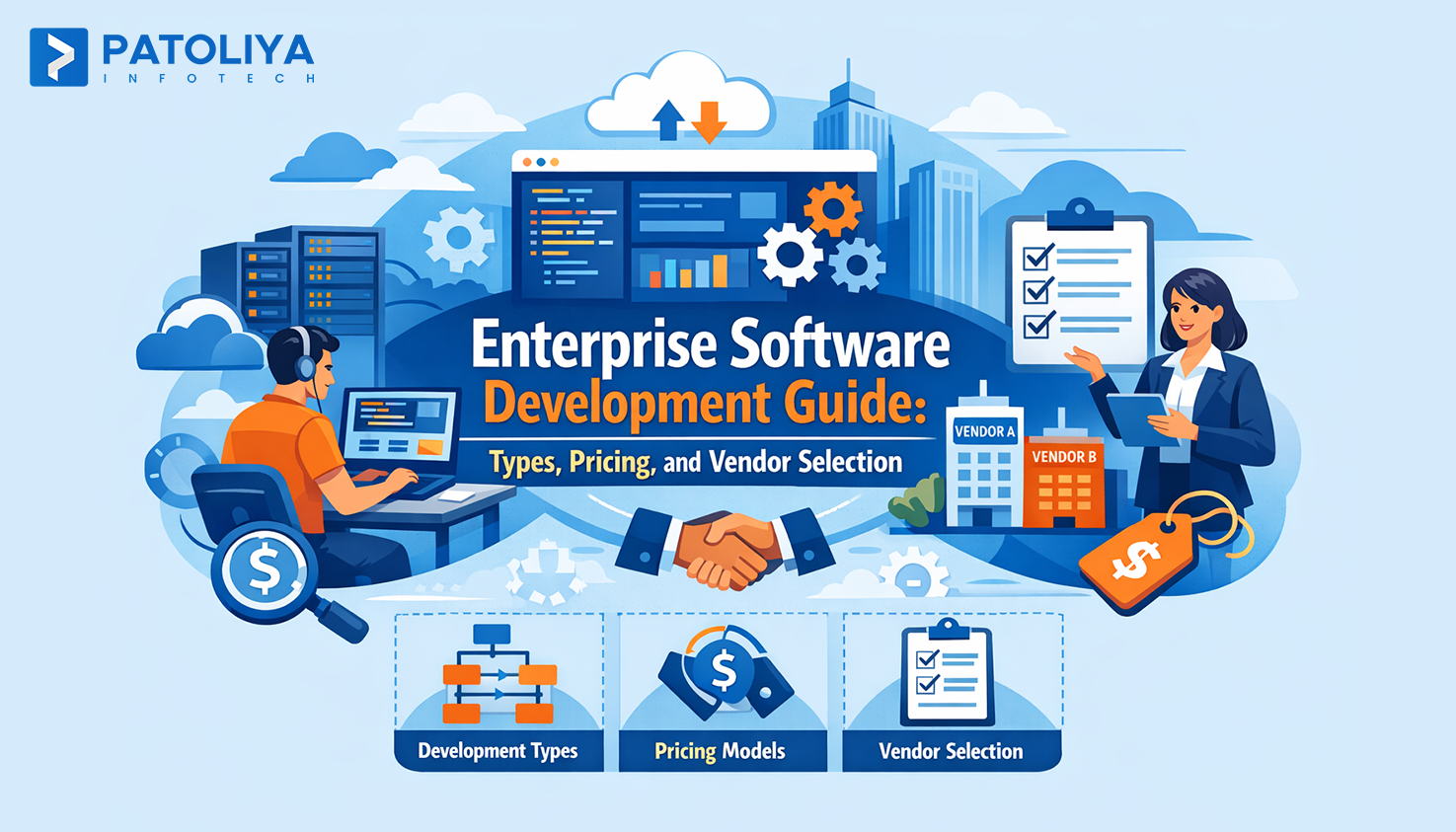
This guide covers everything a decision-maker needs before committing to an enterprise software development engagement: types, process, cost benchmarks, ROI calculation, risk factors, and vendor selection criteria, in one place.
Enterprise software development is the process of building large-scale software systems designed to manage complex business operations across multiple departments, user bases, and data environments simultaneously. It is not configuring an off-the-shelf tool. It is building a system that conforms to your actual business workflows.
Standard custom enterprise software adapts the user to the product. Enterprise software development builds the product around how the organization actually operates. That distinction determines everything from architecture to budget.
| Factor | Enterprise Software | Standard Software |
| Scope | Multi-department, cross-functional | Single user or small team |
| User Base | Hundreds to thousands | Individuals or small groups |
| Customization | Built around business workflows | User adapts to the product |
| Integration | Connects finance, HR, CRM, ERP | Standalone or limited API |
| Compliance | Embedded from Phase 1 | Optional or third-party |
Custom enterprise software is a separate category built for complex operations like compliance, financial processing, and real-time reporting. Treating enterprise software development as a simple web project leads to underestimated costs and timelines.
The five core categories of enterprise software development each solve a different operational problem. The right starting point depends entirely on where your biggest process gap sits today.
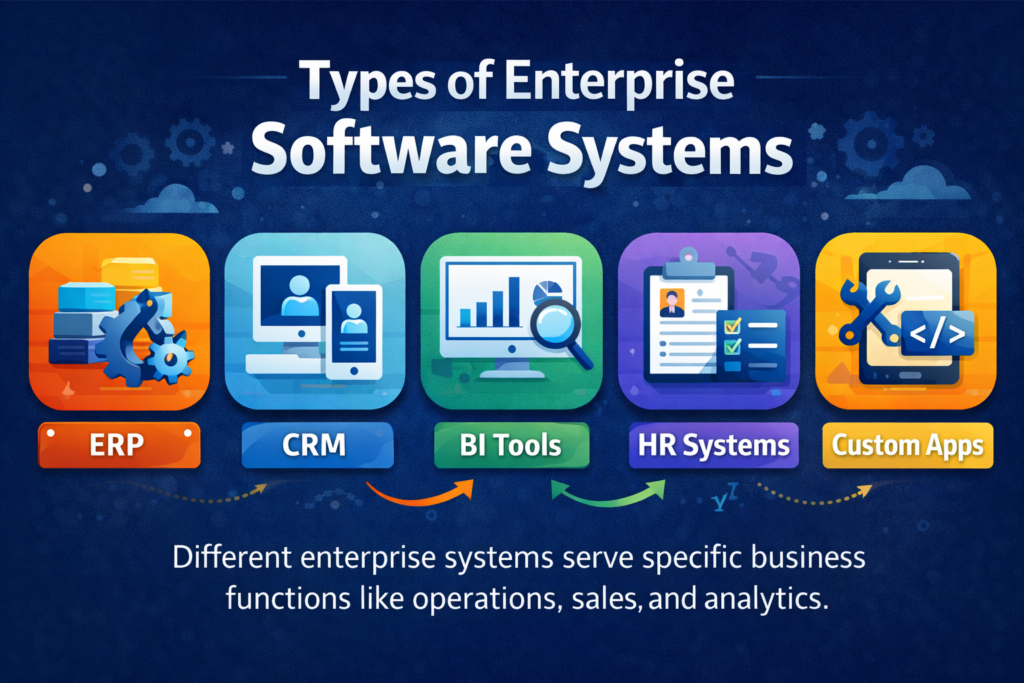
ERP development unifies finance, supply chain, and HR into a single operational system. 67% of ERP implementations are rated successful or very successful. For organizations running fragmented back-office operations on disconnected tools, a custom ERP is the highest-ROI starting point for enterprise application development.
The CRM platform market reached $79.4 billion in 2026, per Statista, making it the largest single segment in enterprise software development spend. Custom CRM builds integrate sales data, automate pipeline management, and produce real-time revenue reporting tied to your specific sales process rather than a generic workflow.
Custom enterprise software covers every use case where no SaaS product exists or where regulatory requirements make off-the-shelf tools non-compliant. Healthcare workflow automation, logistics route optimization, and financial reconciliation engines all fall into this category. These are the builds where generic enterprise software development solutions create more problems than they solve.
BI systems connect data sources across the organization and produce real-time reporting for executive decision-making. It is in connecting systems that were never designed to talk to each other in enterprise software development. Also, it is producing insights that inform cost reduction and revenue planning at the same time.
HR systems automate compliance tracking, compensation processing, and labor law adherence across multiple jurisdictions. For enterprises operating across countries, this is not a convenience feature. It is a legal requirement that enterprise application development must be addressed from sprint one.
Every enterprise software development engagement starts with stakeholder interviews, business process mapping, and an IT capability audit. Organizations that treat discovery as optional in enterprise application development consistently spend 30 to 50% more on mid-build changes than those that invest in it upfront.
Architecture decisions in enterprise software development include microservices integration versus monolith design, cloud-native architecture selection, data flow planning, and integration layer mapping. A bad architecture decision identified and fixed in Phase 2 costs a fraction of what it costs to correct during active development.
The software development lifecycle (SDLC) for enterprise application development uses agile methodology with 2 to 4 week iterations, continuous integration, and sprint reviews for better visibility and control. Waterfall-based enterprise software development leads to higher costs and longer timelines.
Unit, integration, UAT, performance, and security testing are mandatory in enterprise software development, with early bug fixes costing far less than post-deployment. Continuous quality gates in each sprint define professional enterprise application development.
Phased rollout reduces risk compared to big-bang deployment in enterprise software development. Ongoing maintenance, 15 to 25% of build cost annually, is a planned, fixed expense from day one.
Three enterprise software development models vary in cost, timeline, and risk. The right choice of Custom enterprise software depends on your organization’s size, budget, and workflow complexity.
| Factor | In-House Build | Off-the-Shelf | Outsourced Development |
| Upfront Cost | High | Low–Medium | Medium |
| Customization | Full | Limited | Full |
| Time to Deploy | 12 to 24 months | Weeks | 6 to 18 months |
| Software scalability | High | Limited | High |
| Maintenance Control | Full | Vendor-dependent | Shared |
| Best For | Large enterprises | SMBs | Mid-sized to large organizations |
Outsourcing enterprise software development with a qualified partner cuts costs by up to 53% compared to full in-house builds. For mid to large organizations that need custom enterprise software without the overhead of maintaining a permanent in-house engineering team, outsourced enterprise application development consistently delivers the best cost to value ratio.
Evaluating your build model? Speak with Patoliya Infotech's architects for a no-commitment scoping session.
| Scale | Budget Range |
| Small-scale system | $100,000 – $250,000 |
| Mid-tier platform | $250,000 – $500,000 |
| Enterprise-wide system | $500,000 – $2M+ |
These figures are based solely on build costs. Proper enterprise software development budgeting involves total cost of ownership (TCO) modeling from day one.
These figures cannot be negotiated in enterprise application development. They are the basic cost structure of every enterprise software development program.
| Location | Hourly Rate |
| Offshore teams | $25 – $75/hour |
| US-based teams | $75 – $250/hour |
Geographic arbitrage can lower enterprise software development costs by 40 to 70% with no compromise on quality if the vendor has a structured delivery model for enterprise application development.
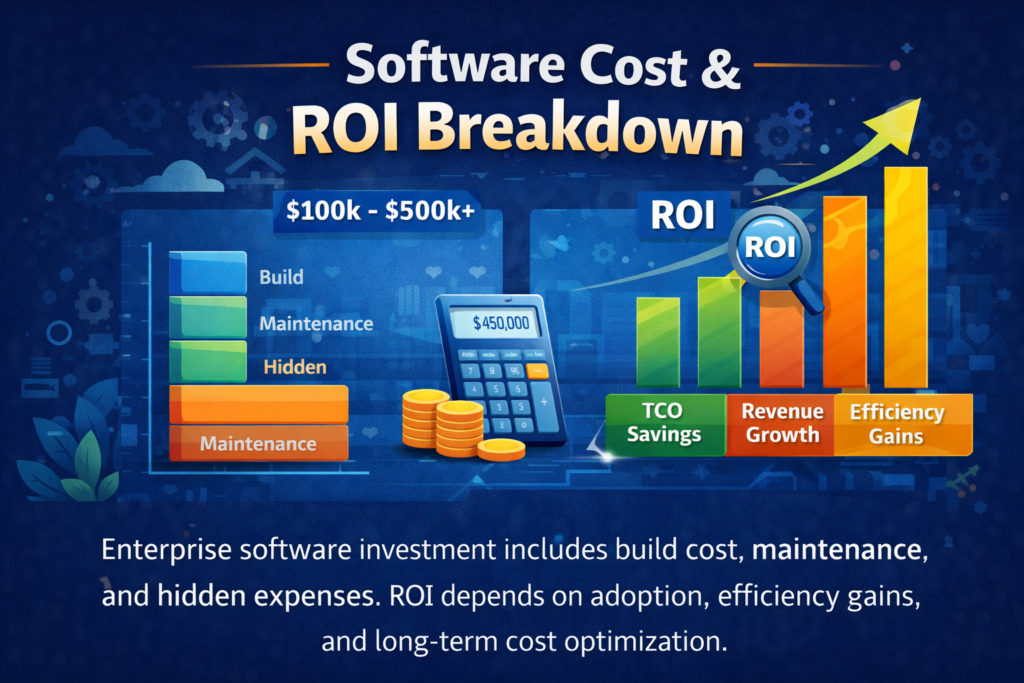
| Metric | Benchmark |
| Processing time saved | Up to 50% via automation (Decode Agency) |
| Operational cost reduction | ~30% using low-code with automation |
| Revenue growth | Up to 200% for sustained transformations |
None of these results is guaranteed for Custom enterprise software. They depend on how well the solution is deployed, adopted, and enhanced. These three factors are most often underfunded in enterprise software development projects.
Mid-size enterprise software development delivers value in 12to18 months, while enterprise-wide systems take 18to 24 months for full ROI. Phased rollouts with strong adoption can reduce this timeline by 6 to12 months.
Three measures are required for CFOs evaluating enterprise software development projects:
Maintenance is an asset management cost. Boards that treat it as overhead consistently underfund it and then wonder why their enterprise software development investment underperforms.
Scope creep: Every change in requirements without control during the process of software development in an enterprise incurs costs that are 3 to 5 times higher after the build than during the build. Baseline scope documentation is non-negotiable in Custom enterprise software.
Integration complexity: Integration of new systems to existing infrastructure, such as modernization of legacy systems, is often more than originally estimated. Consider providing 20 to 30% contingency for integration costs.
Security and compliance gaps: Compliance with GDPR, HIPAA, and industry regulations should be built in from Phase 1. Retrofitting compliance to enterprise application development can be more costly than the original build.
Low user adoption: Without role-based training and change management, well-built software systems always underperform. Adoption failure is the most common cause for Custom enterprise software solutions failing to generate expected ROI.
Vendor lock-in: Proprietary technology stacks are inflexible in the long term. Source code ownership and data portability rights must always be negotiated before any enterprise software development contract.
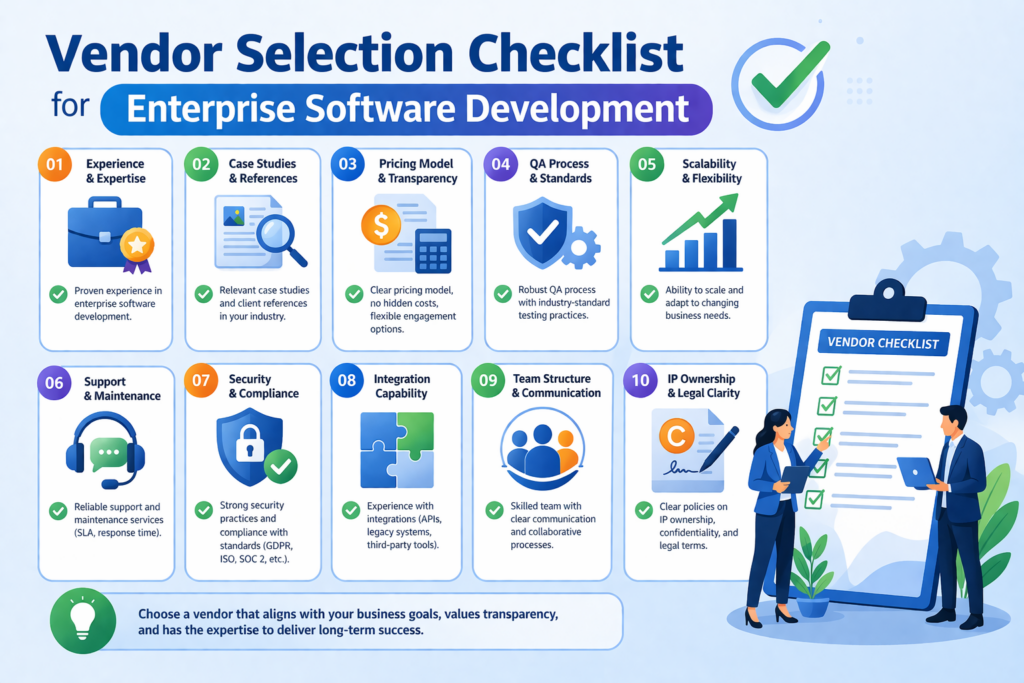
Patoliya Infotech delivers full-stack enterprise application development across web, mobile, and cloud with proven experience in fintech, logistics, healthcare, and SaaS. Every enterprise software development engagement follows an agile model with sprint reporting and strict SDLC quality gates.
Patoliya Infotech delivers enterprise software development at offshore rates with a structured delivery process that includes milestone-based contracts, Clutch-verified reviews, and direct Project manager access throughout the engagement.
Our India-based software development model ensures competitive pricing without compromising the quality of the delivered software. Both fixed pricing and dedicated team pricing models are applicable. Ready to scope your project? Connect with our team at Patoliya Infotech to get your detailed project scope and cost estimate within 48 hours.
The right enterprise software development outcome depends on three decisions made before a line of code is written: the build model that fits your organization's scale and workflow, a cost plan that includes full TCO rather than just build cost, and a vendor with measurable delivery history in your industry. Organizations that treat enterprise application development as a strategic investment consistently outperform those that treat it as a procurement exercise. The wrong partner costs significantly more than the software itself. If your project is at scoping stage, let's map the architecture and cost model together before your RFP goes out.
Ready to define your Custom enterprise software project? Contact Patoliya Infotech for a technical consultation and get your project estimate within 48 hours.