Table of Contents
TL;DR: Most companies treat ecommerce website development as a one-time purchase instead of an ongoing system decision. Shopify works for small catalogs, Magento and headless setups fit complex catalogs and B2B logic, and custom builds win once integrations get heavy. Pick your approach based on your order volume three years out, not your current budget.
Most ecommerce projects fail because the wrong platform and architecture were chosen from the start. Ecommerce website development is about creating a system where products, payments, inventory, and customer data work together seamlessly as your business grows. Get those foundations wrong, and you'll end up paying with lost conversions, operational bottlenecks, and expensive rebuilds.
Many businesses invest in ecommerce web development services expecting a quick launch, only to discover later that their pricing rules, B2B workflows, or integrations require far more flexibility.
This guide explains when to build, when to buy, and how to choose an ecommerce website development platform and partner that can support your business for years instead of forcing a rebuild in eighteen months.
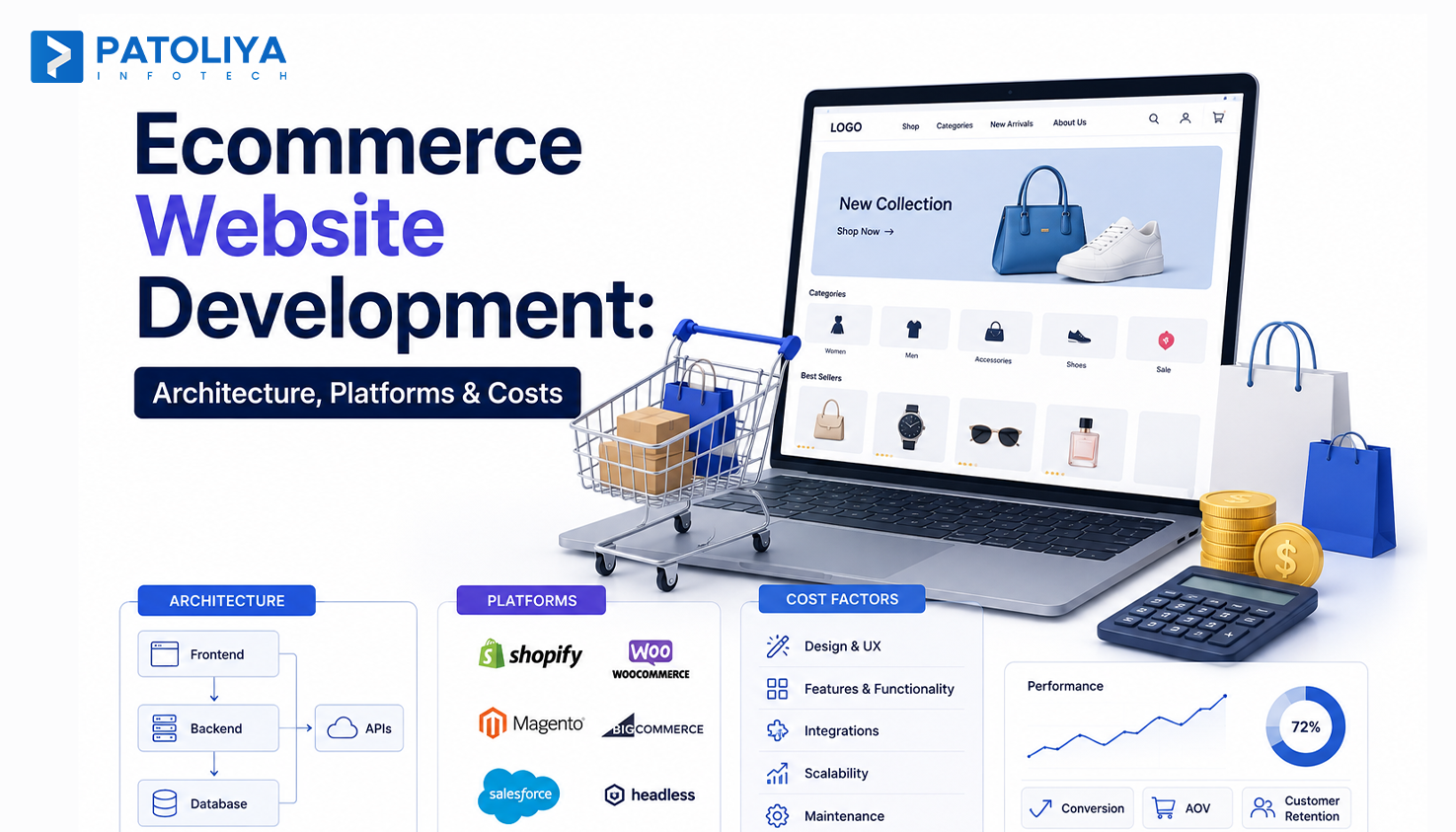
Ecommerce website development covers four layers working together, not one website file.
Basic store builders give you a catalog and a checkout button, nothing more. Real ecommerce website development means custom logic for discounts, tax rules across regions, multi-warehouse inventory, and API connections that update in real time.
Ecommerce web development services that only offer themes and plugins cannot support that level of logic once your SKU count or order volume grows past a few thousand orders a month.
Modern stores increasingly separate the frontend from the backend, so either side can change without breaking the other. This shift toward API driven systems is why headless ecommerce keeps coming up in ecommerce website development conversations, even for mid-sized brands that are not enterprise yet.
Custom ecommerce website development makes sense once you have logic that a platform cannot natively handle.
Platforms earn their place when speed matters more than control. A single brand selling under five hundred SKUs with standard shipping rarely needs custom ecommerce website development. The platform route gets you live in weeks, not months, and that speed has real value early on.
| Scenario | Best Fit |
| Standard catalog, single warehouse | Platform build |
| Complex pricing, multiple buyer types | Custom ecommerce website development |
| High SKU count, frequent promotions | Hybrid architecture |
| Tight integration with ERP or CRM | Custom ecommerce website development |
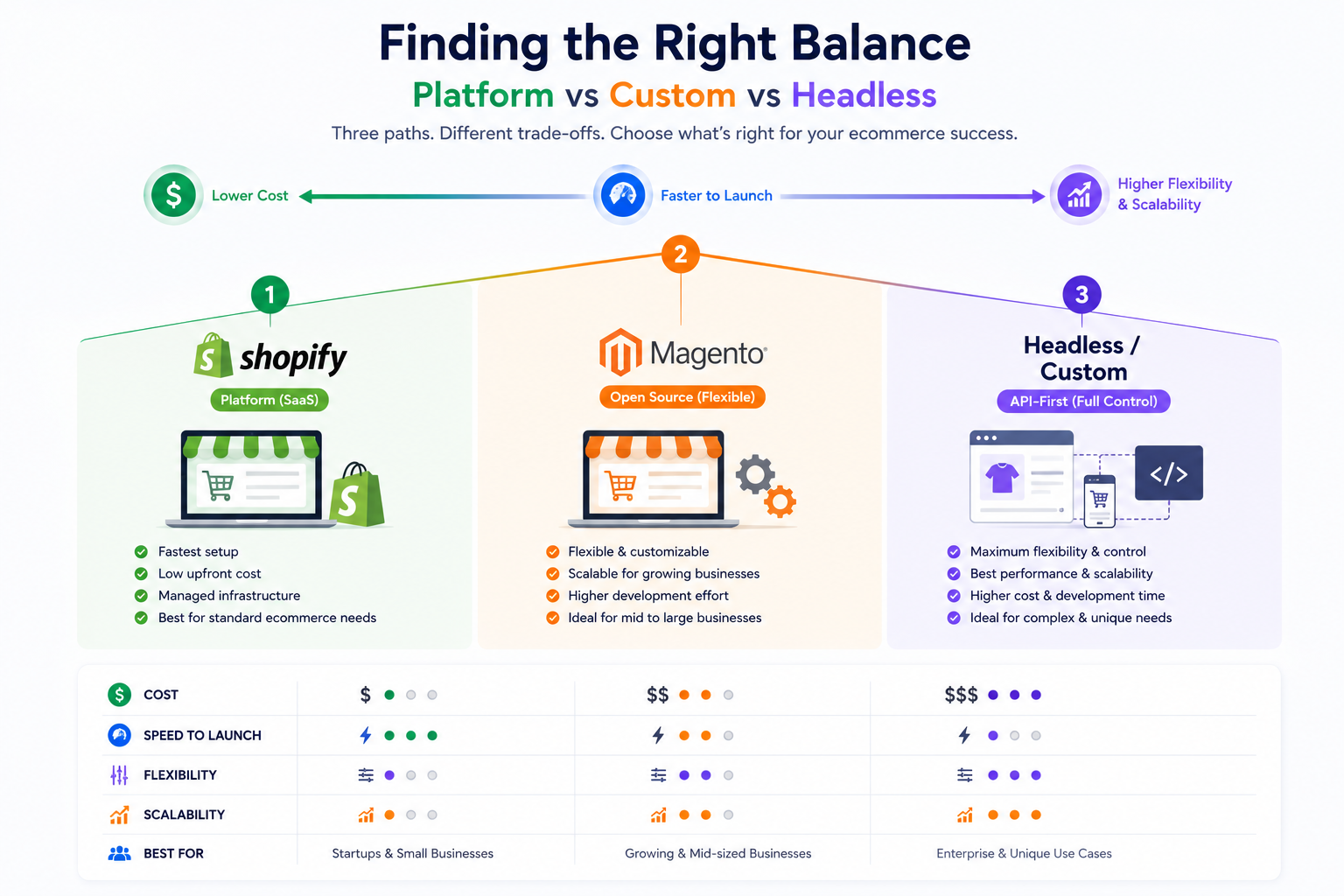
Hybrid ecommerce website development setups are becoming the default for mid-market brands. You keep a platform for checkout and payments while building custom modules for pricing, search, or B2B portals on top. The real decision is not cost alone. It is cost-weighed against control and how fast you expect to scale.
A brand growing twenty percent a year cannot keep patching a templated theme every quarter, and that patching cost usually exceeds the price of doing custom ecommerce website development properly the first time.
Most ecommerce platforms do not fail at launch. They fail eighteen to thirty-six months later when order volume and catalog complexity outgrow the original ecommerce website development setup.
Legacy ecommerce website development setups disguise an architecture problem as a staffing problem. When your inventory tool, CRM, and storefront do not talk to each other, that gap is an ecommerce backend development issue.
Growing catalogs quickly outgrow basic plugins. Ecommerce web development services help businesses manage variants, bundles, and region-specific pricing with the right architecture
The business impact of poor architecture decisions shows up as lost revenue first, IT tickets second. Every minute a checkout lags or a price displays wrong, you lose a buyer who will not come back to retry. That is the real cost of treating ecommerce website development as a one-time line item instead of an ongoing investment.
The frontend layer handles what shoppers see and touch. Component-based frameworks let you update a single page section, like a product card or filter bar, without redeploying the entire ecommerce website development site.
The backend layer runs on an API driven architecture, so orders, inventory, and pricing logic stay independent from the storefront. This separation is exactly what makes headless ecommerce practical for brands that need a custom frontend experience but do not want to rebuild order logic from scratch.
| Layer | Function | Why It Matters |
| Frontend | Storefront, search, filters | Direct impact on conversion |
| Backend | Orders, inventory, pricing | Stability under load |
| Data and caching | Speed at scale | Page load under traffic spikes |
| Integrations | Payments, ERP, CRM | Removes manual reconciliation |
The database and caching strategy decide whether your site survives a flash sale or crashes during one. Payment, ERP, and CRM integrations are where most ecommerce website development budgets get blown, because every system has its own quirks and rate limits. Security and performance need to be planned in from day one, not patched in after a breach.
Cloud infrastructure that scales horizontally during traffic spikes is no longer optional for any brand doing real volume, and skipping this step is the single most common reason ecommerce website development projects need a second round of funding within a year.
Ecommerce platform migration becomes necessary when your current platform caps your growth, not when you simply get bored with the design.
Ecommerce platform migration is rarely about wanting something newer; it is about removing a real constraint.
Data, SEO, and downtime risk are the three things that derail migrations. URL structures change, redirects get missed, and rankings can drop for months if the migration plan skips a proper redirect map.
URL structures change, redirects get missed, and rankings can drop for months if the migration plan skips a proper redirect map. Post migration, the ecommerce website development work is not done.
Page speed, checkout conversion, and integration stability all need a full audit cycle in the first thirty days.
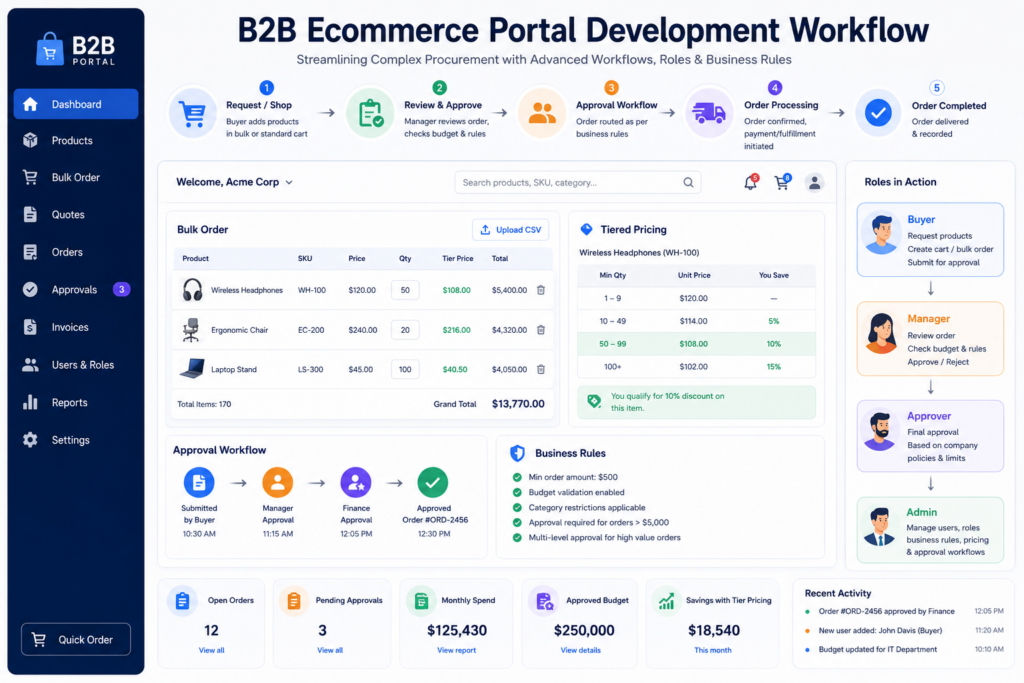
B2B buying looks nothing like B2C, and most ecommerce website development projects underestimate that gap until mid-build. B2B buyers expect negotiated pricing, purchase approval chains, and bulk reorder tools that consumer storefronts never need.
Strong ecommerce web development services prioritize B2B UX for multiple decision makers in a single purchase, something consumer-focused themes rarely account for.
Enterprise workflow requirements, like custom quote approval or contract renewal reminders, are exactly why most B2B portals end up needing custom ecommerce website development instead of a stock platform extension.
Entry-level builds on a platform template to cap your ecommerce website development flexibility fast once order volume grows.
| Cost Driver | Hidden Impact |
| Third-party integrations | Ongoing API and licensing fees |
| Maintenance | Security patches, plugin updates |
| Scaling | Server and infrastructure upgrades |
| Custom features | Developer hours beyond the initial quote |
Hidden costs sink more budgets than the build itself, and businesses that skip this conversation upfront end up paying for it as a surprise invoice later.
Long-term ownership cost versus a SaaS subscription model deserves real math, not a gut decision. A SaaS platform fee feels smaller monthly, but custom ecommerce website development often costs less over three years once you account for transaction fees and forced plugin upgrades on the SaaS side.
Conversion rate improvements are the clearest return on any ecommerce website development investment, since even a small checkout fix compounds across every order after launch.
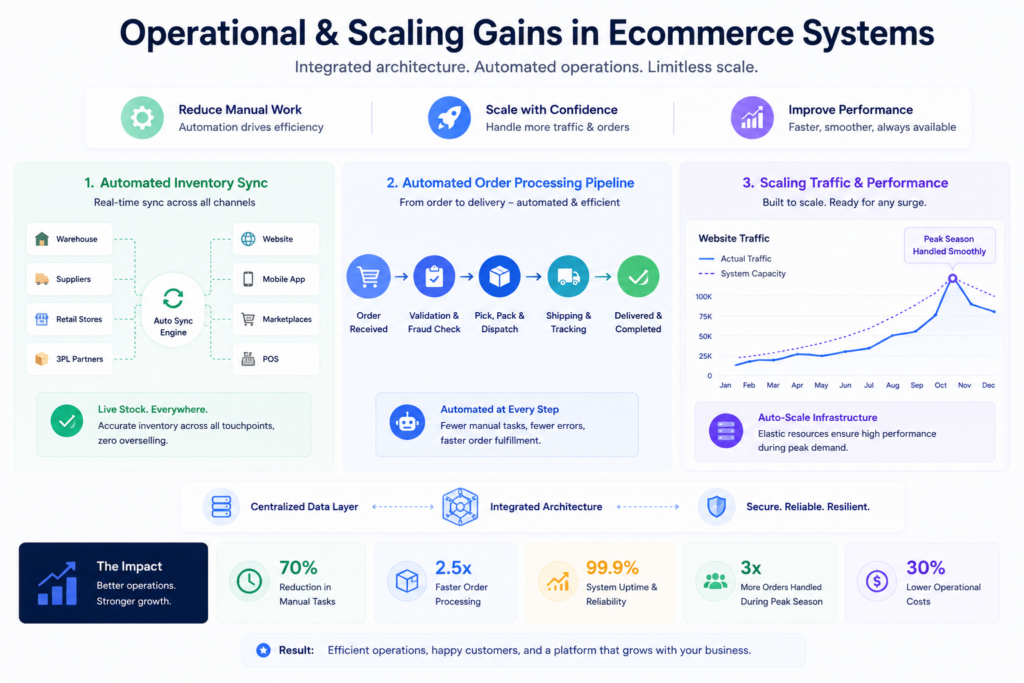
Reduced operational load matters just as much as conversion in any ecommerce website development rollout. When inventory, orders, and fulfillment sync automatically, your team stops doing manual data entry and starts doing work that grows the business.
Vendor and Platform Lock In: Vendor and platform lock-in is the risk most businesses do not see until they try to leave their ecommerce website development setup. Some platforms make data export deliberately hard, and that alone should factor into your initial decision.
Architecture and Integration Failures: Poor system architecture and integration failures in ecommerce website development both surface the same way, with broken syncs and support tickets piling up months after launch.
Performance, SEO, and Long-Term Maintenance: Performance and SEO degradation often happen quietly, since a slow site loses rankings before anyone notices the speed drop.
Every integration you add is one more thing that can break during a future update, and that compounding complexity is exactly why a clear ecommerce website development roadmap matters more than picking the trendiest tool.
Technical Depth and Integration Experience: Technical depth matters more than a flashy portfolio in ecommerce website development. Ask any partner offering ecommerce web development services how they handle integration failures, rather than how fast they can launch a homepage.
UX Capability and Scalability Planning: Ecommerce UX design capability should be visible in past ecommerce website development work. A pitch deck claim alone does not prove it. The scalability planning approach tells you whether a partner is thinking about your business in year three or just about the invoice this quarter.
Range of Services and Post Launch Support: Experience across different ecommerce web development services and more than one platform signals a partner who can actually recommend the right approach instead of pushing whatever they know how to build. Post-launch support model is the detail most businesses forget to ask about until something breaks at 11 pm on a Saturday.
Each platform fits a different stage of ecommerce website development growth, and picking based on what a competitor uses is how most businesses end up with the wrong tool.
Fast to launch, strong app ecosystem, best for brands under a few thousand SKUs.
Key Features: Hosted infrastructure, large app marketplace, fast checkout.
Best For: DTC brands prioritizing speed to market.
Open source flexibility for catalogs with complex pricing and multi-store needs.
Key Features: Deep customization, multi-store support, strong B2B extensions.
Best For: Mid-market brands with complex catalog logic.
WooCommerce development is WordPress-based and flexible for content-heavy brands that sell alongside blogs or media.
Key Features: Full CMS control, large plugin library, lower entry cost.
Best For: Content-driven brands with moderate catalogs.
Decoupled frontend and backend for brands needing a fully custom storefront experience.
Key Features: API first architecture, fast frontend performance, flexible integrations.
Best For: Brands with strong design needs and complex backend logic.
Patoliya Infotech helps businesses build scalable ecommerce website development solutions that go beyond templated platforms. Instead of focusing only on storefront design, the team starts with backend architecture, integrations, and business workflows to create a foundation that supports long-term growth.
If your current platform is limiting growth, Patoliya Infotech can help you build an ecommerce solution that's ready for what's next. Book a scoping call to identify architecture gaps before your next growth phase.
The success of your online store depends on more than choosing the right platform. It starts with building an architecture that supports your products, customers, and long-term business goals. Whether you need a quick platform launch or fully customized ecommerce web development services, the right solution is the one that fits your business today while preparing you for tomorrow.
Investing in the right ecommerce website development strategy now can save significant time, cost, and complexity as your business grows. Build with scalability in mind, and you'll spend more time growing your business instead of rebuilding it.
Ready to build an ecommerce platform that scales with your business? Connect with Patoliya Infotech for a consultation, and let's design a solution that's built for long-term growth.