Table of Contents
AWS migration strategy delivers ROI only when execution aligns with workload criticality and cost visibility.
Over 80% of on-premises workloads are overprovisioned, according to TSO Logic research cited by AWS. That is money leaving the building every month with no return. AWS migration services are built to fix that, but only when the cloud migration to AWS strategy matches the workload, the budget accounts for real costs, and the chosen AWS migration partner has done this before.
AWS operates across 105 Availability Zones globally, with 200+ services available post-migration. Without the right AWS migration strategy, organizations overprovision, overspend, and stall. This guide breaks down what lift and shift AWS migration services actually cover, how to evaluate costs and ROI, and what to verify before any commitment is made.
AWS migration services are a suite of managed tools, professional services, and AWS migration partner programs that help migrate applications, databases, servers, and full workloads aligned to an AWS migration strategy from on-premises environments or competing clouds to lift and shift AWS. The scope goes well beyond pressing a button. AWS migration services cover discovery, dependency mapping, wave planning, execution, cutover, and post-migration optimization.
The Three Delivery Layers:
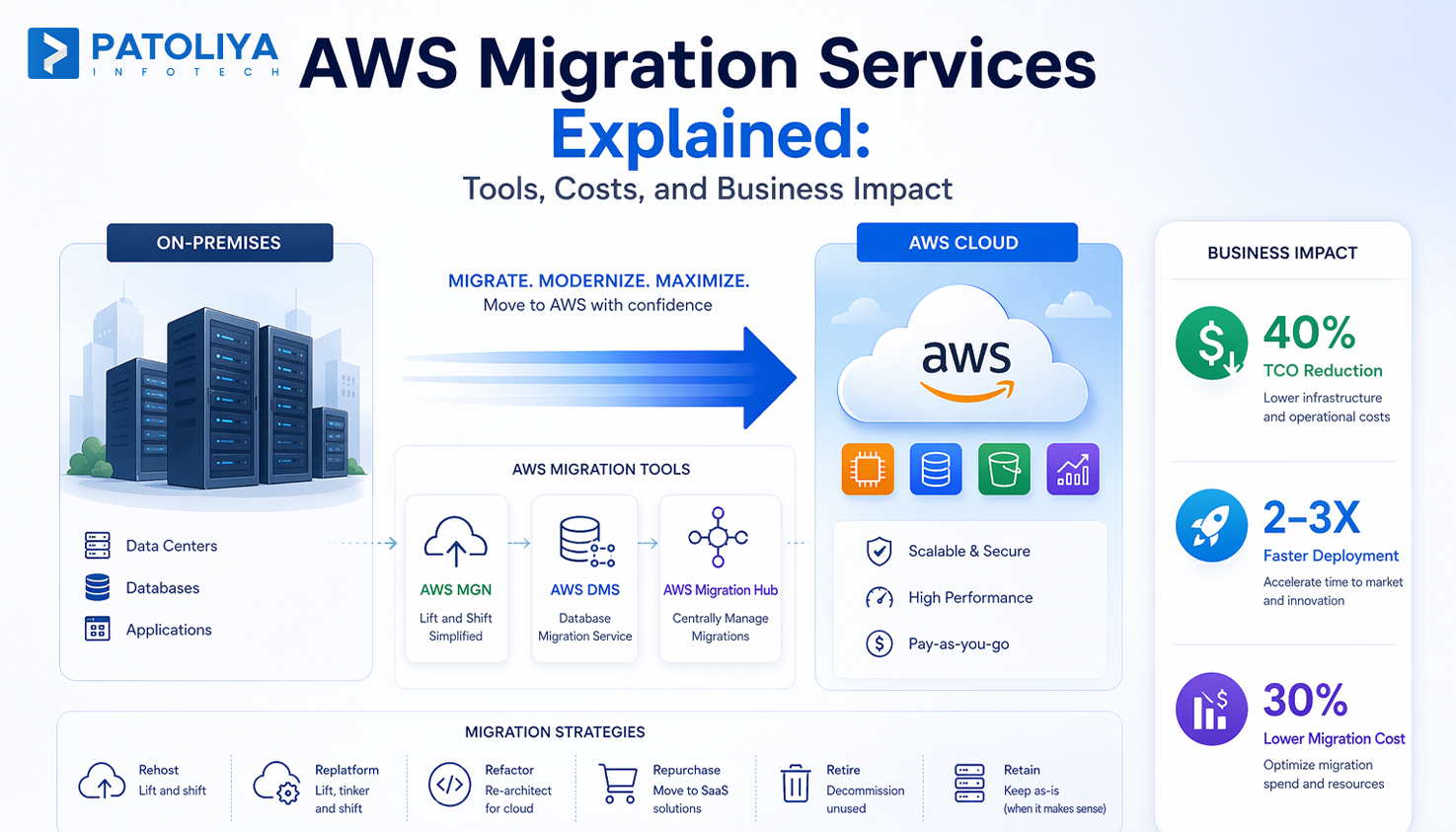
Native AWS tools handle the technical execution. AWS Application Migration Service, AWS Database Migration Service, AWS Migration Hub, and AWS Transform manage replication, database transfers, progress tracking, and large-scale modernization.
AWS Partner Network (APN) fills the gap between what automation handles and what requires experienced judgment through cloud migration to AWS. This can be like AWS migration strategy, architecture design, compliance mapping, and optimization in AWS migration services.
Third-party tools such as Carbonite, Fivetran, and Dynatrace extend coverage for specialized data pipelines, observability, or regulatory requirements in AWS migration services.
One fact shapes every plan: AWS migration services are not a single event. Depending on workload migration complexity and portfolio size, a full engagement runs 3 to 24 months. Any plan that treats migration as a weekend cutover will exceed budget before the first application moves from cloud migration to AWS.
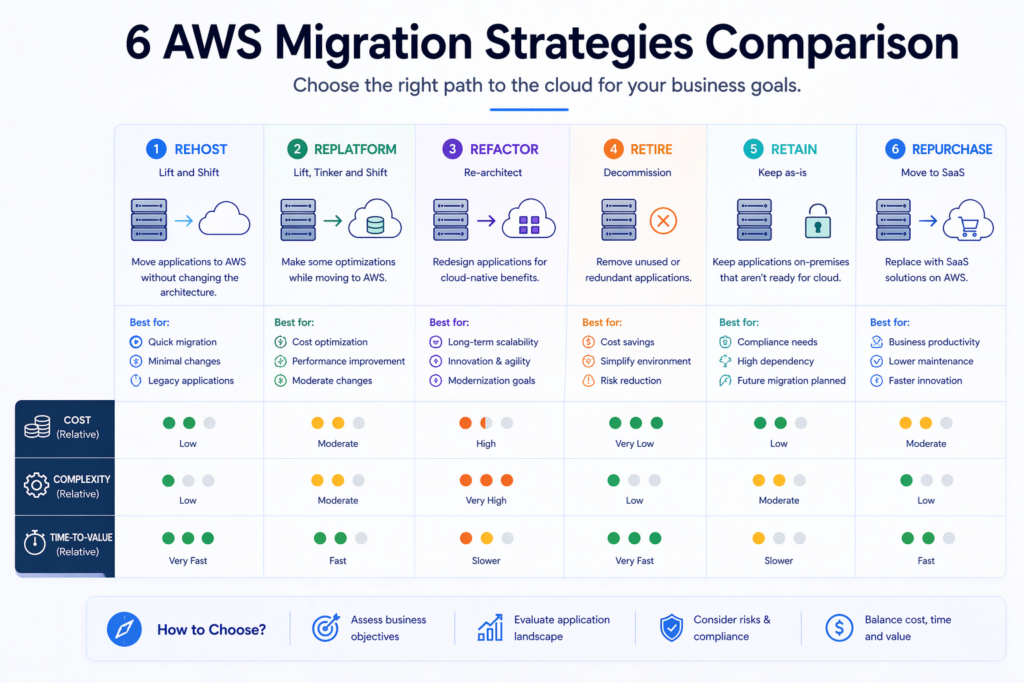
The wrong AWS migration strategy costs more than a delayed start. Each approach rehosting replatforming refactoring carries a different risk, cost, and time to value profile. Applying one AWS migration strategy to a portfolio that requires another is among the most common reasons AWS migration services engagements go over budget and stall.
Lift and shift AWS moves workloads to the cloud without code changes. AWS Application Migration Service performs continuous block-level replication and significantly compresses cloud migration to AWS timelines. Speed is the primary advantage of AWS migration services.
The risk is that legacy inefficiencies travel with the workload. Overprovisioned servers on-premises become overprovisioned servers in lift and shift AWS, and they are billed monthly for AWS migration services.
This AWS migration strategy works best for tight timelines, compliance-sensitive systems that cannot be modified, and migrations where stabilization comes before optimization.
Replatforming targets specific optimizations without full code rewrites. Moving MySQL to Amazon RDS is the standard example. The upfront cost of AWS migration services is higher than that of lift and shift AWS, but cost control improves significantly.
Refactoring rebuilds applications for cloud migration to AWS native architectures: microservices, serverless, containers.
Among rehosting, replatforming, and refactoring paths, this is the path for cloud migration to AWS that delivers the most long-term value with the most complexity. The right choice of AWS migration services when scalability drives the migration, not cost reduction alone.
A thorough migration assessment typically surfaces 10 to 20% of portfolios belonging here compared to any migration wave.
The AWS cloud migration tools inside any AWS migration services engagement determine execution speed, downtime exposure, and post-migration cost. Each AWS cloud migration tool solves a specific problem. Using the wrong AWS cloud migration tools for a workload type creates rework and delays cutover.
MGN performs continuous block-level replication from physical, virtual, or cloud-hosted servers. It is the primary engine for lift and shift AWS at scale. Free for the first 90 days per source server, then $0.042 per server per hour with EC2 and EBS billed separately.
AWS Database Migration Service handles homogeneous migrations (Oracle to Oracle) and heterogeneous migrations (SQL Server to Aurora). Pricing runs across on-demand, serverless, and Database Savings Plans through AWS migration services. DMS Fleet Advisor's free inventory automation will be discontinued in May 2026. Organizations using it for workload migration planning need an alternative before that date for cloud migration to AWS.
AWS Migration Hub tracks progress across all tools and accounts at no additional charge. For teams running parallel migrations across regions, lift and shift AWS prevents the visibility gaps that cause cutover failures in large AWS migration services programs.
AWS Transform is an agentic AI service for VMware, .NET, and mainframe modernization. AWS cloud migration tools data shows it reduces manual effort equivalent to 648 developer years and accelerates Windows modernization 5x. This kind of AWS migration services is changing the economics of cloud migration to AWS for organizations carrying significant legacy debt.
| Tool | Best For | Pricing Model | Downtime Risk |
| AWS MGN | Server rehost | Free (90 days) + infrastructure costs | Minimal |
| AWS DMS | Database migration | On-demand / Serverless | Low |
| AWS Migration Hub | Progress tracking | Free | None |
| AWS Transform | Large-scale modernization | Custom / Agentic | Low |
| AWS Discovery Service | Dependency mapping | Free | None |
| Business Size | Total Budget | Timeline |
| SMB / Startup | $50,000 to $250,000 | 3 to 6 months |
| Mid-market | $100,000 to $500,000 | 6 to 12 months |
| Enterprise (100+ servers) | $1 million+ | 12 to 24 months |
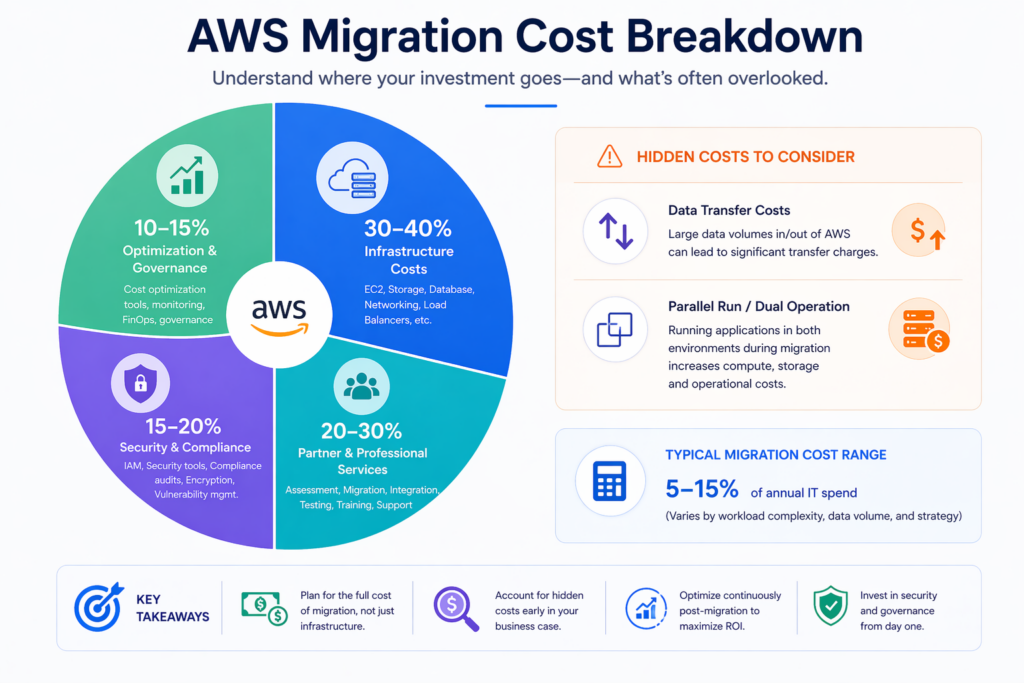
Most organizations budget for infrastructure and forget everything else during cloud migration to AWS. Here is where money actually flows in a real AWS migration services engagement:
These four items routinely blow budgets of AWS migration services that looked solid on paper:
Use these before any lift and shift AWS migration services vendor conversation:
AWS Migration Evaluator removes guesswork from the first number you put in front of a CFO.
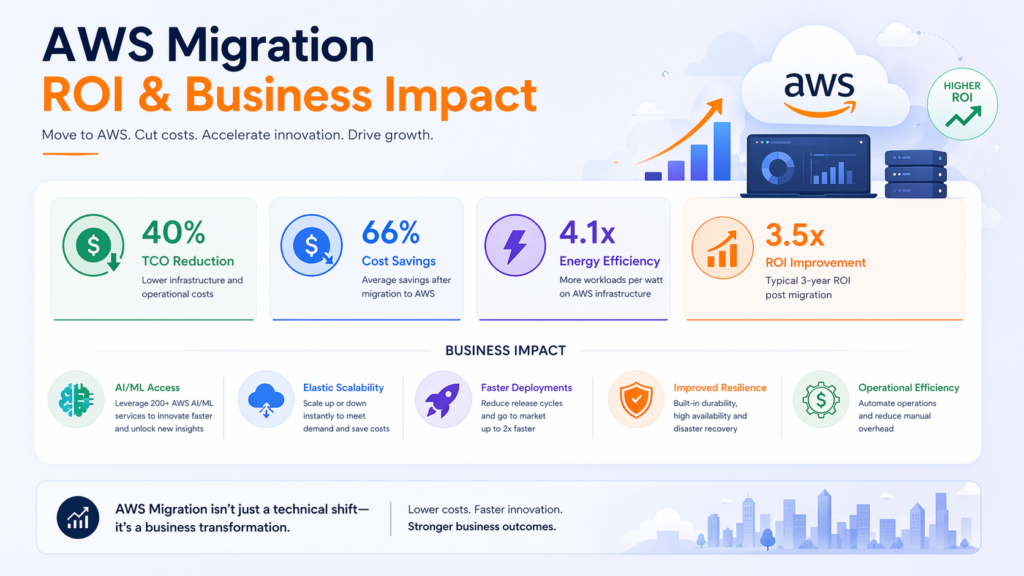
The numbers C-suite decision-makers rarely see in AWS migration strategy proposals:
Elastic scaling without capex. Absorb demand spikes without hardware procurement cycles that take quarters to lift and shift AWS.
AI and ML access. Cloud is the only viable path to enterprise-scale AI infrastructure at a reasonable cost. On-premises GPU clusters are a capital trap in AWS migration services.
Talent retention. AWS-certified engineers earn 25 to 30% more than equivalent on-premises roles. Cloud environments attract better technical talent and retain them longer through cloud migration to AWS.
Speed to market. Refactoring cloud-native applications reduces deployment cycles in ways that compound over 24 to 36 months with the help of lift and shift AWS cloud migration tools.
Real example: Fanatics Commerce migrated 1,800 servers across five data centers through AWS migration services and achieved a projected 48% infrastructure cost savings.
Applications rarely live in isolation within AWS migration services. A three-tier web application touches authentication services, legacy databases, third-party APIs, and monitoring agents. Unmapped dependencies cause cutover failures that nobody sees coming until the maintenance window is already open.
Run the AWS Application Discovery Service before any planning of AWS migration services begins. It is free, and it surfaces what teams always assume they already know during cloud migration to AWS.
Parallel-run environments, data transfer charges, and license costs routinely exceed initial estimates by 30 to 50%. The fix is not optimism in the lift and shift AWS, and the AWS migration strategy.
It is using Migration Evaluator plus a hard 20 to 30% contingency line in every AWS migration services budget.
The legacy system talent pool is shrinking. COBOL and mainframe engineers' average age is 45 to 55. Cloud migration to AWS requires AWS-certified architects, not just existing IT staff who attended a two-day course.
Healthcare (HIPAA), finance (PCI-DSS), and public sector (GDPR) workloads require compliance-aware migration paths. AWS has invested €7.8 billion in European Sovereign Cloud infrastructure specifically for these workloads. On-premises to cloud transitions in regulated industries need this to be mapped before the first server moves to AWS migration services.
Over-reliance on proprietary AWS migration services without portability planning creates future cost and flexibility issues. The architecture decisions of AWS cloud migration tools made during the AWS migration strategy are expensive to undo three years later.
| Factor | AWS Migration | Azure Migration | GCP Migration |
| Market share | 32% global cloud | ~24% | ~12% |
| Native tool depth | Broadest (200+ services) | Strong for Microsoft workloads | Strong for data/AI workloads |
| SMB migration cost | $50K to $250K | $5K to $40K (simpler projects) | Variable |
| Enterprise cost | $1M+ | $200K to $600K+ | Variable |
| Best fit | Diverse enterprise workloads | Microsoft-heavy organizations | Data engineering, ML-heavy stacks |
| AI readiness | AWS Transform (agentic AI) | Azure AI Foundry | Vertex AI |
AWS migration services are the default choice for organizations with diverse, large-scale enterprise workloads. The breadth of native tooling and global infrastructure depth is unmatched in the AWS migration strategy.
Azure suits businesses heavily invested in the Microsoft ecosystem (.NET, SQL Server, Active Directory). Moving to AWS migration services from a Microsoft-dominant stack adds complexity and cost.
GCP is strongest for data-intensive and machine learning workloads during cloud migration to AWS. If your primary driver of AWS cloud migration tools is analytics infrastructure, GCP deserves evaluation before committing to AWS migration services.
The wrong lift and shift AWS migration partner costs more than their fee. It costs time, team morale, and sometimes the entire program. Verify every aspect of AWS migration services before signing anything.
Technical Qualifications
Commercial and Compliance
Post-Migration
An AWS migration partner who cannot provide reference customers in your sector is a risk no assessment score can offset.
Evaluating AWS migration partners? Patoliya Infotech offers a no-obligation migration assessment to map your workloads, estimate costs, and identify risk before you commit.
Patoliya Infotech's AWS migration services engagements cover the full lifecycle: discovery, dependency analysis, AWS migration strategy selection, execution, and post-migration optimization.
Heterogeneous migrations through AWS migration services are a specific strength. Moving legacy databases and custom applications where generic AWS cloud migration tools fall short is where the difference between an experienced AWS migration partner and a generalist shows up.
What clients get:
We treat AWS migration services as an ongoing engagement. The work after cutover determines whether the projected TCO reduction actually shows up on the invoice.
AWS migration services are not a commodity. The right strategy, AWS cloud migration tools, and partner determine whether you realize the projected 40% TCO reduction or absorb budget overruns that could have been prevented in week one of planning.
Before moving forward, resolve four variables: workload complexity, compliance requirements, total migration timeline, and post-migration optimization plan. None of these can be figured out after signing up for any AWS migration services.
Do not sign with any AWS migration partner before completing a proper migration assessment. The assessment is where bad decisions get caught cheaply, before they become expensive project failures.
Ready to build a realistic migration plan? Contact Patoliya Infotech for a structured migration assessment built around your workloads, budget, and compliance requirements.