Table of Contents
TL;DR: Route optimization software solves a math problem, not a navigation question. Fleets that switch from manual delivery route planning to algorithm-based software typically cut mileage and fuel costs by double-digit percentages within months. The right approach depends on fleet size, constraint complexity, and how much control over the underlying logic your team actually needs.
The costliest route optimization mistake is confusing navigation with optimization. Real optimization is a combinatorial problem, the kind operations researchers have studied for decades, and the algorithm choice decides whether a fleet saves five percent on mileage or 25% percent. Most teams buy software and assume it is solved, then wonder why dispatch costs keep rising. Manual delivery route planning breaks down the same way once stop counts exceed what a dispatcher can effectively manage.
This guide explains what route optimization software actually does, the algorithms running underneath it, what a production build costs, and how operations teams should decide whether to buy, integrate, or build one in-house.
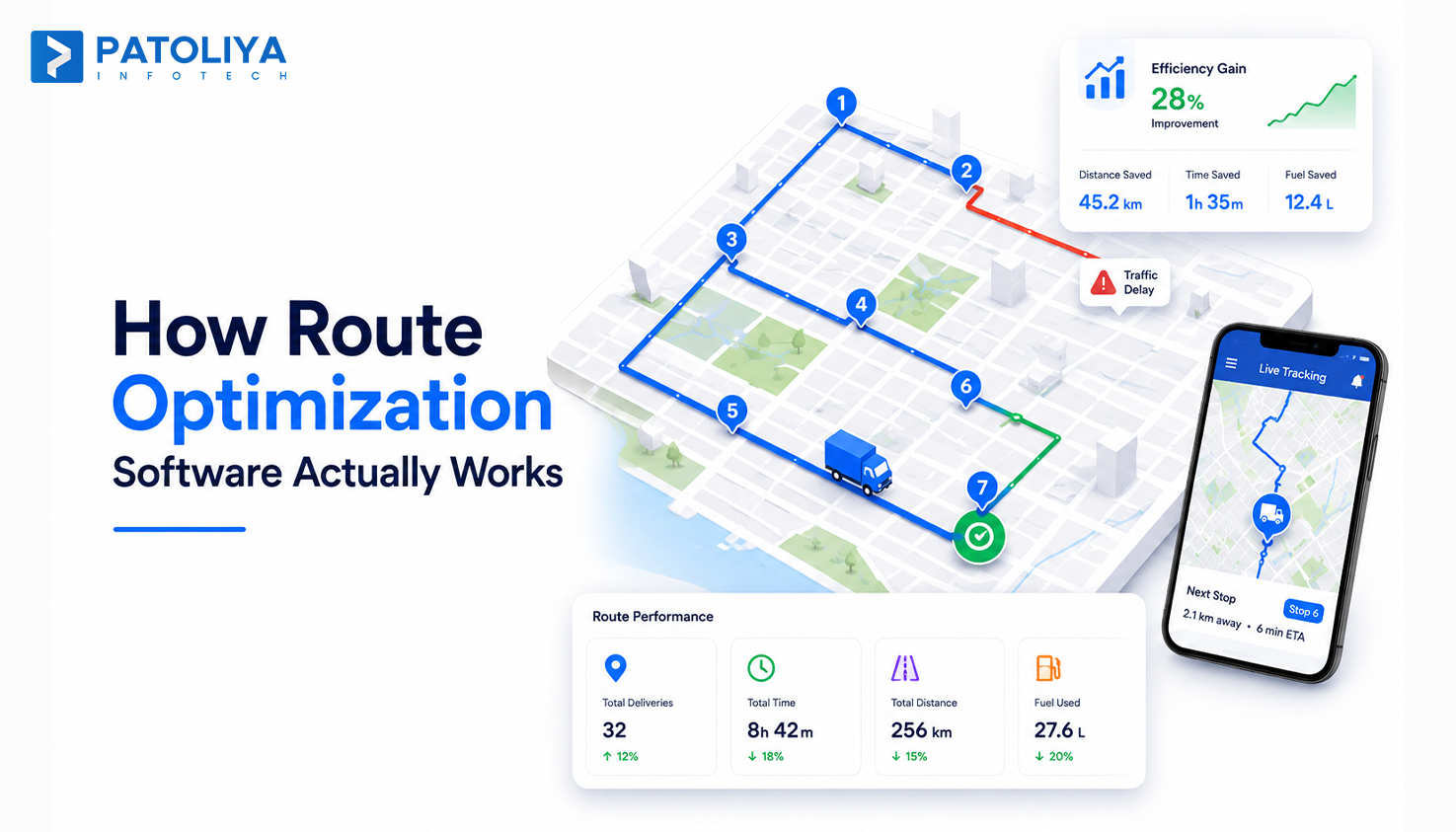
Route optimization means calculating the most efficient sequence and vehicle assignment across every stop in a fleet, the foundation of any delivery route planning system, factoring in time windows, vehicle capacity, and driver hours together. It treats planning as an optimization problem, not a series of individual stops handled one at a time.
A maps API calculates directions between locations, but delivery route planning requires optimizing the entire route across all stops. Route optimization software solves the harder version of that problem, known in operations research as the vehicle routing problem, where dozens of stops, vehicles, and constraints interact at once.
Getting directions right between two points is trivial. Getting the sequence and assignment right across an entire fleet through proper planning is the actual job worth paying for.
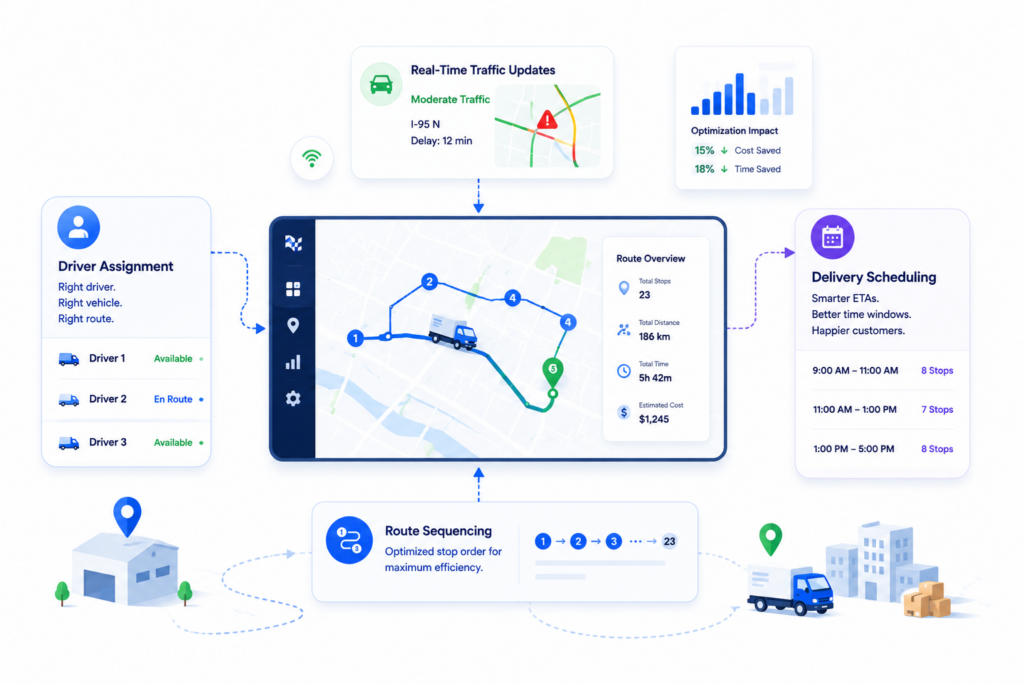
Every unnecessary mile a driver runs compounds across a fleet that runs dozens of routes daily, turning a small inefficiency into a real budget line item.
Fuel cost optimization built into the route optimization engine, not bolted on as an afterthought, is what actually moves this number down.
Manual delivery route planning cannot account for every time window constraint across a growing stop count, and missed windows turn into penalty clauses fast.
Route optimization that respects every time constraint simultaneously is the only way to hit SLA targets consistently at scale.
One dispatcher can manually handle delivery route planning for a small fleet, but that same dispatcher becomes the ceiling on growth once stop counts climb past a few hundred a day.
Automated route optimization software removes that human bottleneck entirely.
Without a clear breakdown of why a route ran long, teams repeat the same mistakes every week without realizing it.
The teams that actually fix this build a feedback loop from completed routes back into the optimization engine, not just a dashboard nobody checks.
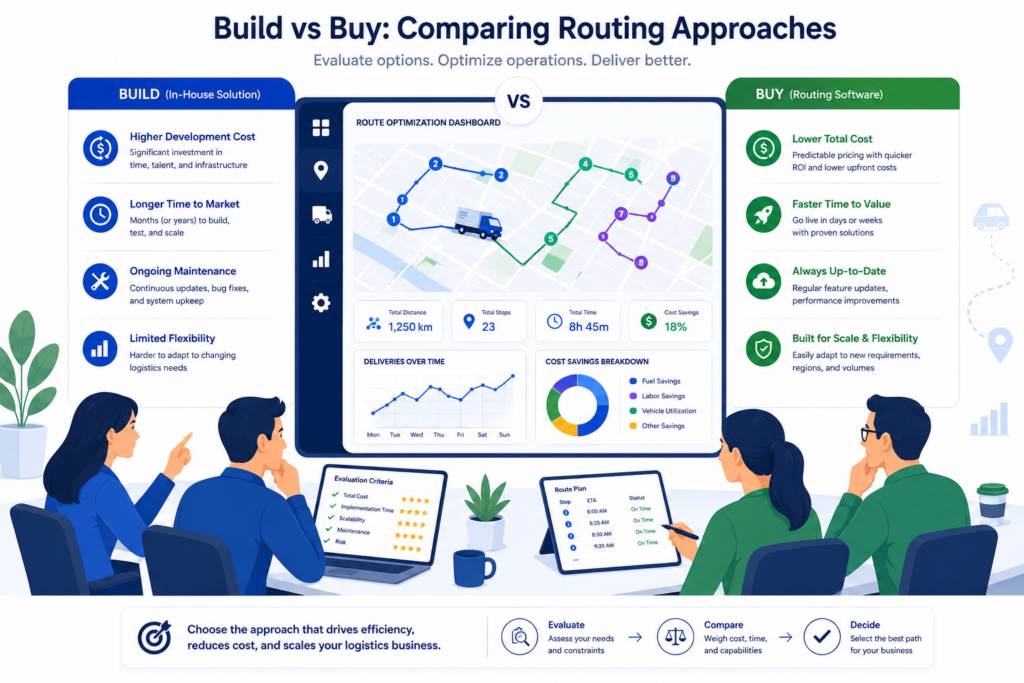
Off-the-shelf SaaS routing platforms deploy quickly and work best for fleets under 50 vehicles that need speed more than customization.
The tradeoff is low to medium control over the underlying logic, since the algorithm stays a black box you cannot tune directly.
Pairing an open source solver with a custom integration layer takes eight to fourteen weeks and gives medium to high control over route optimization logic.
This route fits teams with in-house or outsourced engineering capacity already available to maintain their own delivery route planning system.
A fully custom built platform takes four to nine months to build but delivers full control over proprietary constraints.
This fits enterprises running 150 or more vehicles where generic logic cannot capture the actual operational complexity involved.
Manual or spreadsheet-based delivery route planning costs nothing beyond labor and works fine under fifteen stops a day or before product-market fit.
Past that point, the labor cost of manual planning exceeds the cost of any route optimization option on this list.
| Approach | Time to Deploy | Cost Model | IP Control | Best Fit |
| Off-the-shelf SaaS | Days to weeks | Per driver subscription | Low to Medium | Sub 50 vehicle fleets |
| Open source solver plus custom build | 8 to 14 weeks | One-time dev plus hosting | Medium to High | In-house engineering available |
| Fully custom platform | 4 to 9 months | High one-time dev plus maintenance | High | 150 plus vehicle enterprises |
| Manual or spreadsheet | None | Labor only | N/A | Under 15 stops a day |
Off the Shelf Pricing: Most SaaS optimization software prices per driver or per task monthly, scaling cost directly with fleet size rather than charging a flat platform fee.
This model favors smaller fleets running simple delivery route planning needs where total driver count stays predictable month to month.
Custom Build Pricing: A single depot MVP using an open-source solver typically costs far less than an enterprise build with multi-region compliance and ERP integration baked in.
Annual maintenance on a custom route optimization build adds a recurring cost most teams underestimate during initial budgeting.
Hidden Cost Variables: Integration with existing TMS or WMS systems adds cost and timeline that rarely shows up in a vendor's initial quote.
Always ask for integration scope as a separate line item before comparing prices across software vendors.
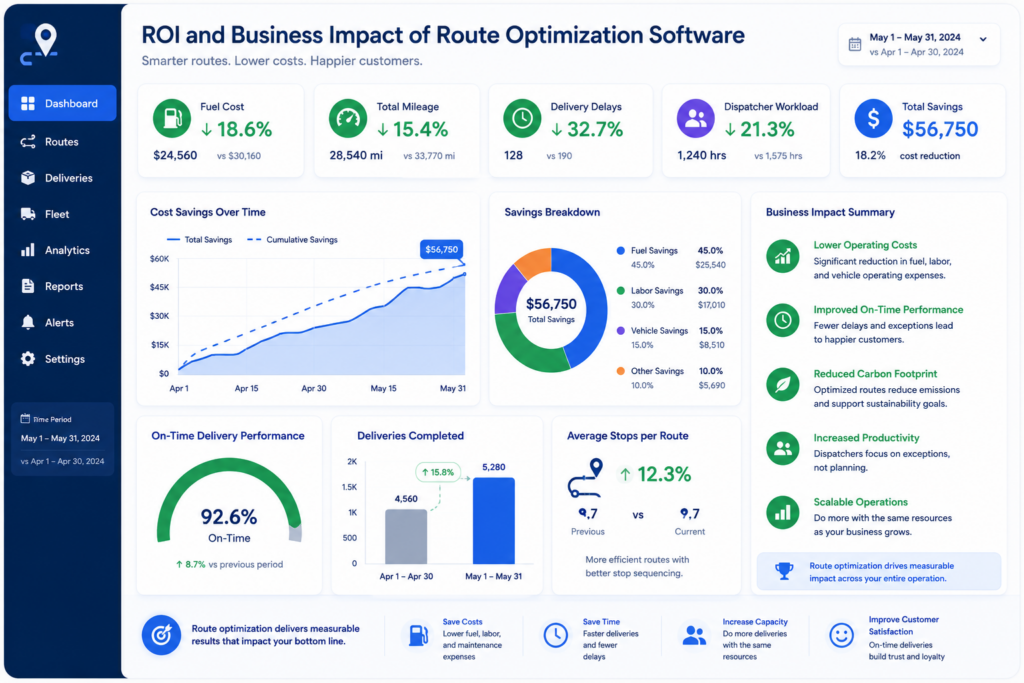
Mileage and Fuel Savings: Switching from manual delivery route planning to automated optimization typically cuts total mileage meaningfully within the first few months of going live, since the algorithm catches inefficiencies a human planner misses every single day.
SLA Compliance Improvement: Automated route optimization that respects every time window constraint simultaneously reduces missed delivery windows directly, which translates into fewer penalty payouts and fewer frustrated customers calling support lines.
Dispatcher Time Recovered: Removing manual planning from a dispatcher's daily workload frees that time for exception handling and customer issues instead of redrawing the same routes by hand every morning before shift start.
Scalability Without Headcount Growth: A fleet running automated software can grow stop count substantially without adding dispatcher headcount in proportion, since the algorithm absorbs the planning complexity that used to require another person.
| Checklist | Why It Matters |
| Support for the specific constraints your fleet handles daily. | Ensures the platform can optimize real-world operations, not just basic time windows. |
| API access for real-time traffic integration. | Enables dynamic routing adjustments as road conditions change throughout the day. |
| Explainability for route optimization decisions. | Helps dispatchers understand and trust why routes are generated in a particular sequence. |
| Scalability for increasing stop volumes and fleet sizes. | Prevents the need to replace the platform as operations grow. |
| Integration with existing dispatch, telematics, and ERP systems. | Reduces manual work and improves operational efficiency. |
| Pricing model disclosed clearly (per driver, per task, or flat fee). | Eliminates unexpected costs and simplifies budget planning. |
| Data export and ownership rights confirmed in writing. | Protects operational data and avoids vendor lock-in. |
| Defined pricing path as fleet size grows. | Supports predictable scaling without contract renegotiation. |
| Contract terms and service commitments documented upfront. | Establishes accountability and clear performance expectations. |
| Exit and migration process defined before implementation. | Makes it easier to switch providers or bring delivery route planning in-house later. |
These four names come up most often when operations teams compare software built for real fleet complexity, not just basic stop sequencing.
Founded in 2009, Route4Me runs across web, iOS, Android, and a REST API, focused on field sales sequencing and delivery route planning at high stop volume.
Best for: High-volume field sales and last-mile fleets needing fast sequencing without a custom build.
Founded in 2012 with a lean team, Onfleet pairs route optimization software with proof of delivery tracking built for local operations.
Best for: Local and last mile operations needing proof of delivery alongside routing.
Founded in 2013, Bringg runs cloud orchestration with Salesforce integration, built for route optimization across multiple carriers at once.
Best for: Enterprises coordinating delivery across multiple carriers under one platform.
Founded in 2015, Locus runs an AI dispatch and route optimization software platform built for retail and FMCG distribution at scale.
Best for: Retail and FMCG enterprises running dispatch complexity beyond basic sequencing tools.
Patoliya Infotech scopes the actual constraint complexity in your fleet first, then builds or integrates a route optimization solution matched to that complexity.
Every engagement starts with a scoped technical estimate mapping fleet size and constraints against the build, buy, or hybrid path that actually fits. Route optimization decisions get made on real numbers, not vendor marketing claims, and every delivery route planning recommendation comes with the math behind it.
Best for: Logistics and field service teams that want a route optimization software partner who hands over full ownership, not a locked-in subscription relationship.
Route optimization software has moved from a logistics nice to have into infrastructure that decides fleet margin every quarter, not just delivery speed. Teams that treat delivery route planning as a math problem instead of a navigation feature are the ones actually cutting costs. Fleet size, constraint complexity, and how much control you need over the underlying logic should drive the build, buy, or hybrid decision, not which vendor has the flashiest demo.
The cost of getting this wrong compounds fast. Every week running on manual planning or a black box platform that cannot explain its own routing decisions is a week of mileage, fuel, and dispatcher time you cannot get back.
Want a scoped technical estimate mapping your fleet against the right route optimization build path? Let's talk through your routing requirements.