Table of Contents
A dedicated development team is not outsourcing, and it is not staff augmentation. It is a fully managed squad you direct but do not employ. The model works when you need sustained product velocity without the 4 to 6-month in-house hiring cycle. Get the engagement structure wrong, and you will pay in-house rates for outsourced output.
Hiring in-house takes 4 to 6 months per engineer. Project outsourcing locks you into scope. Most product companies sit stuck between the two, bleeding time and budget on a problem that the dedicated development team model was built to solve. The model gives you a managed engineering squad, full directional control, and none of the HR overhead. The catch: it only works when you set it up correctly. This guide breaks down exactly how a dedicated software development team engagement works, what it costs by region in 2026, and the conditions that determine whether it beats every alternative.
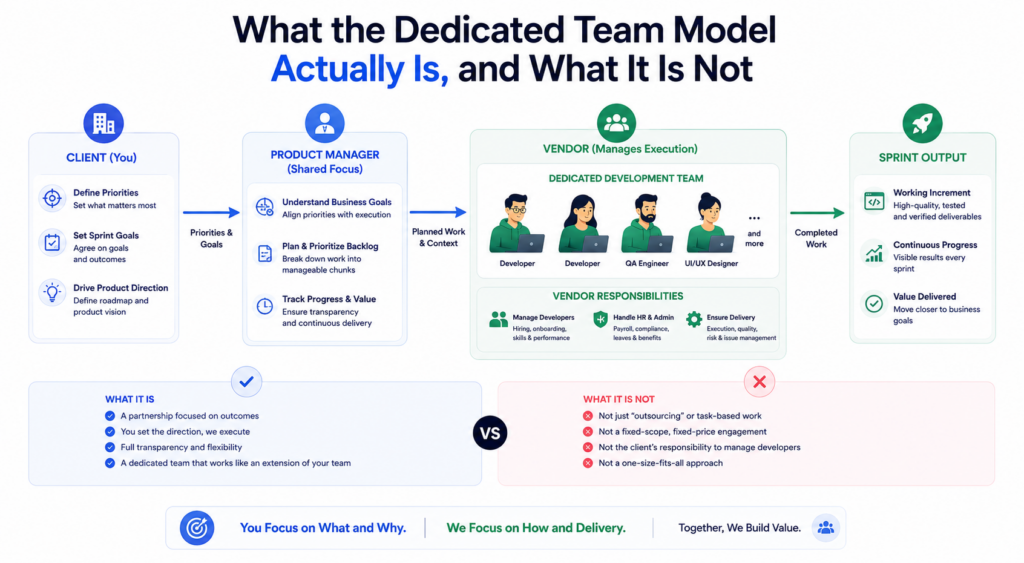
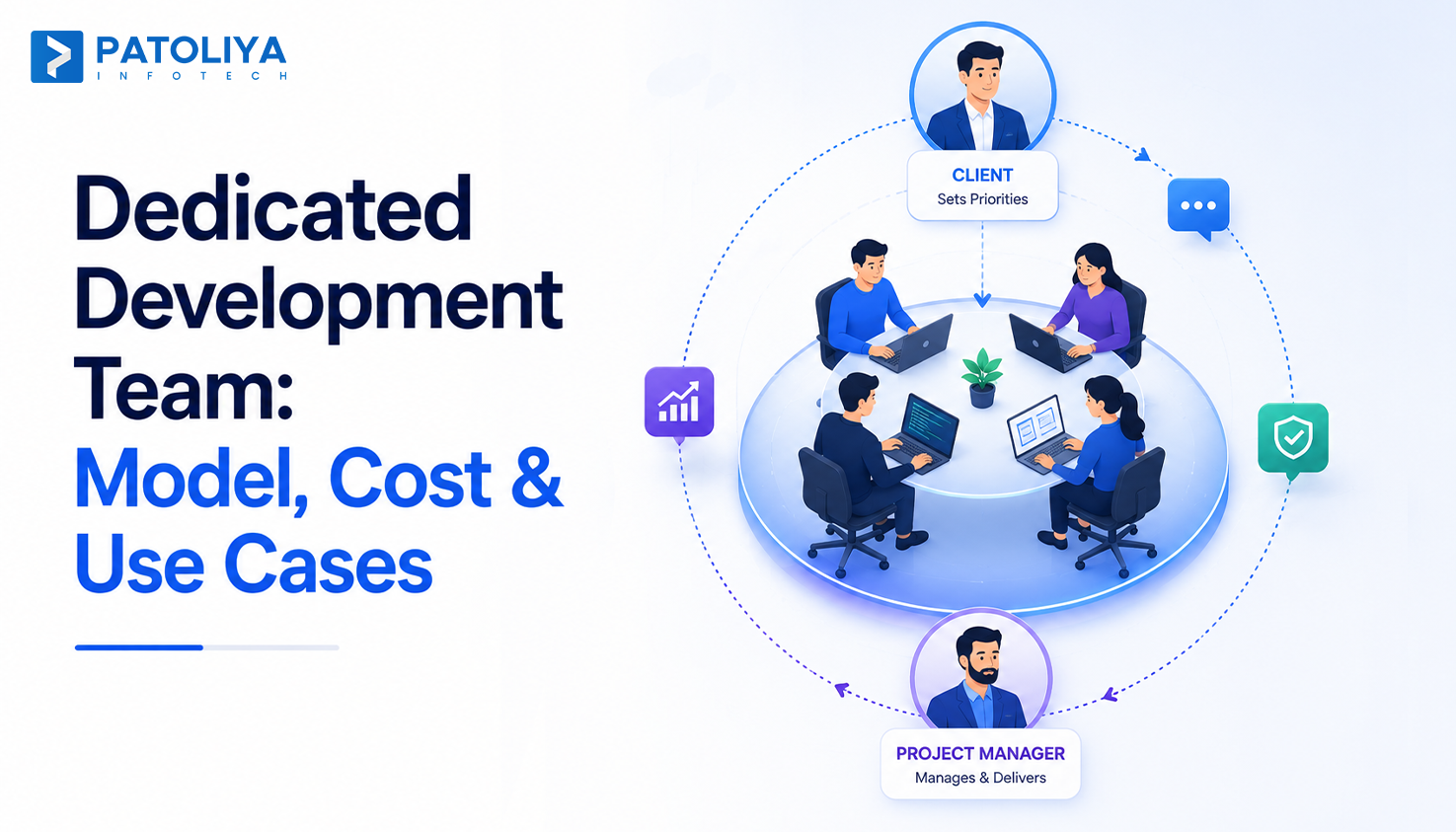
A dedicated development team is a vendor-employed engineering squad that works exclusively on your product under your direction. You set priorities. The vendor handles HR, infrastructure, and retention. Most organisations confuse this with at least two other models.
| Model | Who Manages | Scope Flexibility | Best For |
| Dedicated development team | Client directs, vendor employs | High | Long-term product work |
| Staff augmentation | Client manages fully | Medium | Filling specific skill gaps |
| Project outsourcing | Vendor manages | Low | Fixed-scope delivery |
| Extended team model | Shared | High | Scaling existing teams |
| Freelance | Client manages | High | Short task-based work |
Staff augmentation drops individual developers into your existing team structure. You carry all management weight. A dedicated software development team comes with its own operating rhythm. The vendor manages team health, HR, and continuity. The distinction matters because it determines who carries delivery risk when a developer leaves.
The dedicated development team model wins on sustained product work. It loses on short, fixed-scope projects. Most companies find this out after signing a 12-month contract.
Four Conditions That Indicate a Dedicated Team Is the Right Model
Four Signals That a Dedicated Team Is the Wrong Choice
When none of these conditions applies, hire dedicated dev team arrangements consistently outperform both alternatives on delivery speed and cost per feature shipped.
A dedicated development team engagement runs in four distinct phases. Most breakdowns happen in phase three because nobody planned for it.
Scoping (Weeks 0 to 2)
Define team composition, tech stack, communication protocols, and output expectations. A dedicated software development team built without a clear tech stack requirement produces mismatched candidates.
Team Assembly and Contracting (Weeks 2 to 4)
Vendor sources candidates. You interview and approve. IP clauses, repository access, and exit terms get finalised here, not later.
Integration and Onboarding (Weeks 5 to 8)
Access provisioned. Codebase walkthroughs completed. Sprint cadence established. This phase is where most clients underinvest and then wonder why velocity is low at month two.
Ongoing Operations (Month 3 Onward)
The dedicated development team operates at full capacity with weekly sprint ceremonies, async standups, and defined escalation paths.
| Client Controls | Vendor Controls |
| Product priorities | Salaries and benefits |
| Sprint planning | Developer HR and compliance |
| Technical direction | Team retention and replacement |
| Release decisions | Local employment law |
The three most common failure points: access not provisioned before day one, no internal tech lead available for questions, and sprint ceremonies skipped in weeks one to three. A dedicated software development team cannot self-start without structured integration.
Every dedicated development team vendor will tell you their teams ramp fast. The real numbers tell a different story.
Realistic Week-by-Week Output Expectations for a New 5 to 8 Person Dedicated Team
| Timeline | Expected Velocity |
| Weeks 1 to 2 | 10 to 20% of full capacity |
| Weeks 3 to 4 | 30 to 40% |
| Weeks 5 to 8 | 50 to 70% |
| Weeks 9 to 12 | 80 to 100% |
Plan for 8 to 12 weeks before a dedicated software development team reaches full velocity with structured onboarding. Without it, expect 3 to 6 months.
Accelerates:
Kills it:
The dedicated development team quote you receive is not the cost. The true cost includes management overhead, tooling, onboarding time, and the vendor margin built into every developer rate.
| Region | Junior ($/month) | Mid-Level ($/month) | Senior ($/month) |
| India | $2,000 to $3,500 | $3,500 to $5,500 | $5,000 to $8,000 |
| Eastern Europe | $4,500 to $6,500 | $6,500 to $9,500 | $9,000 to $14,000 |
| Latin America | $3,500 to $5,500 | $5,500 to $8,000 | $7,500 to $12,000 |
| Southeast Asia | $2,500 to $4,000 | $4,000 to $6,000 | $5,500 to $9,000 |
| US In-House (all-in) | N/A | $10,000 to $16,000 | $15,000 to $25,000 |
When you hire dedicated dev team resources, add these to every quote:
| Region | Monthly Total | Annual Total |
| India | $18,000 to $26,000 | $216,000 to $312,000 |
| Eastern Europe | $32,000 to $48,000 | $384,000 to $576,000 |
| Latin America | $24,000 to $36,000 | $288,000 to $432,000 |
| US In-House | $65,000 to $90,000 | $780,000 to $1,080,000 |
Team augmentation pricing comparisons look favourable until you add the hidden costs. Build those into your business case before presenting to a CFO.
A dedicated development team is not always cheaper. At a specific team size and tenure, the cost crossover hits, and in-house hiring becomes more economical.
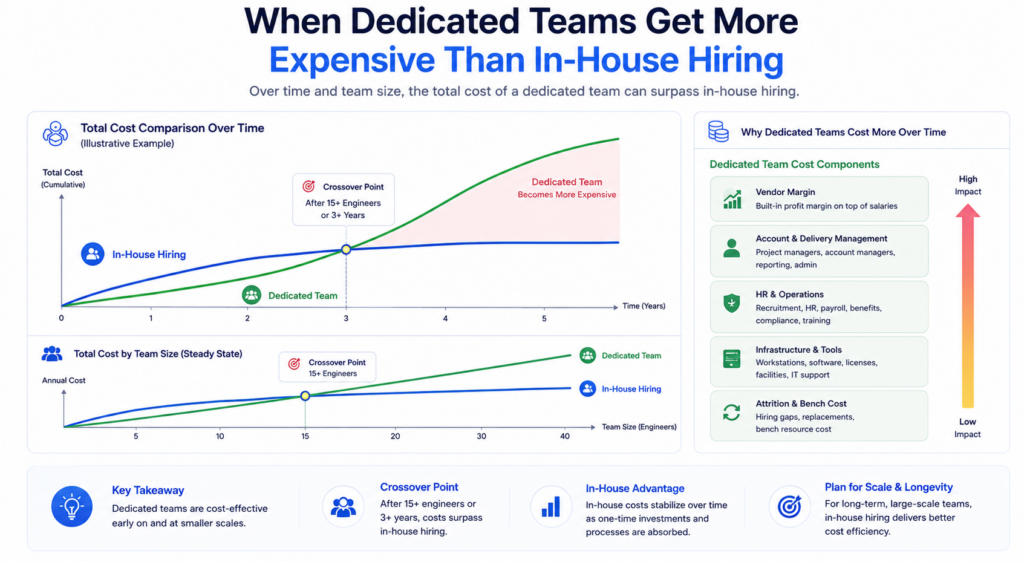
Crossover calculation:
Vendor annual cost + management overhead vs. in-house salary + benefits (30%) + recruiting (15 to 20% of salary) + equity + HR infrastructure
When the crossover happens in practice:
Below 10 engineers and under 24 months, a dedicated software development team almost always wins on total cost. Above those thresholds, model it explicitly. The answer is not automatic either way.
The BOT offshore model is the path companies take when they want a dedicated development team today and direct employment ownership in 3 years. Most vendors offer it. Few clients understand what the transfer phase actually costs.
In a standard dedicated development team arrangement, the vendor employs the team permanently. In BOT, the vendor builds and operates for an agreed period, then transfers employment to a client-owned legal entity in the offshore location.
Entity setup costs $15,000 to $40,000. The transfer timeline runs 18 to 36 months. Developers who joined under the vendor's employment brand do not always transfer. Build retention incentives into the BOT contract before the transfer phase begins, not during it.
The dedicated team contract you sign in week three governs every problem you will face in month eighteen. Most clients read the rate card and skim the rest.
1. IP Assignment Language: The contract must use “hereby assigns,” not “agrees to assign”. Present-tense language transfers IP at creation. Future-tense language creates a gap your lawyers will charge you to close later.
2. Key Person Clause (Team Stability Guarantee): Name critical team members. Define the notice period for replacement and who covers transition costs. Without this, vendors substitute developers with no contractual consequence.
3. Source Code Escrow and Repository Access: Your organisation owns the repository. Not the vendor. If the vendor hosts the repo on your behalf, define the 24-hour access revocation SLA in the contract.
4. Exit and Knowledge Transfer Obligation: Define the minimum knowledge transfer period, who pays for it, and what deliverables it produces. Verbal agreements here fail consistently.
5. SLA Definitions and Penalties: Velocity targets, defect rates, and PR turnaround times need numbers, not descriptions. "Timely delivery" is not an SLA.
6. Non-Solicitation Scope: Define whether the clause is mutual. One-sided non-solicitation clauses that prevent you from hiring team members directly while not restricting the vendor are common and negotiable.
Rate escalation clauses tied to local inflation indexes. Automatic renewal with 90-day notice requirements. Dispute resolution requiring arbitration in the vendor's jurisdiction. Read the boilerplate. Every clause in it was put there because a client dispute made it necessary. When you hire dedicated dev team resources, legal review of the contract is not optional.
Managing a dedicated development team without HR authority is a skill most product leaders have not developed. The tools are different. The accountability structure has to be explicit.
You cannot put a developer on a performance improvement plan. You can escalate to the vendor with documented output metrics and request a replacement. Define the escalation path, the metric thresholds that trigger it, and the vendor's response SLA before month one.
Require a minimum 4-hour daily overlap window. A dedicated software development team operating with less than 4 hours of shared time consistently underperforms on sprint commitments. Use async standups in your project tool daily and synchronous sprint ceremonies weekly.
Recognition travels. Send direct feedback to developers, not just to the vendor PM. Include the team in product context discussions. Teams that understand the product they are building show measurably higher retention and output quality than teams operating as a code factory.
IP ownership in a dedicated development team engagement is almost always clear in theory and contested in practice. The gap is between legal ownership and operational access.
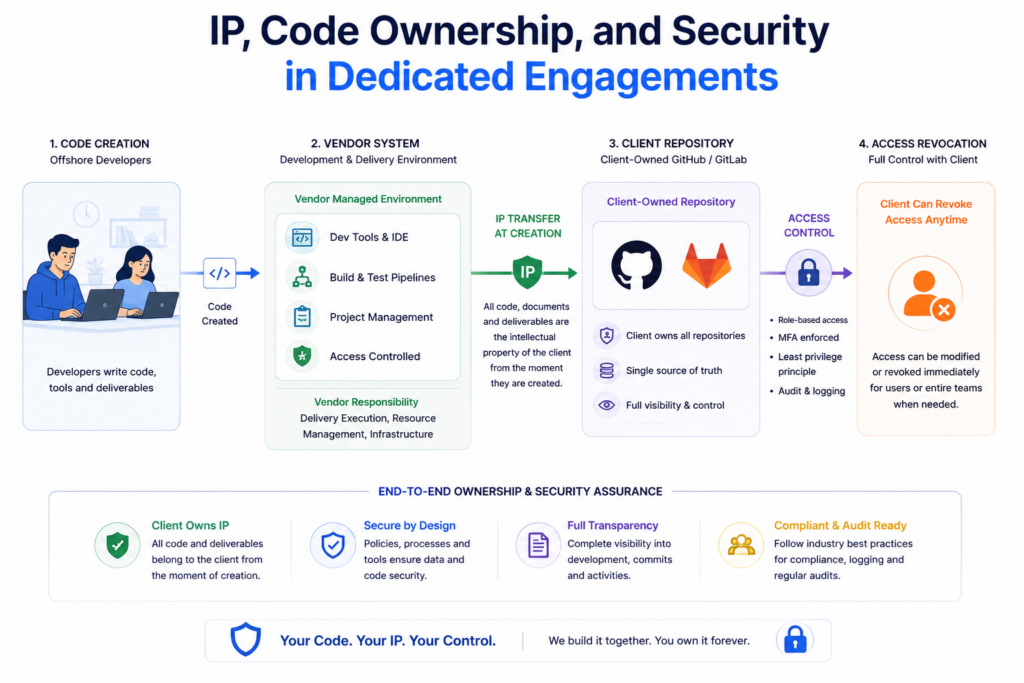
You own all work product created under the engagement from day one, provided the contract uses present-tense assignment language. Background IP the vendor brings to the engagement must be listed explicitly in a contract exhibit. Unlisted background IP creates disputes.
Offshore dedicated developers working in vendor-managed environments can create access control gaps. Run all repositories under your organisational GitHub or GitLab account. Manage secrets through your own vault, not the vendor's.
Define access revocation as a 24-hour contractual SLA. When the engagement ends, you should be able to remove access before the exit conversation is over.
Most dedicated development team failures are predictable. They follow one of four patterns, and they accelerate if nobody names them early.
1. Team Instability via Vendor Substitution: Vendors replace developers without adequate notice. Output drops. Institutional knowledge leaves. Key person clauses prevent this.
2. Productivity Plateau: The team reaches 60 to 70% velocity and stays there. Usually caused by unclear product ownership on the client side, not poor developer quality.
3. Misaligned Incentives: Vendor margin comes from headcount. Efficiency that reduces headcount reduces vendor revenue. Structural conflict, worth naming in the vendor relationship.
4. Client-Side Ownership Vacuum: No internal product owner with technical context. The dedicated software development team builds what it can interpret, not what the product needs.
Define exit triggers before month one: sustained velocity below 60%, two consecutive sprint misses above 30% scope, or key person replacement without approval. When triggers hit, activate the knowledge transfer clause immediately. A dedicated development team transition without a documented handover period costs 2 to 4 months of productivity on the receiving side.
The vendor selection process for a dedicated development team has one reliable filter: how they answer the questions that make them uncomfortable.
| # | Capability Checkpoint | Why It Matters |
| 1 | Engagement Transparency | Shows real-world accountability and ability to recover from delivery issues |
| 2 | Team Management Structure | Ensures focus, availability, and avoids overloaded project managers |
| 3 | Developer Replacement Process | Prevents delivery disruption when team changes happen |
| 4 | Code & Repository Ownership | Ensures you retain full control of code and IP |
| 5 | Developer Attrition Rate | Lower attrition means stable velocity and less knowledge loss |
| 6 | Team Composition Quality | Directly impacts code quality and delivery speed |
| 7 | Interview Rights | Ensures you control skill validation before onboarding |
| 8 | IP Assignment Clarity | Eliminates legal ambiguity over ownership of work |
| 9 | Trial Engagement Model | Reduces risk before long-term commitment |
| 10 | Pricing Transparency | Builds trust and prevents hidden markup structures |
The vendor that answers question one with a real story is the vendor worth talking to further. Most will not. That tells you something useful before you sign anything.
Patoliya Infotech builds dedicated development teams for product companies that need engineering velocity without the hiring cycle. The engagement model is structured around the gaps where most dedicated software development team arrangements fail: onboarding clarity, contract transparency, and post-cutover stability.
When you hire dedicated dev team resources through Patoliya Infotech, here is what the engagement actually looks like:
Your migration is only as good as the sequence behind it. Let's build that first. Or if you want to see exactly what the right team structure looks like for your stage, request a team structure proposal and get a clear answer in one call.
The dedicated development team model has matured from a cost-arbitrage play into a primary engineering delivery structure for product companies that cannot afford the hiring cycle or the scope rigidity of project outsourcing. The single variable that determines whether it works is not the vendor. It is the clarity of your product ownership on the client side. Get that right, and a dedicated software development team will outperform in-house hiring on speed, cost, and flexibility at almost every stage below 15 engineers. Get it wrong, and you will pay full rates for a team operating at 60% capacity. The sequence, the contract, and the onboarding plan matter more than the rate card.