Table of Contents
Six to ten weeks under a partner's legal entity, then shifts full ownership to the client at a contracted milestone, usually 18 to 36 months out. Once that happens, management fees stop, and the team becomes a direct hire base.
A captive entity in India can take a year to register and staff properly. A build operate transfer engagement gets engineers writing code in six to ten weeks while ownership sits with the partner until a later date. That gap between launch speed and eventual ownership is the entire reason this model exists. This BOT model IT outsourcing guide will explain how build operate transfer actually works, what it costs through 2026, and where the real risk sits before you sign anything.
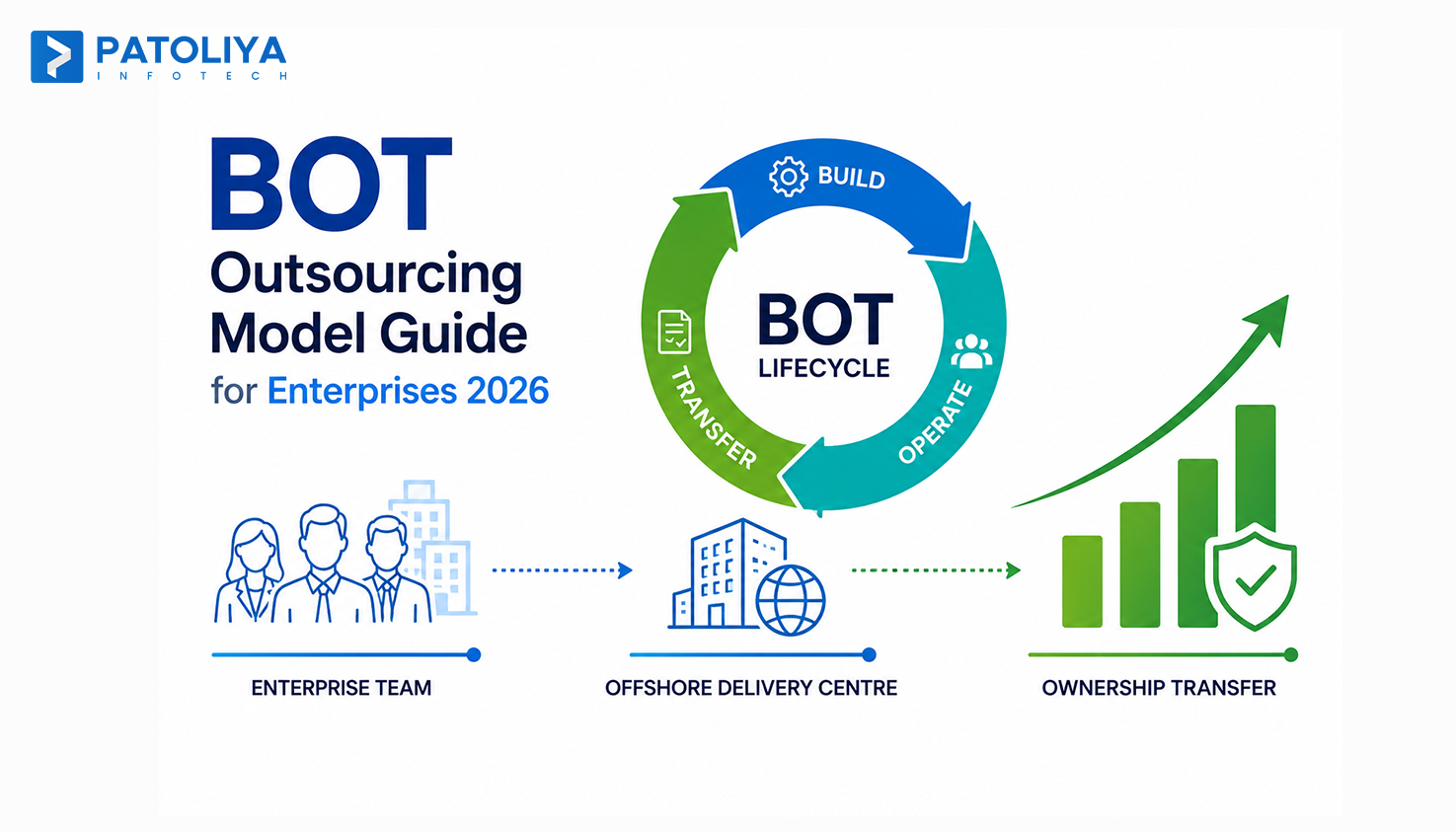
Build operate transfer means a partner builds a team, operates it under their own entity, then transfers ownership to the client at a fixed milestone.
The BOT outsourcing model emerged to close the gap between slow captive registration and ownership free staffing deals.
It replaces direct offshore captive setup and pure staff augmentation, sitting between launch speed and final ownership.
Build operate transfer is not permanent outsourcing. Every contract carries a dated transfer clause that traditional outsourcing skips entirely.
BOT vs Adjacent Terms
| Term | Ownership Path |
| Build operate transfer | Transfers to client at milestone |
| Outsourcing | Stays with vendor |
| Dedicated team | Stays with vendor |
Phase 1: Build (Weeks 1 to 10)
The partner registers infrastructure and hires engineers under their own entity, so onboarding starts before the client owns anything.
Phase 2: Operate (Months 3 to 24+)
The team works only for the client while the partner runs HR and compliance. This is where most build operate transfer offshore value gets delivered.
Phase 3: Transfer (Months 19 to 27)
Ownership, contracts and IP move to the client here, completing the managed to captive transition through ROC filings.
Stakeholder Roles and RACI Matrix
| Activity | Client | Partner |
| Sprint priorities | Accountable | Consulted |
| Payroll and compliance | Informed | Accountable |
| Transfer execution | Accountable | Responsible |
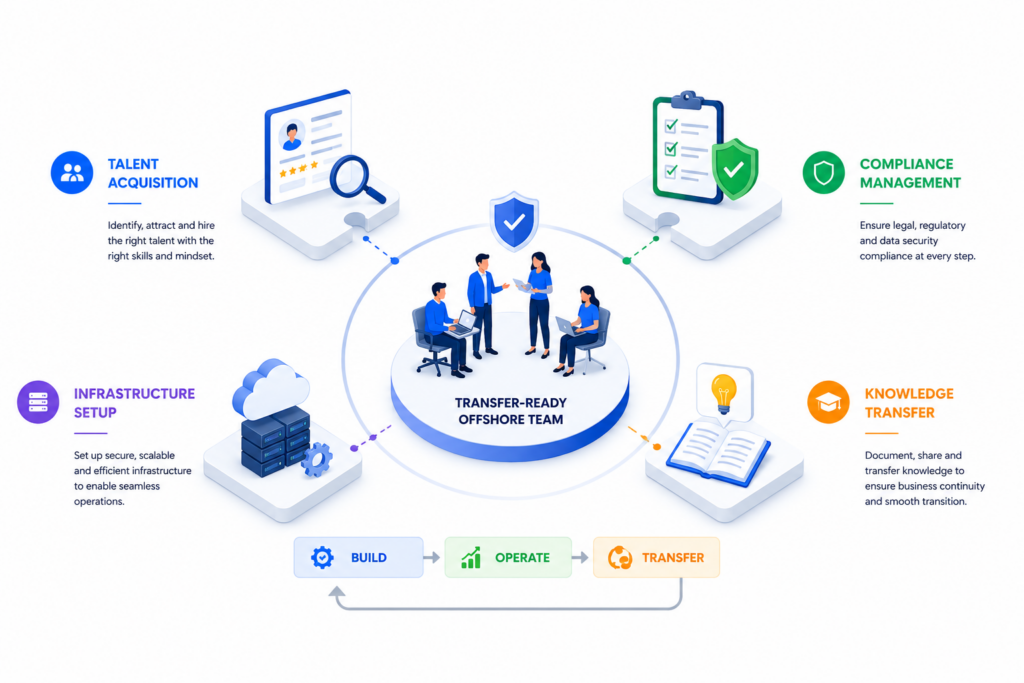
Talent Acquisition and Staffing Infrastructure: A build operate transfer partner recruits against the client's technical bar, not generic resumes pulled from a database.
Legal Entity Setup and Compliance Management: PF, ESIC and labour filings run under the partner's entity during the operate phase, so the client registers nothing early.
Technology Infrastructure Provisioning: Laptops, VPN and security tooling get set up before day one, building the offshore development centre BOT model IT outsourcing teams need to ship immediately.
Knowledge Transfer and Documentation Governance: Documentation standards get built from sprint one, so transfer day never turns into a scramble for missing context.
Direct Captive Setup Is Capital Intensive: Registering an offshore captive setup needs entity formation and HR infrastructure before one engineer gets hired. Build operate transfer removes that upfront capital need.
Outsourcing Leaves IP and Talent Uncontrolled: Outsourcing vendors own the engineer relationship permanently. With build operate transfer offshore contracts, IP is assigned to the client at the employee level from day one.
Greenfield Offshore Hiring Takes 6 to 12 Months: Direct hiring means building a recruiting brand from zero. A build operate transfer partner already runs a pipeline, cutting that to under ten weeks.
Post Transfer Integration Is Underestimated: Companies plan the transfer date but skip integration planning, and productivity drops fast when client side onboarding is not ready.
Cost Efficiency Without Captive Setup Risk: Engineers cost a fraction of onshore rates while the client avoids the capital exposure of an entity before the team proves itself.
Scalability Within and Beyond the BOT Structure: Headcount scales inside the contract, and after transfer, the client hires directly with zero vendor markup.
Risk Reduction vs Direct Captive and Pure Outsourcing: A build operate transfer contract spreads compliance risk to the partner early, then removes it completely at transfer.
Faster Time to Market: Teams ship working sprints in six to ten weeks instead of the six to twelve months a captive build needs.
Access to India's Engineering Talent Market: Partners running active pipelines for build operate transfer offshore roles place senior engineers faster than cold client-side recruiting.
Long Term Cost Ownership vs Perpetual Staff Augmentation: These BOT model IT outsourcing benefits include a hard end date for vendor markup, completing the BOT outsourcing model to owned team shift for good.
| Criteria | BOT Model | Dedicated Team | Staff Augmentation | Outsourcing | In House |
| Team Ownership | Transfers at milestone | Vendor owned | Vendor owned | Vendor owned | Client owned |
| IP Control | Client-owned day 1 | Variable | Variable | Vendor-side risk | Full client |
| Setup Time | 4 to 8 weeks | 1 to 3 weeks | 1 to 2 weeks | 2 to 4 weeks | 6 to 18 months |
| Year 1 Cost (10 Engineers) | $336K to $504K | $240K to $480K | $220K to $440K | $200K to $400K | $1.2M+ |
While other engagement models prioritise speed or flexibility, build operate transfer balances rapid setup with future ownership and control.
Dedicated team arrangements provide ongoing development capacity, but ownership remains with the vendor. For companies planning a future captive operation, build operate transfer offers a structured transition to full control.
Staff augmentation helps fill immediate talent gaps but does not create an owned engineering organisation. A build operate transfer offshore model focuses on building a complete team that can eventually become part of the client's business.
Traditional outsourcing delivers project outcomes while the vendor retains ownership of the team and operations. A BOT model IT outsourcing builds an engineering capability that transfers to the client at a predefined stage.
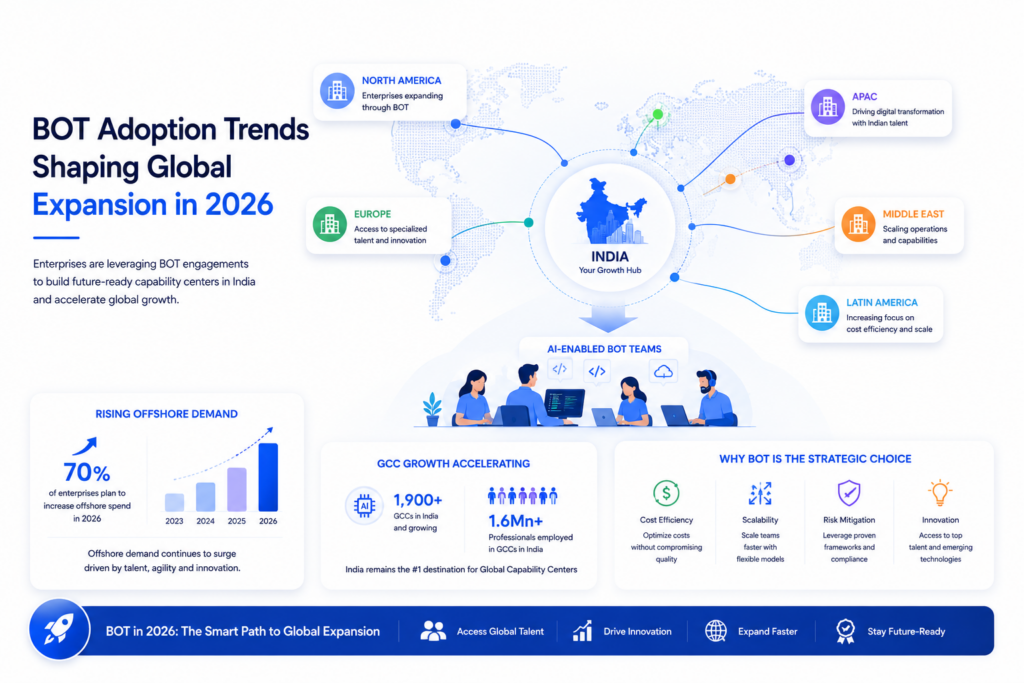
A GCC setup India initiative can take months to establish due to hiring, compliance, and operational requirements. BOT outsourcing model accelerates the process by providing an operational team first and transferring ownership later.
| Cost Component | Small (5 to 10 engineers) | Mid Market (11 to 30 engineers) | Enterprise (31 to 75 engineers) |
| Engineer CTC | $1,400 to $2,800/mo | $1,600 to $3,200/mo | $2,000 to $4,500/mo |
| Management Fee | $800 to $1,500/mo | $700 to $1,200/mo | $600 to $1,000/mo |
| Transfer Fee | $15K to $30K | $25K to $50K | $50K to $120K |
| Year 1 Total | $168K to $420K | $420K to $1.66M | $1.12M to $4.95M |
Small Team Pricing (5 to 10 Engineers)
At this size, the BOT pricing structure carries a higher per-engineer fee since fixed compliance costs are spread across fewer heads.
Mid Market Pricing (11 to 30 Engineers)
Fees drop as headcount climbs, and transfer fees often shift to a multiple of monthly cost instead of a flat number.
Enterprise Pricing (31 to 75 Engineers)
Enterprise build operate transfer contracts negotiate the lowest per engineer fee but the highest absolute transfer fee.
Hidden Cost Variables to Negotiate
Get PF, ESIC and gratuity itemised separately. Infrastructure scaling overage catches unprepared buyers off guard at growth stages.
Contract Duration and Fee Correlation
Shorter twelve month contracts typically carry a 15 to 25 per cent fee premium since the partner recovers setup cost faster.
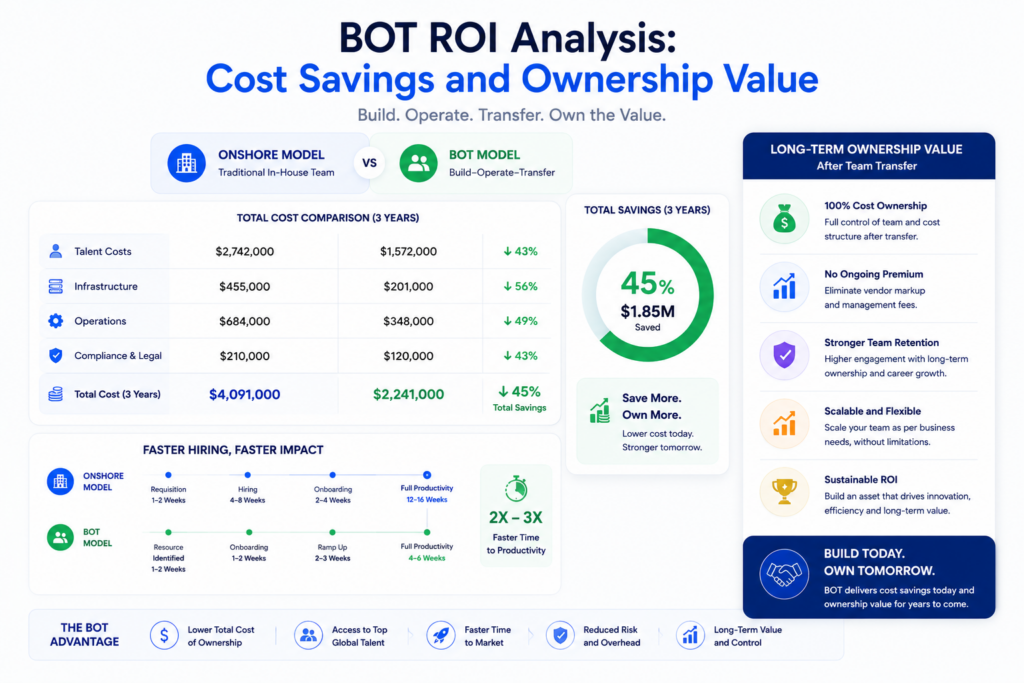
| Metric | 10 Engineer Team | 25 Engineer Team |
| Onshore Annual Cost | $1.2M to $1.8M | $3.0M to $4.5M |
| BOT India Annual Cost | $280K to $420K | $700K to $1.05M |
| Year 1 Savings | $780K to $1.38M | $2.3M to $3.45M |
| Post Transfer Annual Savings | $48K to $90K | $120K to $225K |
Development Cost Savings vs Onshore: The gap between onshore pay and a build operate transfer cost structure stays wide enough to show seven-figure savings at scale.
Faster Time to Market: Sprint one starts in under ten weeks against six to twelve months for a captive build, a gap that compounds across release cycles.
Hiring Efficiency: Partners with active pipelines fill senior roles faster than client-side recruiting starting cold in an unfamiliar market.
Operational Scalability: Headcount flexes without renegotiating a master agreement, unlike staff augmentation tied to fixed seat counts.
Ownership Economics: Once a build operate transfer offshore contract completes, the client stops paying management fees for good.
A build operate transfer offshore engagement can significantly accelerate global expansion, but success depends on managing risk and legal exposure from the start.
IP Ownership Gaps: Ensure employee-level IP assignment agreements are in place from day one to protect intellectual property throughout the engagement and transfer process.
Communication Breakdowns: Appoint a dedicated engagement manager with clear escalation authority to maintain alignment between client and vendor teams.
Transfer Integration Failure: Start transition planning at least six months before the transfer milestone to ensure a smooth handover of people, processes, and systems.
Engineer Attrition: Include a contractual attrition SLA below 15% annually and require a replacement strategy to preserve team continuity.
Compliance and Security Exposure: Work with partners that maintain SOC 2 Type II and ISO 27001 certifications and conduct regular security and compliance audits.
Addressing these risks early helps organizations maximize the benefits of a BOT outsourcing model while reducing disruption during the ownership transition.
| Checklist Item | Why It Matters |
| Employee-level IP assignment | Ensures intellectual property remains protected during and after transfer. |
| Defined transfer trigger and process | Prevents ownership disputes and transition delays. |
| Capped early exit fee | Reduces financial risk if plans change. |
| SOC 2 Type II and ISO 27001 certification | Demonstrates mature security and compliance practices. |
| Named engagement manager | Provides accountability and faster issue resolution. |
| Attrition SLA below 15% annually | Helps maintain team stability and knowledge retention. |
| Itemized compliance costs | Avoids unexpected legal and operational expenses. |
| Backup bench within four weeks | Minimizes disruption from employee departures. |
| Contract novation schedule | Ensures smooth transfer of agreements and responsibilities. |
| Proven BOT delivery record | Confirms the vendor can successfully execute a BOT outsourcing model. |
These five names get mentioned most when companies search for a build operate transfer partner that has executed a transfer, not just sold one.
Founded in 2015 with a team of 150 plus, Patoliya runs build operate transfer engagements for mid-market companies with a documented transfer playbook built into every contract.
Best for: Mid market companies running a BOT model IT outsourcing with 10 to 50 engineers who want a partner that has completed transfers before.
Founded in 2003 with over 27,000 employees globally, Globant handles large-scale digital transformation work with build operate transfer offshore delivery as a secondary engagement model, not the core offering.
Best for: Enterprises already running Globant for transformation work who want BOT model IT outsourcing folded into an existing vendor relationship.
Founded in 1990 with a workforce of 22,000 plus, Persistent runs compliance heavy build operate transfer contracts for regulated industries needing 50 or more engineers under one entity.
Best for: Enterprises in BFSI or healthcare needing a BOT contract model with heavy regulatory documentation.
Founded in 2000 with a team exceeding 35,000, Mphasis delivers large enterprise build operate transfer offshore engagements with Tier 1 governance standards across BFSI and insurance.
Best for: Large enterprises needing Tier 1 governance on a high headcount build operate transfer contract.
Founded in 2002 with a team of 2,000 plus, N iX runs BOT model IT outsourcing engagements for regulated industries needing nearshore time zone overlap out of Eastern Europe.
Best for: Companies needing GDPR aligned build operate transfer delivery with European time zone overlap.
Patoliya Infotech helps companies build offshore teams with a clear path to ownership. Every build operate transfer engagement is structured with transfer terms, IP protection, and governance defined upfront, ensuring transparency throughout the partnership.
What sets us apart:
Ready to build and own your offshore team? Connect with our experts to discuss your BOT strategy, evaluate transfer timelines, and create a roadmap tailored to your growth objectives.
| Phase | Timeline | Key Activities |
| Build | Weeks 1 to 4 | Define scope, finalise contracts, and begin recruitment. |
| Setup | Weeks 5 to 10 | Hire talent, onboard engineers, and establish infrastructure. |
| Operate | Months 3 to 18 | Deliver projects, manage performance, and scale the team. |
| Transfer | Months 19 to 27 | Transition employees, processes, and operations to client ownership. |
A well-structured BOT model IT outsourcing ensures faster setup, lower risk, and a seamless transition to a fully owned offshore team.
The build operate transfer model is designed to help organisations launch offshore teams quickly without sacrificing the long-term goal of full ownership. By combining rapid team setup with a structured transition plan, businesses can scale efficiently while maintaining control over talent, processes, and intellectual property.
Successful BOT outsourcing model engagements define transfer terms, IP ownership, and governance upfront, reducing risk during the ownership transition.
Want to understand what a build operate transfer engagement would look like for your business? Speak with our team to explore timelines, team structures, and estimated costs based on your growth goals and hiring requirements.