Table of Contents
TLDR: IT vendor management is the process of governing technology suppliers from contract to renewal. Organizations with formal IT vendor management programs recover up to 9% in contract value through better negotiations and SLA enforcement. Without it, vendor sprawl and third-party risk become costly operational problems.
Most IT leaders discover their IT vendor management problem the same way: a critical vendor misses an SLA, the breach goes undetected for weeks, and the damage surfaces in a customer escalation or an audit finding. By that point, the contract leverage is gone, and the relationship is already strained. Vendor portfolios above 20 active contracts become unmanageable without a formal system. This guide covers IT vendor management from framework design through vendor selection, pricing, and ROI measurement. By the end, you will know exactly how to structure your program, what it costs, and which providers to evaluate.
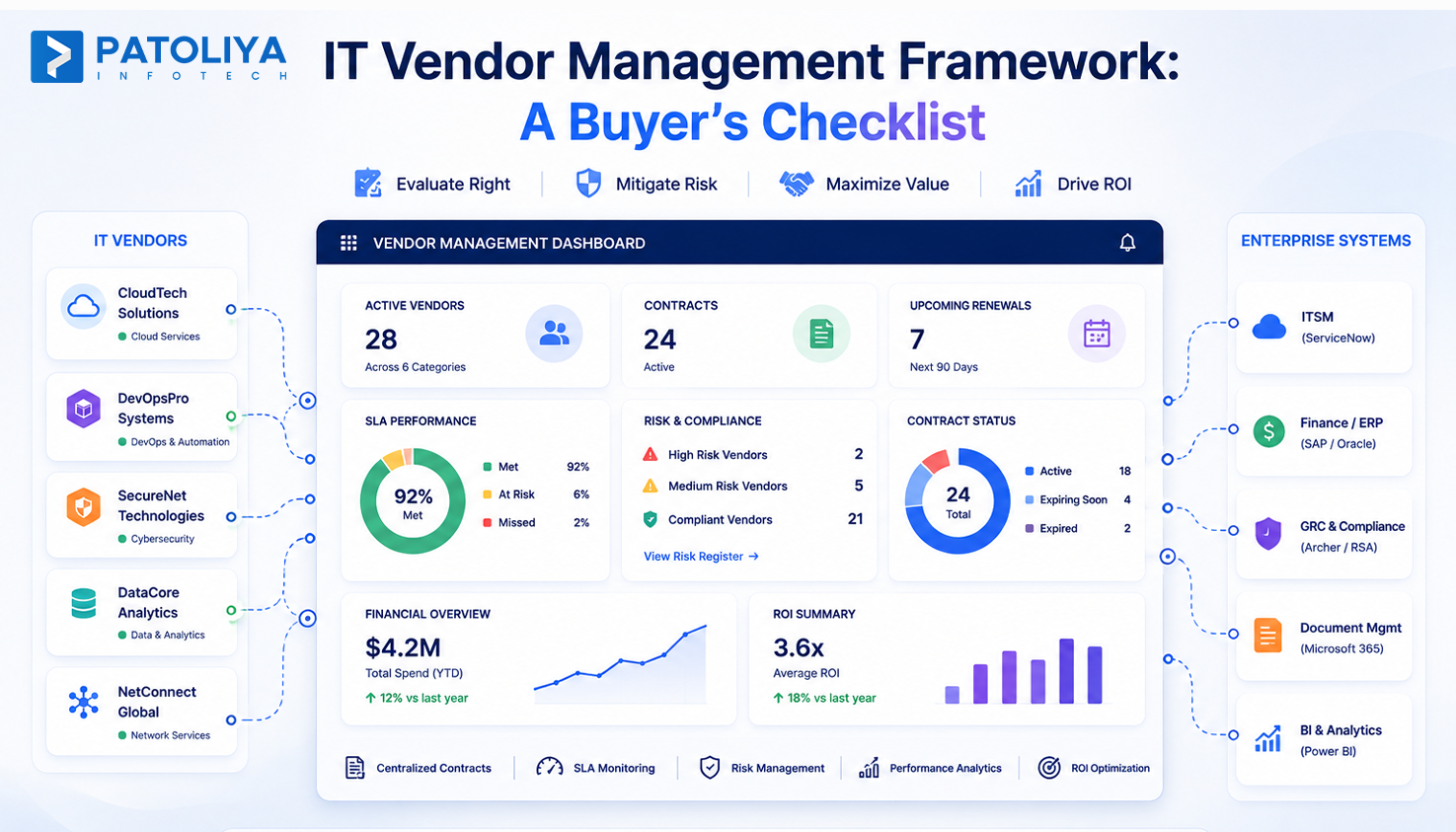
IT vendor management is the complete process of selecting, contracting, monitoring, and renewing technology vendors to protect commercial value, manage third-party risk, and align supplier performance to business outcomes.
It spans every phase of the vendor relationship, from vendor evaluation criteria during sourcing to MSA contract negotiation, SLA monitoring, and renewal strategy.
Managing IT vendors without a structured lifecycle means each phase gets handled reactively. Sourcing happens under pressure. Contracts auto-renew without review. SLA breaches accumulate without penalty enforcement.
| Lifecycle Phase | Core Activity |
| Sourcing | RFP, scoring, shortlisting |
| Contracting | MSA, SLA definition, liability terms |
| Performance | Scorecard reviews, QBRs |
| Risk | Third-party assessments, compliance audits |
| Renewal | Commercial leverage, consolidation decisions |
Managing IT vendors as a strategic function recovers measurable cost and risk value every year. IT vendor management done administratively just delays the damage.
IT vendor management delivers four operational capabilities that manual processes and point tools cannot replicate at scale: lifecycle governance, SLA enforcement, performance scoring, and contract control.
| SLA Tracking Method | Breach Detection Speed | Audit Trail | Penalty Enforcement |
| Manual spreadsheet | Days to weeks | None | Rarely enforced |
| SLA management software | Real time | Full log | Automated calculation |
Strong IT vendor management does not just protect you from bad vendors. It extracts more value from good ones by creating structured performance accountability on both sides.
The operational problems this discipline solves are specific and measurable in managing IT vendors.
IT vendor management solves problems that get worse every quarter they go unaddressed. These four are the ones that cost organizations the most.
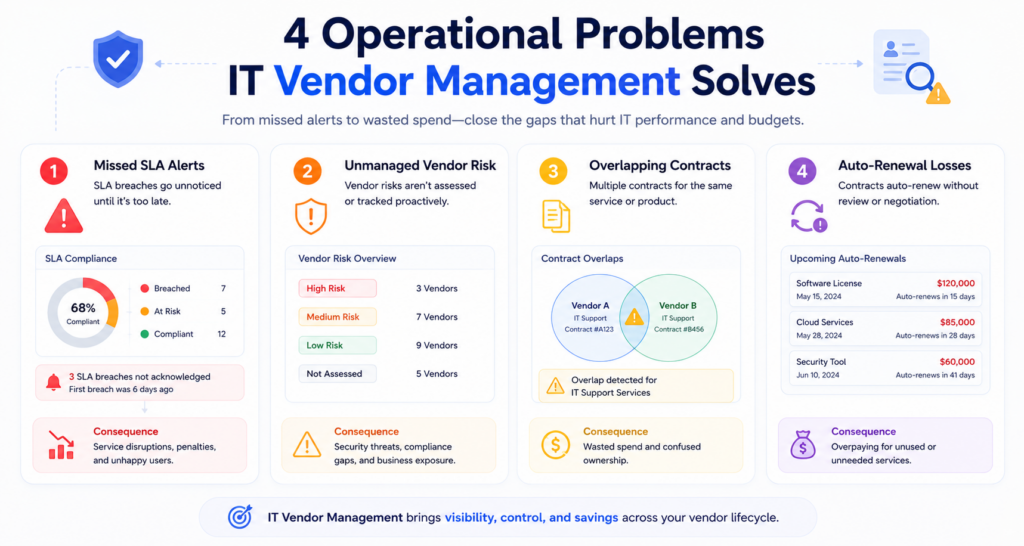
SLA breaches in unmanaged vendor portfolios surface in customer complaints, not dashboards. By the time the breach is documented, the contractual penalty window has often closed. Structured IT vendor management with SLA management software catches breaches at the incident level, not the escalation level.
Vendor risk management without a framework means risk assessments happen ad hoc, usually after an incident. In managing IT vendors, every vendor with access to your systems, data, or infrastructure carries third-party risk. Structured NIST cybersecurity framework practices help organizations strengthen third-party security and vendor governance controls.
A systematic vendor risk management program scores each vendor by data access, criticality, and compliance status on a defined cycle. Enterprise Cloud Migration Services projects often increase vendor dependency and third-party compliance exposure.
Vendor risk management tiers by exposure level:
| Risk Tier | Vendor Type | Assessment Frequency |
| Critical | Core infrastructure, payment processing | Annual + event-triggered |
| High | Cloud platforms, data processors | Annual |
| Medium | SaaS tools with limited data access | Every 18 months |
| Low | Non-data vendors, hardware suppliers | Every 2 years |
Managing IT vendors reactively means consolidation only happens after a budget crisis or merger forces it. Large-scale IT outsourcing operations usually require centralized vendor governance and contract visibility.
A proactive vendor consolidation strategy identifies capability overlaps and redundant contracts before renewal cycles. Organizations that plan consolidation recover 15 to 25% of vendor spend within 18 months.
Auto-renewals are the most expensive passive decision in IT vendor management. Vendors price renewals assuming you have not benchmarked the market. Entering renewal 90 days early with documented performance data and competitive alternatives consistently produces better commercial outcomes.
Managing IT vendors through these four lenses converts your vendor portfolio from a cost center into a managed asset.
The right approach depends on your portfolio size and internal capacity for SLA management software.
Four approaches to IT vendor management exist in practice. Each fits a different organizational maturity level and vendor portfolio size.
Works for portfolios under 10 vendors with low compliance requirements. Falls apart above that threshold. No real-time SLA tracking, no automated renewal alerts, and no audit trail. The cost of a missed renewal or undetected breach typically exceeds the cost of a proper tool within one contract cycle in managing IT vendors.
SLA management software alone solves the performance monitoring problem but leaves sourcing, contract management, and vendor risk management unaddressed. Suitable for organizations with a mature procurement function that only need SLA visibility added. Not a full IT vendor management solution.
Enterprise VMS platforms like Coupa and Ivalua cover the full IT vendor management lifecycle in one system. Implementation timelines run 6 to 18 months.
Total cost of ownership, including implementation, starts at $50,000 annually. Justified for organizations managing IT vendors at 50+ active contracts with compliance reporting requirements.
An outsourced provider delivers IT vendor management as a service: contract register, SLA dashboards, scorecard reviews, and renewal management handled externally.
Faster to deploy than a VMS platform (30 to 60 days to baseline). Cost ranges from $2,500 to $6,000 per month for portfolios of 15 to 50 vendors.
| Approach | Setup Time | Best For | Weakness |
| Manual | Immediate | Under 10 vendors | No scale or audit trail |
| SLA management software | 2 to 4 weeks | SLA visibility only | Incomplete lifecycle coverage |
| VMS Platform | 6 to 18 months | 50+ vendor enterprises | High cost and long deployment |
| Managed Service | 30 to 60 days | 15 to 50 vendors | Less customization |
The right model is determined by vendor count, compliance exposure, and internal IT procurement capacity.
IT vendor management costs vary by deployment model, vendor count, and whether you are building internal capability or buying managed services.
| Component | Cost Range |
| Contract register setup | $3,000 to $8,000 one-time |
| SLA management software (entry tier) | $300 to $800/month |
| Internal labor (part-time) | $15,000 to $30,000/year |
At this tier, IT vendor management is largely a process and tooling investment. The ROI comes from catching one auto-renewal or SLA breach, which typically exceeds the setup cost in the first year.
Managed retainer engagements covering managing IT vendors across this portfolio range cost $2,500 to $6,000 per month. This includes contract register maintenance, SLA monitoring, quarterly scorecard reviews, and renewal management.
Enterprise platforms start at $50,000 annually, exclusive of implementation. Implementation for a 100+ vendor portfolio runs $40,000 to $150,000 depending on integration complexity with ERP, ITSM, and procurement systems.
Total cost of ownership almost always runs 30 to 50% above the licensing or retainer figure. Budget for it before you commit to a model.
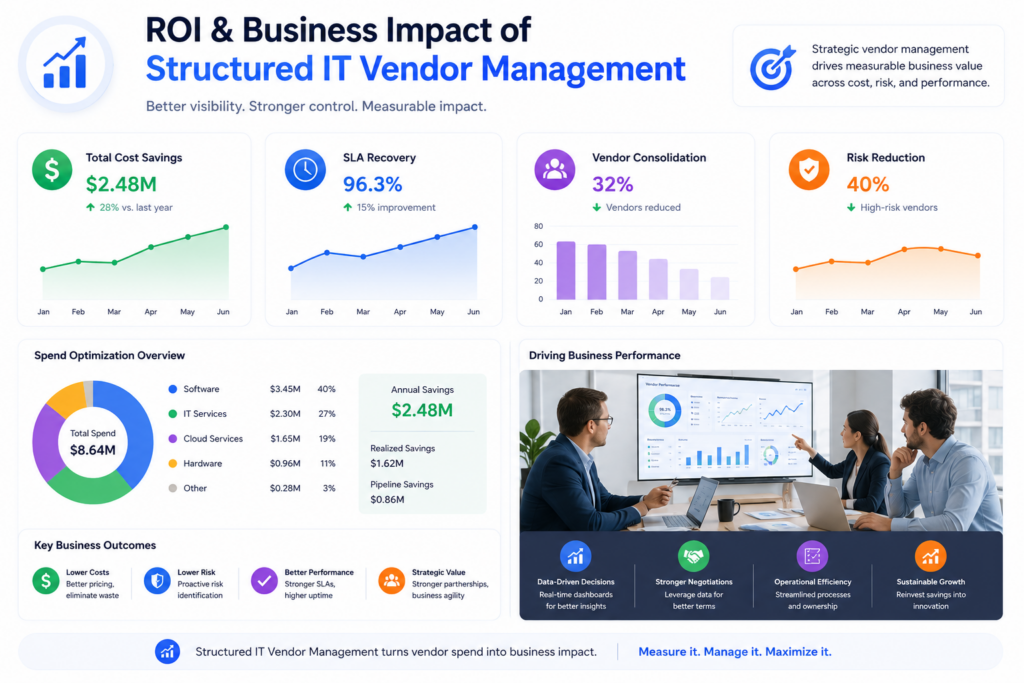
IT vendor management ROI shows up in four measurable places. Each one compounds in value as your vendor portfolio matures.
Organizations entering renewals with documented performance data recover 8 to 15% on contract value consistently. On a $500,000 annual vendor spend, that is $40,000 to $75,000 per cycle. IT vendor management pays for itself here alone.
Automated SLA tracking reduces breach detection from days to hours. Faster detection means documented credit recovery under penalty clauses that otherwise go unclaimed. That recovered credit directly offsets program costs in managing IT vendors.
A planned vendor consolidation strategy across a 40-vendor portfolio identifies 20 to 30% capability redundancy. Eliminating overlapping contracts reduces licensing spend and support overhead on a repeating annual cycle.
Vendor risk management failures carry direct financial consequences: GDPR violations, SOC 2 audit findings, and liability from undocumented subcontractor access.
A structured vendor risk management program with defined assessment cycles reduces regulatory exposure before it becomes a penalty. For regulated industries, this is a compliance requirement, not optional overhead for managing IT vendors.
IT vendor management ROI compounds year over year. The program funds itself by year three through renewal outcomes alone.
Every IT vendor management program carries risks that get worse the longer they go unaddressed.
Vendors processing your data without a signed Data Processing Agreement create direct GDPR and CCPA liability. IT vendor management programs must include a data residency audit for every vendor with system or data access. Undocumented subcontractor chains are the most common compliance audit gap.
IT vendor management without defined escalation paths lets performance issues sit unresolved at the operational level. Define escalation triggers in every vendor contract and assign internal ownership before a breach occurs. Organizations that hire offshore developers should define escalation ownership and communication workflows early.
Vendor quality decreases as attention shifts to newer clients. Scope increases as informal requests accumulate outside the contract. Quarterly scorecard reviews and annual contract audits catch both patterns before they compound into a renegotiation problem.
Vendor risk management programs should flag any vendor representing more than 30% of critical IT spend for concentration review. A service level agreement compliance failure at that vendor becomes a systemic risk. Structured vendor risk management identifies this exposure before it surfaces as an operational crisis. Flexible resource augmentation models can increase third-party access management complexity across enterprise systems.
Every risk of managing IT vendors here is solvable with the right controls in place from day one.
Choosing the right partner for IT vendor management requires evaluating ten criteria before any commercial conversation begins.
| Evaluation criteria | What to Verify | |
| 1 | Vendor lifecycle coverage | Does it cover sourcing through renewal or SLA only? |
| 2 | SLA management software capability | Real-time breach alerting and ITSM integration |
| 3 | Vendor risk management framework | Defined assessment methodology and scoring model |
| 4 | Contract register functionality | Renewal alerts, auto-renewal tracking, and clause library |
| 5 | Vendor scorecard design | Quarterly cadence with documented scoring criteria |
| 6 | IT procurement process integration | ERP, ServiceNow, Jira compatibility |
| 7 | Reporting and executive dashboards | Board-level visibility into portfolio performance |
| 8 | Consolidation analysis capability | Overlap identification across capability areas |
| 9 | Compliance documentation | GDPR, SOC 2, sector-specific audit trail support |
| 10 | Implementation timeline | Days to baseline, not months to go-live |
The most common selection mistake in IT vendor management is buying a platform for its feature list rather than its fit to your operational model. A VMS with 200 features deployed in 12 months delivers less value in year one than a managed service with 20 features deployed in 30 days.
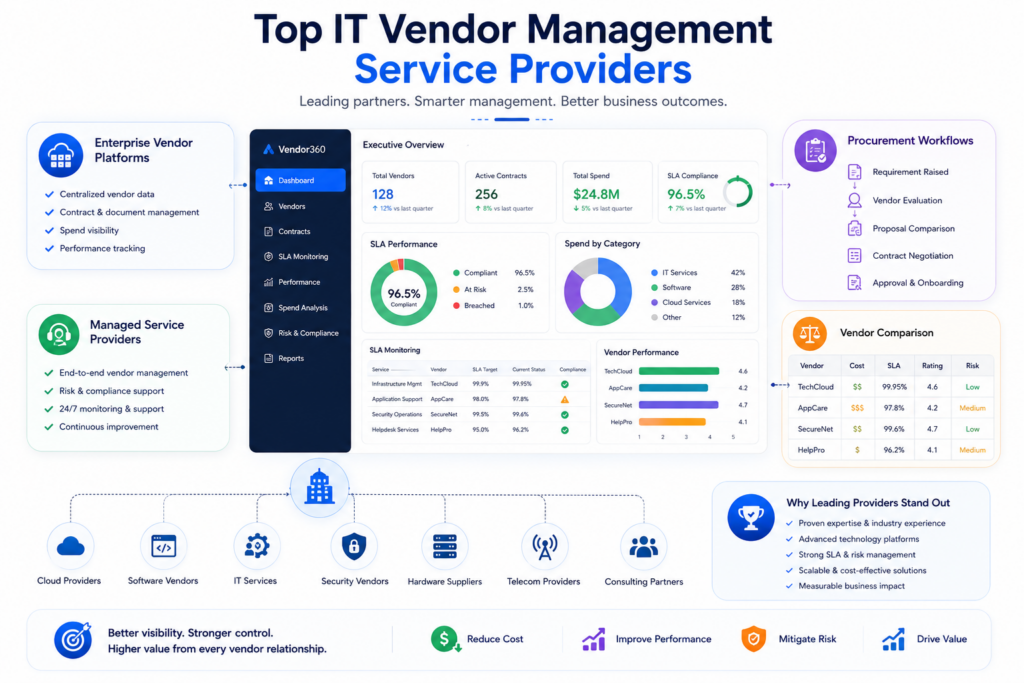
Patoliya Infotech delivers IT vendor management as a structured managed service for technology companies and enterprises managing 15 to 100+ active vendor relationships.
Best for: IT leaders who need a formal IT vendor management program running fast without a 12-month VMS implementation.
Engagement: Managed retainer and project-based models available.
Coupa is an enterprise spend management platform with strong IT vendor management and SLA management software capabilities built into its supplier management module.
Best for: Large enterprises needing unified spend and IT vendor management in one system.
Pricing: From $50,000 ACV, implementation separate.
Ivalua is a procurement and supplier management platform with deep configurability for complex IT vendor management environments.
Best for: Enterprises with complex procurement workflows and compliance reporting requirements.
Pricing: Custom enterprise pricing.
Vendorful is a mid-market vendor management platform focused on simplifying IT vendor management for organizations that find enterprise VMS tools overbuilt for their needs.
Best for: Mid-market IT teams needing structured IT vendor management without enterprise platform complexity.
Pricing: From $1,500/month.
IT vendor management programs fail when they are built around a platform rather than your actual portfolio. We deliver a baseline in 30 to 60 days, not 12 months. As an enterprise software development company, Patoliya Infotech helps organizations structure scalable IT vendor governance and SLA management programs.
Here is what that includes:
If your vendor portfolio has outgrown informal management, let's map your current state and build a program that fits. Book a scoping call and receive a vendor management gap assessment within five business days.
IT vendor management has moved from a procurement function to a board-level risk and cost discipline. Organizations that treat it as administrative overhead absorb avoidable contract losses, compliance exposure, and operational inefficiency at compounding cost. The right model, whether managed service, VMS platform, or hybrid, depends on your vendor count, compliance requirements, and internal capacity. If your IT vendor management program needs a structured foundation, let's sit down and scope it together.