Table of Contents
TLDR: The best AI code review tools in 2026 cut PR cycle time by 40% and catch security issues human reviewers miss. Automated code review AI handles logic errors, style enforcement, and vulnerability flagging before code reaches production. This guide compares 8 tools, so your team ships faster without trading safety for speed.
Speed without safety is technical debt with a timer. Engineering teams shipping at scale know that manual PR reviews are the hidden bottleneck, and the cost of a missed vulnerability post-deploy far exceeds the cost of a good AI code review tool. GitHub Copilot code review features have pushed awareness of automated code review AI into mainstream adoption, yet most teams still pick tools based on brand familiarity rather than fit. This guide explains the 8 best AI code review tools of 2026, what separates them, what they actually cost, and which one belongs in your stack.
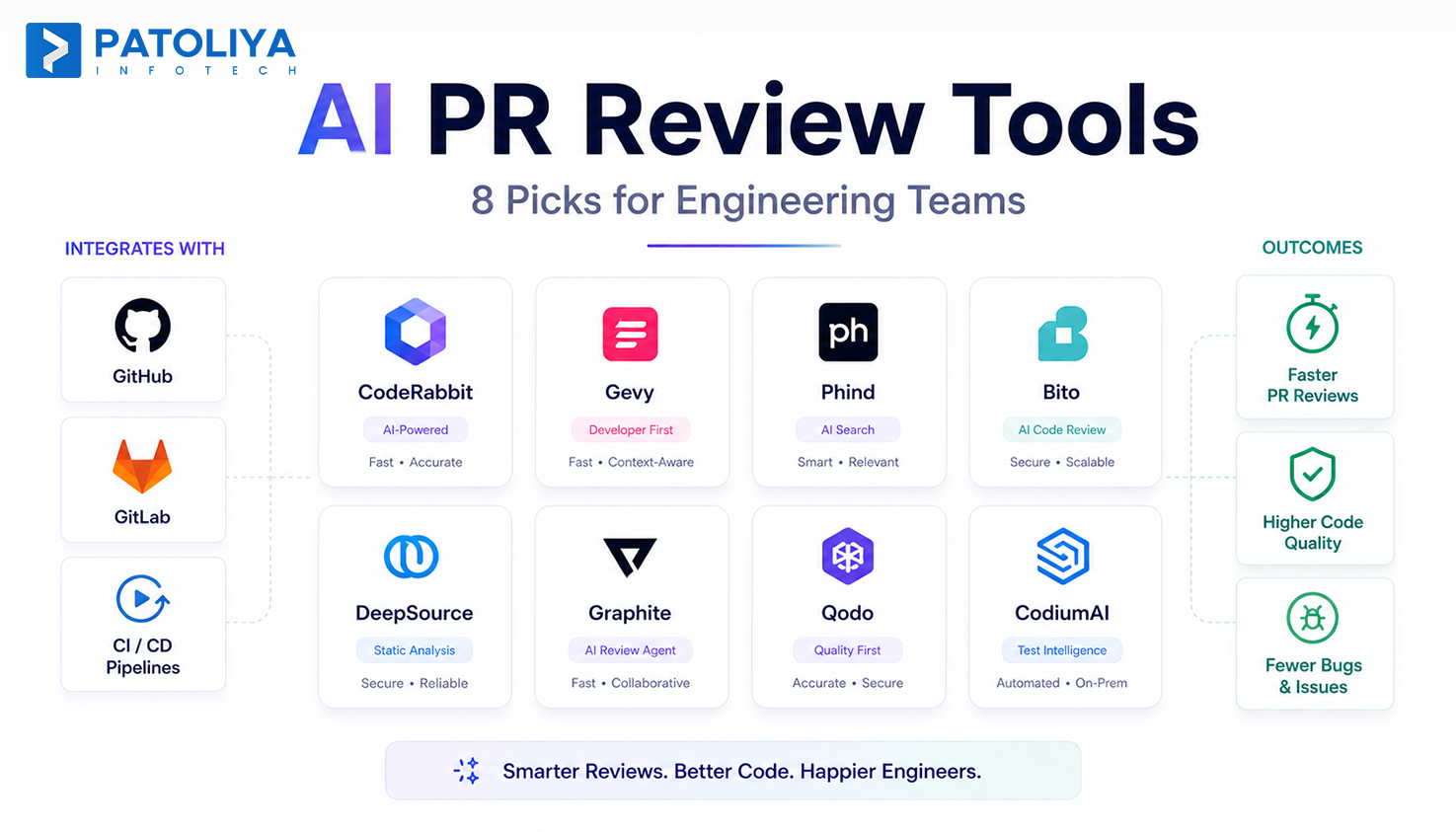
AI code review tools analyze pull requests, diffs, and commit history using machine learning to detect bugs, vulnerabilities, and code quality issues before human review. These automated code review AI systems integrate with platforms like GitHub, GitLab, and Bitbucket, or plug into your DevOps CI CD pipeline.
Unlike traditional static analysis AI linters that rely on fixed rules, AI PR review tools understand context. They don’t just flag issues; they explain why a change matters across the codebase, improving code quality enforcement and reducing tech debt detection gaps.
In 2026, these AI code review tools will have matured significantly. Trained on large code datasets, they now identify code smell detection patterns and logical risks at scale. Pull request automation is no longer just about speed; it ensures consistency across distributed teams.
The goal is not the replacement of any AI PR review. AI code review tools reduce repetitive review effort so engineers can focus on architecture and critical decisions.
The real value of automated code review AI is not one feature. It is the combination of capabilities working together before any human reviews a line.
Automated code review AI solves four structural problems that slow engineering teams down across team sizes and stacks, making it essential for AI code review tools.
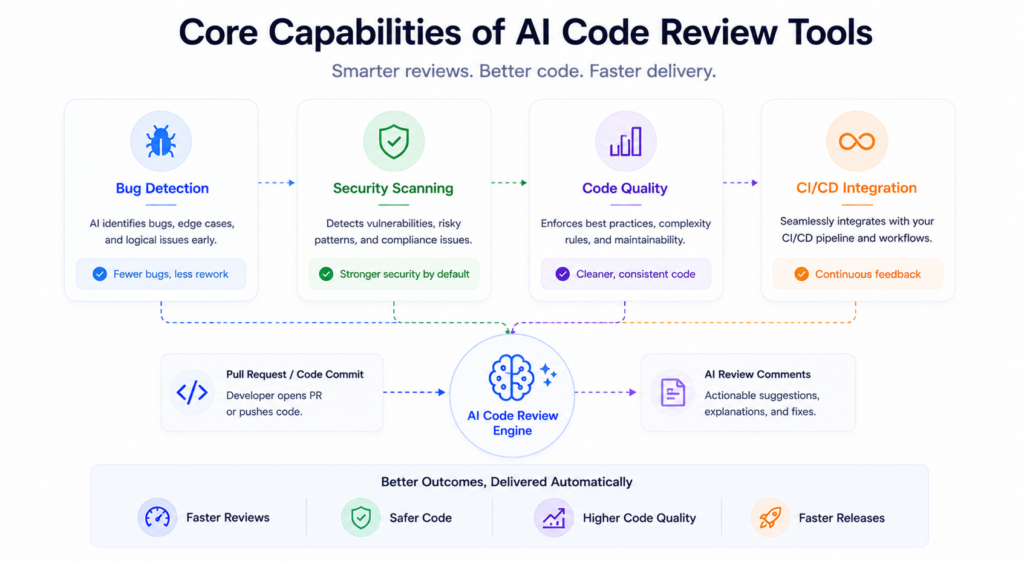
PRs waiting on reviewers is the most common deployment bottleneck in teams of over 10 engineers. AI PR review tools triage automatically.
Low-risk PRs get approved faster.Complex PRs highlight the issues reviewers should prioritize first. Pull request automation compresses cycle time without cutting corners.
A tired engineer at 4 pm will not catch a subtle authentication bypass. AI code review tools with integrated static analysis AI do not get tired. They flag the same class of vulnerability at commit one and commit ten thousand.
Different engineers have different standards for AI code review tools. Code quality enforcement through automated code review AI creates a baseline that applies equally to a junior contributor in Bangalore and a principal engineer in Berlin. The rule runs every time.
New engineers spend weeks learning what "good code" looks like for a specific codebase. AI code review tools surface those standards inline during the PR process. Onboarding friction drops because feedback is immediate, specific, and consistent, not dependent on who reviews that week.
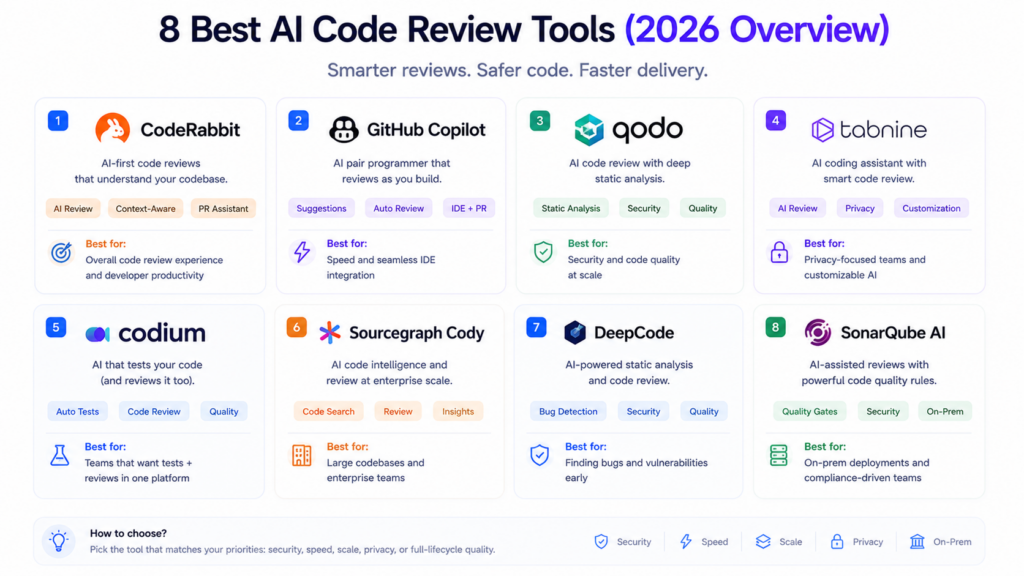
Each AI PR review tool below is evaluated on review depth, language support, integration quality, and realistic pricing. This is a decision-stage comparison, not a feature checklist.
CodeRabbit is a purpose-built automated code review AI for GitHub and GitLab with line by line comments, PR summaries, and codebase-aware context for AI code review tools.
Key Features:
Best For: Teams wanting deep AI PR review with minimal setup time through AI code review tools.
Pricing: Free tier available. Pro at $12/user/month and Enterprise custom.
Client Review: 4.7/5
GitHub Copilot code review adds AI-powered PR review directly inside GitHub, flagging issues and explaining code changes in natural language.
Key Features:
Best For: Teams already on GitHub who want automated code review AI without adding another vendor of AI code review tools.
Pricing: Included in Copilot Business at $19/user/month.
Client Review: 4.4/5
Qodo combines AI code review tools with test generation, helping teams enforce quality and coverage simultaneously.
Key Features:
Best For: Teams where test coverage is a consistent gap.
Pricing: Free for individuals. Teams plan from $19/user/month.
Client Review: 4.5/5
Cody uses your entire codebase as context for AI PR review, making it effective for large monorepos among AI code review tools.
Key Features:
Best For: Large engineering organisations with complex dependency graphs using AI code review tools.
Pricing: Free tier. Enterprise from $19/user/month. Self-hosted pricing custom.
Client Review: 4.3/5
Snyk Code delivers security-first automated code review AI with real-time scanning and direct CVE mapping for AI code review tools.
Key Features:
Best For: Security-conscious teams and regulated industries.
Pricing: Free for open source. Team at $25/user/month.
Client Review: 4.6/5
SonarQube is the enterprise standard for code quality enforcement and tech debt detection across 30+ languages within AI code review tools.
Key Features:
Best For: Enterprises needing audit trails and compliance-grade code quality enforcement for AI code review tools.
Pricing: SonarCloud is free for open source. Team from $10/month per 100K lines. Enterprise custom.
Client Review: 4.5/5
Tabnine's AI PR review module runs entirely on-premises, making it the top choice for teams with strict data sovereignty requirements.
Key Features:
Best For: Financial services, defense contractors, and healthcare teams where cloud transmission is blocked.
Pricing: Enterprise only. Custom pricing based on seat count and deployment model.
Client Review: 4.2/5
Korbit AI provides AI PR review with a focus on knowledge transfer, explaining the "why" behind every suggestion for AI code review tools.
Key Features:
Best For: Teams with high junior-to-senior ratios where education matters as much as enforcement for AI code review tools.
Pricing: Starts at $10/user/month. Enterprise custom.
Client Review: 4.4/5
Pricing for AI code review tools varies more than vendor websites suggest. Here is what actually happens when you get to procurement.
Pricing by Team Size Tier:
| Team Size | Estimated Monthly Cost | Recommended Tool |
| 1 to 5 devs | $0 to $60 | CodeRabbit Free, Qodo Free |
| 6 to 20 devs | $180 to $500 | CodeRabbit Pro, Snyk Teams |
| 21 to 100 devs | $500 to $2,500 | SonarCloud, Sourcegraph Cody |
| 100+ devs | $2,500 to $15,000+ | SonarQube Enterprise, Tabnine |
Hidden Costs to Budget For:
Contract Models:
Most automated code review AI vendors offer monthly and annual billing. Annual saves 15 to 25%. Enterprise contracts often include minimum seat commitments. Verify whether seat counts apply to all engineers or just active reviewers.
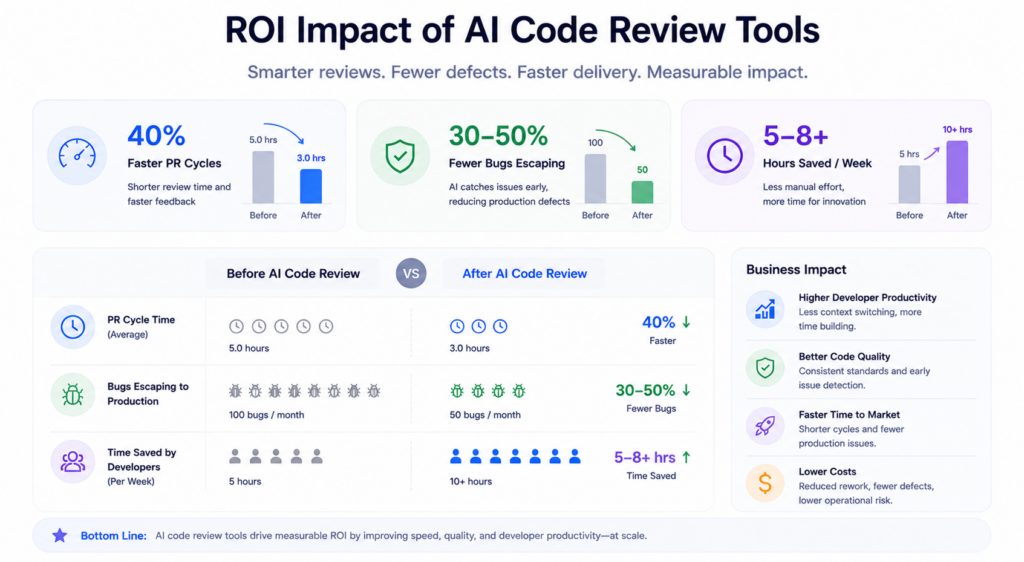
The ROI case for AI PR review is straightforward when measured correctly.
Engineering Time Recovered: At 3 hours per week recovered per engineer, a 10-person team at $120,000 average fully loaded cost recovers tool costs within 30 days at standard SaaS pricing of AI code review tools.
Defect Escape Rate Reduction: Teams using automated code review AI consistently report 30 to 50% fewer post-merge bug reports. Fewer production incidents mean fewer all-hands incidents pulling engineers off roadmap work.
Time-to-Market Acceleration: Pull request automation compresses review cycles. Faster cycles mean more deploys per sprint. More deploys mean faster feature velocity.
Scalability Economics: Hiring a senior reviewer costs $180,000 to $250,000 per year. An AI code review tool at $12 to $25 per user per month does not replace that judgment. It handles the volume that was slowing that engineer down.
Every AI PR review tool carries trade-offs. Decision-makers need to evaluate these before signing.
Cloud-based AI code review tools transmit PR diffs to external LLM APIs. For most teams, a signed DPA and a confirmation that code is not used for model training is sufficient. For financial services or defense, only on-premises tools like Tabnine qualify.
A tool that flags 40 issues per PR, most of them irrelevant, will be ignored within two weeks. Evaluate false positive rates during trials. Automated code review AI that engineers stop reading is worse than no tool.
Junior engineers who rely entirely on AI code review tools without understanding why a pattern is wrong will struggle when the tool is unavailable. Use AI feedback as a teaching mechanism, not a crutch.
Several AI code review tools are venture-funded and early stage. Evaluate financial stability, especially for tools you intend to deeply integrate. GitHub Copilot code review and SonarQube carry lower lock-in risk given established company backing.
Use this before any purchase decision on AI code review tools:
| Tool | Best For | Languages | On-Premises | Starting Price |
| CodeRabbit | Fast setup | 20+ | No | $12/user/mo |
| GitHub Copilot Code Review | GitHub-native teams | 20+ | No | $19/user/mo |
| Qodo | Test coverage | 15+ | No | $19/user/mo |
| Sourcegraph Cody | Large monorepos | 30+ | Yes | $19/user/mo |
| Snyk Code | Security focus | 25 | No | $25/user/mo |
| SonarQube | Enterprise compliance | 30+ | Yes | Custom |
| Tabnine | Data sovereignty | 25 | Yes | Custom |
| Korbit AI | Junior team upskilling | 15+ | No | $10/user/mo |
The selection of an AI code review tool is a quick decision. Integrating it correctly into a live engineering workflow takes weeks when done without experience.
We specialize in AI-powered engineering infrastructure for product companies and agencies. On automated code review AI implementations for AI code review tools, the team delivers:
Most teams Patoliya works with see PR cycle time improvements within the first 30 days. That is not a marketing claim. It is a measurable output from the correct implementation of AI code review tools.
If your team is evaluating AI PR review tooling and wants a scoped implementation plan, let's look at your current pipeline together.
The difference between teams that get value from AI code review tools and those that don’t comes down to implementation quality, not the tool itself. Choose from the options above based on your stack, security requirements, and team size, then focus on rollout, integration, and developer adoption.
The ROI of AI code review tools is measurable, and risks are manageable. Teams relying entirely on manual reviews at scale are already slowing down release velocity and accumulating hidden technical debt.
Keep your automated code review AI shortlist to three AI PR review tools. Run a focused evaluation over one week using real pull requests and pipeline conditions. Decide based on impact, not features. Not sure which one fits your workflow? Let’s figure it out together.