Table of Contents
Most CTOs evaluating IoT development companies compare dashboards and hourly rates before checking whether a vendor has kept a system live past 50,000 devices. That gap between demo and deployment is where most IoT projects die.
The IoT market is expected to hit $865.20 billion by 2030 at 9.6% CAGR. 54% of enterprises already use IoT to cut costs and review the adoption data, meaning competitors are not waiting on a perfect vendor selection process. When you hire IoT developers without verifying production depth first, you pay twice.
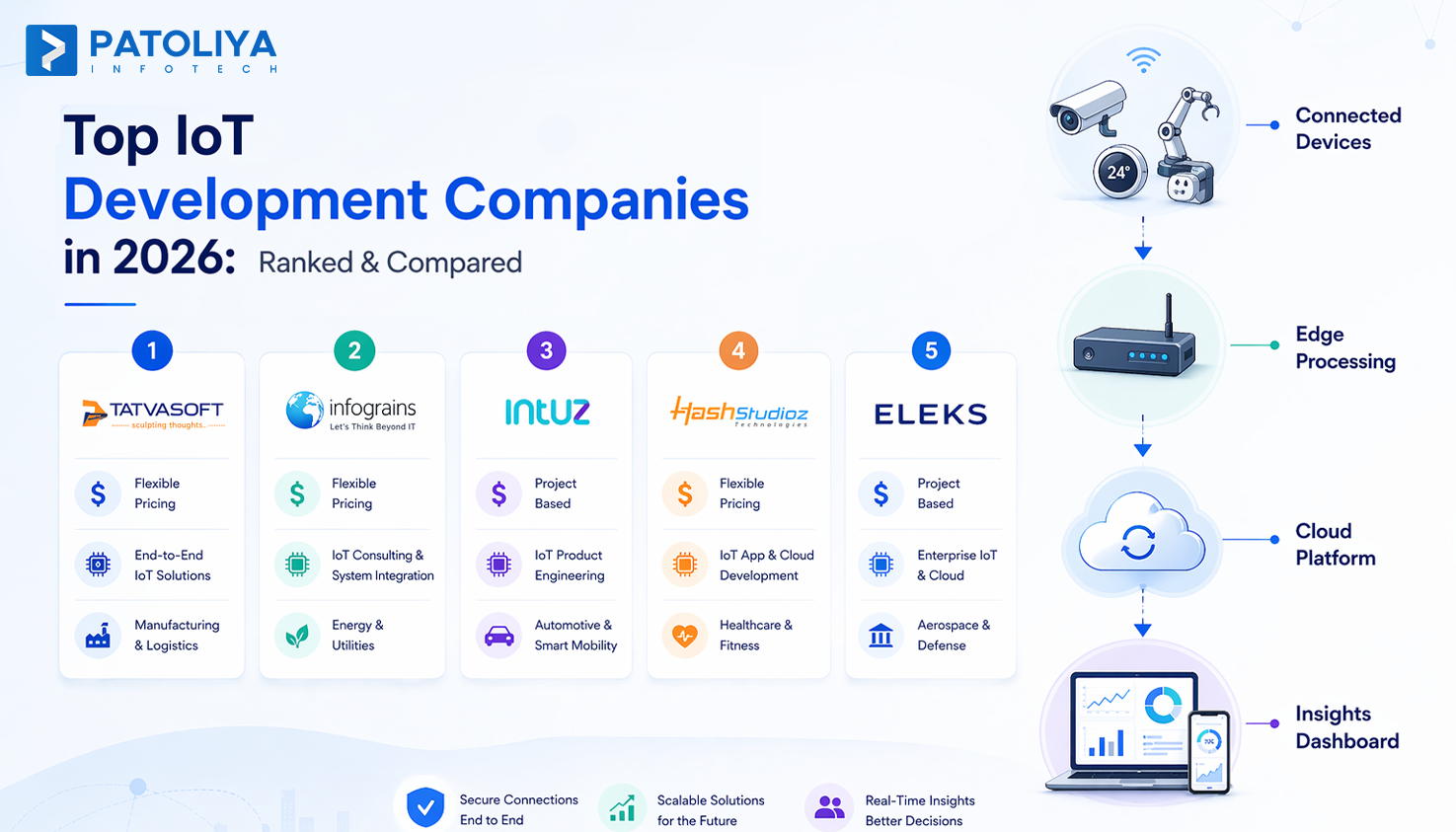
This guide breaks down the top 5 IoT development companies in 2026, what separates them, what they cost, and how to choose the right one.
A real IoT development companies owns the full chain from firmware to cloud to the application your team uses daily. A software vendor builds the app layer and calls the project done. That difference costs enterprises months of rework and hundreds of thousands in integration debt. The strongest IoT development companies hold all four delivery layers and still meet post-launch SLA. Most Internet of Things companies own one layer well and subcontract the rest without telling you.
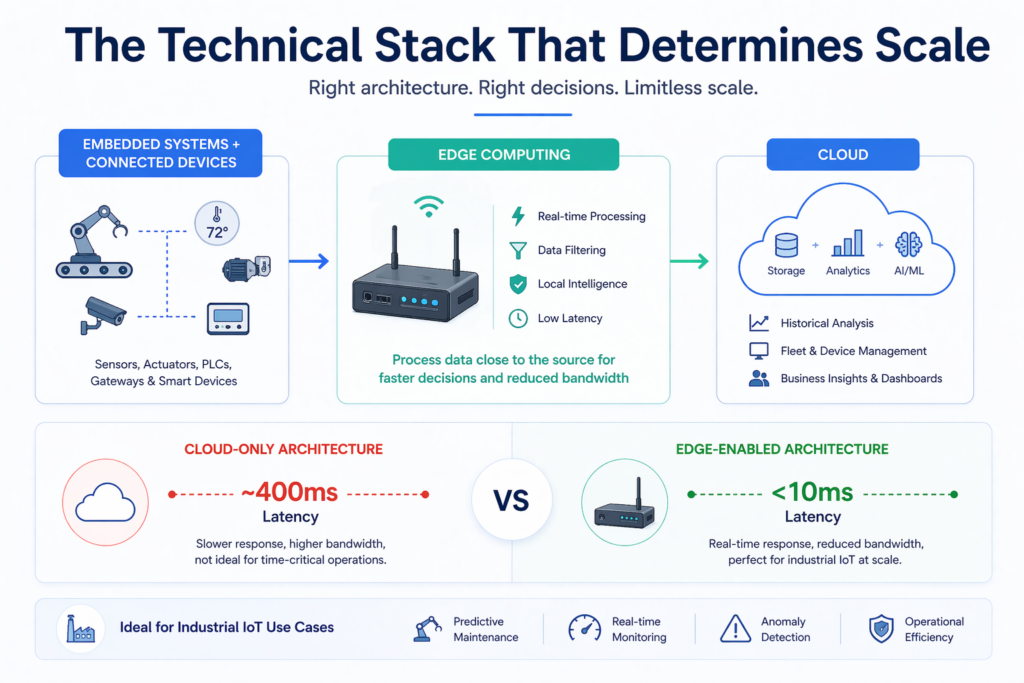
Embedded systems and connected devices are where most vendors fall back on IoT development companies. Edge computing cuts latency from 400ms to under 10ms and keeps operations live during connectivity drops.
Protocol choice is architecture in IoT app development. MQTT handles telemetry. OPC UA covers industrial machines. Matter leads consumer hardware. Teams that hire IoT developers must align cloud pairing early, as wrong decisions double the degree costs in year one.
Most teams score UI before auditing device provisioning workflows. That sequence is backwards. Ask for SLA documentation from IoT development companies before scoping ends. Any IoT software development company unable to produce it immediately should raise a concern.
| Delivery Layer | What to Verify |
| Device / Embedded | Firmware ownership, OTA pipeline |
| Connectivity | MQTT, OPC UA, Matter expertise |
| Cloud Platform | AWS/Azure/GCP pipeline design |
| Application Layer | API, mobile, web, analytics |
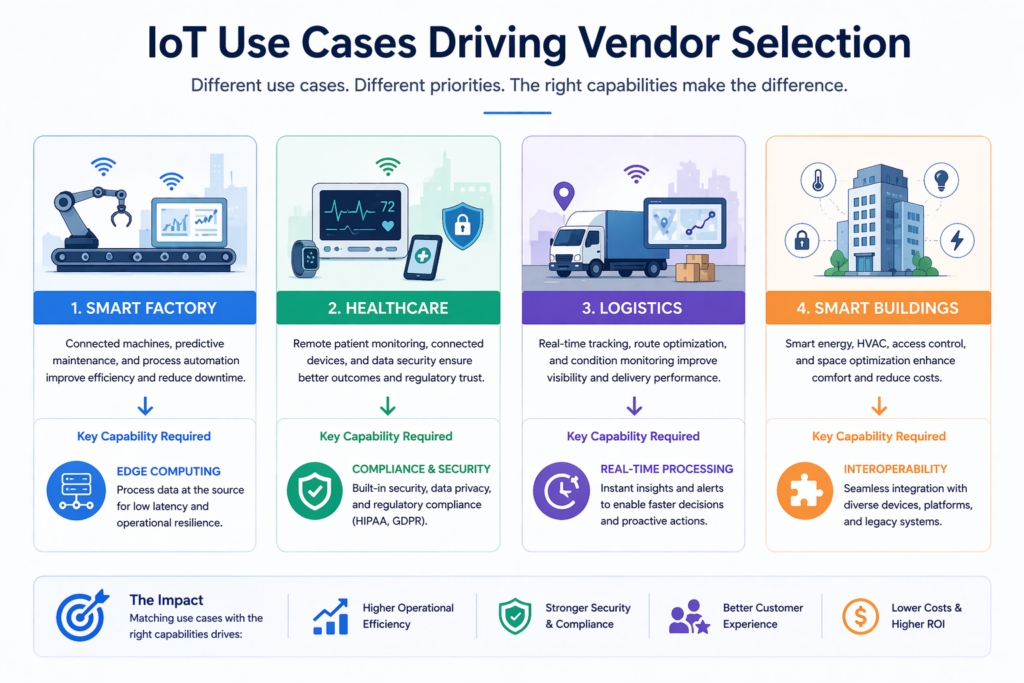
The use case determines the IoT development companies. A healthcare monitoring platform and a factory sensor network share almost no technical requirements, even though both fall under IoT app development. Choosing a vendor before mapping your use case to required capabilities is the first planning mistake that Internet of Things companies count on buyers making.
Smart manufacturing needs edge computing at the machine level through IoT development companies. Industry benchmarks cite 45% downtime reduction from predictive maintenance, requiring sub-100ms local processing. Healthcare remote monitoring demands HIPAA-compliant pipelines from day one.
Logistics is non-negotiable on real-time latency. Smart infrastructure needs interoperability above everything. These experienced IoT development companies are already accounted for in architecture decisions.
The right IoT software development company for your project has verified production case studies in your specific vertical, not adjacent ones repackaged as relevant in IoT development services.
| Use Case | Critical Capability |
| Manufacturing | Edge computing and OPC UA |
| Healthcare IoT | HIPAA-compliant data pipelines |
| Logistics/Fleet | Real-time edge compute |
| Smart Buildings | Interoperability + Matter protocol |
These IoT development companies were evaluated on delivery depth, protocol expertise, vertical track record, and buyer fit. Each is strongest for a specific project type. Match vendor strengths to your use case before opening any budget conversation for IoT development services.
Azilen Technologies is a data-first IoT software development company specializing in AI-led IoT ecosystems and ThingsBoard integrations. Among IoT development companies, they stand out where device data must feed directly into machine learning pipelines.
Teams looking to hire IoT developers with genuine AI integration depth will find real value here. Their IoT app development work shows analytics-layer capability that generalist internet of things companies rarely match on a production deployment.
Limitation: Less suited for hardware-first projects where firmware engineering is central.
Value: Strong IoT software development company when the intelligence layer matters more than device-level hardware ownership.
ScienceSoft delivers a strong industrial IoT architecture with proven predictive maintenance across manufacturing, logistics, and utilities. Among IoT development companies, few match their OPC UA and Modbus expertise in real factory environments.
If you need to hire IoT developers with deep industrial credentials, these kinds of IoT development companies are a serious choice. Their IoT development services are built for enterprise scale, positioning them distinctly among Internet of Things companies.
Limitation: Less suited for hardware-first projects where firmware engineering is central.
Value: Strong IoT software development company when the intelligence layer matters more than device-level hardware ownership.
Softeq stands out among IoT development companies for its hardware-aware approach, covering firmware, embedded systems, and hardware-software co-development.
Among Internet of Things companies, it is ideal when physical devices are part of the scope. Its IoT app development is strongest for products built from scratch. Teams looking to hire IoT developers for connected product engineering will find Softeq a strong fit as an IoT development companies.
Limitation: Not the right choice of IoT development services for purely software-layer projects where hardware already exists.
Value: Safest pick when firmware ownership and device engineering are non-negotiable delivery requirements.
SoluLab combines IoT development services with blockchain, positioning itself uniquely among Internet of Things companies for traceability-heavy use cases like supply chain and healthcare asset tracking. Within IoT development companies, it stands out for compliance-driven builds. Teams that hire IoT developers for standard use cases may find this added layer unnecessary, but for audit-focused environments, its IoT app development delivers targeted value.
Limitation: Blockchain layer inflates the budget for projects where traceability is not a core requirement.
Value: Valuable for a specific problem set of IoT development services. Evaluate only if immutable traceability is a firm technical requirement from IoT development companies.
Patoliya Infotech is a full-stack IoT software development company with 8+ years across manufacturing, logistics, and healthcare. With $25–$49/hr rates and projects starting at $5,000, it is a highly accessible option among IoT development companies for mid-market buyers.
When you hire IoT developers here, cloud, mobile, and web layers are managed in-house on AWS and Azure. Among Internet of Things companies, it delivers strong price-to-performance and delivery accountability.
Limitation: Best for software-layer IoT. Not suited for standalone custom firmware builds from scratch.
Value: Most practical entry for operations heads and CTOs who need results without the enterprise procurement overhead of IoT development companies.
IoT development services pricing is not linear. Each tier adds layers of engineering complexity that rate comparisons alone cannot capture. Most budget surprises of IoT development companies come from post-launch costs, not the build phase itself.
Entry-level MVP (sensor, cloud, dashboard): $15,000 to $40,000. Covers telemetry and a functional interface. No firmware customization included from IoT development companies.
Mid-market full-cycle platform: $50,000 to $150,000. Includes protocol integration, multi-device support, and post-launch structure.
Enterprise industrial IoT: $200,000 and above. Covers smart factory solutions, compliance frameworks, and device provisioning at the scale of IoT development companies.
| Region | Typical Hourly Rate |
| US / Canada | $100 to $200/hr |
| Eastern Europe | $50 to $99/hr |
| India / South Asia | $25 to $49/hr |
When you hire IoT developers offshore from IoT development companies, the savings are real. What erodes them is a vendor with no documented post-launch obligations. Confirm IoT app development SLA costs, update cycles, and device scaling fees in the contract before signing.
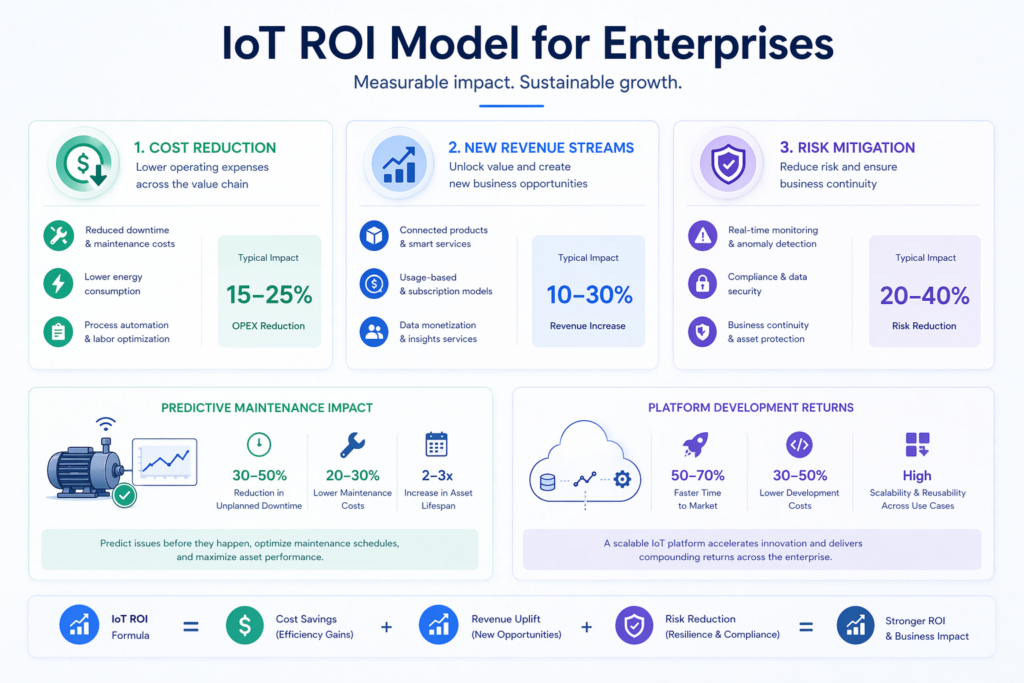
IoT app development ROI is measurable and specific enough to use in capital expenditure justifications directly with your finance team from IoT development companies.
IoT could generate $5.5 trillion to $12.6 trillion in global economic value by 2030, explore the full McKinsey analysis. Three categories determine your actual return.
Operational cost reduction is immediate from IoT development companies. Energy optimization and reduced manual inspection hours are measurable within year one of the deployment of the IoT app development.
Revenue from new data products is the mid-term payoff most buyers miss when evaluating IoT development services from IoT development companies. Clean device data becomes a subscription analytics product.
Risk mitigation is the most undervalued category. A single prevented equipment failure from predictive maintenance can return the entire IoT platform development investment in one event.
Enterprise payback runs 18 to 36 months. Any IoT software development company that cannot show measured ROI case studies should move down your shortlist immediately.
Most IoT development companies will not surface these in a sales call. These five failure modes account for the majority of write-offs before go-live.
Security gaps lead the list. 48.2% of IoT-to-IT connections come from high-risk devices. Any shortlist of internet of Things companies that skips security architecture in week one of scoping is already a warning.
Legacy ERP and SCADA integration failures cause more timeline overruns than any build-phase challenge of IoT app development. Require proof-of-concept integration against your actual stack before the full build begins, with the help of IoT development companies.
Scalability gaps are invisible to pilots. A system built for 500 connected devices fails somewhere between 5,000 and 50,000 without load testing against real traffic.
Vendor lock-in through proprietary platforms leaves zero leverage in year three. Open-standard architectures protect you.
Compliance blind spots in GDPR, HIPAA, and IEC 62443 cannot be retrofitted. IoT development companies require architectural decisions in week one of any IoT app development engagement.
Good IoT development companies answer these without hesitation. An IoT software development company that cannot produce evidence should come off your shortlist. Use every question on every call before a scoping agreement with any Internet of Things companies is signed.
Evaluating right now? Patoliya Infotech offers a free scoping call to validate your architecture and budget before you commit to a partner.
For mid-market buyers, Patoliya Infotech solves the exact problem most face when they want to hire IoT developers: affordable internet of things companies lack depth, and capable ones price for Fortune 500 cycles.
The most practical IoT software development company for teams that need results without enterprise pricing. See if they fit. Request a no-commitment project review.
Choosing between IoT development companies comes down to four filters: capability fit, pricing bracket, post-deployment support, and verified security posture. The shortlist narrows fast once compliance requirements are applied honestly.
Most projects fail because buyers evaluate Internet of Things companies as software shops instead of system integrators. The best IoT development companies in 2026 own the full problem, from device to dashboard, and stay accountable well after launch day.
Ready to evaluate your options? Talk to Patoliya Infotech and get a scoped estimate within 48 hours.