Table of Contents
Texas's healthcare system is changing at a rate that is not comparable in the country. Providers around the state have been forced to reconsider how they offer care due to a number of factors, including increased patient demand, growing operating costs, labor shortages, supply chain limitations, and changing regulatory requirements.
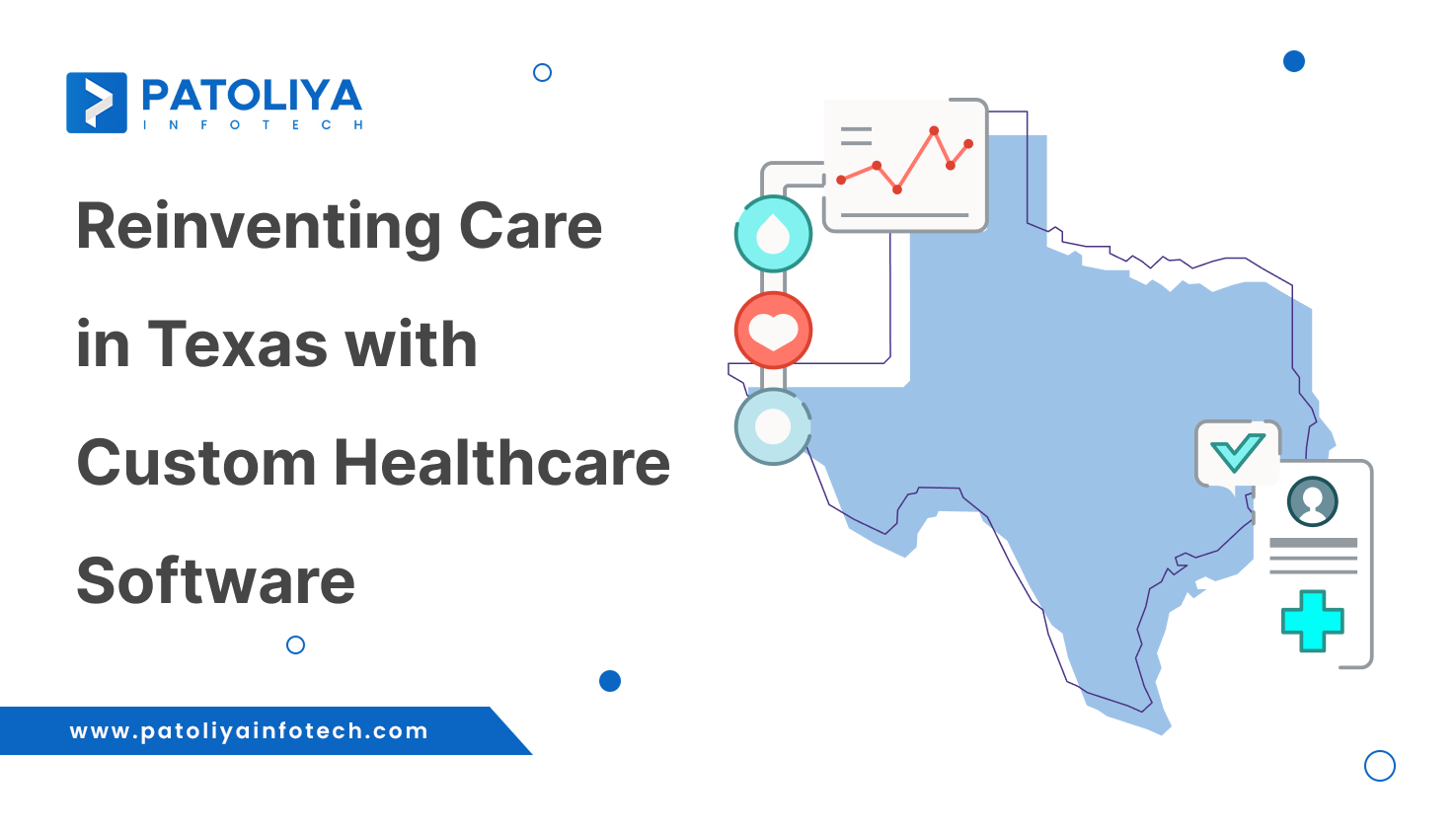
While these difficulties are significant, they have also paved the way for a more in-depth, strategic discussion about technology, especially how Custom Healthcare Software Development in Texas is becoming the foundation of a more efficient, scalable, and data-driven healthcare ecosystem.
Modernizing healthcare IT has become a business-critical demand in recent years, rather than a forward-thinking effort. Executives from hospitals, ambulatory centers, multispecialty networks, diagnostic chains, and up-and-coming digital health providers are coming to the same conclusion: Texas healthcare organizations' operational and clinical needs are no longer satisfied by generic, off-the-shelf software solutions.
In reality, the way forward is to create solutions that are tailored to Texas's particular healthcare infrastructure; these systems should be cloud-native, interoperable, AI-capable, legal with regulations, and precisely built around the workflows of regional providers.
This article examines in detail, at the executive level, how bespoke software is transforming Texas's healthcare industry's competitiveness and efficiency. In addition to analyzing the technology itself, the objective is to analyze the larger market forces that are pushing modernization as well as the strategic results that healthcare executives could expect from investing in specialized digital infrastructure.
In 2023, U.S. healthcare spending exploded to $4.9 trillion, marking a 7.5% annual increase, the fastest in over a decade. Healthcare now consumes 17.6% of the entire U.S. economy, creating a level of financial pressure that is reshaping the decision-making framework of healthcare leaders nationwide.
Texas has been hit especially hard. Hospital price hikes, increasing facility fees, post-pandemic demand surges, and a rapid spike in prescription drug spending, particularly high-cost therapies such as GLP-1 drugs, are driving premiums upward and stretching organizational budgets.
U.S. healthcare spending skyrocketed to $4.9 trillion in 2023, the fastest growth in more than ten years at 7.5% annually. Due to the fact that healthcare currently accounts for 17.6% of the US economy, financial strain is changing how healthcare executives make decisions across the country.
Texas has been very severely impacted. Premiums are rising and straining organizational budgets due to hospital price increases, rising facility fees, post-pandemic demand spikes, and a sharp increase in prescription medication costs, especially for expensive medicines like GLP-1 pharmaceuticals.
For Texas providers, this means:
Incremental improvements are insufficient to address these issues. They necessitate structural change, and software helps contribute to that transformation.
The majority of healthcare businesses in Texas rely on operational software, billing platforms, appointment scheduling systems, and electronic health records (EHRs) that were never intended for the complex workflow realities of contemporary healthcare. Legacy systems were not designed for intelligent management, but rather for documentation. Interoperability, multi-site coordination, and the requirement for real-time data-driven decision-making are challenges they face.
Instead of requiring people to adjust to inflexible, generic systems, custom software enables healthcare executives to design around the operational DNA of their company.
Custom software minimizes friction where standard systems cause it.
Custom design opens up scalability where generic systems restrict it.
Custom solutions link and elevate data that is bottlenecked by outdated systems.
When it comes to the diversity of healthcare, Texas is unlike any other state. The state is a microcosm of every significant healthcare issue in the United States, from the medical centers of Houston and Dallas-Fort Worth to the cutting-edge digital health sector in Austin and the rural areas of West and East Texas.
Healthcare organizations in Texas have to deal with:
Instead of depending on inadequate generic solutions, custom healthcare software development allows enterprises to build their digital ecosystems around the reality of their operating environment.
The real worth of bespoke software is not found in its feature set, but rather in how those features increase organizational performance, clinical accuracy, operational efficiency, and patient experience.
The main types of bespoke healthcare software that are transforming Texas healthcare are thoroughly examined here.
Hospitals in Texas frequently oversee thousands of daily touchpoints, including admissions, cycles of discharge, procedures, tests, prescriptions, and inspections. The operational foundation that establishes structure and flow among these departments is a single Hospital Management System (HMS).
Personalized HMS solutions provide:
Also they enable hospitals to develop customized modules that facilitate workflow alignment at scale for high-volume departments like cardiology, orthopedics, emergency care, and oncology.
Traditional EMR/EHR systems developed more than ten years ago are still used by the majority of Texas providers. These platforms enable basic documentation, but they don't have the intelligence, adaptability, and integration capabilities needed for the dispersed and hybrid care models of today.
Typical examples of custom improvements are:
| Capability | Standard EHR | Custom-Enhanced EHR |
| Workflow Alignment | Limited | Tailored to specialties & departments |
| Interoperability | Basic | HL7/FHIR-native |
| Automation | Minimal | AI-driven workflows |
| Multisite Support | Limited | Enterprise-grade |
| Cost Efficiency | Low | High ROI through optimization |
One of the highest rates of diagnostic testing in the nation is seen in Texas. For effective treatment, especially in high-volume urban areas like Dallas and Houston, rapid response times, accurate tracking, and open workflows are essential.
Platforms for custom LIMS support:
With a completely customized LIMS architecture, diagnostic chains with various sites may integrate their whole testing ecology.
Primary care physicians are in short supply in nearly 20% of Texas counties. Telemedicine has emerged as a vital resource for both individuals and health institutions looking for economical methods to prioritize patient care.
Custom platforms, in contrast to generic telehealth technologies, completely integrate with:
Also, they enable healthcare companies to handle high quantities of virtual visits without sacrificing quality by supporting multi-specialty routing, AI triage, and predictive analytics.

Inconsistent revenue cycles, claim rejections, manual billing mistakes, and payer-specific complications are common problems for Texas providers. Custom RCM systems enable businesses to maximize:
Settlements may be accelerated and revenue leakage, a major issue in multi-location healthcare firms, can be greatly reduced with a tailored RCM system.
Patient experience is emerging as a competitive differentiation as healthcare consumerization picks up speed. Support for custom CRM platforms:
Healthcare CRM is no longer an optional tool, it’s a growth and retention engine.
The next decade of Texas healthcare will be shaped by predictive models that:
AI is not replacing clinicians, it is augmenting their capability and capacity.
| Software Type | Efficiency Outcome | Strategic Impact |
| HMS | Faster patient throughput | Operational excellence |
| EHR Enhancements | Reduced clinician workload | Better care continuity |
| LIMS | Faster diagnostics | Improved clinical accuracy |
| Telemedicine | Scalable hybrid care | Expanded access |
| RCM | Faster reimbursements | Stronger financial stability |
| CRM | Higher patient engagement | Competitive positioning |
| Analytics | Better decision-making | Organizational resilience |
Texas healthcare software must align with:
Custom solutions lower risk and operational costs by integrating compliance into their architectural framework.
Operational Efficiency: Workflows are aligned across departments and locations and redundancies are cut down using custom solutions.
Clinical Efficiency: Doctors spend more time doing medicine and less time recording.
Financial Efficiency: Businesses decrease billing friction and increase cash flow predictability.
Strategic Efficiency: Future growth, mergers, acquisitions, and the expansion of digital care are all supported by custom software.
Healthcare companies in Texas are getting started on a new age that includes linked clinical ecosystems, AI-enabled automation, hybrid care models, and data-driven decision-making. Efficiency is the cornerstone of sustainability, competitiveness, and patient happiness in this setting, not just a production statistic.
Texas's providers receive exactly what they want from custom healthcare software development: solutions that mirror their operations, address their particular problems, and let them shape the future of healthcare on their own terms.
Businesses who invest in intelligent, scalable, and unique software architectures will not only run more smoothly, but they will also set the standard for healthcare innovation in Texas for the next ten years.