Table of Contents
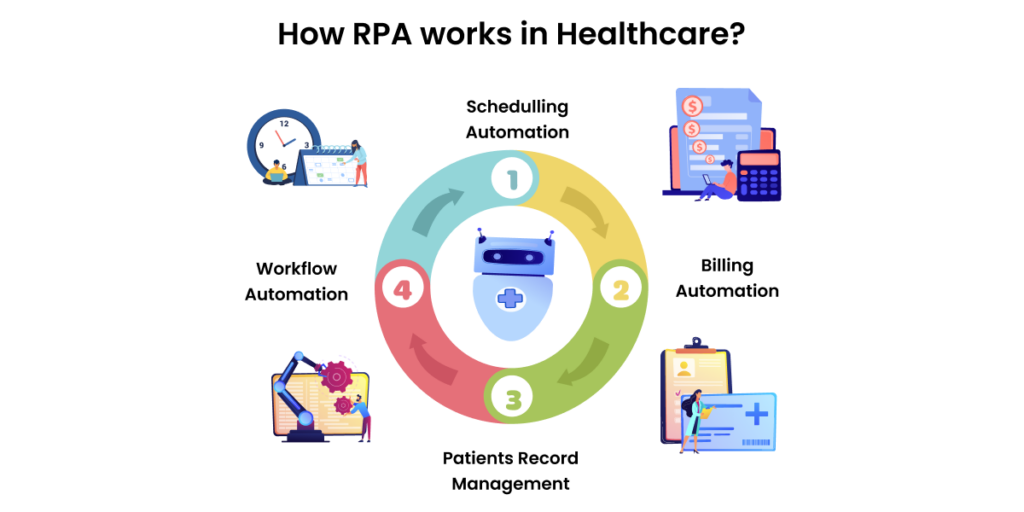
RPA in healthcare refers to the use of software or bots to automate repetitive and difficult operations in order to increase productivity, accuracy, and staff and patient experience. This helps overcome obstacles in the healthcare industry, such as staffing shortages, increasing compliance requirements, administrative overburden, and the ongoing need to enhance patient experience. This immediately improves workflow and the operating cycle. Understanding how these bots operate is crucial to comprehending RPA technologies, and proper implementation is also important.
RPA (Robotic Process Automation) in healthcare bridges communications and makes predictions when it combines with AI and modern technologies. There are certain problems, but they can be overcome. We also go into how RPA (Robotic Process Automation) helps in preventing revenue leakage in this blog.
Onboarding of patients: Bots enter clean data into the EHR, validate IDs, and extract data from forms. This reduces the time for registrations.
Planning: RPA automatically reschedules cancellations, fills open slots, and sends reminders.
Verification of eligibility: Bots access payer portals, check coverage, take screenshots, and instantly update patient records.
Claims and denials: RPA in healthcare submits claims, monitors their status every day, and highlights denials with accurate error codes. Also, directs them to be corrected.
RCM and billing: Charge entry, payment posting, refund processing, and reconciliation are all automated. This lessens the leakage of funds.
Medical coding: For quicker coder review, data is extracted from clinical notes and mapped to recommended codes.
Readiness for an audit: Bots maintain an ongoing audit trail by collecting logs, policy updates, and evidence files.
Lab findings: RPA in healthcare collects test results, creates reports, and quickly sends them to physicians. So, turnaround times are shortened.
Pharmacy and supply inventory: Bots monitor consumption trends, forecast shortages, and automatically initiate purchase orders.
Data transfer across systems: In the absence of integrations, RPA cleans, verifies, and transfers data between EHR, LIS, PACS, and RCM.
Coordination of surgery: This automates OR case sequencing, equipment readiness updates, and surgical preparation checklists.
Summaries of discharges: This gathers test results, vital signs, prescription drugs, and notes to automatically provide organised summaries that are available for clinician review.
In the healthcare industry, robotic process automation (RPA) converts repetitive operations into automated workflows:
Mirrors human behavior: Bots log in, click, type, and send data much like humans do.
links several systems together: Operates without extensive backend interaction across EHR, LIS, PACS, and billing platforms.
Staff support: Minimizes manual labor, avoids mistakes, and frees up medical staff to concentrate on patients.
24/7 implementation: Operates 24/7 with complete audit trails for transparency and compliance.
For instance:
A hospital found that more than 200 patients' insurance information was manually copied into the EHR by its administrative staff. This is every day from the payer portals. The labor was difficult, prone to mistakes, and slowed the flow of patients. This was the first thing they automated.
For instance:
After mapping its claims submission procedure, a revenue cycle team discovered that four manual data checks were no longer required because the EHR had already supplied them. Eliminating them before automation improved precision and decreased the complexity of the bot. ROI is greatly increasing as a result.
Analyze the platform according to your needs. This may be,
Making the incorrect choice results in bot failures or difficult maintenance for IT.
For instance:
A supplier that uses Microsoft 365 chose Power Automate. This makes it possible for Outlook, Excel, Teams, and their cloud EHR to link seamlessly. This lowers license costs and cuts integration time in half.
A pilot should be a consistent and repeated procedure with few deviations. It is perfect for early success. The objective is to confirm:
A successful pilot fosters confidence between the administrative and clinical teams, which is essential for broader adoption.
For instance:
Doctors and patients receive lab results automatically from a diagnostic center. Every ten minutes, the bot examined LIS, retrieved finished results, and safely transmitted them. The turnaround time for results was reduced from four hours to forty-five minutes. This is generating organizational buy-in immediately.
For instance:
Following the automation of appointment reminders, a hospital extended RPA to:
The company saved more than 300 employee hours a month as a result.
RPA in healthcare is not a one-time implementation. Bots need to be watched over because,
Configure frequent audits, bot-health warnings, and dashboards for ongoing monitoring.
Strong monitoring reduces workflow disruptions and avoids revenue loss or operational delays.
For instance:
A payer's portal user interface upgrade caused a claim-status bot to malfunction. The team found the problem within 30 minutes, resolved it that same day, and prevented a full-day backlog because performance monitoring was in place.
Hospitals frequently use outdated EHRs, billing software, LIS, and physical programs without APIs.
Robotic process automation (RPA) connects these systems by mimicking human activities. This can include editing fields, pulling data, and logging in without modifying the backend code.
RPA extracts data from outdated interfaces and transfers it into more recent apps, cloud systems, or analytics tools.
This minimizes human labor and guarantees seamless data flow even in the absence of APIs in systems.
RPA was utilized by a hospital with a 20-year-old billing system to extract daily charge files and upload them to a contemporary RCM tool. There is no vendor dependency, no costly migration, and no downtime.
Due to the possibility of system outages, data loss, and interruptions in patient care, healthcare organizations frequently fear significant IT upgrades.
RPA makes it possible to modernize gradually. This involves automating procedures while maintaining the functionality of essential old systems.
Data freezes, personnel retraining, and downtime are often necessary for legacy replacements.
RPA ensures the smooth performance of daily tasks. This guarantees the continuous operation of clinical workflows, labs, billing, and patient scheduling.
RPA offers instant benefits in healthcare technology contexts where updates take years. This can include speed, accuracy, data flow, and interoperability without requiring IT upgrades.
Because of this, robotic process automation is the fastest and safest option to modernize.

100% of claims are examined by bots for coding mistakes, missing modifiers, and inconsistent documentation.
RPA checks coverage, policy status, cost, deductible, and prior authorization restrictions to confirm patient insurance.
To identify unbilled services or missing charges, bots review clinical records, procedure logs, and EMR data.
To ensure correct and compliant submissions, RPA regularly analyzes claims in conjunction with payer policies, NCCI modifications, LCD/NCD rules, and ICD-10 updates.
After reviewing payer responses, bots classify denials into categories such as coding-related, medical necessity, expired authorization, etc.
RPA drafts appeal letters, gathers necessary paperwork, attaches medical records, and submits claims again.
Revenue cycle staff merely deal with exceptions rather than manually monitoring hundreds of denials, and bots perform repetitive tasks 24/7.
RPA speeds up reimbursements and lowers AR backlogs by cutting the time it takes to prepare claims.
Bots find underpayments, overlooked extra codes, or inaccurate charge schedule rates by comparing collected reimbursements with payer contracts.
Recurring error patterns, such as a department lacking specific codes, are displayed on integrated RPA analytics dashboards. This enables revenue cycle leaders to address the underlying issue.
Bots escalate risky accounts by automatically tracking aged claims. This prevents revenue losses from expired filing restrictions and allows for timely follow-up.
| Benefit | Description |
| Reduced Administrative Workload | Repetitive jobs, including data entry, previous authentication checks, and claim filing, are replaced by robotic process automation (RPA). This increases productivity in contemporary healthcare IT setups and frees up 30–50% of staff time. |
| Faster Patient Processing | RPA in healthcare speeds up data transit between EHR systems, insurance verification, and registration. This shortens wait times for patients and streamlines the provision of care. |
| Higher Accuracy and Fewer Errors | Robots precisely carry out rules, removing human error in EHR updates, medical coding, and claim creation. This leads to operations that are reliable and compliant. |
| Increased Revenue and Stronger RCM | Eligibility checks, code audits, rejection management, and payment posting are automated via RPA. This helps hospitals increase overall claim recovery and stop leakage. |
| Better Patient Experience | Employees can devote more time to clinical care, patient communication, and follow-up with RPA to relieve administrative burdens. A smooth and human-centered experience is being produced as a result. |
| Stronger Cybersecurity and Compliance | RPA supports HIPAA by maintaining audit records, regulated access, and standardized procedures. This lowers the hazards associated with data management and increases the reliability of healthcare technology systems. |
| Cost Savings | RPA manages high-volume workflows constantly, eliminating labor-intensive activities, overtime, and rework due to human mistakes. This results in 50–70% operational cost savings. |
| Challenge | Explanations with solutions |
| Resistance and Fear of Losing a Job | Conduct organized training and demonstrate to employees how robotic process automation (RPA) eliminates tedious tasks. Promote automation as a tool that helps doctors, nurses, and administrative personnel by lowering burnout. Emphasize RPA implementation success stories in the healthcare industry. |
| Selecting Inappropriate Procedures | Start with high-volume and rule-based jobs like data entry, eligibility checks, and claims posting, where ROI can be quantified. Make sure the appropriate workflows are automated first with the use of process discovery tools. |
| Complexity of Integration | To link legacy EHRs, billing systems, and contemporary healthcare technology platforms, use RPA in conjunction with AI, APIs, and connectors. This speeds up deployment and lessens reliance on backend coding. |
| Security and Compliance Issues | Put in place audit logs, stringent credential vaulting, encrypted bots, and role-based access. To protect patient data, make sure your RPA platform is compatible with HIPAA and healthcare compliance frameworks. |
To read medical records, comprehend clinical information, and automate judgment-based processes, robotic process automation (RPA) will integrate OCR, NLP, and ML. As a result, RPA goes from a rule-follower adjuster to intricate workflows in various healthcare technology systems.
Bots in the healthcare industry use AI models and analytics on top of RPA to identify risk trends, find missing data, and anticipate denials. This helps doctors make decisions more quickly with proactive insights.
RPA with AI capabilities will handle medication warnings, follow-ups, personalized reminders, and check-ins for chronic care. This results in ongoing, automated patient interaction without adding to the workload of the staff.
Hospitals will automate bed management, OR scheduling, staffing models, and inventory decisions using analytics and RPA in healthcare. Leaders will be able to model scenarios, anticipate bottlenecks, and streamline workflows in real time with the help of virtual reproductions of hospital operations.
Apart from automation and operational chores, RPA in healthcare can help to upgrade legacy systems. It is secure for managing labs, pharmacy inventories, surgical coordination, discharge summaries, and data movement across EHR, LIS, and PACS. RPA (Robotic Process Automation) improves the financial cycle by preventing revenue leakage. This occurs when coding errors are found, audits and denials are managed, underpayments are found, and leakage trends are predicted. There are various benefits, but the challenge is implementing RPA correctly.
The appropriate implementation and integration with modern technology helps to generate ROI in the long run. If the implementation is not great, it will become a burden in the long run. Choose a company like Patoliya Infotech that has years of experience and the latest technology in order to improve software quality.