Table of Contents
71% percent of developers now use software frameworks to automate testing alone. That number tells you something most C-suite leaders miss: framework selection in framework vs library decisions is not an engineering decision. It is a business decision that directly affects delivery speed, maintenance cost, and product scalability.
The global custom software development market hit $43.16 billion in 2024 and is projected to reach $146.18 billion by 2030, as per Grand View Research, 2024. Every dollar of that market runs on software frameworks chosen well or chosen poorly.
A software development framework is a pre-built, reusable code components foundation that standardizes application structure. Without the right one, teams rebuild solved problems from scratch, adding cost and technical debt at every sprint.
Types of software frameworks differ in framework vs library trade-offs by use case, stack, and scale. This guide helps to understand the real cost implications, ROI benchmarks, and the checklist your team needs before selecting one.
A software framework is a pre-built code structure that gives development teams a standardized foundation, removing the need to solve baseline architecture problems on every new project.
Framework vs library is the single most misunderstood distinction in vendor conversations. Your code calls a library. A software frameworks calls your code. That difference is called inversion of control, and it has direct implications for how locked-in your team becomes to a technology choice.
Choosing a software development framework means accepting its structural rules. Choosing a library keeps your team in control of architecture. Neither is wrong in any framework vs library architecture decision. But conflating them leads to architecture decisions your engineers will spend years undoing in an enterprise application framework context.
Every Types of software frameworks ships with a directory structure, pre-built modules, routing, templating, and security defaults. These modular programming components remove baseline dev effort from every sprint.
A team starting without a software frameworks spends the first two to four weeks building infrastructure that every framework ships within a framework vs library structure on day one. That is four weeks of budget spent on solved problems.
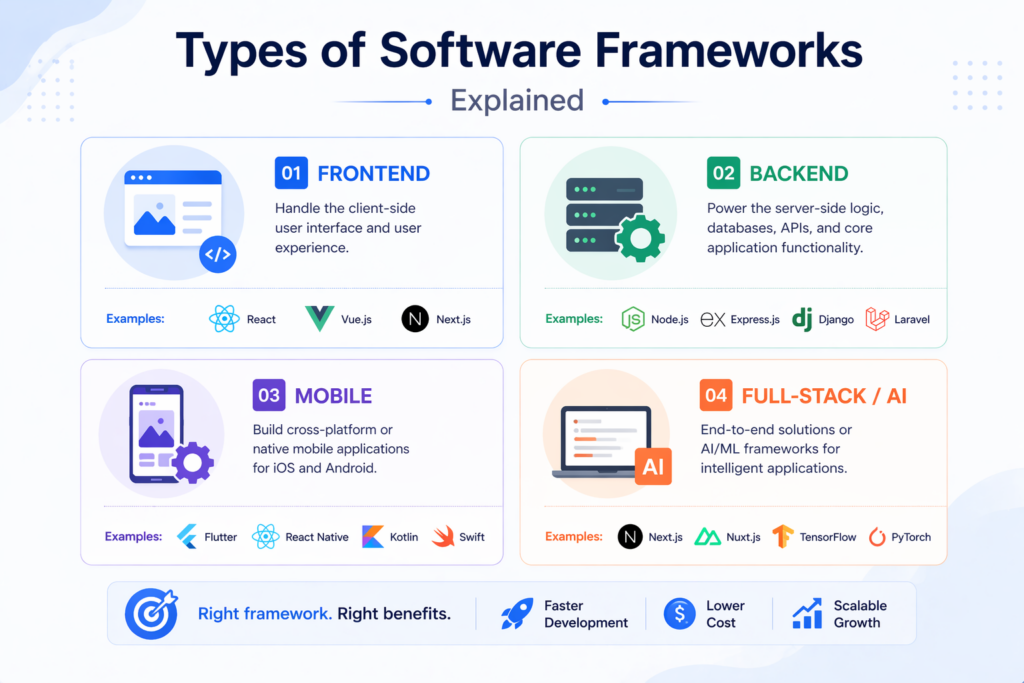
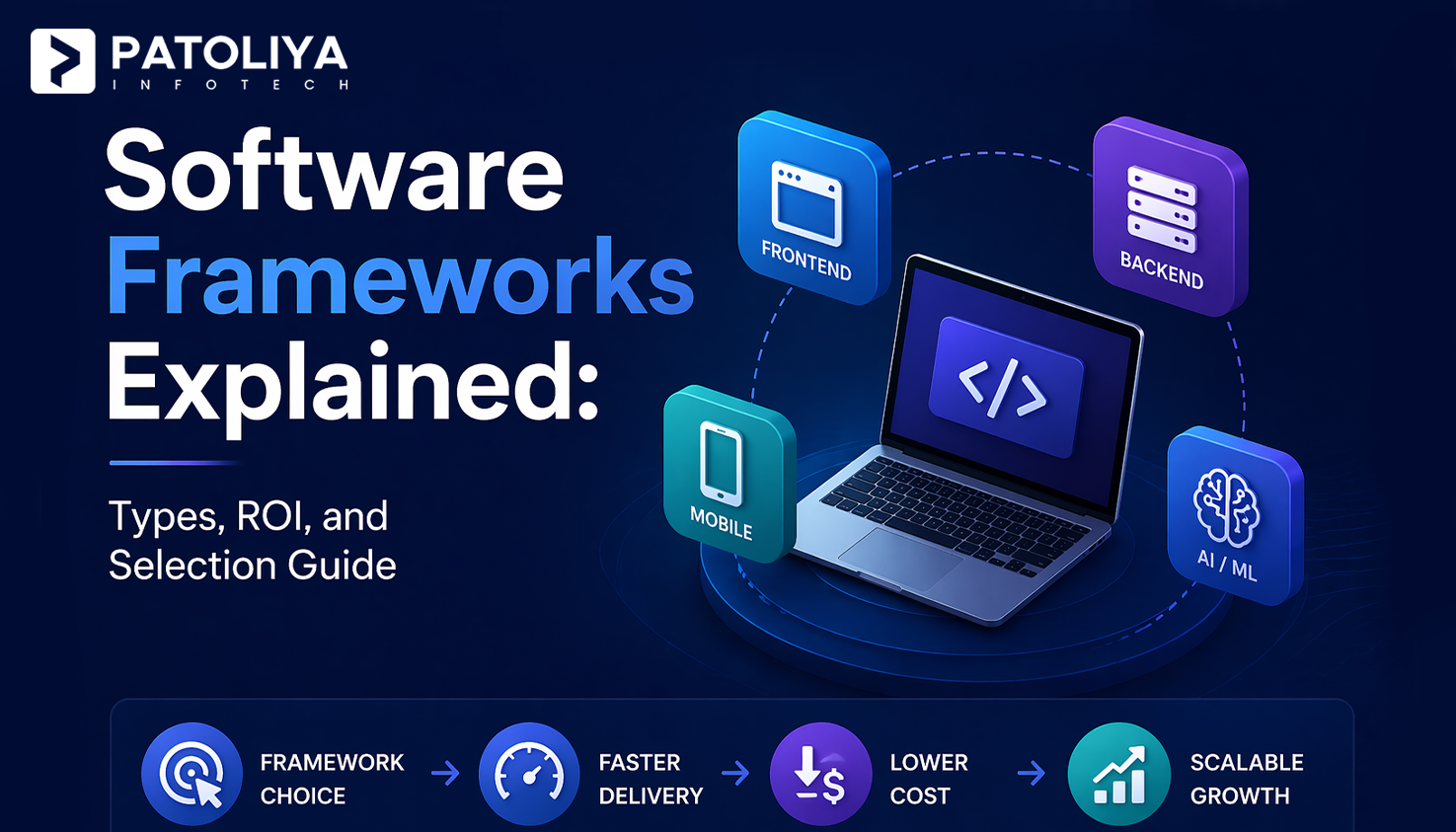
Web development frameworks on the frontend determine how fast your customer-facing product renders, scales, and gets maintained. React holds 39.5% market share globally and powers over 11 million websites, as per Stack Overflow Developer Survey, 2024. Angular shows 17% enterprise growth year over year. Vue.js fills the gap for teams needing a lighter option.
Types of software frameworks on the frontend map to framework vs library use cases. React fits SaaS dashboards and high-interactivity portals. Angular fits large-scale enterprise application framework requirements with strong typing and corporate backing. Vue.js fits mid-market teams needing faster onboarding than Angular allows.
Frontend frameworks are your user's first impression. Pick the wrong one in any framework vs library architecture decision, and you are refactoring UI architecture while your competitors ship features.
Backend frameworks govern API performance, data handling, and multi-tenant scalability. Node.js hit 40.8% usage in 2024, overtaking React as the most-used web development frameworks category. Django fits data-heavy platforms and fintech. Laravel fits SMB to mid-market web apps. Ruby on Rails still delivers for teams prioritizing convention over configuration.
Software development framework selection on the backend comes down to two factors: team expertise and performance ceiling. A team fluent in Python ships faster on Django than on Node.js, regardless of benchmark scores.
Types of software frameworks for mobile are split between Flutter, React Native, and Ionic. Flutter and React Native both enable scalable application development across iOS and Android from a single codebase. The time to market advantage over native development is real. For most B2B and consumer apps under enterprise scale, software frameworks like Flutter cut build time by 30 to 40%.
Next.js leads full-stack software frameworks with 52.9% adoption among frontend developers. FastAPI is the fastest-growing backend framework category in 2024. PyTorch is preferred by over 75% of ML researchers according to Larion, 2025. For enterprises building AI features into existing products, software development framework selection now includes AI and ML layers as first-class architecture decisions.
Types of software frameworks deliver business value in four measurable ways. Speed, cost, security, and scalability. Each one maps directly to a budget line your finance team already tracks, especially in an enterprise application framework.
Pre-built application development tools inside every major software framework eliminate baseline engineering work. Teams using established software development framework options compress initial build timelines by weeks. Enterprise-wide implementations typically break even at 18 to 24 months. Phased software frameworks adoption with quick wins accelerates that timeline significantly.
In-house development at a median $133,080 annual salary costs approximately $64 per hour in direct salary alone. Software frameworks reduce rework and testing overhead, directly compressing cost per-feature. The development lifecycle shortens when teams build on proven architecture rather than custom-building infrastructure.
Major software frameworks ship with CSRF protection, input sanitization, and authentication scaffolding. For fintech, healthcare, and logistics, this removes a significant compliance engineering burden. An enterprise application framework with built-in security defaults is not a convenience. It is a risk management tool.
Software architecture patterns inside component-based software frameworks allow incremental scaling without rebuilding the core of any framework vs library architecture. This matters most for SaaS platforms growing user bases without proportional cost growth. A web development frameworks choice made at 1,000 users should still perform at 1,000,000 users without a full rebuild.
Types of software frameworks or any enterprise application framework should be driven by team expertise, project lifespan, and integration requirements.
| Framework | Type | Best For | Learning Curve | Community Size | Scalability |
| React | Frontend | SaaS dashboards, customer portals | Medium | Very Large | High |
| Angular | Frontend | Large-scale enterprise apps | High | Large | Very High |
| Node.js | Backend | Real-time APIs, event-driven apps | Medium | Very Large | Very High |
| Django | Backend | Data-heavy platforms, fintech | Medium | Large | High |
| Laravel | Backend | SMB to mid-market web apps | Low-Medium | Large | Medium-High |
| Flutter | Mobile | Cross-platform consumer and B2B apps | Medium | Growing | High |
| Next.js | Full-Stack | SEO-heavy SaaS, content platforms | Medium | Very Large | High |
| FastAPI | Backend/AI | AI-integrated APIs, ML services | Medium | Fast-Growing | High |
The types of software frameworks in this table cover the full production stack. The right enterprise application framework is rarely the most popular one. It is the one your team can ship, maintain, and upgrade over a 3 to 5year product lifespan.
Web development frameworks like React and Angular dominate enterprise frontend for one reason: talent availability. Choosing a software development framework with strong community backing reduces hiring bottlenecks over the full code reusability lifecycle. A framework nobody uses is a framework nobody can maintain when your lead engineer leaves.
Not sure which software frameworks fit your product roadmap? Patoliya Infotech's engineering team can map your requirements to the right stack.
Software frameworks in an enterprise application framework carry no licensing cost at the enterprise tier. React, Angular, Django, and Laravel are all open-source. The real cost of framework vs library is everything that surrounds them.
Most production-grade software frameworks are free to use. Infrastructure costs vary. Serverless and cloud-native setups are now standard in 2026. External development partners charge $75 to $250 per hour for software development framework expertise. Offshore web development frameworks specialists run $25 to $75 per hour.
Types of software frameworks carry upgrade cycles that most procurement teams do not budget for. Angular and React both release major versions annually. Skipping upgrades creates security vulnerabilities. Retraining costs when switching software frameworks mid-project are significant. An Angular to React migration in an enterprise codebase takes six to twelve months minimum.
Vendor lock-in risk compounds when proprietary extensions layer on top of open-source enterprise application framework cores. In the decision of framework vs library, the framework is free. The migration away from it is not.
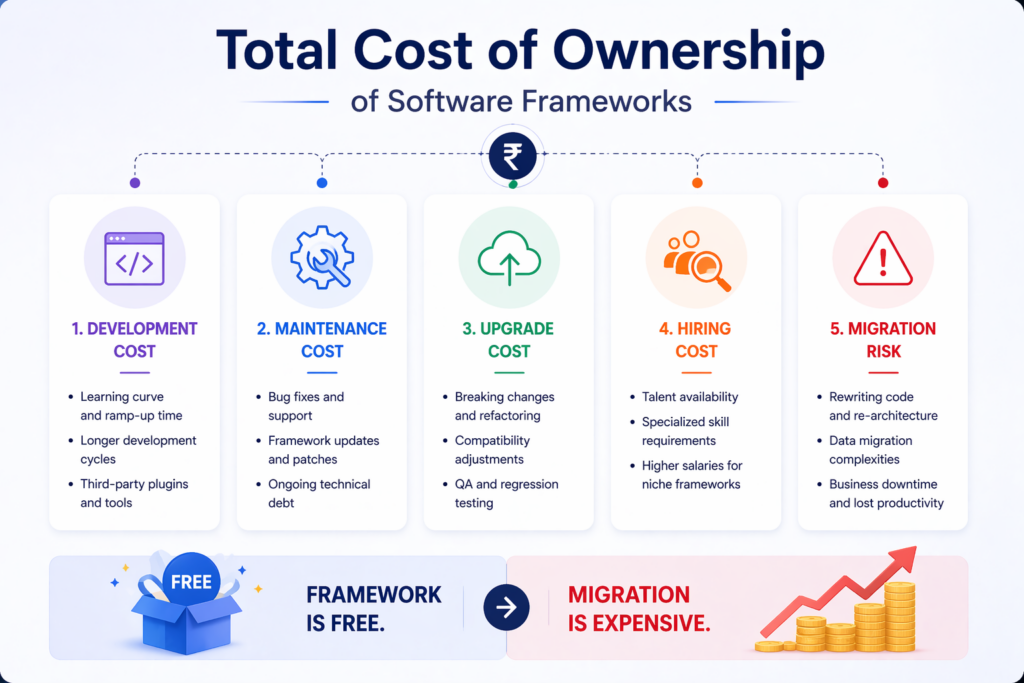
Factor in initial build, ongoing maintenance, upgrade cycles, and developer availability. A popular software development framework like React or Node.js has stronger talent availability, directly lowering hiring and replacement costs over three to five years. Framework vs library decisions made at the architecture stage determine your TCO more than any vendor negotiation will.
Software frameworks do not generate ROI by existing. They generate ROI by compressing the cost of every feature your team ships after adoption.
Software development framework adoption reduces baseline coding tasks directly. Companies with strong integration, often software frameworks dependent, achieve 10.3x ROI from AI initiatives versus 3.7x for poorly connected systems. The gap between those numbers is the quality of the architecture of the enterprise application framework.
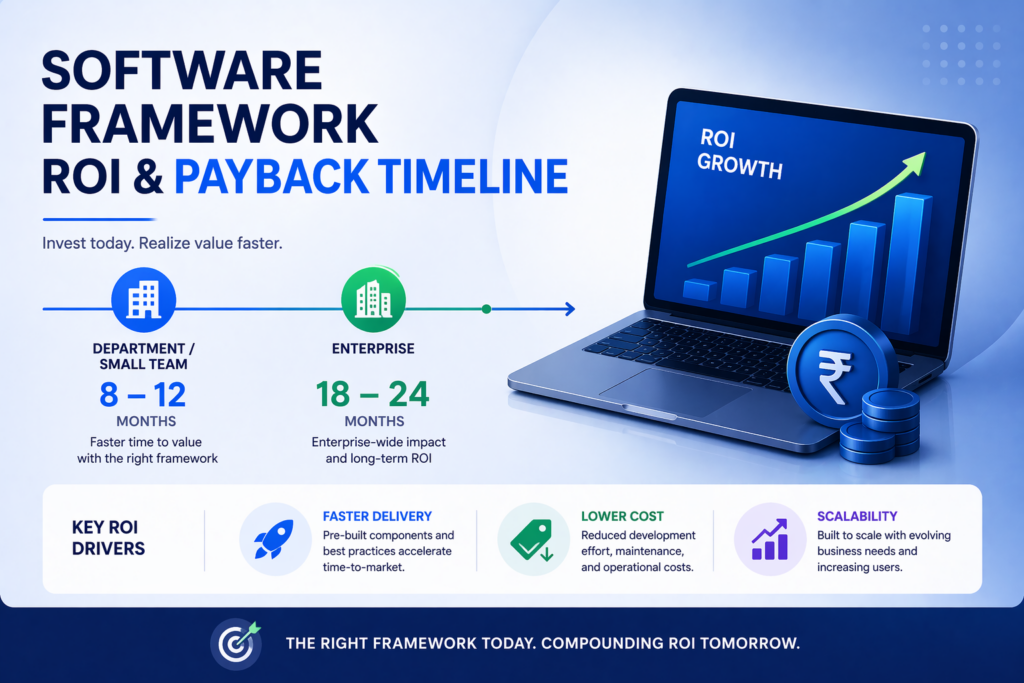
Types of software frameworks deployments break even at different timelines.
| Deployment Scale | Break-Even Timeline |
| Department-level solution | 8 to 12 months |
| Enterprise-wide rollout | 18 to 24 months |
| Phased with quick wins | Interim ROI captured earlier |
Phased web development frameworks deployment captures interim ROI and reduces executive risk exposure. Committing to a full enterprise rollout on day one is how companies spend 18 months waiting for the value that phased adoption delivers in six.
Only 35% of digital transformation initiatives meet their value targets globally. The 65% that miss consistently cite poor technology stack decisions as a root cause.
Enterprise application framework mismatches, particularly picking solo-developer software frameworks for enterprise-scale projects, are a repeatable failure pattern.
The wrong software development framework does not just slow delivery. It makes every subsequent sprint more expensive than the last.
Every software framework's adoption decision carries four categories of risk. Most teams only plan for one.
Switching software frameworks mid-product is expensive. Angular to React migrations in enterprise codebases take 6 to 12 months. Enterprise application framework lock-in compounds when the framework's proprietary patterns are embedded across hundreds of components. Plan your exit before you commit to your entry in framework vs library.
Generic web development frameworks handle broad use cases but underperform hand-optimized solutions at very high loads. Mitigation starts at the architecture stage, not after the performance audit flags an issue in the production of Software frameworks.
Choosing a niche or declining software development framework creates future hiring bottlenecks. Check GitHub activity, community forums, and corporate backing before committing. Types of software frameworks with declining community support become maintenance liabilities within three to five years.
Software frameworks release breaking changes on major version updates. Skipping upgrades creates security vulnerabilities that compound over time. Budget for upgrade cycles at the outset. A framework vs library decision made without factoring in upgrade cost is an incomplete decision.
The vendor you choose to implement software frameworks determines whether your architecture decision pays off or compounds into debt.
| Checkpoint | Why It Matters |
| Framework expertise matches your stack | Claimed expertise without case studies is not expertise |
| Portfolio at a similar scale and industry | Relevant experience reduces delivery risk |
| On-time delivery rate with specific data | Testimonials are marketing. Delivery data is evidence |
| Upgrade and maintenance policy post-launch | Most vendors disappear after go-live |
| Code ownership and IP transfer in a contract | Your software development framework codebase must be yours |
| Security practices: OWASP compliance | Web development frameworks without security audits are liabilities |
| Fixed-price vs. time-and-material clarity | Matches your risk tolerance to contract structure |
| Exit clauses defined upfront | Offboarding terms matter as much as onboarding terms |
One question worth asking every partner before signing: "Which software frameworks would you recommend for this project, and why?" A strong partner gives a data-backed answer. A weak one defaults to whatever stack they know best.
Software frameworks adopt data matters for three practical reasons: talent sourcing, community longevity, and tooling ecosystem depth.
Frontend frameworks by adoption:
Backend frameworks by adoption:
Mobile software frameworks:
AI/ML software frameworks:
Full-stack web development frameworks:
For product teams choosing software frameworks, the implementation partner matters as much as the framework itself. We operate across the full software frameworks stack with 10+ years of active delivery.
Ready to validate your software framework's decision with an experienced team? Connect with Patoliya Infotech now.
The software frameworks your team chooses shape how fast you ship, how much you spend maintaining it, and whether your product scales without a rebuild.
With the custom software market growing toward $146 billion by 2030, the organizations that get software development framework decisions right early will compound that advantage over the years. The ones that get it wrong will spend those years migrating.
The selection of types of software frameworks is not a one-time architecture meeting. It is a business decision with a 3 to 5 year cost horizon. Web development frameworks, enterprise application framework choices, and partner capability all feed into that horizon.
Patoliya Infotech works with product teams to match the right software frameworks to the right business outcome. Schedule a free technical consultation and get a stack recommendation specific to your project scope.