Table of Contents
Software projects don’t fail at deployment, but they fail when “done” is never clearly defined during planning.
Application lifecycle management exists because software is not a one-time build. It is a living business asset that accumulates decisions, dependencies, compliance obligations, and technical debt every single day. Organizations that treat application lifecycle management as optional face a predictable outcome: a release that breaks production, an audit with no documentation trail, or a retirement decision made three years too late.
The global application lifecycle management market grows at 8.6% CAGR through 2029, see full market forecast. That number reflects one reality: informal software coordination at enterprise scale does not work.
This guide covers what application lifecycle management is, how each stage functions, what ALM implementation costs, which ALM tools fit which environments, and how to build a business case before your next vendor decision.
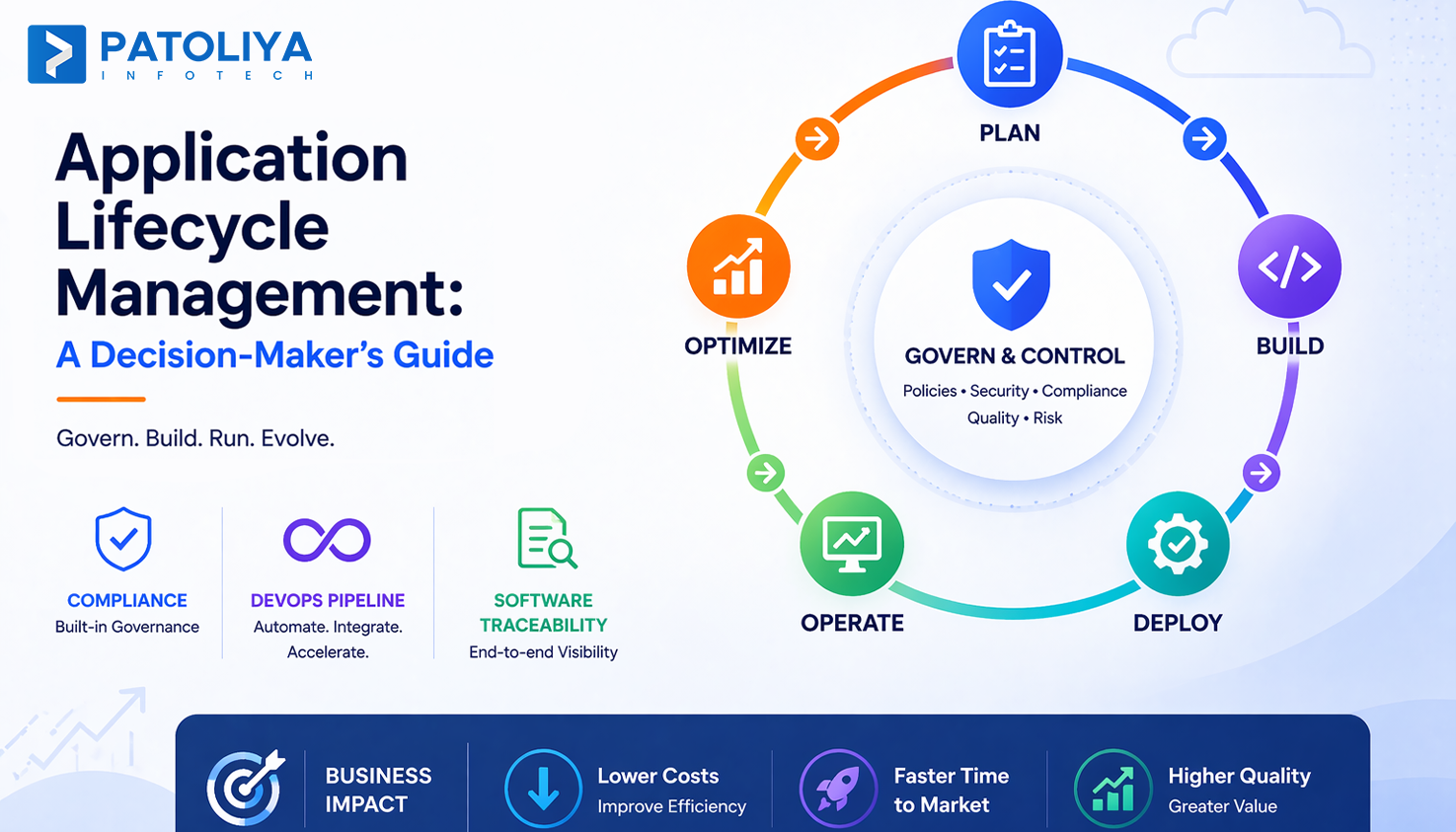
Application lifecycle management is a structured framework for governing software across its complete lifespan, from the first business requirement through active development, deployment, maintenance, and final retirement. It connects people, processes, and application lifecycle management software into one traceable, auditable system.
The defining feature is governance. Basic project management tracks tasks and timelines. Application lifecycle management adds compliance traceability, cross-functional accountability, and documentation structure on top of delivery. It answers not just what is being built but why, for whom, at what risk, and what happens when the application reaches end of life.
Enterprise ALM addresses the scale dimension directly. When an organization manages dozens of applications across multiple teams, regulatory environments, and infrastructure stacks, informal coordination breaks down. Enterprise ALM creates the governance layer that keeps every application visible, every decision traceable, and every release controlled.
Application lifecycle management is not a single tool. It is a framework that application lifecycle management software supports, and ALM tools execute. Buying a tool without the framework produces the same chaos, just with better dashboards.
ALM vs SDLC is one of the most misunderstood distinctions in software governance. Getting it wrong changes how you budget, staff, and structure oversight at the executive level.
The ALM vs SDLC comparison comes down to scope and duration. SDLC covers the technical process of building software: requirements, design, code, test, deploy. It is project-bound and ends at release.
Application lifecycle management starts before the first line of code and continues long after the last deployment, covering software retirement planning, compliance monitoring, and ongoing governance throughout the asset's life.
| Factor | ALM | SDLC |
| Scope | Full application lifespan, including retirement | Development phase only |
| Focus | Business and technical alignment | Technical delivery |
| Stakeholders | Business, dev, QA, compliance | Primarily development teams |
| Governance | Built-in traceability and compliance | Optional |
| Timeframe | Ongoing | Project-bound |
Application lifecycle management decisions affect procurement budgets, vendor contracts, audit readiness, and compliance posture directly. SDLC decisions affect sprint velocity. Enterprise ALM operates at a fundamentally different level of business risk. Confusing ALM vs SDLC leads to underinvestment in governance and overinvestment in delivery tooling that cannot solve the underlying problem.
Every ALM implementation covers six core stages in the ALM vs SDLC context. Skipping anyone does not simplify delivery. It moves the cost downstream, where it is harder and more expensive to fix.
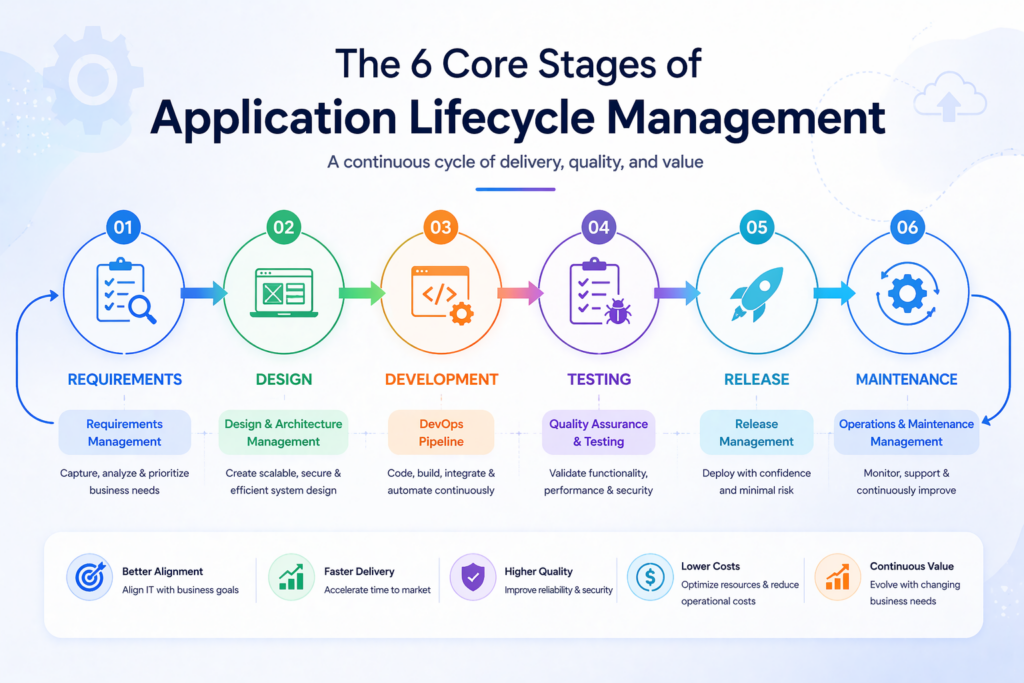
Decisions made here define 60 to 70 percent of the total project cost, review the IBM cost analysis. Application lifecycle management starts with requirements because drift here is the leading cause of budget overrun. Application lifecycle management software at this stage captures stakeholder inputs, maps business goals to user stories, and creates the requirements management baseline that every downstream stage depends on.
System design decisions in application lifecycle management determine infrastructure costs, integration complexity, and long-term maintainability. Enterprise ALM frameworks document architecture decisions formally so they remain visible to teams that join the project two years later.
ALM tools at this stage connect source control, code review, and DevOps pipeline execution into a single governed workflow. Application lifecycle management here means every commit is traceable to a requirement, not just to a ticket.
This is where compliance gaps surface. Application lifecycle management frameworks mandate test coverage against original requirements, not just against what developers assumed they were building. ALM implementation that skips formal QA linkage produces audit failures later.
Controlled rollout, rollback protocols, and change management software integration define this stage. Application lifecycle management software at deployment enforces approval gates that protect production from untested changes.
Software retirement planning is the most skipped stage in application lifecycle management. Organizations that ignore retirement accumulate decommissioned applications that still hold live data, active credentials, and unpatched vulnerabilities. That is not a technical problem. It is a liability.
Organizations that implement structured application lifecycle management frameworks reduce software delivery timelines by up to 30%, according to Aqua Security research. That is not a tool benefit in ALM vs SDLC evaluation scenarios. That is a governance benefit.
Application lifecycle management creates value across three vectors: speed, quality, and audit readiness.
Faster delivery comes from eliminating the handoff failures that cause rework cycles between QA, dev, and product. Better quality comes from traceability that connects every defect back to its origin requirement. Audit readiness comes from documentation that exists because the process required it, not because someone remembered to write it down.
ALM implementation produces compounding returns. The first release under a new enterprise ALM framework is harder. The fifth is significantly faster. Application lifecycle management software creates institutional memory that survives team turnover.
Enterprise ALM delivers the highest ROI in three sectors.
Finance requires compliance-driven delivery with full audit trails under regulations like SOX and Basel III.
Healthcare mandates patient data security and regulatory adherence under HIPAA and FDA guidelines.
Manufacturing enforces safety-critical software traceability requirements under ISO 26262 and DO-178C.
In all three, the cost of a governance failure exceeds the entire annual cost of ALM tools by orders of magnitude.
Application lifecycle management software pricing varies more than most buyers expect in ALM vs SDLC purchasing decisions. The starting license cost is rarely the actual cost.
Pricing Reference Table:
| Tool | Starting Price | Model | Best For |
| Azure DevOps | From $1/user/month (free up to 5 users) | SaaS | .NET environments |
| Jira (Atlassian) | From $8.15/user/month | SaaS | Agile teams |
| Micro Focus ALM | From $150/month | On-premise / SaaS | Regulated industries |
| Visual Studio Enterprise | ~$9,000/year (3 concurrent users) | License | Enterprise ALM |
| Tuleap | Free | Self-hosted | Teams starting out |
The ALM vs SDLC confusion directly affects purchasing decisions. Teams that think they are buying application lifecycle management software often end up with a project tracking tool that covers only the development phase. Verify that any platform you evaluate covers the full lifecycle, not just the build stage.
In ALM vs SDLC comparisons, ALM implementation costs extend well beyond license fees. Implementation and integration services, training and onboarding, plugin licensing, support tier upgrades, and per-seat scaling costs routinely double the first-year budget for enterprise ALM deployments.
The services segment of the application lifecycle management market is growing faster than the software segment because organizations consistently underestimate integration complexity. Budget for professional services at a minimum of 40 to 60 percent of your first-year software cost when scoping any serious ALM tools evaluation.
The ROI of application lifecycle management runs across three measurable vectors when analyzing ALM vs SDLC impact: speed, quality, and cost reduction.
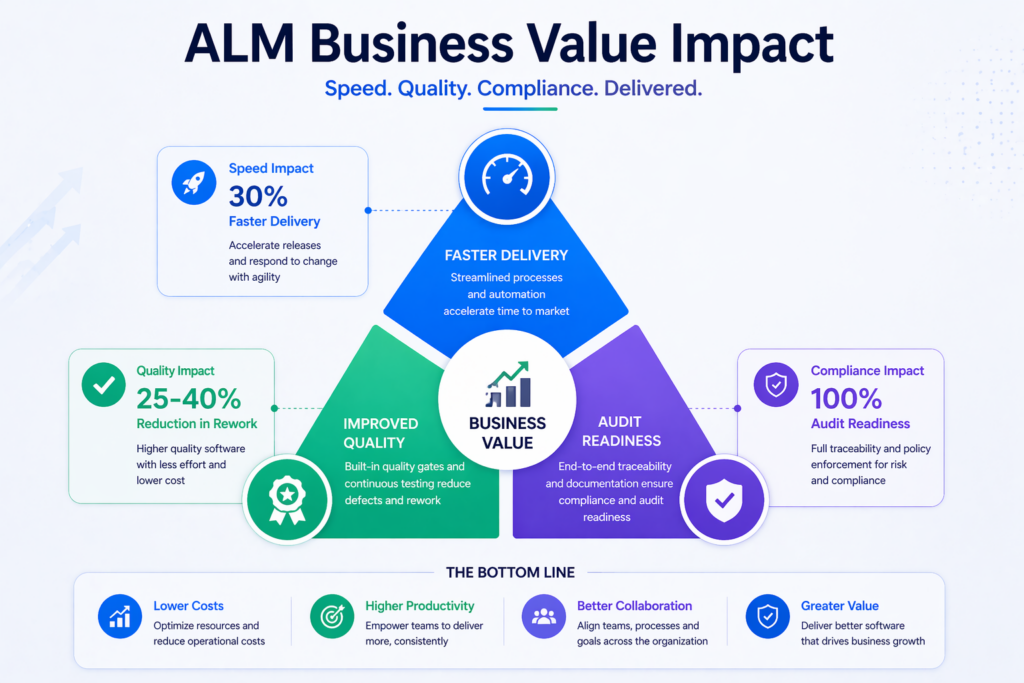
A 30% reduction in delivery timelines (Aqua Security) translates directly to reduced sprint overhead, faster time to market, and fewer emergency releases. For an engineering team shipping four major releases per year, that is roughly one full release cycle recovered annually.
Quality impact is where application lifecycle management software pays for itself fastest. Defects found in production cost 6 to 15 times more to fix than defects found during requirements review (IBM Systems Sciences Institute). ALM tools that enforce requirements traceability push defect discovery left, where it is cheaper.
Cost reduction comes from consolidation. Enterprise ALM platforms replace multiple disconnected subscriptions for requirements management, test management, and release management tooling. The net saving on tooling alone often covers 20 to 30 percent of the ALM implementation investment.
Frame the ask as an infrastructure investment, not a tool purchase, during the comparison of ALM vs SDLC. Quantify current rework cycles, failed releases, and compliance gap remediation costs. Map application lifecycle management capabilities directly to those cost centers. The question for your CFO is not "how much does application lifecycle management software cost" but "how much is the absence of enterprise ALM costing us per quarter?" That reframe changes every budget conversation.
ALM implementation fails most often not because the technology is wrong, but because the organizational change is underestimated in ALM vs SDLC adoption scenarios.
High upfront costs deter mid-market organizations despite long-term returns. The talent gap is real: ALM implementation requires DevOps, automation, and compliance expertise that most teams do not have internally.
Vendor lock-in is a structural risk in proprietary application lifecycle management software, where data export formats and API dependencies create switching costs that compound over time.
Organizational resistance is the most underestimated barrier. Application lifecycle management changes workflows across QA, dev, and product simultaneously. That is three teams with three different incentive structures being asked to adopt new processes at the same time. Without executive sponsorship and structured change management, enterprise ALM adoption stalls at the pilot stage.
Modular ALM tools platforms address the budget and adoption problem. Licensing only the modules your team needs today reduces upfront cost and lowers resistance by limiting workflow disruption. The ALM vs SDLC confusion also surfaces here: teams that misunderstand the scope of application lifecycle management often resist adoption because they think they already have SDLC tooling covered.
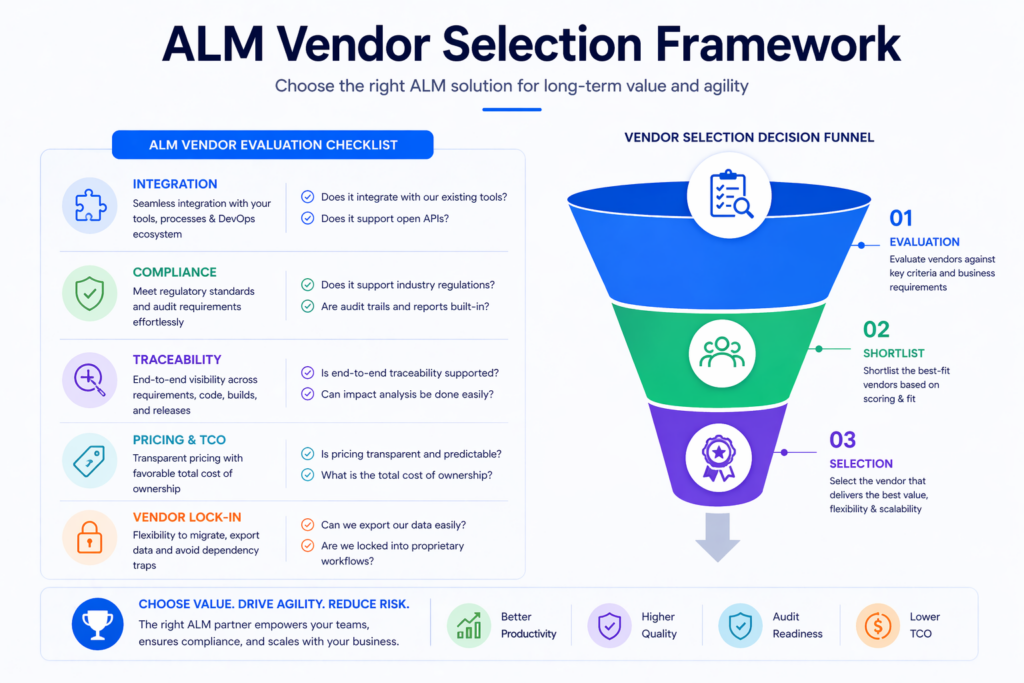
Before shortlisting any application lifecycle management software vendor in ALM vs SDLC, verify these criteria without exception.
Methodology support: Does the platform support Agile, Waterfall, hybrid, and SAFe? Enterprise ALM environments typically run multiple methodologies simultaneously.
Integration depth: ALM tools must connect to your existing CI/CD pipeline, source control, and defect tracking systems. Shallow integrations create the same silos you are trying to eliminate.
Traceability and audit trail: Full software traceability from requirement to deployment to retirement is non-negotiable for regulated industries.
Compliance coverage: Verify HIPAA, ISO, DO-178C, or SOX coverage depending on your sector before ALM implementation begins.
Deployment flexibility: On-premise vs SaaS matters for data sovereignty and security policy compliance.
Pricing structure: Per-seat vs concurrent user licensing has a significant cost difference at scale for enterprise ALM deployments.
Vendor lock-in risk: Evaluate export formats and API openness before signing. Switching application lifecycle management software mid-program is expensive.
Support tier SLAs: Know what "enterprise support" actually means before your production environment depends on it.
Speak with Patoliya Infotech's ALM specialists to get a completed evaluation template mapped to your specific stack and compliance requirements.
These are the ALM tools that dominate current enterprise evaluations. Each serves a different environment.
Jira (Atlassian):
Azure DevOps (Microsoft):
Codebeamer:
OpenText AQM:
SpiraTeam:
Tuleap:
Patoliya Infotech delivers application lifecycle management implementation that goes beyond tool setup. Most vendors configure software. Patoliya maps your existing workflows, compliance requirements, and team structure to an ALM implementation framework that actually fits how your organization operates.
The outcome is faster delivery cycles, audit-ready documentation, and reduced dependency on any single ALM tools vendor.
If your organization is ready to close the gap between your current state and a governed application lifecycle management framework, let's map it out together. Schedule a discovery call with Patoliya Infotech.
Application lifecycle management is not a procurement decision. It is an operational framework that determines whether your software assets create value or accumulate risk over time. The ALM vs SDLC distinction matters at the executive level because governance failures cost more than delivery failures. ALM implementation done right compounds: every release gets faster, every audit gets cleaner, and every retirement gets planned instead of discovered.
The question is not whether your organization needs enterprise ALM. It is how far behind the cost of not having it has already put you.
If you are evaluating application lifecycle management for your organization, schedule a no-obligation discovery call with Patoliya Infotech to map your current gaps to the right framework.