Table of Contents
Hotel booking app development is important if the company wants to create a unique segment in the travel industry. The hospitality industry is expanding and changing the way people travel. People love to travel, and Generation Z and Alpha have a fire in their blood to explore the world.
The travel and hospitality sector is growing rapidly with time as people look for personalization and memorable travel moments. Hotel booking apps allow hotel operators to facilitate direct communication with their customers, reduce dependence on other platforms, and increase profits with customized promotions and reward schemes.
When investing in hotel booking app development, it's more important to stay ahead of the curve than to enter an expanding field. Modern hotel booking applications can provide hyper-personalized experiences, predictive analytics, and real-time availability with advances in AI, machine learning, and data analytics.
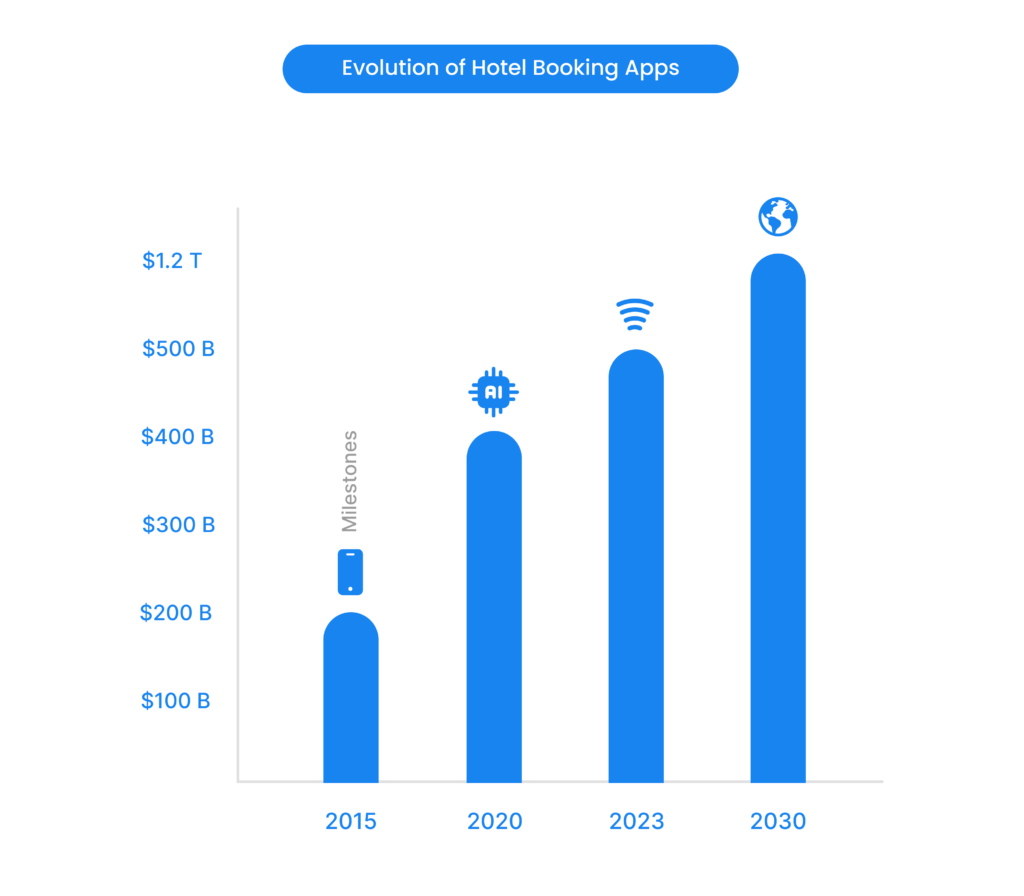
In terms of the new generation and the development of user-friendly designs, the lodge booking app is truly a jackpot. Now is the best time for any business to capitalize on this new need for an app that not only satisfies but wows users. Hotel reservation apps are leading the way for the future of virtual travel.
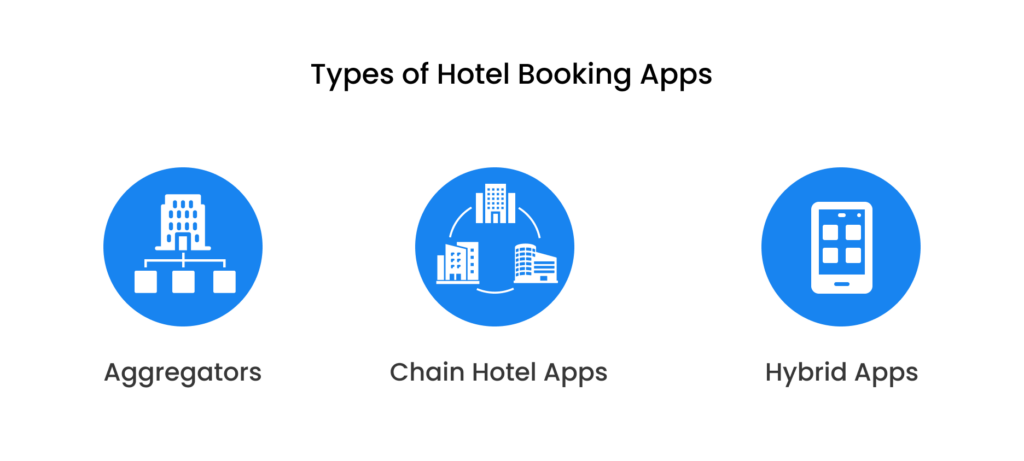
The type of hotel booking app development you would like to develop shall vary based on your future goals, models, and market.
Hotel booking consolidators make it easy for travelers to compare prices, location, facilities, and opinions about several hotels.
How they operate:
Apps aggregate hotel information from various sources, such as hotels, online travel agencies (OTAs), and private owners of properties. The best possible options are displayed to the user through various filters such as price, location, and rating, among others.
This tool enables a traveler to compare the rates offered by a number of hotels all at once.
This is how they make their money
Large hotel businesses create these apps for their own properties and loyal customers.
How they operate:
From reservation to check-out, chain hotel applications offer the whole visitor experience. Personalized room preferences, digital room keys, loyalty benefits, and mobile check-in are some of these amenities.
By doing this, hotels can avoid paying large commissions to third-party platforms. Benefits, including discounts, reward points, and perks, are provided to guests.
This is how they make their money
The functions of aggregators and brand-specific applications are combined in hybrid apps.
How they operate:
They provide independent hotels and boutique properties with listings from other sources. This showcases their unique personality. Special features like customized vacation packages, local events, and last-minute offers are available in these hotel booking app developments.
Hybrid apps provide customization and diversity. Smaller hotels become visible without compromising their unique brand identity, and travelers have greater choices.
This is how they make their money
Read More: Every Travel Business Needs Custom Software to Stay Competitive
How your hotel booking app development generates income, draws customers, and grows sustainably will determine the right business model. Among the popular models are,
In the hotel booking business, this is the most popular and successful approach.
How it operates:
Hotels use the app to list their rooms, and the platform receives a commission for each reservation made via it. Typically, this ranges from 10% to 25%. It works best with hybrid booking apps and aggregators.
Why it functions well:
Challenges:
Users can access premium services or exclusive deals through the subscription model in return for a regular fee. Apps with subscription-based features, such as HotelTonight, have been tested.
How it operates:
Customers pay a monthly or yearly fee to get features including priority customer assistance, easier cancellations, and reduced pricing. This hotel booking app development is for audiences who may be luxury or frequent travelers.
Why it functions well:
Challenges:
A freemium business model requires the user to pay for further functionalities, with the basics being free. This model is famously known for apps that aim to acquire a large number of users before generating any revenue.
How it operates:
Basic booking features are free for users, but premium features like personalized recommendations, trip insurance, or other offers require payment.
Why it functions well:
Challenges:
The advertising version boosts sales by displaying ads to users. Combining this strategy with additional revenue streams is a standard procedure.
How it operates:
This hotel booking app development works with travel-related firms, including airlines, vehicle rental providers, and tour operators, to generate customized ads. Revenue is generated through pay-per-click (PPC) and cost-per-impression (CPM) agreements.
Why it functions well:
Challenges:
Agencies that need to book hotels for their staff members can use the corporate reservation version.
How it operates:
This hotel booking app development offers business clients features like cost tracking, bulk booking, and connection with corporate travel policies. Service fees or yearly contracts are the sources of revenue.
Why it functions well:
Challenges:
Read More: Creating a Payment App with Seamless User Experience
Read More: Guide to Mobile App Development for Enterprises
Creating a hotel booking app development requires a proven strategy to ensure long-term customer satisfaction, high performance, and ongoing customer satisfaction. A detailed tutorial on creating a hotel booking app from scratch can be seen below.
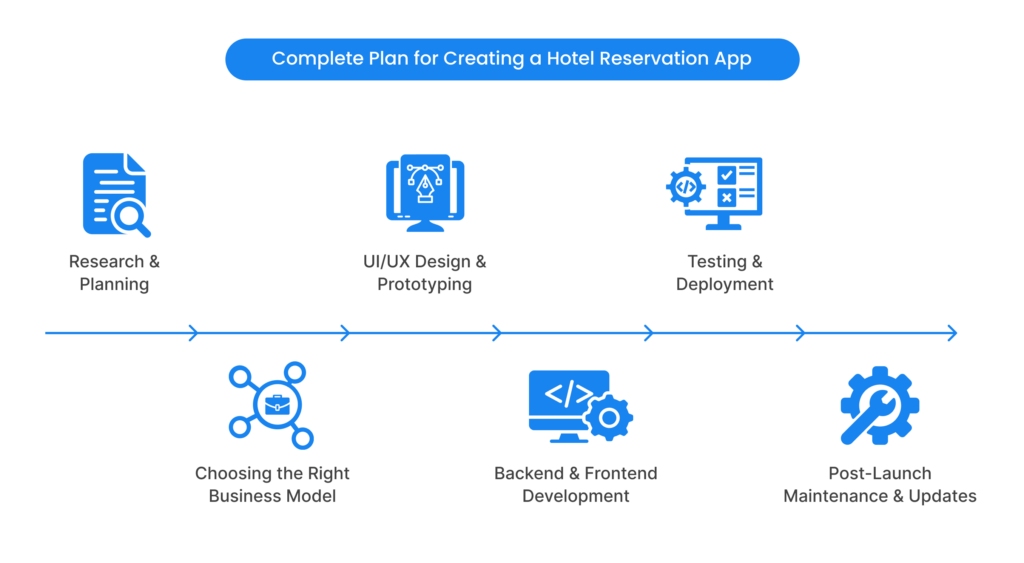
Before making any advancement, detailed research becomes necessary to comprehend market dynamics, competitiveness, and customer expectations.
Market analysis: Examine user activity, market, and expansion trends. The increased use of the hotel booking market is an indicator that there is strong market demand.
Competition Analysis: It should clearly specify the target audience for the application, such as family members, business travelers, budget and luxury tourists, so that modifications of the application can be made accordingly.
Target Audience: Clearly identify your target users, such as families, business travelers, budget travelers, or luxury travelers, so that the app is customized to meet their needs.
Read More: Streamline Your Hotel Operations with Property Management Software
The business model outlines how your hotel booking app development makes money and grows over time.
Commission-based business model: Earn money based on a percentage of each completed hotel booking.
Subscription Model: For hotels to be able to publish their properties on the site as well as advertise, they need to subscribe.
Freemium Model: While premium visibility and functionalities are chargeable, basic entries are free.
Advertising-Based Model: Promoted listings and sponsored placements bring in money.
Corporate Travel Model: Offer customized booking and reimbursement options to corporate and business travelers.
User Satisfaction and booking conversions are largely dependent on effective design for hotel booking app development.
Wireframing and Prototyping: Before even embarking on app development, it is essential to create a layout for your app and develop prototypes for user flows.
User-Centered Design: To minimize friction, facilitate easy searches, smooth ordering procedures, and navigation.
Branding and Visual Consistency: Make use of a simple and contemporary interface that enables hotel comparison, booking, and discovery.
This stage is the development of the core function of the application, focusing on scalability and security.
Technology Stack:
Frontend: React Native (for cross-platform apps), Swift (iOS), Kotlin (Android).
Backend: Node.js, Python (Django/Flask), or Ruby on Rails.
Database: PostgreSQL, MySQL, Firebase.
APIs & Integrations:
Frontend Development: Implement user interface components and interactive elements.
Backend Development: Build APIs, database architecture, and business logic.
Cloud Hosting: Deploy backend services on AWS, Google Cloud, or Azure for scalability.
Comprehensive testing ensures that your software functions properly and securely on all devices before it is released.
Types of Testing:
To confirm individual components, use unit testing.
Integration testing to make sure third-party services and APIs function properly.
Performance evaluation to manage heavy traffic volumes.
Security testing to guard user information and stop fraud.
Conduct user acceptance testing (UAT) to receive actual feedback from the users.
Deployment Procedures:
The act of releasing an app is just the beginning. The key to sustained success is to keep upgrading for hotel booking app development.
Bug fixes and performance enhancements: In order to ensure the program remains stable, track user input and crashes.
Feature Improvements: Continually roll out new features like AI-powered suggestions and voice search.
Marketing and User Engagement: These can be retained using social media, loyalty cards, and push notifications.
Data Analytics and Insights: Tracking ordering behavior, conversion rates, and consumer behavior for future optimization.
The cost of developing a hotel booking application is quite high, and it is important to be aware of the factors that determine the cost of the application if the project is to be planned effectively. The complexity, functionality, platform, and approach of the application have a positive and negative impact on the cost of the app. Below, for effective planning, we present a detailed costing of the major factors affecting the final cost of developing a hotel booking app.
| App Complexity | Features | Estimated Cost ~ ($) | Timeline |
| Basic App | MVP features (search, booking, payments, reviews) | ~20,000 - 50,000 | 3-6 months |
| Mid-Range App | Advanced features (AI recommendations, loyalty programs, multi-language) | ~50,000 − 100,000 | 6-9 months |
| Complex App | Custom features (virtual tours, dynamic pricing, corporate booking tools) | ~100,000 − 250,000+ | 9-12+ months |
App Launch Planning
It takes preparation to launch your app in order to raise awareness and draw in your initial user base. Early access users, a pre-launch campaign, and post-launch marketing are all necessary.
Optimization for the App Store (ASO)
Optimize the app's title, description, keywords, photos, and videos to make it more discoverable. Update your app store listing and encourage users to provide positive reviews to maximize the quantity of downloads from the app store.
Referral Programs
Reward referrals with things like booking credits to encourage them. This will help ensure a cheaper and more trusted means of acquiring customers.
Hotel Partnerships
Enhance the quality of inventory and offer your customers additional reasons to use your application for booking purposes by collaborating with hotels for special package discounts, early bird discounts, and/or special rates.
User Engagement Campaigns
To retain your users and encourage them to make repeated bookings, you can conduct customized engagement campaigns, special deals, reward schemes, and push notifications.
Booking Conversion Rate: It is essential to monitor the rate at which visitors actually complete their bookings, which will enable them to identify where difficulties are experienced within the site during this process.
User Retention Rate: This will help in estimating the retention rate of users to evaluate the usability and average levels of satisfaction they are experiencing. This will allow for the estimation of the rate at which users
Lifetime Value of the Customer: It is required to calculate the total revenue that can be expected from the user over the span of their interaction with the mobile application.
Cost of Acquiring Customers (CAC): Make sure that the cost of acquiring the user is not greater than the LTV.
Return On Investment: Compare booking revenues to development, marketing, and operating expenditures to make informed company decisions about profitability.
Read More: How Finance Digitalization Can Revolutionize Your Financial Management
To develop a unique hotel booking software, you need to be knowledgeable, creative, and user-focused. Delivering fantastic, personalized applications that increase engagement and income is our specialty at Patoliya Infotech. Here's why we're the ideal partner for your project:
Hotel booking app development has emerged as a vital component for a business that aims to stay relevant in the market. The application, strategy, and business models must satisfy certain requirements in order to provide end users with a quick, simple, and customized experience.
When businesses focus on the right metrics for improvement and make continuous efforts based on consumer behavior, a hotel booking app can develop into an extraordinary revenue driver and growth catalyst for any hotel business.
For business managers, hotel booking apps are also a strategic way to take ownership of customer relationships. A business-owned application allows them to control customers, pricing, and engagements. That is the key to effective decision-making.
At the end of it all, success in launching a hotel booking app depends on its ability to align with consumer requirements as well as business objectives. When this happens, it becomes a scalable growth channel that promotes differentiation along with enhancing efficiency.