Table of Contents
TL;DR: Order management system development connects every sales channel, warehouse, and back office system into one workflow, so orders route, stock updates, and shipments trigger without manual entry. Brands running spreadsheets past three channels lose hours every week that a connected OMS handles automatically.
Every successful ecommerce business eventually faces the same challenge: the systems that helped them grow become the systems slowing them down. More channels mean more orders, but they also mean more inventory checks, more manual updates, and more opportunities for mistakes.
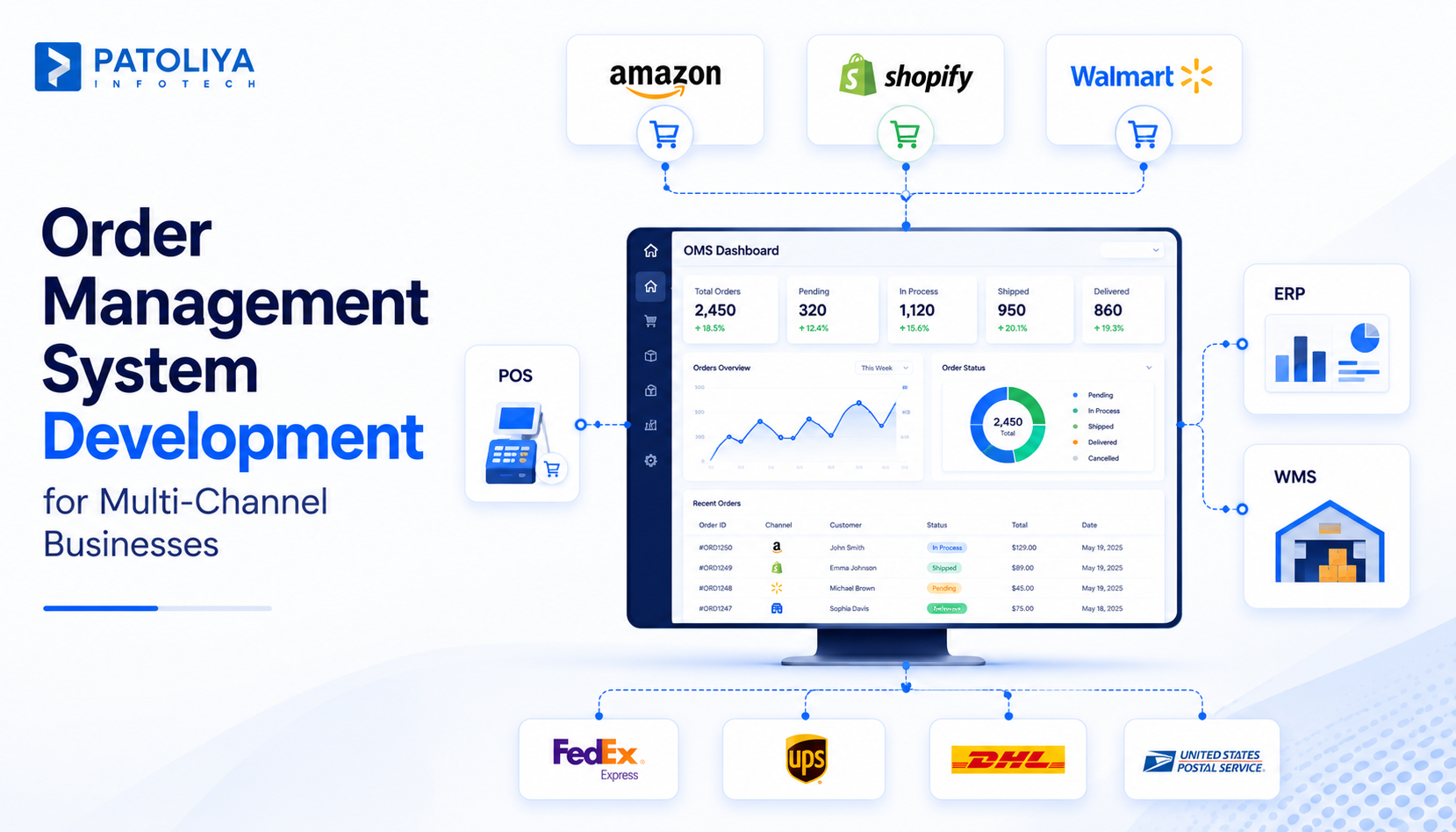
Order management system development gives growing businesses a way to bring those moving parts together. Instead of managing orders across disconnected tools, teams gain a centralized system designed around their workflows. This guide explains what makes an OMS effective, when businesses need one, and how to approach development strategically.
The First 1,000 Orders Are Easy
A founder running one Shopify store and a shared spreadsheet can track a thousand orders fine. This stage does not need order management system development yet, and building one too early wastes budget.
What Changes at 10,000 Orders Per Month
At ten thousand orders a month, one wrong stock count means dozens of oversold items before anyone notices. This is the volume where most businesses start real order management system development conversations, and it is where order management system development actually pays for itself.
Why More Sales Channels Create More Operational Complexity
A second marketplace does not double the work. It multiplies it, since every channel adds its own rules and its own failure points. A multi-channel order processing system absorbs that multiplication, so staff never carry it, closing the exact gap that order management system development exists to solve.
Order Capture
The moment a customer clicks buy, the order needs to land centrally. A clean order processing workflow, built on the same discipline covered in trust strategies for a smoother workflow, captures the order and cart details within seconds.
Validation
Payment has to clear, the address has to be real, and the order has to pass basic fraud checks before it moves forward.
Good order management system development treats validation as a gate, since a bad order caught early costs far less than one caught after it ships.
Inventory Reservation
The system reserves stock the instant an order passes validation, so the same unit cannot be sold twice.
This single step is where most manual systems fail, which is why inventory sync sits at the center of any serious order management system development build.
Warehouse Assignment
Order routing decides which warehouse, store, or 3PL fulfills the order, based on stock levels, shipping cost, and delivery speed, made in milliseconds for a business with several fulfillment points.
Shipping
Once a warehouse is assigned, the system generates a pick list, packing slip, and shipping label without anyone touching a keyboard. This is where fulfillment automation does its heaviest lifting.
Returns and Refund Loop
A return reverses everything the original order triggered: stock returns, a refund process, and the reason gets logged. Order management system development treats this loop as part of the same journey as the sale.
The Central Order Database: Every order needs one authoritative record that every system reads from and writes to, or two systems eventually disagree about the same order. Understanding the database vs. data warehouse distinction helps clarify why this record has to live in a fast, transactional system rather than a reporting one. This single database is the foundation on which any custom order management software is built.
Event-Based Processing: A well-built custom order management software platform does not wait and check every few minutes for changes. It reacts the instant something happens: an order placed, a payment cleared, a package shipped. This is what makes real-time order management system development possible, following the same event-driven architecture principles used across modern distributed systems, and it eliminates the batch delays that older systems accept.
Integration Layer: The order management system development stack needs one clean layer that talks to the ERP, WMS, CRM, and every marketplace, so a new connection never means rebuilding the system. This layer is the ecommerce backend, tying every system together, the kind of work we handle through database and cloud transformation the piece that most off-the-shelf tools get wrong.
This layer is the ecommerce backend, tying every system together, the piece that most off-the-shelf tools get wrong.
Business Rules Engine: Routing logic, approval thresholds, and exception handling need to live in a rules engine that the business can adjust without a developer.
This separates a custom order management software platform built to last from one needing a rebuild every time a policy changes.
Monitoring and Logging: Every order needs a full history of what happened, when, and why. This log is the difference between finding a problem in five minutes and guessing for a day, the same discipline behind the key elements of a DevOps culture. Few write-ups cover this part of order management system development, but it decides how painful year two becomes.
Automatic routing should handle the majority of orders by assigning them to the right warehouse, store, or fulfillment location based on stock availability, customer proximity, and operational priorities.
This reduces manual intervention and improves order accuracy while allowing teams to focus on exceptions.
Inventory should be reserved immediately after order validation to prevent overselling and inaccurate stock counts.
Delayed inventory allocation is one of the biggest causes of channel conflicts during peak sales periods, making real-time inventory control a critical part of order management system development.
Payment failures should trigger predefined workflows instead of manual follow-ups. A modern system can hold the order, notify customers, provide recovery options, and automatically cancel unsuccessful transactions after a defined period, the same rigor covered in how application security testing safeguards transactions.
Not every order requires manual review. A smart order management system should automatically process standard purchases while routing high-value orders, suspicious transactions, or unusual delivery requests for human approval.
Stock shortages should trigger automated responses such as backorder creation, alternative product suggestions, or customer notifications. This prevents abandoned orders and helps businesses maintain customer trust during inventory fluctuations.
Returned products should update inventory automatically after inspection and approval. With nearly one in five online orders now coming back, connecting returns with inventory systems ensures accurate availability across every sales channel and prevents outdated stock information.
Different regions often need different shipping carriers, tax handling, and delivery promises. A custom order management software build, the product of real order management system development, lets a business encode these rules once, so no region gets forced into the same generic workflow.
Amazon, Walmart, and a direct storefront each enforce their own packaging, labeling, and performance requirements. Building an order management system development around these specific rules avoids the account suspensions that hit sellers using a generic process for every channel. This is a common gap that generic tools never close.
VIP customers, wholesale accounts, and first-time buyers often deserve different handling, whether faster shipping or a different approval threshold. A rules engine built through proper order management system development keeps that logic out of a spreadsheet someone maintains by memory.
A same-day promise for local orders and a five-day promise for cross-country orders need separate logic for driving warehouse assignment. This is a business-specific rule that an off-the-shelf system rarely handles, which is why enterprise buyers move toward a real multi-channel order processing system built around their own rules.
Business Process Discovery
Every real order management system development project starts by mapping how orders move today, including every manual workaround staff use, the same discovery-first approach outlined in the lifecycle of software development. Skipping this step is the top reason projects go over budget.
Solution Architecture
The team designs the database structure, integration layer, and rules engine before writing code, matching the order management system development architecture to the channels and warehouse network already in place.
API Integration
Each connection, from marketplaces to the ERP to shipping carriers, gets built and tested before the pieces connect, forming the backbone of the finished custom order management software platform. Rushing this step is where timelines slip.
Workflow Configuration
Business rules for routing, approvals, and exceptions get configured and tested against real order scenarios, so the system behaves correctly the first time it handles a live order, the whole reason order management system development exists.
Pilot Launch
A small percentage of real orders run through the new order management system development build while the old process stays live as a backup, the same safety net regression testing provided before a full rollout, catching edge cases before the full switch.
Production Rollout
Once the pilot proves stable, the full order volume moves over, and the team hands off monitoring so order management system development becomes a living system that keeps improving.
API-First Design
Every function in the system should be callable through an API from day one, letting a custom order management software platform add a channel or internal tool without a rebuild.
Queue-Based Processing
Orders should process through a queue that can absorb sudden spikes, like a flash sale, without dropping orders. Systems without this pattern, a core piece of solid order management system development, buckle exactly when volume matters most, not unlike the failure patterns covered in how to deal with a connection leak.
Horizontal Scaling
The system needs to add capacity by adding servers, never by pushing one machine to its limit, a scaling decision that ties directly into cloud cost management trends. This decision determines whether the order management system development holds up during a ten times normal traffic event.
Failure Recovery
When a marketplace API goes down or a payment provider times out, the system should retry automatically and alert a human only when retries fail, a standard piece of solid order management system development. Manual recovery does not scale past a handful of incidents a week.
Performance Monitoring
Response times, queue depth, and error rates need constant tracking every single day. A monthly check catches problems too late.
Teams running a real multi-channel order processing system who skip this step in order management system development find out about a broken integration from angry customers, never on a dashboard.
| Approach | Best Fit | Advantages | Limitations |
| Extend Existing ERP | Businesses with lower order complexity that already have an ERP handling most operational logic. | Lowest upfront investment, faster implementation, and works well before the business requires a complete multi-channel order processing system. | Reaches limitations when channel volume, routing rules, or workflow complexity increase beyond ERP capabilities. |
| Use Middleware Integration Platforms | Businesses that need multiple marketplaces, ecommerce, and system connections without highly customized workflows. | Helps connect different platforms and enables data flow between sales channels, ERP, and fulfillment systems. | Often requires additional workarounds when businesses need specific approval rules, advanced order routing, or unique processes. |
| Develop Custom Order Management Software | Enterprise businesses with complex workflows, multiple channels, unique fulfillment rules, or large-scale operations. | Provides complete control over order processing workflow, integrations, automation rules, and scalability. Full order management system development removes dependency on workaround solutions. | Requires higher upfront investment and careful planning compared to extending existing tools. |
ERP extensions offer lower upfront costs but can become restrictive as order volume and workflows expand. Middleware platforms improve connectivity but may require adjustments for specific business processes. Order management system development creates a scalable foundation for complex operational requirements.
Choosing between these three paths is, in many ways, the same decision covered in staff augmentation vs. managed services, build in-house capacity, extend what you already have, or bring in a dedicated partner to replace the process outright.
A business showing several of these signs at once has likely outgrown manual tools and needs real order management system development the same threshold covered in our guide to choosing an IT solution provider:
Any one of these alone might be a process fix. Three or more together usually means the business needs a real multi-channel order processing system.
| Criteria | Why It Matters |
| Inventory, pricing, and order status source of truth | Prevents conflicting data across systems |
| Workflows causing order delays | Identifies where automation creates the biggest impact |
| Systems responsible for inventory ownership | Avoids stock mismatches and inaccurate availability |
| Exceptions requiring human review | Reduces unnecessary manual processing |
| Business-critical integrations for launch | Keeps the first phase focused and efficient |
Answering these points before engaging a development partner helps businesses define priorities, reduce discovery time, and keep the custom order management software scope aligned with actual operational needs.
Patoliya Infotech begins every order management system development project by understanding existing workflows, sales channels, warehouse operations, and business rules before designing the solution.
The team builds a scalable OMS architecture around actual operational requirements instead of forcing businesses into predefined templates.
What this includes:
Build an order management system designed around your operations. Talk to our OMS experts and plan your next phase of growth.
An order engine either runs itself or quietly costs a business time and money every day. Order management system development replaces manual coordination with a connected workflow that manages everything from checkout to delivery in one system, a core piece of any serious digital transformation guide for growing ecommerce brands. The businesses that build this early spend their growth years scaling instead of constantly fixing operational gaps. Firefighting becomes the exception, not the daily routine.
If your team is spending too much time chasing order updates, inventory issues, or disconnected systems, it may be time to rethink your current setup. Tell us how your orders are currently moving, and we'll help you determine where automation can have the greatest impact.