Table of Contents
Most legacy system modernization programs fail not during execution but before it. The actual total cost of ownership for legacy systems runs 3.4× higher than organizations estimate. Getting the sequence right, before writing a single line of new code, is what separates a successful migration from a $10M lesson.
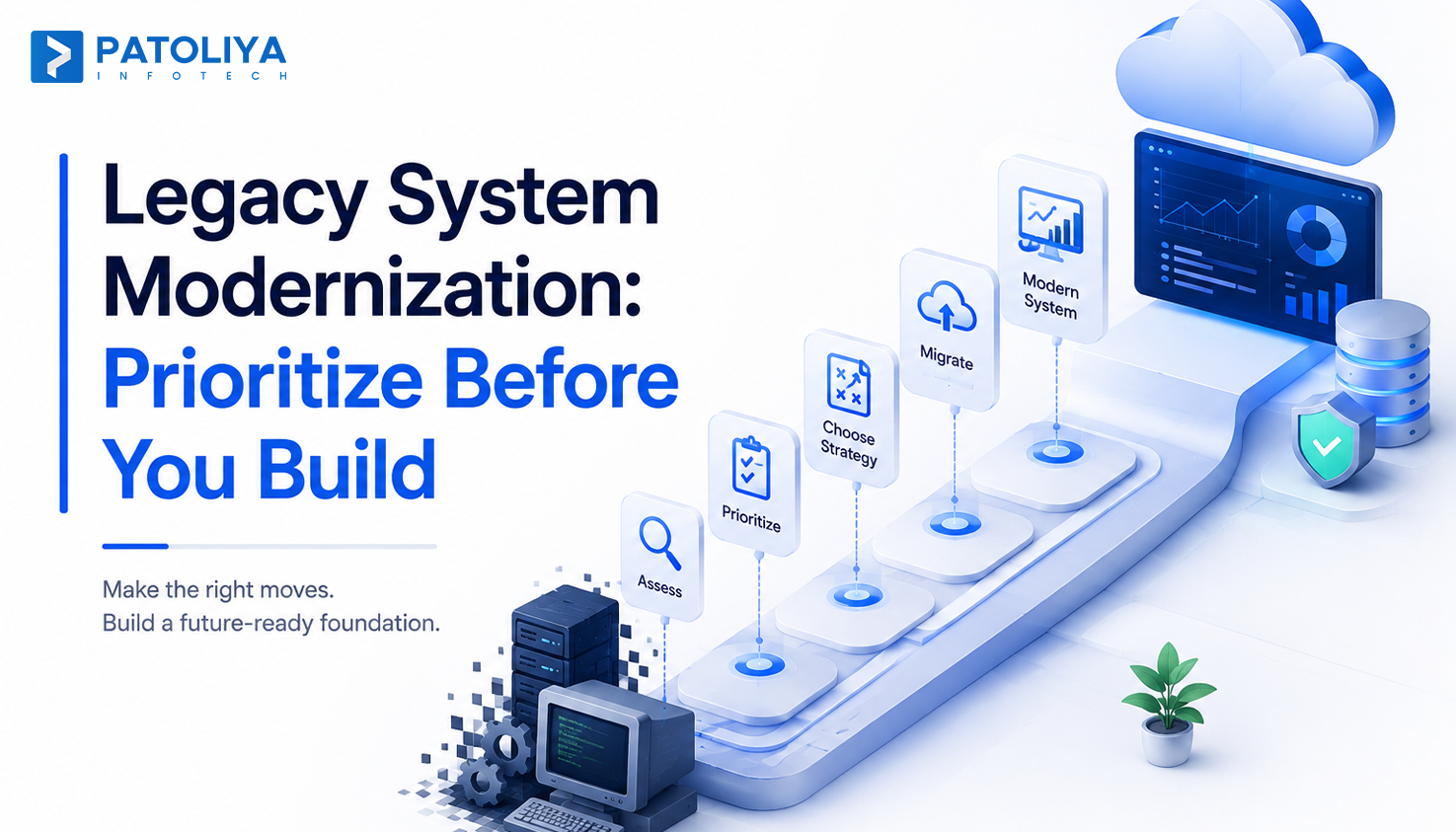
Legacy system modernization success depends less on tools and more on sequencing and prioritization. The failure pattern is consistent: teams skip sequencing, document little to nothing, and treat architecture decisions as a checklist instead of a diagnostic output. Modernizing legacy applications is a problem of prioritization and execution order.
Most programs do not fail due to tools or talent, but because decisions are made in the wrong sequence from the start in modernize legacy applications. This guide outlines the exact sequence, framework choices, and organizational steps that determine the outcome.
Legacy system modernization fails most often in planning, not execution. In modernize legacy applications, three structural issues undocumented dependencies, wrong pattern selection, and undefined success criteria cause most failures.
The Three Pre-Execution Failures That Break Most Programs
Most programs enter execution with at least one of these active:
The Hidden Dependency Trap Most Teams Miss
Systems built over 15 to 20 years accumulate dependencies nobody mapped. A billing module touches a reporting system through a shared database view nobody documented. When you modernize legacy applications, you inherit every one of those relationships, mapped or not.
Why Sequencing Errors Quietly Drive Most Failures And Rarely Get Called Out
Sequence determines blast radius. Migrating a high-coupling, undocumented system first creates the kind of cascading failure that ends programs. Legacy system modernization succeeds when sequencing is treated as a decision framework
Legacy system modernization requires a working definition of legacy. Most organizations conflate four distinct categories and apply the wrong remedy to each.
The Four Categories Most Teams Confuse and Treat as the Same Thing
| Category | Defining Characteristic | Right Response |
| Technically outdated | Old language and infrastructure | Re-platform or refactor |
| Functionally blocked | Cannot deliver needed capability | Re-architect or replace |
| Operationally fragile | Frequent outages, single point of failure | Stabilize first, then migrate |
| Compliance risk | Cannot meet current regulatory requirements | Prioritize immediately |
The Application Portfolio Audit as Day One
Before any legacy system modernization work starts, run a portfolio audit. Categorize every application by the table above. For modernize legacy applications, the audit answers the only question that matters: which systems are blocking business capability right now?
Choosing a legacy system modernization pattern without diagnosing your system first is like prescribing surgery before reading the chart. The pattern must follow the diagnosis.
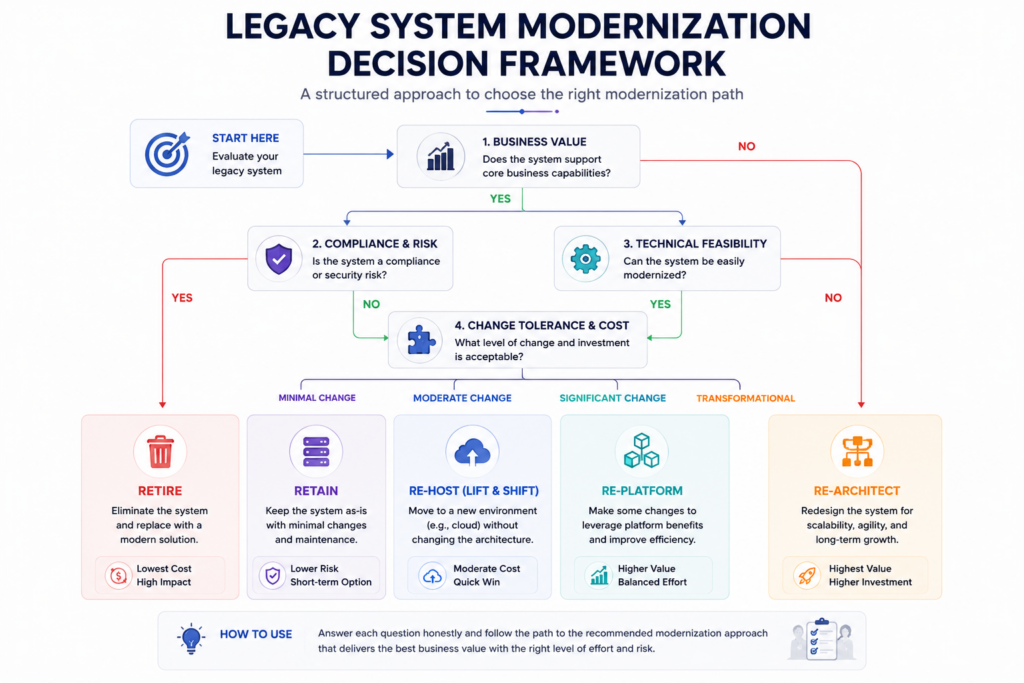
The modular monolith is the most underused destination in legacy system modernization. It gives you clean internal boundaries, single-deployment simplicity, and an exit path to microservices if the data eventually justifies it. To modernize legacy applications, Most enterprises do not need distributed microservices. They need better-organized monoliths.
In legacy system modernization, the order of migration determines whether the program builds confidence or erodes it. Start with the wrong legacy to cloud migration system, and you will spend six months recovering instead of progressing.
Score every modernize legacy applications on these four dimensions before sequencing:
1. Blast Radius: How many downstream systems break if this migration fails? High blast radius systems migrate last.
2. Business Criticality: Revenue-generating or compliance-critical systems need the most preparation, not the fastest migration.
3. Data Coupling: Tightly coupled data models extend timelines. Monolith to microservices transitions almost always surface hidden data coupling that the original schema did not document.
4. Undocumented Logic Density: Legacy system modernization with high undocumented logic density needs a documentation phase before migration begins. This is not optional.
What to Retire First Before Any Migration Begins
Retire dead systems in the first 30 days. In legacy system modernization, this reduces integration surface area, simplifies dependency mapping, and gives the team a visible win before the difficult modernize legacy applications start.
Sequencing Mistakes and Their Consequences
| Mistake | Consequence |
| Starting with the most complex system | Team loses confidence in the program |
| Skipping documentation phase | Business logic gaps surface during UAT |
| Migrating before retiring redundant systems | Wasted effort on systems that should not have moved |
Undocumented business logic is the single most consistent cause of overruns in legacy system modernization timelines. It is not a technical problem. It is an organizational one.
Three Extraction Techniques That Actually Work
Characterization Testing: Wrap the modernize legacy applications with tests that document actual behavior, not what the spec says it should do. Run the test suite against the new system as a functional parity baseline.
Domain Expert Structured Interviews: Focus interviews on exception cases, not standard flows. Standard flows are usually documented. The exception handling rarely is for legacy system modernization.
AI-Assisted Code Analysis: Modern AI tooling can identify undocumented function purpose at roughly 83% accuracy. Use this as a first pass before human review, not as a replacement for it.
The Logic Extraction Sequence Before Migration Begins
Run characterization tests first in modernize legacy applications. Then interviews. Then AI analysis to fill gaps. Treat the output as a migration gate. No migration starts until logic extraction reaches a documented threshold, such as 90% of transaction paths covered.
Technical debt reduction is not the goal of legacy system modernization. The goal is faster delivery, lower risk, and greater operational efficiency. Treating every debt item as equal wastes time and budget on systems that are not blocking anything. The right question for legacy to cloud migration is: Does this debt block a business capability or introduce compliance risk?
The Four-Bucket Triage Framework
Fix now: Blocks capability or creates compliance exposure.
Fix during migration: Can be addressed as part of the modernization work without extending scope.
Tolerate: Does not block capability. Leave it.
Retire: The system carrying the debt is being decommissioned anyway.
Technical Debt Triage: Focus on Business Impact Over Severity
A security debt item in a system scheduled for retirement in 90 days ranks below a performance debt item blocking a revenue-generating feature. Severity without business context produces the wrong prioritization list.
Legacy re-architecture decisions made in month one determine operational cost for the next decade. Most legacy system modernization programs underestimate this.
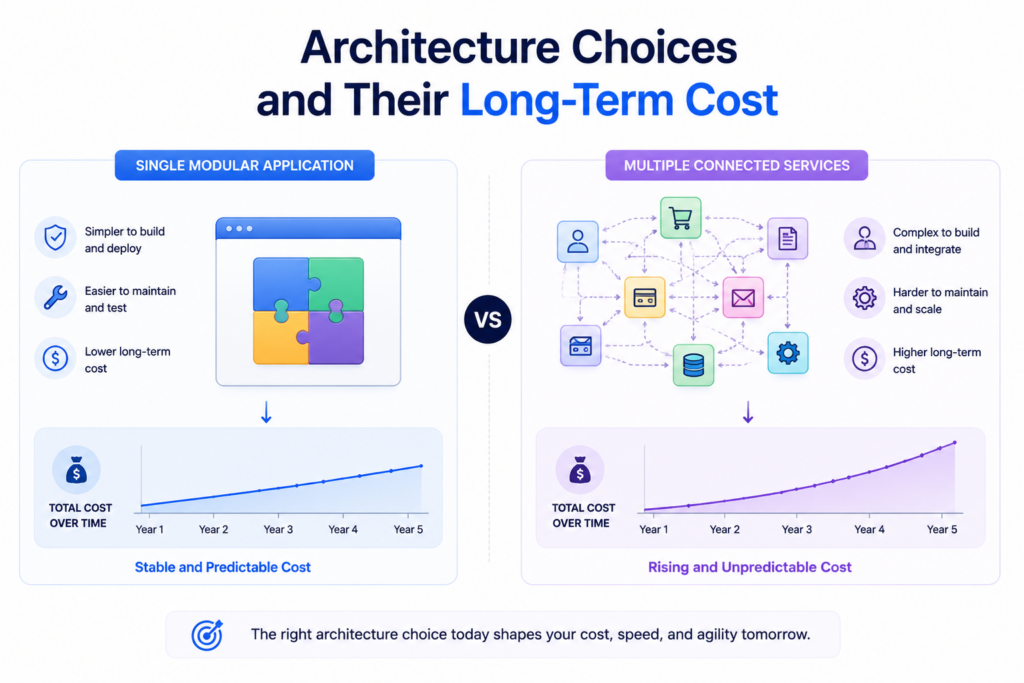
Mainframe modernization and large-scale re-architecture programs that defaulted to microservices are now producing operational cost data showing 40 to 60% higher infrastructure spend compared to well-structured modular monoliths at equivalent scale.
The overhead comes from distributed system management, inter-service latency handling, and the observability stack required to monitor dozens of services.
For legacy to cloud migration, a modular monolith delivers clean domain boundaries and a single deployment artifact. For most enterprise legacy system modernization programs handling under 500 requests per second, this is the correct destination.
Independent scaling requirements per service, separate team ownership by domain, and deployment frequency above 10 releases per day per service are the three conditions that justify the microservices overhead. If your program does not meet all three, a modular monolith will outperform it operationally.
Legacy to cloud migration is not one decision. It is a sequence of infrastructure decisions with different cost and risk profiles at each stage for legacy system modernization. Most organizations treat it as a single event and overspend as a result.
Lift-and-Shift as a Staging Strategy
Re-Platform Decision Gates
The Parallel-Run Cost Nobody Budgets For
Legacy system modernization fails organizationally as often as it fails technically. The architecture a program produces mirrors the communication structure of the organization behind it.
Conway's Law applied to modernization programs shows that a monolithic IT organization produces monolithic systems. Even with modern cloud tooling, centralized ownership leads to tightly coupled architecture because decisions, dependencies, and approvals flow through shared structures.
In practice, this results in shared backlogs, cross-team dependencies, and releases that require coordination across multiple groups. For legacy to cloud migration, these delays are not process issues; they are structural outcomes of the organization design. In legacy system modernization, the system often ends up reflecting how teams interact rather than how the architecture is intended to function.
For modernize legacy applications, the principle is simple: if you want modular systems, you must first create modular teams.
In practice:
Without this, legacy system modernization efforts often produce distributed monoliths, systems that are separated in code but still dependent in execution.
Team capability must guide migration order. For legacy to cloud migration, a team without cloud-native experience should not start with high-complexity systems.
In practice:
Skill gaps for modernize legacy applications directly shape delivery risk and must be accounted for in migration sequencing decisions.
The most common reason risk controls fail during legacy system modernization cutovers is that rollback criteria were never defined.
Teams enter production cutovers with no agreed threshold for "this is bad enough to roll back."
Define Success Metrics Before Migration Begins
Establish a functional parity baseline: document 200 critical transaction paths with performance benchmarks from the legacy system. Every new modernize legacy applications must meet or exceed these before cutover is approved.
Rollback Triggers: Specific Thresholds, Not Abstract Criteria
In legacy system modernization, define rollback conditions as numbers. Error rate above 2% sustained for 15 minutes triggers rollback. Latency above 3× baseline for any critical path triggers rollback. Abstract criteria like "significant degradation" produce disagreements during incidents.
How to Know a Strangler Fig Migration Is Actually Complete
The strangler fig pattern migration is complete when 100% of production traffic routes through the new system and the legacy routing layer has been decommissioned. Not when the new legacy system modernization handles most traffic. Partial migration is not migration.
The legacy system modernization program ends. The post-modernization problems start. Most organizations discover these at the 6-month production review.
1. Performance Degradation at Real Production Load: Test environments rarely replicate peak production load patterns. Plan a load test at 150% of expected peak before declaring success.
2. Observability Gaps: Legacy systems had monitoring built over years. New systems often ship with minimal instrumentation. Build the observability stack before cutover, not after.
3. Team Capability Debt: The team that built the legacy system is not automatically equipped to operate the new one. For legacy system modernization, operational runbook creation and incident response drills are post-migration requirements.
4. Integration Brittleness: Lift-and-shift vs re-platform decisions often defer integration redesign. Integration points built on legacy assumptions break as the surrounding system evolves.
Building the Post-Migration Monitoring and Correction Plan
Set review checkpoints at 6, 12, and 24 months post-cutover. Each checkpoint should measure error rate, latency percentiles, deployment frequency, and incident rate against the pre-migration baseline.
Most legacy system modernization business cases understate cost by 35 to 45%. The base estimate is usually accurate in legacy to cloud migration. The hidden costs are not.
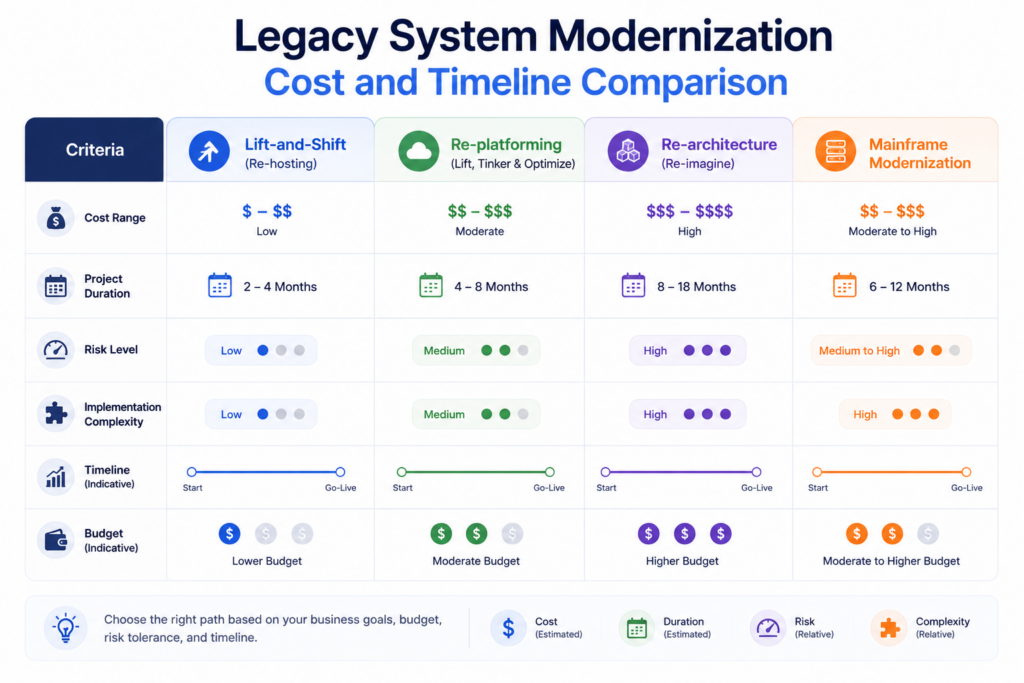
| Modernization Type | Typical Cost Range |
| Lift-and-shift | $40K to $150K |
| Re-platforming | $100K to $250K |
| Re-architecture | $300K to $1M+ |
| Mainframe/COBOL | $500K to $2M+ |
Legacy re-architecture has a higher upfront cost than maintaining existing systems. However, in many legacy system modernization initiatives, the long-term economics tell a different story. Once maintenance, incident response, and opportunity costs are included, legacy systems often cost far more than expected. The maintenance decision is rarely as cheap as it appears.
In legacy system modernization, the partner you choose defines the outcome more than the architecture you design.
| Capability Checkpoint | Requirement | Why It Matters |
| Characterization testing | Named tools with defined process | Ensures real system behavior is captured before changes begin |
| Rollback readiness | Pre-defined cutover thresholds | Prevents irreversible production failures |
| Cloud migration experience | Proven, named enterprise outcomes | Confirms ability to execute at scale |
| Modular monolith delivery | Architecture chosen via diagnosis | Avoids premature microservices complexity |
| Modernization track record | Documented production uptime results | Validates real-world reliability |
| Parallel-run planning | Budgeted and scoped dual-run strategy | Reduces cutover and transition risk |
| Business logic extraction | Structured, gated methodology | Protects undocumented system intelligence |
| Post-migration support | Defined SLA-based checkpoints | Ensures stability beyond go-live |
Legacy system modernization done right requires a team that sequences before it executes. Patoliya Infotech runs application portfolio audits as day one, applies pattern selection through diagnostic frameworks, and defines rollback criteria before migration begins.
If your legacy system modernization program is stalled or hasn't started yet, let's map the right sequence together.
Legacy system modernization fails at the sequence, not the execution. Every stalled program shares the same fingerprint: pattern chosen before diagnosis, business logic assumed rather than extracted, and rollback criteria written during an incident instead of before one.
The technical work required to modernize legacy applications follows the sequencing work. Get the order right and execution becomes manageable. Get it wrong, and no engineering talent recovers the timeline or the budget.
Your legacy systems carry decades of business logic that a rewrite will not automatically transfer. That knowledge has to be extracted deliberately, not discovered mid-migration.
If you’re planning a modernization program, start with the sequence before the system.