Building a Scalable Healthcare SaaS Platform
Table of Contents
Healthcare Saas platforms are popular because of the cloud-based solutions they offer to enterprises. This is one kind of digital health solution. Building cloud-based healthcare software is expensive. These cloud systems require maintenance and upgrades on a regular basis. Small and start-up businesses cannot afford it. These constraints may mean that they are unable to compete in the market. They are unable to develop in terms of product quality and modern technology.
Many hospitals struggle to follow general regulations. Integrating modern technology with outdated systems is also an issue. What if someone did all of this for you? They supply everything from scratch for a certain amount of money. This is where healthcare SaaS systems come in.
Cloud-based services allow you to manage all systems from one central location. You do not require money for development or maintenance. Even reputable cloud-based healthcare software companies supply regulations and compliance. This contributes to improved health care with security.
The Healthcare SaaS market is projected to $71.44 billion by 2030. This is reflecting a rapid 17.26% annual growth rate (CAGR). (Src)
What is a Healthcare SaaS Platform?
The healthcare saas platforms were created to allow businesses to operate services and manage their businesses online without having to develop their own software.
The Healthcare SaaS platform is built on cloud-based applications. The cloud is used for internet data storage. The term saas refers to software as a service.
This is how remote services are delivered over the internet. Any organization can use cloud-based software without having to create it. It only charges for subscribing to services for a set length of time.
Key Features and Uses of Healthcare SaaS Solutions
Patient Record Management (EHR)
- This manages Electronic Health Records (EHRs), patient data, and medical history.
- Remote patient monitoring software is also widely used. This provides accurate and safe data wherever you desire.
Appointment & Scheduling
- Online scheduling, appointment scheduling, and booking are made simple by healthcare saas software.
- This increases employee productivity and reduces administrative burdens.
Telemedicine & Remote Monitoring
- Secure virtual consultations and continuous health tracking are made possible through connected devices.
- This improves patient access to care and improves chronic disease management. This helps to reduce travel for both sides with Telemedicine SaaS Solutions.
Medical Billing & RCM
- This automates the billing and claims process with medical billing saas. Also useful for managing the revenue cycle.
- This improves financial management by speeding up payments and lowering claim denials. This improves operating efficiency.
Data Analytics
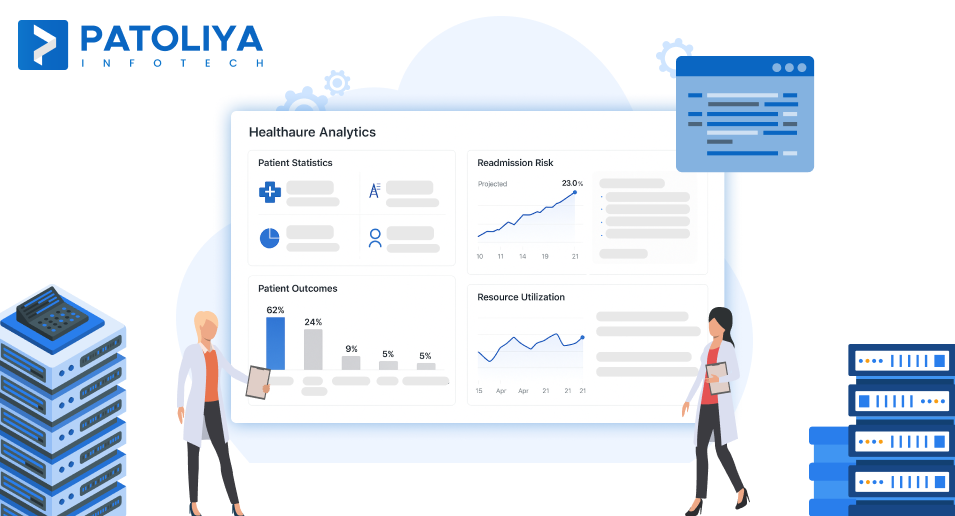
- Visual dashboards provide significant insights. These insights are relevant to operations, clinical outcomes, and performance metrics.
- This improves decision-making. These decisions can be used to optimize resource allocation and improve patient outcomes.
Patient Portals
- This is beneficial for patients to have secure access to their medical records. This could include medications, testing reports, and communication tools.
- This improves patient engagement and care plans. Also, reduces administrative calls.
Benefits of Healthcare SaaS Platforms
| Benefits | Core Advantage | How it Impacts Healthcare |
| Cost-Effectiveness | Reduces high upfront hardware and maintenance costs through a subscription model. | Provides advanced technology at a predictable and lower price point. |
| Improved Accessibility | Enables remote, anytime access to patient information, records, and services. | Improves the coordination of patient care and decision-making for mobile and remote employees. |
| Enhanced Efficiency | Automates workflows like scheduling and billing. This reduces manual administrative tasks. | Allows medical personnel to concentrate on patient care with the help of cloud-based healthcare software. |
| Scalability | Supports additional clinics, users, or data with ease and without requiring infrastructure upgrades. | Allows healthcare organizations to grow and adapt fast to changing demand with healthcare saas platforms. |
| Better Patient Care | Increases patient engagement, individualized treatment plans, and remote monitoring. | Improves overall satisfaction and patient outcomes. |
| Data Security & Compliance | This guarantees laws such as HIPAA and any laws unique to a given nation. | lowers the legal risk for providers and guards against breaches involving sensitive patient data. |
7 Steps to Develop a Scalable Architecture for HealthTech SaaS Applications
- Divide your systems into small, independent modules. A microservices architecture can be used for this. This guarantees that the other programs won't be impacted if one has problems.
- Create your platform with multiple infrastructures. This makes it easier to service multiple organizations using a single platform.
- Make sure your app integrates with other systems and conducts secure data transactions.
- Use a reliable healthcare cloud infrastructure. Search for compliant cloud systems for a healthcare saas platform.
- Ensure that all data is encrypted. Choose a platform that follows safety rules. Healthcare saas Apps provide patient information.
- Use modern technologies to integrate with existing systems. AI-based technologies provide predictive analytics. It also provides you with clinical support.
- Check that the program scales and adapts to the market. Create a backup and ensure that your software can handle pressure.
Keys to a Successful SaaS Solution for Healthcare
Compliance-First Design
- The system must follow national, GDPR, and HIPAA privacy laws.
- This avoids legal and financial problems. It also guarantees data security.
User-Friendly Interface
- An easy-to-use and effective design for staff, nurses, and physicians.
- keeps adoption rates high while reducing employee discomfort and training time.
Real-Time Analytics
- This provides immediate data insights and reporting capabilities.
- This helps fast decision-making and ongoing improvement of operations.
Seamless Interoperability
- The simplicity of connecting to and exchanging data with legacy systems that are already in place.
- This avoids data silos and makes it simple to integrate with current healthcare systems. This is essential for a healthcare saas platform.
Reliable Vendor Support
- Provides Continuous software updates, along with high-quality and quick support.
- Ensures system stability, fast fixes errors, and keeps the platform up to date with changing technology and laws.
Benefits of Healthcare SaaS Platform to Organizations
| Benefits | Organizational Impact | Key Results | Real-Life Example |
| Enhanced Accessibility | Allows remote collaboration and data access across teams and locations. | Improves service delivery and care coordination. | During an emergency weekend call, a doctor utilizes a mobile device to view a patient's electronic health record. |
| Cost Efficiency | Reduces capital expenditure by eliminating large upfront investments. | Replaces Capital Expenditure with a flexible and predictable Operating Expenditure.This means you only pay for the services you actually use. | A new clinic avoids buying a server and pays a monthly subscription for its practice management software. |
| Better Data Management | This provides centralized and secure data repositories. This data is hosted by the SaaS vendor on the internet. | Eliminates errors, increases storage capacity, and ensures legal compliance. | A hospital's lab, billing, and EHR data are all combined into a single cloud-based platform. |
| Greater Collaboration | This enables real-time collaboration and safe information sharing among providers. | Increases the speed of diagnosis and treatment planning. Better collaboration is the greatest feature of the healthcare saas platform. | Specialists in different places communicate fast via a HIPAA-compliant chat platform about a patient's complex condition. |
| Strengthened Security | Benefits from continuous monitoring and vendor security expertise. | This Minimizes data breach risks and ensures robust data protection. | The SaaS vendor automatically patches the software against a new cybersecurity threat. This protects all client data. |
| Better Patient Outcomes | Provides proactive, individualized care via quick data access and remote tools. | This improves patient happiness and clinical quality. | A Remote Patient Monitoring (RPM) platform alerts a nurse when a patient's vital signs decline. |
Challenges in Implementing Healthcare SaaS Platform
| Challenges | Description | Impact | How to Overcome It |
| Security and Compliance | keep up with national and international laws, like HIPAA. | If data is not properly managed, it might lead to concerns and the loss of patient trust. | Choose a vendor who uses encryption, multi-factor authentication (MFA), and security assessments. |
| Interoperability | Ensuring that all current clinical systems can easily connect and exchange data with the new SaaS system. Integration is important to look for in healthcare saas platforms. | Coordination and employee productivity are hampered by data silos and disjointed workflows. | Demand that the SaaS solution make use of contemporary industry standards such as HL7 and FHIR (Fast Healthcare Interoperability Resources). |
| Implementation & Integration | The challenging task of moving years' worth of patient data from outdated platforms to the new cloud environment. | Migration entails a significant risk of data corruption and can be expensive and time-consuming. | For a while, run the new and old systems at once. To reduce delay and risk, data accuracy is tested, and users are trained department by department. |
| Data Privacy | Protect sensitive health information (PHI) stored and transmitted via the cloud infrastructure. | Patient consent, secure access, and encryption are crucial necessities. | Maintain regular logs and audits for compliance. Get a cloud-based healthcare software provider with a Business Associate Agreement (BAA). |
| Ongoing Support & Maintenance | For continuing assistance, look for a third-party SaaS provider. Fetal feature enhancement and monitoring are also covered. Someone who fixes security vulnerabilities, too. | Downtime, bugs, and slow vendor responses can disrupt patient care. Continuous support is vital for healthcare saas software. | Select a system with an intuitive and user-friendly design (UX). This lowers the learning curve. And giving staff a lot of instructions. The vendor's continuous technical support is essential for long-term operations. |
Checklist for HIPAA Compliance in Healthcare SaaS Platform
Data Encryption
- Use AES-256-bit encryption for data at rest in storage. Use TLS or SSL for data in transit when accessed.
- This protects the integrity and security of ePHI from unauthorized access.
Multi-Factor Authentication (MFA)
- Require all users to validate their identity using two separate factors. This can be a password and a one-time code.
- This strengthens login security. This helps to prevent unwanted access. No matter if the password is stolen.
Access Controls & Logging
- This enforces role-based access. This means that only the relevant info is visible. Also, it keeps complete audit logs of every user activity and data access.
- Creates a permanent record for auditing and breach investigation, and restricts access to PHI to authorized staff.
Secure Cloud Infrastructure
- Just install the application on cloud infrastructure platforms. This establishes services in accordance with best practices and produces a setting that complies with HIPAA.
- Ensures that the underlying physical and technical infrastructure meets high security requirements. This is important for a healthcare saas platform.
Disaster Recovery & Backup
- Implement systems for automatic and continuous backups. This creates a clear disaster recovery plan to restore full service fast after any major incident.
- This guarantees data availability and integrity. This helps to reduce PHI loss caused by system failures or natural disasters.
Business Associate Agreements (BAA)
- Implement a formal contract like a BAA. This is between the healthcare organization and the SaaS vendor.
- The vendor is legally obligated to comply with HIPAA and secure PHI on behalf of the covered entity.
The Power of Analytics in Healthcare SaaS Platform
Data analytics is utilized in healthcare software as a service (SaaS) platforms. This is to turn operational and patient data into useful information.
Better Decision-Making
This gives information about treatment and resource allocation. This helps management and doctors in making better decisions.
Track Patient Outcomes
This measures treatment results and care patterns across large patient populations. This helps in discovering effective treatment practices and improving patient care.
Predict Health Trends
Predicts disease, risk factors, and equipment needs using machine learning and historical data. This enables proactive care models and resource planning, such as staffing and inventory.
Reduce Operational Costs
Finds revenue cycle inefficiencies and enhances supply chain or workforce management. Costs are reduced, and budget performance is enhanced. Reduction of cost is what is great about the healthcare saas platform.
Enhance Transparency
This generates graphical dashboards. This dashboard displays financial data, patient satisfaction ratings, and performance indicators. This encourages data-driven accountability and boosts stakeholder confidence.
Why Self-Service Analytics is a Game Changer
The basic idea of self-service analytics is to give managers and physicians instant access to their own data, such as patient trends or clinic efficiency. The IT department is not needed for this.
This is useful for creating dashboards, reporting, and analyzing data. Users do not require technical expertise for this. It gives frontline staff more authority.
There is a major decrease in the time between needing and receiving information. This makes it possible to make staffing, patient outreach, and clinical protocol changes fast.
Doctors may fast explore particular patient groups or therapy results. This improves the quality of care.
The Future of Healthcare SaaS Platforms
Greater use of AI and Automation in Clinical Workflows
SaaS platforms use AI-powered healthcare platforms to automate repetitive processes. This is like scheduling, documentation, and prior authorizations.
AI will help physicians make clinical decisions. AI increases efficiency by assisting with data analysis to suggest diagnoses and the best course of therapy.
Increased Adoption of Personalized Care Models
Future healthcare saas platforms will make use of patient data from wearables, lifestyle, and genomes. This contributes to truly personalized treatment.
Healthcare SaaS technologies will assist in creating customized drug schedules, risk assessments, and treatment plans. This moves the approach to care from a broad to a personalized one.
Growth in Global Interoperability and Secure Data Exchange
There will be a strong focus on seamless communication between systems. Healthcare saas software makes it possible for medical records to track a patient between states, providers, and even nations.
Stronger security protocols and new standards will make sure that this data interchange is fast and safe. This improves continuity of care and gets rid of data silos. Data security maintenance is a great feature of the healthcare saas platform.
How SaaS Helps Improve Patient Care
Doctors can track patient health from anywhere using mhealth apps that connect to the healthcare SAAS platform.
Records and medications are processed automatically. This ensures accurate and error-free care.
Doctors have fast access to all of your health information. This allows for a faster diagnosis and the best treatment option.
Employees spend less time scheduling and billing. They can concentrate on more important things.
Unlock Next-Gen Healthcare SaaS Solutions with Patoliya Infotech
Patoliya Infotech has vast expertise in developing Healthcare SaaS Platforms. This provides you with high-quality solutions that will become valuable assets for your business. Our expertise ranges from cloud architecture to the application of technology such as AI in mhealth apps. Contact us today.
Conclusion
A Healthcare SaaS Platform is a strategic decision to build safe, high-quality apps. Companies can reduce tasks by directly receiving regulatory and compliance-based cloud architecture from their vendors. Companies can save money on development and maintenance because they no longer have to build their own software. Because the organization relies on another cloud-naive platform, they obtain high-quality features straight from the provider via subscription.
These systems customize and secure healthcare by utilizing technologies such as cloud technology, artificial intelligence, and data analytics. This technology automates tasks while optimizing resource allocation. This contributes to fewer claim denials and more personalized treatment plans. This results in improved patient care.
When current technology is integrated with a healthcare SaaS platform, it allows for predictive analysis. This offers remote patient monitoring and great healthcare support.