Table of Contents
87% of Agile teams run Scrum, yet more than half switch frameworks or layer on a second one within the first year, according to the State of Agile Report 2024. I have seen this pattern across more than 200 client projects at IT Software development company. The problem is never the framework itself. It is teams choosing based on what they have heard of, not what their delivery model actually demands. Kanban Vs Scrum is one of the most consequential process decisions a software team makes, and most teams treat it like a coin flip.
The Agile methodology comparison mistake costs sprints, budget, and sometimes the entire project momentum. This blog covers Kanban Vs Scrum across structure, roles, workflow, metrics, and real team fit so you walk with a clear, defensible decision.
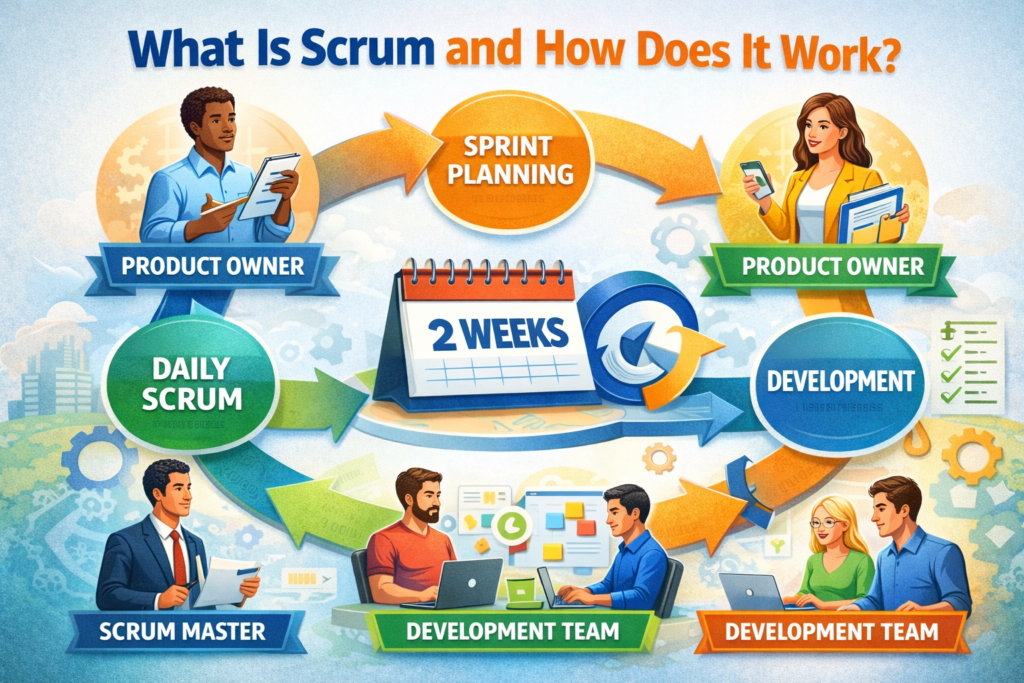
Three roles define every Kanban Vs Scrum decision involving Scrum. The Product Owner owns backlog management and sets sprint priority based on business value. The Scrum Master removes blockers and ensures ceremonies run correctly. The development team self-organises and delivers a working increment by the end of the sprint. No overlap and ambiguity.
A fintech company is using Scrum over Kanban Vs Scrum. The Product Owner prioritises all sprints every two weeks. The Scrum Master facilitates the daily stand-up meeting. In Agile methodology comparison, the development team delivers a tested feature by Friday. There is no confusion about who makes decisions and who is accountable for what.
65% of teams use two-week sprints, per the State of Agile Report 2024. Once the sprint starts, the scope is locked. New requests go to the backlog. Iterative delivery happens in fixed increments with velocity tracking, giving Scrum vs Kanban for software teams a reliable release forecast after three to five sprints. The table below maps every ceremony to its purpose and time investment so you can evaluate the real overhead in Agile methodology comparison before committing.
| Sprint Ceremony | Purpose | Time Box | Who Leads |
| Sprint planning | Select backlog items, commit to the goal | 4 hours | Scrum Master with Product Owner |
| Daily Scrum | Surface blockers, sync progress | 15 minutes | Scrum Master |
| Sprint Review | Demo working software to stakeholders | 2 hours | Development team |
| Retrospective | Improve the process with the team | 1.5 hours | Scrum Master |
The ceremony overhead is roughly 8 hours per two-week sprint. That is 10% of a 40 hour week. In Kanban Vs Scrum, that investment pays back through reduced rework and stakeholder misalignment. If your Scrum vs Kanban for software teams treats ceremonies as interruptions rather than tools, Scrum will fail regardless of how well you set it up.
Kanban is a pull-based Agile framework in Kanban Vs Scrum, built around a visual Kanban board, enforced WIP limits, and continuous flow. In Agile methodology comparison, Kanban has no sprints, required roles, or mandatory ceremonies. Work enters the system and moves forward when capacity opens. The framework improves your existing process without requiring you and Scrum vs Kanban for software teams to restructure around it.
In Agile methodology comparison, the Kanban board maps every stage of your workflow as columns in Kanban Vs Scrum. Tasks move left to right. Nothing advances until the column ahead has open capacity. Here is a real support team board from a Patoliya Infotech client running a SaaS product maintenance workstream.
| To Do | In Progress | In Review | Done |
| Bug #42 | Bug #39 | Bug #37 | Bug #35 |
| Bug #43 | Bug #40 | — | Bug #36 |
The moment In Review fills to its WIP limit of two, no new task moves from work in Progress. In Kanban Vs Scrum, the team resolves the review bottleneck first. This single discipline exposed a recurring QA handoff delay that had been invisible in Slack threads for six months. In Scrum vs Kanban for software teams, Kanban surfaces process problems the moment they happen, not at the next sprint review.
WIP limits make Kanban Vs Scrum a true workflow choice by turning boards into flow control systems. The Cumulative Flow Diagram reveals bottlenecks when bands widen. Cycle time and lead time replace velocity tracking, providing accurate operational insights by measuring actual delivery performance instead of planned commitments in Agile methodology comparison.
Scrum structures work into time-boxed sprints with a fixed start, a fixed end, and a committed scope in between. Kanban Vs Scrum at the workflow level is the difference between a scheduled train and a conveyor belt. Scrum drives delivery by schedule; Kanban drives delivery by flow. Your work pattern decides the fit.
In Agile methodology comparison, roles are the key difference in Kanban Vs Scrum. Scrum requires a Scrum Master and Product Owner before work begins, while Kanban uses existing structures. A team can start Kanban instantly, whereas Scrum needs alignment and setup, often delaying implementation.
Scrum protects sprint scope, pushing mid-sprint changes to the backlog and enforcing prioritisation. In Kanban Vs Scrum, Kanban allows continuous reprioritisation within WIP limits, letting urgent tasks flow without disruption. In Scrum vs Kanban for software teams, escalation frequency determines the right fit.
| Metric Type | Scrum | Kanban |
| Primary | Velocity tracking | Cycle time |
| Secondary | Sprint goal completion | Lead time, throughput |
| Planning input | Backlog management | Cumulative Flow Diagram |
| Forecast basis | Historical velocity | Throughput trend |
In Kanban Vs Scrum, metrics shape mindset. Scrum focuses on commitments, while Kanban focuses on flow. In Agile methodology comparison, select it based on how stakeholders measure success.
| Project type | Better framework | Why |
| Mobile app with launch date | Scrum | Fixed scope, fixed deadline, structured reviews |
| SaaS feature roadmap | Scrum or Scrumban | Defined releases with ongoing requests |
| IT support and bug triage | Kanban | Unpredictable volume, no fixed delivery window |
| DevOps and deployment pipelines | Kanban | Continuous flow with no sprint boundaries |
| Content and marketing operations | Kanban | High variety, fast turnaround, no sprint overhead |
| Enterprise platform with phased rollout | Scrum | Complex backlog management, stakeholder gates |
In Agile methodology comparison, New Agile project management teams benefit from Scrum’s guardrails, while experienced, self-organising Scrum vs Kanban for software teams gain more from Kanban’s flexibility. In Kanban Vs Scrum, Agile maturity matters as much as project type.
| Parameter | Scrum | Kanban |
| Workflow | Time-boxed sprints | Continuous flow |
| Roles | Product Owner, Scrum Master, Development Team | No prescribed roles |
| Handling Change | Sprint scope locked | Reprioritise within WIP limits |
| Primary Metrics | Velocity tracking | Cycle time, lead time |
| Secondary Metrics | Sprint goal completion | Lead time, throughput |
| Best for | Defined product builds, fixed releases | Support queues, operational and DevOps work |
| Ceremonies | 4 structured ceremonies per sprint | None required |
| Team Experience | New Agile teams | Experienced, self-organising teams |
| Adoption time | 4 to 6 weeks for competency | Days to implement, weeks to optimise |
| Stakeholder visibility | Sprint review every 1 to 2 weeks | Real-time Kanban board access |
The Kanban Vs Scrum decision depends on how work arrives, delivery timelines, and how much process change your team can absorb.
Choose Scrum in Scrum vs Kanban for software teams when work is defined, deadlines are fixed, and stakeholders need structured visibility, especially for teams building products through custom software development services. In Agile methodology comparison, it suits mobile apps, SaaS platforms, and enterprise rollouts. In Kanban Vs Scrum, Scrum also helps new Agile project management teams build discipline through sprints, improving predictability.
Choose Kanban in Agile methodology comparison when work is unpredictable, like support tickets, bug fixes, or content pipelines. In Kanban Vs Scrum, It allows continuous flow and frequent reprioritisation within WIP limits, without role changes or ceremony overhead.
| Decision Factor | Scrum | Kanban |
| Work Type | Predictable batches | Continuous flow |
| Delivery Style | Regular checkpoints | Flexible delivery |
| Team Experience | New team | Mature team |
| Workload Type | — | — |
| Mixed Workload Handling | Scrumban | Scrumban |
Scrumban combines Scrum structure with Kanban flow, making it ideal when Kanban Vs Scrum is not a clear fit. It retains sprint planning and retrospectives while adding WIP limits and continuous flow, enabling Scrum vs Kanban for software teams to balance roadmap stability with flexibility for mid-cycle changes.
In Agile methodology comparison, Scrumban is effective for hybrid workloads like feature development alongside bug queues or during transitions from Waterfall. It supports both structured planning and adaptive execution without disruption. In Kanban Vs Scrum decisions, when neither fits perfectly, Scrumban provides the balanced approach.
| Situation | Why ScrumBan Works | What to Keep from Each |
| Transitioning from Waterfall to Agile | Gradual shift without losing structure | Scrum ceremonies with Kanban board visibility |
| Long builds with shifting requirements | Planning anchors roadmap; flow absorbs change | Sprint planning with WIP limits |
| Feature work with bug queues | Separate WIP limits handle parallel | Velocity tracking with cycle time |
| Distributed teams | Async flow with structured sync points | Optional Daily Scrum with Kanban board |
The sprint reviews provide clients with structured visibility in Kanban Vs Scrum without having to monitor a Kanban board.
Velocity tracking for sprint three and onwards allows for release date forecasting for all Scrum vs Kanban for software teams.
WIP limits prevent bottlenecks from building up across parallel work streams.
Backlog management, lead time, and cycle time tracking can be done through Jira's Scrum and Kanban boards.
Agile project management coaching is included for all new team structures. This approach to framework adoption is implemented from day one.
Ready to implement the right Agile framework for your team? Connect with Patoliya Infotech to get a framework recommendation based on your actual delivery process.
Kanban Vs Scrum has the right answer for every team. It just requires you to look at your delivery model honestly before choosing. Scrum wins on structure, predictability, and stakeholder visibility for teams building defined products with release windows.
Kanban wins on flow efficiency, flexibility, and zero-friction adoption for Scrum vs Kanban for software teams handling continuous or unpredictable work. Scrumban wins when your workload genuinely spans both. The Agile project management market is projected to reach $96.28 billion by 2029 at an 18.5% CAGR, per Markets and Markets 2024. Getting Kanban Vs Scrum wrong gets more expensive every year you defer the decision. Let's look at your workflow and get this right.