Healthcare Supply Chain Management Software Solving Critical Gaps
Table of Contents
Healthcare supply chain management differs from normal supply chain management. When we hear the term supply chain, we immediately think of inventory control and cost-effectiveness. In healthcare, supply chain management deals with a large number of temperature-sensitive products. Healthcare supply chain software should be closely connected with individual hospital workflows because the urgency of each product differs.
Because healthcare inventory is used for medical treatments, compliance and regulatory criteria are high and must be met. Healthcare supply chain management is more complex since inventory changes over time, predictions must be accurate, and there are so many distributors, suppliers, hospitals, and other stakeholders to deal with.
What Is Healthcare Supply Chain Management Software?
Healthcare supply chain management software optimizes inventories, anticipates demand, coordinates procurement processes, and manages suppliers by combining real-time data and predictive analytics.
It is intended to manage necessary medical inventory while maintaining transparency, controlling expiration, and complying with healthcare laws.
All of this supports improved decision-making and patient care while assisting organizations in managing recalls, preventing stockouts, and maintaining audit readiness.
Why Healthcare Supply Chain Management Is So Important
Healthcare supply chain management is crucial because it protects patient care while keeping costs and risks under control. The procedure minimizes waste from outdated inventory, keeps healthcare operations running smoothly, and avoids shortages of life-saving supplies.
Key Roles in Healthcare Supply Chain Management
Clinical, operational, and financial teams may coordinate supply chain visibility, inventory management, and cost control throughout the medical supply chain with the help of healthcare supply chain management software.
Supply chain managers use this system to estimate demand, manage vendors, and plan inventories. This lowers waste, stockouts, and operational inefficiencies in the logistics of healthcare.
Procurement Teams use healthcare supply chain management solutions to improve hospital procurement. It uses automated procurement workflows to improve supplier collaboration and ensure contract compliance.
For the benefit of doctors and nurses, inventory management ensures that medical equipment is available at the service point. This promotes patient safety and continuity of treatment.
To manage budgets and improve financial performance across the healthcare supply chain, finance teams use cost analysis and cost optimization insights.
Executive dashboards are used by hospital leadership for performance tracking, risk management, and strategic oversight. This is making healthcare supply chain management a business function that can be measured.
Benefits of Healthcare Supply Chain Management Software
Inventory Visibility in Real Time
Healthcare supply chain management software ensures proper medical inventory management by providing real-time inventory visibility across departments and locations.
For instance, a hospital can prevent last-minute surgery delays through quickly identifying essential implants that are available in another unit.
Lower Operating Expenses
Improved demand forecasting and data-driven purchasing reduce procurement costs. this keep the healthcare supply chain from becoming overstocked.
For instance, a multi-facility hospital uses previous consumption data to manage inventory, which lowers emergency purchases.
Reduced Expiry Losses and Waste
In the medical supply chain, monitoring consumption trends and expiration dates reduces waste and safeguards finances.
For instance, by getting automated alerts before product expiration, a pharmacy department reduces the loss of expired medications.
Faster Cycles for Procurement
Hospital procurement procedures and automated replenishment speed purchases and minimize manual labor.
For instance, when stock reaches minimum levels, a supply team immediately reorders PPE without sending emails and following up.
Enhanced Coordination Across Teams
Clinical, operational, and financial teams can access shared data through the healthcare supply chain platform.
For instance, to match supply availability with budget planning, clinicians, procurement, and finance examine the same display.
Common Challenges the Healthcare Supply Chain Software Solves
| Challenge in Healthcare Supply Chain Management | Why This Challenge Exists | How the Software Overcomes It |
| Tracking inventories manually and using spreadsheets | Manual inventory updates are made after the fact. This results in outdated stock data, errors, and duplication. | Spreadsheets are replaced with real-time inventory management, which uses automated updates across departments and locations. |
| Overstocking of low-use items and critical supplies shortages | Poor stock prioritizing and reactive purchasing are caused by inaccurate usage data and predictions. | Usage analytics and demand predictions match inventory levels with actual clinical consumption. |
| Restricted access to point-of-care and bedside data | There are differences between inventory and reality because supplies utilized during care are not regularly recorded. | Continuous consumption is recorded at the patient's bedside using barcode scanning and patient tracking. |
| Slow workflows for approval and procurement | Purchasing and restocking are delayed via manual approvals, emails, and paper-based procedures. | Automated hospital procurement processes speed up approvals and begin quick replacement. |
| Poor supply, clinical, and billing system integration | Disconnected systems result in missed charge capture, manual auditing, and data silos. | Platforms for integrated healthcare supply chain management synchronize clinical records, billing information, and inventories. |
Best Practices for Healthcare Supply Chain Management
Establish Supply Availability as a Daily Operational Requirement
Things to do
- Prior to surgeries and risky procedures, make sure all necessary materials are on hand.
- During daily OR and unit check-ins, discuss the status of the supply.
- Flag missing and replace items early so the case can't be delayed.
- Examine supply-related interruptions each week to identify trends.
Actual instance
One hospital's OR schedule includes a simple supply ready check. The team took quick action if an implant or device was not available the day before surgery. before the day of surgery, eliminating last-minute solutions.
How this creates value
- Reduced the number of postponed and cancelled procedures.
- Surgeons and care teams become less irritated.
- OR scheduling becomes reliable and consistent.
Keep Track of Supply Usage Where Care Is Provided
Things to do
- Record supply usage during procedures, not at the conclusion.
- Eliminate manual data entry and paper lists.
- Connect used goods to the operation and patient visit automatically.
- All departments should document supply utilisation using the same methodology.
Actual instance
Nurses in the lab stopped entering supply data following operations. Time was saved, and accuracy was increased because supplies were immediately linked to each case and documented in real time.
Value produced
- Less rework and more precise billing.
- Complete insight into the actual cost of every treatment.
- Less paperwork and administrative work for medical professionals.
Use live inventory instead of outdated reports
Things to do
- Continually monitor inventory in care units, ORs, and storerooms.
- Adapt the minimum and maximum supply levels to the patient's demands and the location.
- Early detection of expiring things prevents them from becoming waste.
- Do not use weekly spreadsheets to manage inventories in healthcare supply chain management.
Actual instance
By relocating slow-moving products to high-use units before their expiration dates, one hospital was able to reduce the amount of expired supplies.
Value produced
- Decreased waste and needless expenditure.
- Making replenishment decisions quickly and confidently.
- Fewer last-minute and urgent orders.
Make an inventory plan based on the future
Things to do
- Schedule surgeries and anticipated admissions to determine stock levels.
- Inventory should be adjusted early for seasonal increases such as flu season, trauma surges, or spikes in elective cases.
- Observe things with inconsistent usage every day.
- Adopt more flexible safety stock standards.
Actual instance
Rather than depending on historical usage trends, one supply team raised implant supplies before an increase in orthopedic surgeries based on the impending OR schedule.
Value produced
- The ideal stock levels are without going too high.
- Fewer impulsive purchases.
- This increases confidence among Clinicians about the availability of supplies.
Minimize Variation in Supply Without Affecting Care
Things to do
- First, bring consistency to the supplies clinicians use most often.
- Use actual usage statistics to review physician preference items once a year.
- Replace rarely used items with alternatives that are medically similar.
- Keep exceptions to a minimum and justifiable.
Actual instance
One health organization reduced the number of glove and catheter alternatives by about 50%. Clinicians had options where it really mattered, but ordering and storage became easier.
Value produced
- Reduced expenses for procurement and purchases.
- Simpler inventory control.
- Staff will have less confusion at the time of care.
Create Supply Models Based on Service Lines
Things to do
- Make kits for ORs and interventional locations based on procedures.
- Depending on how they function, stock ICU, ED, and outpatient sites differently.
- Align inventory levels with established care pathways.
- When services grow and move to patient therapy, review supply requirements.
Actual instance
In order to free up space and streamline processes, an outpatient surgery center removed extra medical supplies and substituted them with kits tailored to individual procedures.
Value Produced
- Faster turnover of rooms.
- Reduced stock on the shelves.
- Effective workflow.
Assign an Executive Owner to Supply Chain Outcomes
Things to do
- Assign one executive responsible for the outcomes of the supply chain.
- In leadership meetings, review supplier KPIs regularly.
- Keep track of stock-outs, waste, and delays in addition to savings.
- Quickly settle disputes between operations, clinical teams, and finance.
Actual instance
Supply problems that used to take weeks to address were resolved in days once an executive owner was assigned.
Value produced
- Clear accountability.
- Quicker decision-making.
- Better alignment among teams.
Adjust Your Supply Plan When Care Models Change
Things to do
- Inventory should be recalculated when services are expanded.
- Make choices about purchases centrally while maintaining local supply.
- Do not duplicate the same merchandise at several locations.
- Examine the supply requirements for each new service launch.
Actual instance
The hospital used situation classification to plan supplies to prevent overstocking.
Value produced
- Efficient and regulated growth.
- Reduced spending on unnecessary supplies.
- Quicker preparation for new sites.
Key Factors Influencing Healthcare Supply Chain Management
Procedure complexity and patient health
- The seriousness of patients' diseases and the complexity of their operations have a direct impact on supply chain management. Accurate inventory control, specific implants, and zero tolerance for stock-outs are necessary for critical situations.
- The supply chain must be reliable and responsive, as processes become increasingly complex, to ensure safe patient care.
Mandates for compliance and regulatory requirements
- Strict regulations apply to supply chain management in the healthcare sector. This affects the tracking, storage, and sourcing of medical supplies.
- FDA rules, UDI tracking, expiration management, and recall preparedness are some of the compliance requirements. Strong compliance protocols reduce operational risk and promote a safe environment.
Geopolitical dangers and reliance on global suppliers
- Due to the quick effect of disruptions on operations, global suppliers are crucial to modern healthcare supply chain management. These disruptions can be manufacturing shortages, transit delays, and geopolitical crises.
- Companies that manage supplier risk and diversify their procurement are better able to maintain the sustainability of care.
Maturity of interoperability and data quality
- Effective supply chain management is built on accurate data. Decision-making is slowed down, and visibility is restricted by poor data quality, disjointed systems, and a lack of connectivity between procurement platforms, inventory management systems, and EHRs.
- Successful companies make investments in integrated systems that offer reliable and real-time data throughout the medical supply chain.
Alignment of clinician workflow
- When healthcare supply chain management integrates easily into clinical workflows, it is successful. Adoption declines, and errors rise when supply systems add steps for doctors or nurses.
- Efficiency, accuracy, and frontline trust are increased when supply systems are in sync with care.
Models of value-based treatment and payment
- Healthcare supply chain management is becoming important in controlling costs. This is improving outcomes as the industry moves toward value-based care.
- In order to minimize waste and promote consistent care delivery without adding to the administrative burden, providers must be aware of the cost per procedure.
- Decisions made in the supply chain have a growing impact on patient outcomes and financial performance.
Predictive Supply Chain Intelligence in Healthcare
Demand forecasting based on AI makes accurate predictions about future supply requirements by examining historical consumption, seasonal patterns, and procedure volumes. This enables healthcare companies to schedule inventory levels in response to changes in demand.
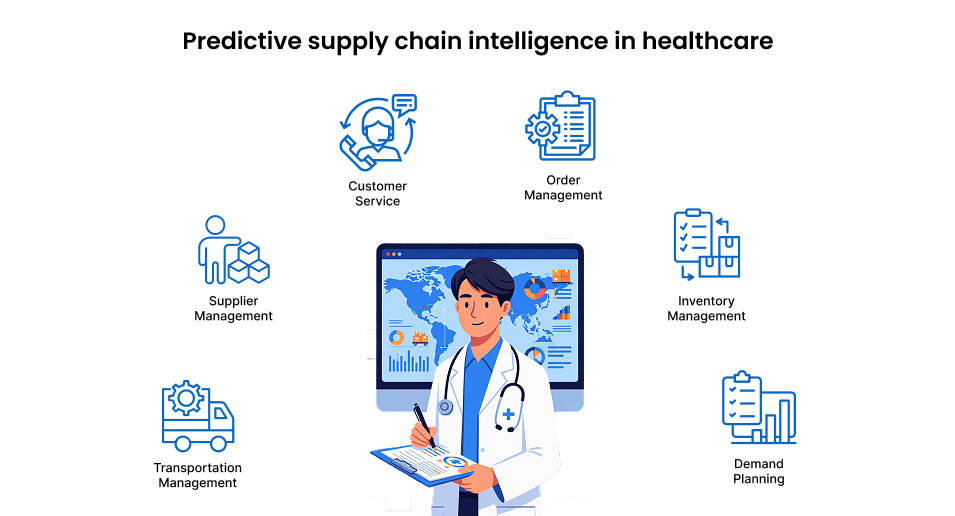
Predictive supply chain information has the ability to anticipate shortages before they happen. Supply teams can take action before stockouts affect patient care through early warning signs like increasing utilization and delayed supplier performance.
High-cost and essential commodities are stocked when inventory is matched with patient abilities and case mix. Inventory methodologies change as patient complexity rises. Throughout the medical supply chain, this is enhancing care readiness and cost control.
Key Metrics To Track for Effective Healthcare Supply Chain Management
Turnover of Inventory
This measures how effectively a hospital consumes and restocks medical supplies over a specified time frame.
High turnover indicates lean, demand-driven inventory in line with clinical use, whereas low turnover shows capital parked in storerooms.
Inventory Turnover Formula: Average Inventory Value ÷ Annual Cost of Goods Used
Useful insights:
Because demand is steady and predictable, high-use OR consumables like gloves and sutures usually aim for an inventory turnover of 8–10 times. Overstocking and subpar par-level settings result from these items' low turnover.
Because of patient diversity and surgeon preference, specialty implants have a lower turnover rate. Procedure delays are more likely when increased turnover is required.
By utilizing procedure-based kits and optimizing par levels, hospitals increase turnover. This keeps essential supplies on hand while facilitating the efficient flow of fast-moving commodities.
Stockout Rate
It measures the extent to which basic supplies are not available when the time comes, thereby creating risks in patient care and healthcare supply chain management.
Stock out rate = Number of stock out events ÷ Total supply requests × 100
Useful insights:
Best-performing hospitals aim to have less than 1% of the critical commodities that are needed in stock.
The best reasons that lead to stockouts include Unreliable suppliers, Inaccurate demand estimates, Inadequate real-time inventory visibility.
Some of these solutions include RFID tracking, automated replenishment alerts, and integrating the EHR system.
Cost of Expired Inventory
It is a direct cost because it quantifies the total cost of the materials that will expire before they are utilized.
Total Cost of Expired Products Over a Period = Value of Expired Inventory
Useful Insights:
Overstocking, poor FIFO (first-in, first-out) processes, and poor visibility in the department are sources of expired merchandise.
Automatic expiry notifications, inventory management, and interdepartmental sharing of stock go a long way in minimizing waste for hospitals.
High-end hospitals make sure that their expired items do not exceed 1% of the overall worth of their inventory.
Time taken for Procurement
This indicates the length of time it takes to fulfill the demand and the supply delivery time in a respective purchasing order.
Procurement Cycle Time = Delivery Date - Purchase Request Date
Useful insights:
The automated work processes reduce the cycle times to only four days, while the manual procurement processes can take a maximum of fourteen days.
There may be cycle times that are longer due to delays in contract searches, vendor choices, or approvals.
Vendor integration, automation, or pre-approved vendor catalogs can decrease procurement time by 50 to 70%. thus making sure that necessary supplies are available when needed.
ROI and Cost Savings
This associates the operational improvements with the results that can be calculated based on the monetary value derived from the investments made in the area of supply chain optimization.
Cost Savings = Baseline Spend - Optimized Spend
ROI (%) = (Net Benefit / Total Investment ) × 100
Useful insight:
Automation, contract compliance, demand forecasting, or standardization will bring about savings.
Leadership will find the justification for spending more money on technology and analytics through the ROI.
Role-Based Dashboards for Supply Chain Teams in Healthcare Supply Chain Management
Supply Managers
They can monitor and supervise supplier performance, expiry exposure, stockout risk warnings, and inventory turnover.
Why it matters: Supply managers can take early action with the use of dashboards. They can fix supplier problems, rebalance stock, and modify par levels, which helps to avoid interruptions.
Finance Teams
They can examine contract compliance, inventory value, expired stock costs, and supply initiative savings.
Why it matters: Supply decisions are tied to financial effects through finance dashboards. Without spending time on operational specifics, this involves increasing cash flow, cutting waste, and preserving margins.
Clinical Leaders
They can manage standardization insights, case delays brought on by supply problems, availability of essential materials, and the outcome impact.
Why it matters: Clinical dashboards emphasize care readiness, which ensures the timely availability of the necessary supplies. Also, it promotes reasonable standardization without restricting medical autonomy.
Common Implementation Pitfalls and How to Avoid Them in Healthcare Supply Chain Management
Inconsistent and Poor-Quality Data
The supply chains of healthcare pull data from several systems: ERP, EHRs, GPOs, and vendors. When item data is not accurate and consistent, the dashboards show wrong numbers.
How to avoid it:
- Clearly spell out who owns, the price, and usage statistics.
- Use consistent units of measurement and naming conventions.
- Automate the cleaning and validation of data.
- Start with a few reliable measurements and increase them.
Lack of Clinician Participation
The IT or supply chain departments often drive the development of dashboards without clinician input. Such viewpoints focus on inventory quantities and costs rather than clinical outcomes, process flow, or care readiness.
How to avoid it:
- Early involvement of clinicians in the design workshops of the dashboards.
- Correlate supply metrics to clinical impact: result variance, preference card accuracy, and case delays.
- Provide role-specific perspectives that respect clinical autonomy.
Data silos and system integration challenges
A disjointed ERP system, EHR system, inventory management system, and supply system hinder full visibility.
How to avoid it:
- Investment in interoperability standards, middleware, and APIs will help develop integrated architectures.
- Align demands for operations with data refresh cycle rates. These would range from real-time to daily and weekly cycles.
- Ensure the ability to view overall data for finance, clinical, and supply information.
- Validate integration using real-world integration processes.
A Dashboard That Fits Everyone
Employing a single visualization screen to help healthcare professionals, managers of supplies, or financial executives is overwhelming. Each group needs information differently and reaches different decisions.
How to avoid it:
- Build role-specific dashboards with personalized alerts and KPIs.
- Emphasize operational insights over comprehensive data views.
- Instead of using only statistics, use trends, standards, and predictions.
- Allow some flexibility while maintaining the same metrics.
An excessive focus on reporting
Dashboards explain what happened, but dashboards do not change behavior. Insights are dormant without alerts and recommendations.
How to avoid it:
- Incorporate predictive analytics such as expiry exposure, demand surges, and stockout risk.
- Use calls to action like standardize, renegotiate, rebalance, and reorder.
- Monitor decisions and results achieved to show value.
- Connect dashboards to management and operational workflows.
Lack of Training and Change Management
Poorly implemented dashboards with incorrect assumptions about customer use also fall short, as customers do not know how or why to use the dashboard. The level of resistance to change and the difference in the level of training given will also lower adoption.
How to avoid it:
- Role-specific training at the site should be scenario-based.
- Identify leaders for the Clinical, Financial, and Supply teams.
- Continuous improvement to dashboards in line with customer feedback.
The Future of Healthcare Supply Chain Management
Demand prediction with AI can predict usage trends, seasonal spikes, and clinical unpredictability, which helps plan inventory accurately.
Clinical, operational, and financial data will be combined with complete supply chain visibility. It provides management with immediate visibility from supplier to point of care and eliminates blind spots.
Teams have exception-based management with smarter automation and decision support. This provides recommendations and alerts for better decisions.
Organizations can protect patient care and financial stability by preparing for shortages, supplier breakdowns, and demand shocks. This emphasizes resilience and risk management.
In an increasingly complex environment, healthcare supply chains become strategic assets that promote safer treatment, higher profits, and overall system flexibility.
Conclusion
Healthcare supply chain management plays a very critical role in ensuring patient safety and cost-effectiveness in the healthcare industry. Inefficient or manual processes of managing the supply chain are prone to a high degree of risks of stockout, inventory overload, or delays in operations, which affect the services provided to the patients. The updated software in managing the healthcare supply chain ensures the availability of the right supplies at the right time and place.
With predictive intelligence, role dashboards, and automated processes, healthcare enterprise providers can now be proactive in preventing disruptions, increasing the readiness of care, and facilitating the support of a value-based care model. Organizations that view supply chain planning as a strategic enterprise benefit from a competitive advantage.
The right healthcare supply chain software improves the financial cycle and operational effectiveness. This becomes a long-term sustainable asset for businesses and helps in the optimal use of resources. We at Patoliya Infotech understand your workflow needs and concerns regarding medical software. We offer outstanding software solutions that satisfy your expectations.
FAQs
How can we improve inventory tracking in healthcare supply chain systems?
Inventory management in healthcare is becoming much easier with the introduction of automatic replenishment, healthcare utilization tracking, and the ability to scan items by barcode and/or RFID. These technologies allow for significant increases in inventory accuracy and inventory visibility.
How do I choose the best software provider for comprehensive healthcare supply chain management?
It's important to select a vendor that has a background working in the healthcare sector, has strong EHR/ERP integration capabilities, has a history of using predictive analytics, provides compliance assistance, and has a cloud-based architecture designed to grow.
Where can I find a review of healthcare supply chain management platforms?
You can find reviews about the various inventory software providers in various industry publications, analyst report reviews, peer recommendations from hospital networks, and healthcare IT review sites.
What are the advantages of cloud-based and bespoke supply chain tools or software for healthcare?
Inventory software providers typically have a proven history of providing their customers with real-time access, scalability, faster deployment times, reduced IT maintenance, and smoothness for specialized healthcare processes, etc.
How can automated procurement tools improve healthcare supply chain efficiency?
Inventory software solutions verify that the end user's contracts meet compliance requirements, speed up the approval process, eliminate manual tasks for the end user, and auto-reorder items based on actual usage.
How do I identify vendors who integrate supply chain management with electronic health records?
When evaluating an inventory software vendor, look for established vendor partners who have demonstrated success in effective EHR integrations, APIs, compatibility with standards, and on-the-job deployment of inventory software in healthcare organizations.
What are the best techniques for reducing waste in healthcare supply chains through technology?
To avoid overstocking, keep track of expiration dates, usage trends, implement FIFO protocols, and use predictive analytics.
What is healthcare supply chain management?
From manufacturers to hospitals and clinics, the healthcare supply chain is the system that ensures the availability of pharmaceuticals, medical equipment, and supplies at the right time and place to support patient care.
What are a supply chain manager's duties and responsibilities?
They deal with vendors, keep expenses under control, forecast demand, maintain inventory, and ensure that supplies are available for clinical operations.
Which 5 roles are essential to the supply chain?
Planning, procurement, production, delivery, and returns.
What kinds of supply chains are there?
Supply chain models include continuous flow, efficient, fast, agile, custom-configured, and flexible chains. Others are lean, global, e-supply chain, push and pull supply chain models.
In supply chain management, what are the 5 Cs?
Company, customers, competitors, collaborators, and context.
Which 7 components make up supply chain management?
Planning, procurement, production, shipping, data exchange, inventory control, and returns.
What are the supply chain management's 5 pillars?
Cost effectiveness, agility, resilience, visibility, and teamwork.