Table of Contents
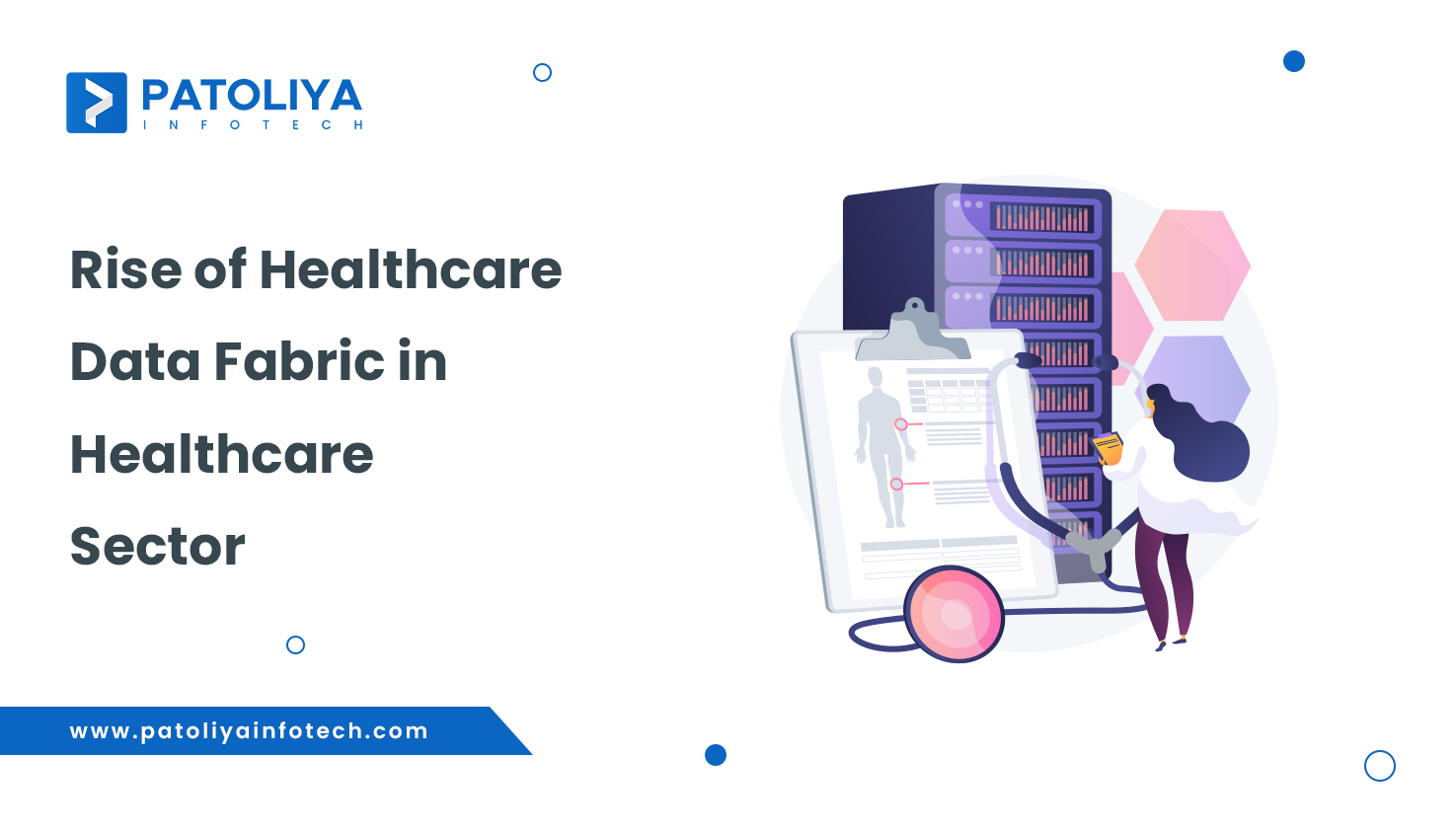
The healthcare industry is rapidly digitizing, yet records are still scattered, divided, and misused. Large volumes of data are generated daily by digital health records (EHRs), imaging systems, wearable technology, and 1/3-birthday celebration programs. Nevertheless, many health systems find it difficult to support interoperability within this ecosystem or to get timely information. That need is met by Healthcare Data Fabric.
The Healthcare Data Fabric provides a single structure by integrating diverse records resources across cloud, on-premises, and edge structures. Rather than transferring data to a primary repository, it provides safe, instant access to data wherever it is kept. Instead of being mostly technical, this conversation is strategic in nature.
Companies will have to satisfy the increasing demands of regulatory compliance, predictive analytics, and tailored care as 2026 draws near. Better patient outcomes, operational efficiency, and innovation in digital health today rely on a contemporary data strategy based on the Healthcare Data Fabric.
The definition of "Healthcare Data Fabric," its current significance, and its future implications for healthcare delivery will all be covered in this handbook.
The Healthcare Data Fabric architecture solution eliminates the requirement for healthcare data to be centralized in one area by enabling seamless integration and connectivity across many systems, locations, and formats.
Unlike conventional data lakes or warehouses, a data fabric makes a single data layer using metadata, AI-driven integration, and intelligent data pipelines. Whether data is housed in external databases, patient apps, imaging systems, or electronic health records, healthcare companies can obtain, manage, and analyze it instantly.
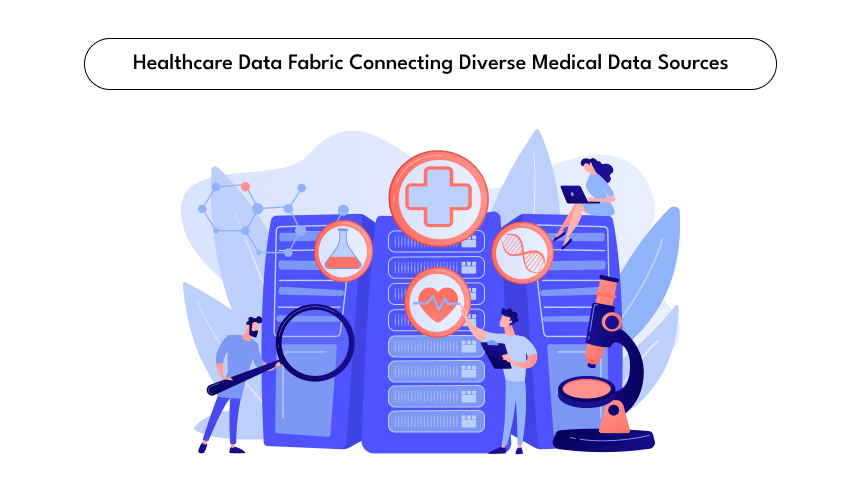
The complexity of healthcare systems is widely accepted. Data related to clinical, financial, operational, and user-generated patient information is separated. A data fabric can help unify this disjointed environment by enabling safe data exchange between organizations and care teams, enabling AI-driven decision-making, and providing a 360-degree perspective of patient health.
The Healthcare Data Fabric is a framework that, in a regulated, data-intensive industry, promotes agility, compliance, and better outcomes.
Though they are often mentioned together in discussions of digital transformation, Healthcare Data Fabric and Data Mesh are two separate approaches to data architecture with different implementations and philosophies.
Data Fabric's primary focus is on technology and integration. It uses automation, artificial intelligence, and metadata to create a single layer across all data sources. This architecture eliminates the need to duplicate data so that healthcare organizations can use, manage, and query it across distributed environments.
The healthcare sector benefits from faster access to patient histories, seamless provider interoperability, and scalable analytics—all while maintaining privacy and control.
Data Mesh is an organizational and cultural shift in addition to a technical one. Data ownership is distributed to domain teams (e.g., cardiology, oncology, and billing) by treating data as a product that each team manages.
Large hospital systems with separated departments may find this useful in the healthcare sector, but it may require extensive coordination and governance to ensure consistent data security and standards.
While Data Mesh may encourage large-scale innovation, for most health organizations in 2025, Healthcare Data Fabric is the more practical and scalable choice. Without requiring a total organizational overhaul, it addresses the urgent problems of data agility, interoperability, and AI readiness.
In short:
Although they are often mentioned together in discussions of digital transformation, Healthcare Data Fabric and Data Mesh are two separate approaches to data architecture with different implementations and philosophies.
Technology and integration are key components of Data Fabric. It uses metadata, AI, and automation to create a single layer that spans all data sources. This architecture enables healthcare organizations to use, manage, and query data in distributed environments without duplicating it.
In the healthcare sector, this translates into faster access to patient histories, seamless provider interoperability, and scalable analytics—all while maintaining privacy and control.
Data Mesh is a cultural and organizational shift rather than merely a technical one. Data ownership is distributed to domain teams (e.g., cardiology, oncology, and billing) by treating data as a product that each team manages.
In the healthcare sector, this may work well for big hospital systems with separated departments, but it may require a lot of governance and coordination to ensure in keeping data security and standards.
While Data Mesh may encourage large-scale innovation, most health organizations in 2025 will find Healthcare Data Fabric to be a more viable and scalable alternative. It resolves the urgent problems of interoperability, data agility, and AI readiness without requiring a total organizational overhaul.
In short:
Healthcare organizations are facing extraordinary difficulties due to the mandates of regulations, the increasing volume of data, and the urgent need for patient-centered, coordinated care. Why Healthcare Data Fabric is now important is explained by the following:
These demands, rather than being worries for the future, are driving the digital transformation of healthcare in 2026 as urgent necessities. The Healthcare Data Fabric enables today’s data-driven care to be more intelligent, faster, and secure.
A strong healthcare data fabric relies on several key elements cooperating to ensure seamless, secure, and intelligent data management.
The fundamental element is the seamless integration of data from various healthcare sources, including electronic health records, medical devices, imaging systems, insurance claims, and patient applications. Large datasets can be utilized instantly without requiring physical relocating or replication thanks to integration pipelines, which normalize and harmonize this data in real-time.
Data location, format, lineage, and relationships are described by metadata, which serves as the fabric's "index." Using this metadata, knowledge graphs link patient records, diagnoses, treatments, and results to create a semantic map of healthcare concepts. In addition to ensuring that clinical meaning is maintained and available, this layer drives contextual data discovery.
Data cataloguing, anomaly detection, and predictive analytics are automated by sophisticated AI and machine learning engines integrated into the fabric. By turning raw data into actionable insights, these capabilities speed up clinical decision-making, population health management, and personalized medicine.
Data in healthcare requires strict security and obedience to regulations. Role-based access controls, data masking, audit trails, and encryption are all enforced by the data fabric. While preserving patient privacy and organizational accountability, governance tools guarantee compliance with HIPAA, GDPR, and other new laws.
Real-time, secure, and intelligent data access—the foundation of next-generation digital health—can only be provided by Healthcare Data Fabric thanks to its architecture.
There are particular difficulties with healthcare data that may prevent innovation and high-quality treatment. Here's how Healthcare Data Fabric tackles the main problems:
Numerous, frequently incompatible, and compartmentalized systems—such as EHRs, labs, imaging, and billing—display healthcare data. This fragmentation makes it more difficult to coordinate patient care and delays insights.
How Fabric Helps: By avoiding expensive centralization, Healthcare Data Fabric establishes a single data layer. It breaks down silos and maintains source system autonomy by facilitating smooth interoperability and immediate data access across systems.
Strict laws like the CCPA and HIPAA require that sensitive health data be handled securely, with role-based access and thorough audit trails.
How Fabric Helps: Compliance controls are directly incorporated into data workflows by the security and governance layer of the fabric. It protects privacy and allows controlled data sharing by enforcing encryption, access controls, and data masking.
To make timely decisions, clinicians and care teams need the most recent patient data; however, bottlenecks are caused by slow integrations and batch data transfers.
How Fabric Helps: Faster diagnosis, treatment, and care coordination are made possible by Healthcare Data Fabric's ability to enable real-time, federated queries across all data sources.
For healthcare organizations looking to improve outcomes, cut costs, and innovate with confidence in 2026, addressing these issues through Healthcare Data Fabric is important.
The real benefits of implementing a healthcare data fabric push the transformation of digital health in 2025 and beyond.
To provide a thorough, 360-degree picture of every patient, Healthcare Data Fabric dismantles data silos. Real-time access to consolidated health records, lab results, imaging, and social determinants of health allows clinicians to make more accurate diagnoses and create individualized treatment plans.
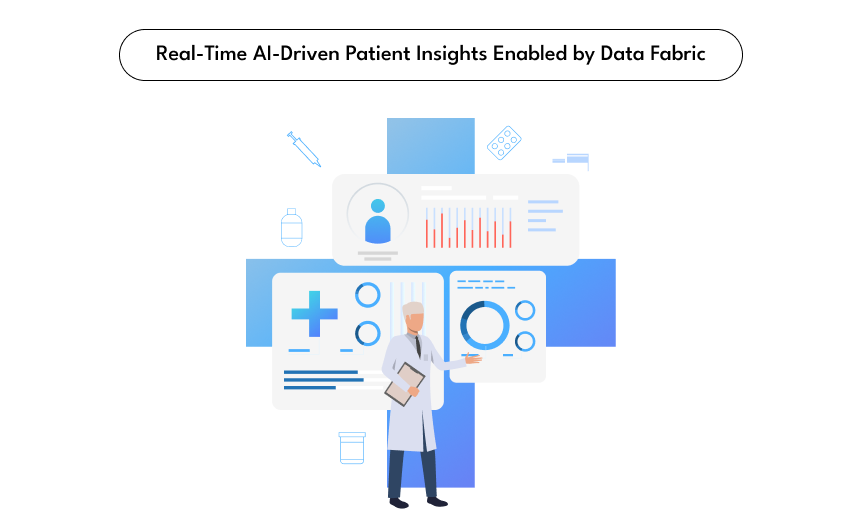
Data fabric speeds up AI model deployment and training by facilitating easy access to integrated, high-quality data. This makes it possible for healthcare institutions to use predictive analytics for risk assessment, population health management, and early disease detection, all of which improve results while lowering expenses.
The fundamental architecture of Healthcare Data Fabric incorporates security, privacy, and compliance. Organizations can safely share data across teams and partners with granular access controls, audit trails, and data lineage, fostering trust with both patients and regulators.
With these advantages, Healthcare Data Fabric is positioned as a key facilitator of safer, more intelligent, and more effective healthcare delivery in the data-driven environment of today.
Healthcare Data Fabric helps organizations extract value from complex data environments by enabling transformative applications throughout the healthcare landscape.
Healthcare professionals can create individualized treatment plans for each patient by combining clinical, genomic, behavioral, and social data. This information can be accessed easily and instantly thanks to data fabric, which enhances patient engagement, adherence, and results.
Data fabric speeds up patient recruitment, monitoring, and analysis by making it easier to aggregate disparate datasets, such as those from wearable technology and electronic health records. This enhances data quality and compliance while cutting trial expenses and schedules.
To maximize resource allocation, cut waste, and boost financial performance, operational data from supply chains, staffing, and billing can be combined and examined. Proactive decision-making is made possible by real-time data access, which reduces administrative burdens.
Data fabric is used by insurance companies to immediately cross-reference billing information, medical records, and claims. AI-powered analytics minimize losses and guarantee compliance by spotting variations and possible fraud early.
These use cases show how the Healthcare Data Fabric fosters creativity, effectiveness, and confidence amongst healthcare stakeholders.
| Feature | Healthcare Data Fabric | Traditional Data Solutions |
| Data Integration Approach | Federated, connects data across systems in real-time | Centralized, requires data movement and storage |
| Data Access Speed | Real-time, on-demand | Batch-based, often delayed |
| Scalability | Highly scalable, cloud-native, and adaptive | Limited scalability, often resource-intensive |
| AI/Analytics Readiness | Built-in support for AI/ML pipelines and predictive analytics | Requires additional layers for AI/ML |
| Governance & Compliance | Embedded, consistent across all sources | Fragmented, often requires manual policy enforcement |
| Operational Flexibility | Dynamic, supports agile workflows and rapid innovation | Rigid, slower to adapt to change |
| Maintenance Overhead | Lower, with automated orchestration and metadata management | Higher, due to manual data pipeline maintenance |
| Best Use Case | Complex, distributed healthcare ecosystems needing real-time insight | Static reporting and historical data analysis |
Many people wonder if it's better to use a data mesh or a data fabric approach as healthcare organizations update their data infrastructure. The response is dependent upon operational objectives, use cases, and organizational maturity.
✅ Best for most healthcare providers, payers, and research institutions
A technology-first approach that doesn't require significant changes to organizational structure is provided by Healthcare Data Fabric. It's excellent at:
Perfect for health systems looking for minimal disruption, quick interoperability, and AI readiness.
✅ Suited for large, data-mature healthcare enterprises
By treating data as a product that is managed by distinct domains (such as departments or business units), Data Mesh places an emphasis on decentralized ownership. It functions best when:
Perfect for big health systems with a strong data culture and sophisticated data capabilities.
Healthcare Data Fabric will change to satisfy new needs as the industry continues its digital transformation. The next step is as follows:
The Healthcare Data Fabric is positioned by these trends as the strategic cornerstone of the upcoming digital health generation, not just as a solution.
The medical field is undergoing a major shift. Despite increasing clinical innovation, regulatory pressure, and patient expectations, many healthcare organizations continue to use antiquated, disjointed data systems. That is no longer viable.
Healthcare Data Fabric offers a modern solution to this challenge:
Data is a key advantage in 2026, not just infrastructure. The architecture that unlocks its full potential is Healthcare Data Fabric.
It is time to switch from conventional, inflexible data stacks to a flexible, intelligent data fabric strategy if any of these apply to you.