Table of Contents
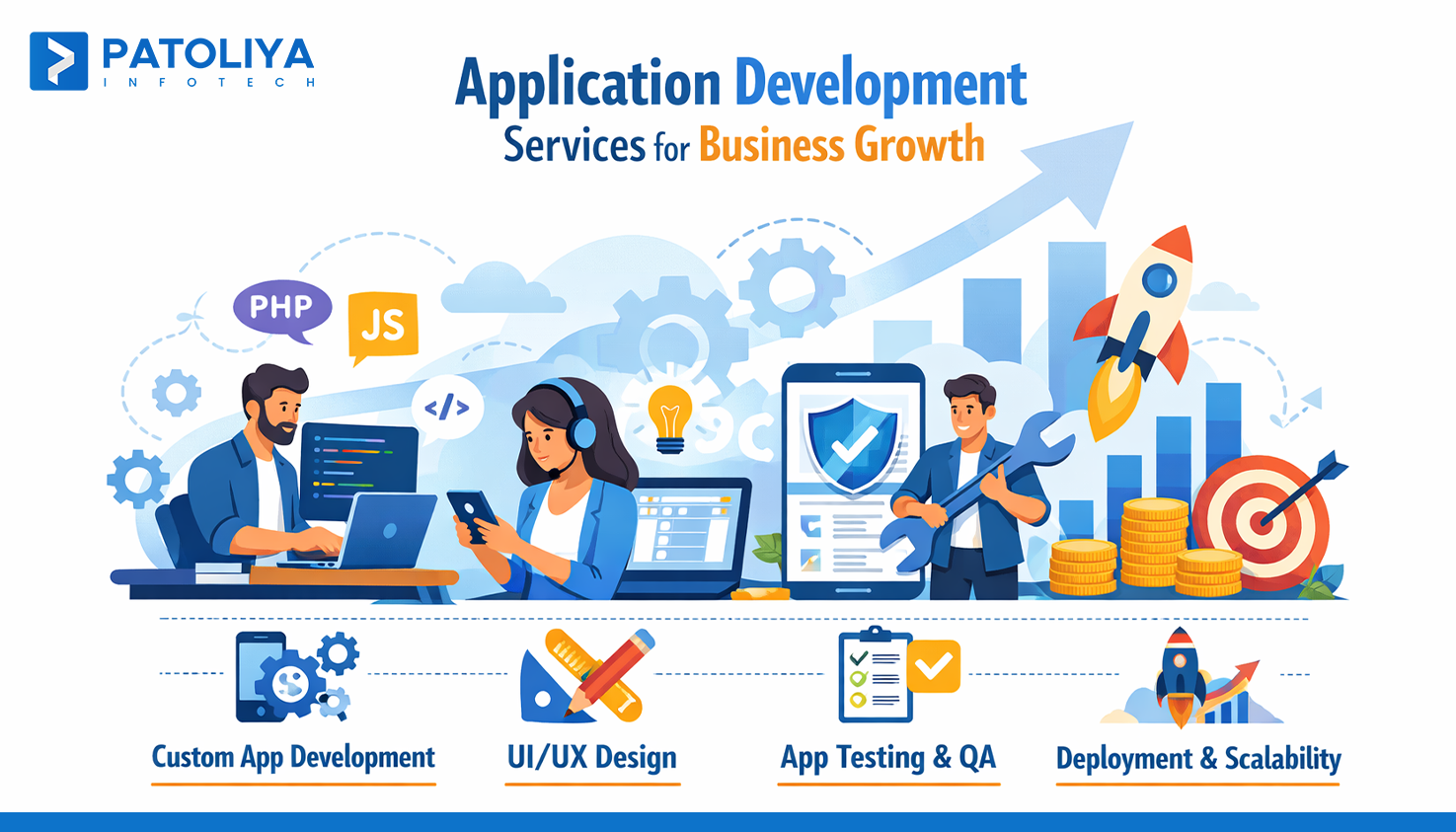
Application development services are essential in modern digital transformation as businesses require customized software solutions rather than generic platforms. Business application development and enterprise application development are growing rapidly due to the increasing demand for automation, data-driven decision-making, and system integration.
Organizations now depend on specialized software to manage operations, customer interactions, and internal workflows efficiently. As business environments become more complex, scalable, and secure, software systems are necessary to support long-term growth. Application development services help companies build flexible platforms that adapt to evolving technology standards, regulatory requirements, and multi-user operational environments while maintaining performance, security, and reliability. Many organizations partner with a reliable custom software development company to ensure long-term scalability, architectural clarity, and technical alignment.
Application development services support the creation of tailored software solutions for business workflows. This includes:
Application development services help organizations build scalable digital platforms aligned with operational goals. Business application development and enterprise application development are often part of advanced customization strategies for long-term technology planning.
Companies choose custom software solutions when commercial tools fail to support specialized operational requirements, regulatory compliance, or automation needs. Application development services are preferred for achieving workflow optimization, centralized data control, and sustainable digital expansion across departments and enterprise environments.
Application development services focus on building secure and scalable software for large organizations. This includes:
Application development services help organizations implement business application development and enterprise application development strategies for operational continuity, security compliance, and workflow automation.
Enterprises choose application development services for ERP system management, centralized financial processing, and workforce operation platforms. Common use cases include customer relationship management, supply chain coordination, regulated healthcare environments supported by structured healthcare software solutions, and large-scale analytics dashboards that support real-time decision-making across corporate environments.
Application development services for web platforms focus on responsive interface design, secure backend integration, cloud hosting, API connectivity, and performance optimization. It also supports application lifecycle management for continuous software improvement and maintenance. Structured web application development services ensure scalable backend connectivity and secure cloud deployment for long-term performance.
These solutions help organizations implement business application development and enterprise application development strategies for scalable digital platforms with strong authentication security and database management.
Organizations choose web-based application development services to improve accessibility, enable centralized software updates, and support SaaS delivery models. These solutions ensure global availability, system reliability, and simplified software management across business operations.
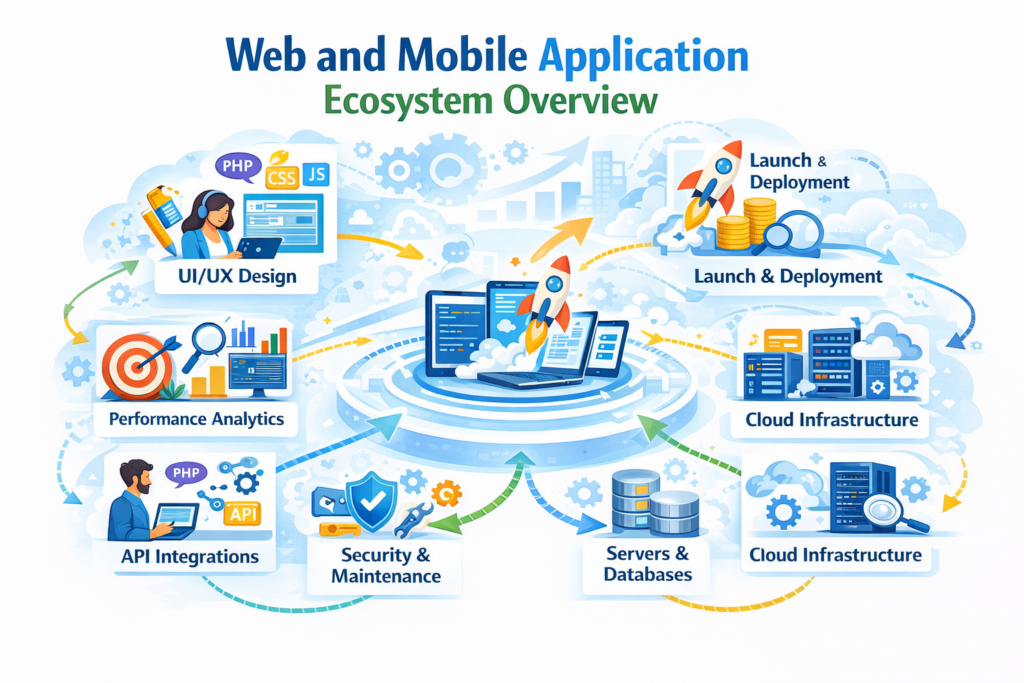
Application development services for mobile platforms deliver secure, high-performance applications for iOS and Android ecosystems. Key focus areas include cross-platform development, API integration, authentication security, and optimized user experience. These solutions support software application development and enterprise application development. For instance, Retail and service companies use mobile application development services to launch customer apps for digital interaction.
Mobile application development services are ideal for customer engagement platforms, workforce mobility applications, and real-time service delivery systems requiring secure connectivity, high performance, and seamless multi-device operation.
Application development services support legacy system transformation through application modernization services. This includes code refactoring, cloud migration, security enhancement, and performance optimization. Organizations use modernization to extend software lifespan while improving scalability and system compatibility with new technologies. Legacy transformation initiatives are often supported by scalable cloud service solutions that enable secure migration and infrastructure modernization.
Legacy platforms often create operational inefficiencies, slow processing speed, and high maintenance costs. Application development services help businesses overcome integration challenges and reduce dependency on outdated infrastructure. This is ensuring smoother digital transformation and long-term system reliability. Modernization also improves security compliance and system performance.
Application development services provide secure and scalable system communication through API development services, supporting business application development needs. These services enable a standardized API architecture for reliable data exchange between platforms and systems.
Common scenarios include CRM synchronization, payment gateway integration, and third-party service connectivity. APIs are widely used to integrate eCommerce platforms with inventory tools, mobile applications with backend databases, and enterprise software with analytics dashboards to enable smooth business operations and real-time information sharing.
Application development services supports seamless system connectivity by delivering business application development integration solutions. Services include:
Enterprises adopt integration services to improve operational visibility, reduce manual data handling, and support unified digital ecosystems. Integrated platforms enhance productivity, ensure consistent information flow across departments, and improve real-time collaboration across business systems.
Application development services enable scalable enterprise application development through a microservices development architecture. This approach divides software into independent modules that communicate through lightweight APIs, improving deployment flexibility and fault isolation.
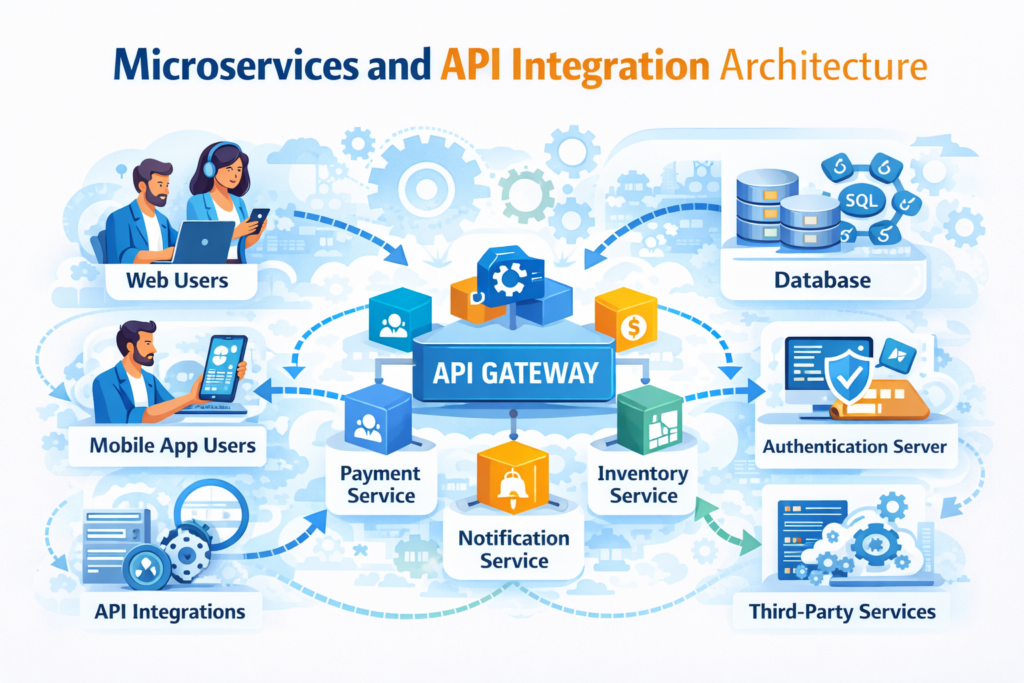
Microservices architecture supports high-performance system design for growing digital workloads. Many engineering teams follow established microservices architectural principles to improve service independence, resilience, and deployment flexibility. Organizations adopt this model to improve system responsiveness, accelerate feature updates, and maintain security compliance across distributed environments.
Application development services accelerate business application development using low-code platforms for rapid solution delivery. This approach supports legacy application upgrade by simplifying system modernization and reducing coding complexity.
Low-code development enables drag-and-drop interface design, workflow automation, and faster deployment cycles, helping organizations improve development speed, optimize operational cost, and maintain scalable application performance.
Application development services provide continuous system reliability through enterprise application development support after deployment. Services include performance monitoring, bug fixing, security updates, and application integration services to maintain system connectivity and functionality across platforms.
Post-launch maintenance ensures system stability, improves user experience, and reduces operational risk by addressing performance issues, updating security layers, and supporting uninterrupted business operations, such as banking transaction workflows and compliance driven processing systems.
Application development services are executed through a structured delivery approach focusing on clear requirement understanding and strong architecture planning for business application development projects. The process begins with detailed business requirement analysis to ensure development aligns with operational objectives.
Architecture-first design ensures systems remain flexible, secure, and extensible over time. Scalable application solutions are planned to handle future workload expansion without major rework. Modern engineering practices, such as low code application development, are selectively used to accelerate controlled development while maintaining quality standards.
The company follows disciplined application lifecycle management covering design, development, testing, deployment, and post-launch optimization, enabling reliable support for both enterprise platforms and growing digital products.
Choosing application development services requires alignment with business application development objectives and long-term digital strategy planning. Organizations must evaluate solution inclusions carefully to avoid scope ambiguity, unexpected cost escalation, and performance limitations. Using scalable application architecture ensures systems can adapt to future operational demands while supporting business growth. Well-structured development models improve reliability, maintainability, and platform extensibility. With the help of enterprise application development, companies achieve sustainable technology investment and efficient digital transformation outcomes.
Application development services deliver customized software solutions. Small businesses focus on business application development, while large enterprises use scalable, secure platforms for digital operations and workflow automation.
Enterprises evaluate complexity, cost, and delivery speed before selection. Application dev services help balance flexibility and efficiency through tailored development and low-code deployment strategies.
Modernization works best when legacy systems function but need performance, security, or integration improvement. Application dev services upgrade infrastructure while supporting enterprise application continuity.
Maintenance includes monitoring, bug fixing, updates, and performance optimization. Application dev services ensure system reliability after deployment.
Integration services automate data exchange across platforms, supporting enterprise workflows and reducing manual processes.
Scalable architecture supports growing workloads, maintains performance stability, and allows businesses to expand technology capabilities without major system redesigns. It ensures reliable operations and future-ready system performance.