API-First Approach In Healthcare Software
Table of Contents
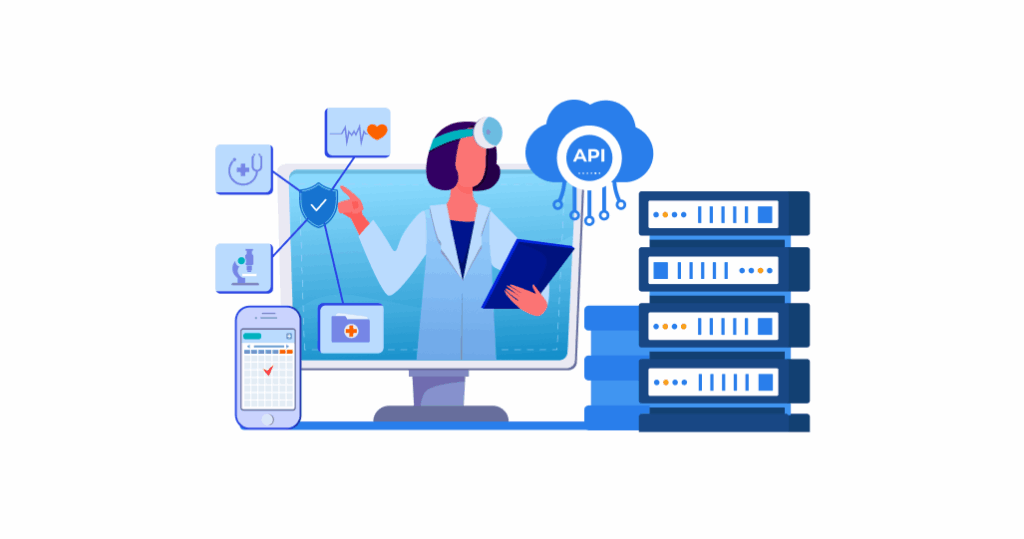
API healthcare software helps multiple systems to communicate with one another. This means saving information interactions between two or more systems simultaneously.
How do we create a blueprint for a house before construction? Similarly, an API is a code-based solution that we create before developing the full software. In the home, we decide which rooms connect to which parts of it. In healthcare software, we create APIs to determine which systems will communicate with which.
API development makes use of technology such as RESTful APIs and data standards like FHIR (Fast Healthcare Interoperability Resources). This helps with the development of a standard language for healthcare data exchange.
A medical record is stored in an EHR. While laboratory diagnosis is handled by another department. The API facilitates the connection between the EHR and the lab department. Also, the transfer of this information to the individual's mHealth app. This helps secure data transactions while also improving data accuracy in the quickest way possible.
What Is An API Healthcare Software?
In traditional methods, people write software first and then connect systems with APIs based on the requirements. Then the API-first strategy is introduced.
The API-first strategy involves making a software blueprint before developing code for software application development.
API is a term for "application programming interface." This includes standards and coding protocols for software applications. This helps the program to communicate with other systems.
When the complete software is built using these API codes and connectivity. We can call it API healthcare software.
Why An API-First Approach Is Essential In Healthcare
The API first strategy is critical for interconnectivity. One patient's information is stored in several departments. Patients must go to each department, and transfers are slow and insecure. What if it combines into one automatically? So, this is what API software does in healthcare.
Healthcare is a complex ecosystem of systems. These are the sections that API healthcare software communicates with one another.
- Electronic Health Records (EHRS/EMRS) → Accessing Patient Demographics, Retrieving Clinical Notes, Querying Lab Results, And Updating Patient Information.
- Patient Portals & Mobile Apps → Patient Registration And Account Management, Appointment Scheduling And Reminders, Secure Messaging, Accessing Medical Records, And Processing Bill Payments.
- Telemedicine Platforms → Programmatic Creation Of Video Consultation Rooms, Secure Communication Features, Integration With Scheduling Systems, Data Logging.
- Wearable Health Devices → Collection Of Real-Time Biometric Data, Synchronization Of Activity Data, Secure Transmission Of Data.
- Lab & Imaging Systems →ordering New Tests or Imaging Studies, Receiving and Pushing Results To The Provider and Patient, and Managing the Status of Orders.
- Billing & Insurance Processors → Checking A Patient's Insurance Eligibility, Submitting Claims Electronically, Processing Payments, And Tracking The Status Of Claims.
- Pharmacy Management Systems → E-Prescribing, Checking For Drug Interactions And Allergies, Automating Prescription Refill Requests, And Inventory Management.
Technologies For API Healthcare Software
RESTful APIs
- This is a common architectural design for API healthcare software development.
- This uses protocols such as HTTP to allow different systems to communicate with one another.
- In healthcare, RESTful APIs are used to get a patient's medical history from an Electronic Health Record (EHR) system.
FHIR (Fast Healthcare Interoperability Resources)
- FHIR is based on HL7. This includes features for observation, such as a blood pressure reading or medication.
- This is widely used for data interpretation and analysis in LABs and hospitals.
JSON and XML
- JSON (JavaScript Object Notation) is built for web application development. FHIR-based APIs use JSON for development.
- XML (Extensible Markup Language) is used to create and transfer data. This is useful for generating tabs or features.
OAuth 2.0 and OpenID Connect
- These are the security protocols for API healthcare applications.
- OAuth 2.0 gives patients secure authorization to access information without a password.
- OpenID Connect is an identification layer built on top of OAuth that validates the user's identity. Both ensure the security and privacy of critical information.
Key Benefits Of API Healthcare Software
| Benefits | Description | Examples |
| Smooth Data Exchange | Helps the safe and easy movement of data across various healthcare systems. The global standard for it in APIs is called FHIR (Fast Healthcare Interoperability Resources). | A doctor can use their Electronic Health Record (EHR) system to instantly view a patient's lab results from an outside laboratory, prescription history from a pharmacy, and many other things. It all came together naturally to create a single, general view. |
| Integrate Privacy & Security | Gives security and compliance with regulations such as HIPAA and GDPR at the very start of the design process. Use industry-standard protocols such as OAuth 2.0 and OpenID Connect to build a secure gateway for data access and user authentication. | When a patient portal app requests a user's health information, the API does not provide access. It first uses procedures to verify the patient's identification and rights, then encrypts the data and generates a safe, logged transaction. |
| Faster Growth | Supports multiple teams to work on different systems at the same time. This parallel development model is efficient as it allows teams to develop different components of a system using the same API blueprint. | Using the same API code, one developer can develop an app while another adds new features. This allows for faster development in less time for api software development in healthcare. |
| Prepare for the future | Creating a single API foundation can make it easier to add new features or rebuild the entire app in the future. This helps with the fast acceptance of new technology. | API healthcare software may easily integrate a new AI tool for analyzing X-rays or data from a new brand of smartwatch. The API is meant to integrate with new systems easily. This reduces the cost of developing new technology or systems. |
| A Better Experience for Everyone | This improves interfaces and workflow processes. This improves staff productivity and is easy to use for patients. | Staff saves time by not having to manually enter information. Patients can locate everything in one place, which saves time and effort. |
| Saves Time and Money | This minimizes the cost of creating a new system. Continuous monitoring and maintenance are not required. There is no expense for technological integration. | To avoid paying a high cost to adapt a new lab system to an existing EHR, a hospital can use its current API. |
Benefits for Developers
Parallel Development using Mock APIs
Developers can design extra features or systems based on the same API code.
Faster integration with other systems
Communication protocols have already been developed, making it simple to integrate two communication systems.
Platform and Language-Independent APIs
The API is the same, no matter the programming language or operating system you are using.
Improved developer experience (DX)
Clear instructions and fewer defects make the development process much more efficient and enjoyable.
Adaptability for Updates
It is possible to change a single feature of the software while maintaining the rest unchanged.
Higher Fault Tolerance
If one component of the system fails, it will not disrupt the entire application.
Benefits for Businesses
Faster Time to Market
Developers may create new goods and features for clients faster by using parallel development and reusing components.
Lower development costs
It saves money by reducing rework and implementing standard protocols from the start.
Increased productivity
Reducing double work increases the speed of developers and workers.
Greater safety
Regulations and protocols provide secure systems from the start of API development.
Greater scalability
The design facilitates the addition of new features or the development of new technology without requiring significant effort or change.
New revenue streams
API is a product for other firms to create code and new ways to generate revenue.
Innovation is the most important thing in api development. At Patoliya Infotech, we believe in providing high-quality services with an innovative approach in API healthcare software.
Challenges of Implementing API-First
Early Investment
API-First strategy demands time to plan the full blueprint. The initial expense of developing an API for healthcare software is high.
API Quality Dependence
A weakly built or poorly documented API can cause long-term issues with efficiency and security. which is why protocols, standards, and governance are important.
Moving Away from Traditional Models
Many companies believe in coding first and then developing APIs. This needs to change.
Companies that want to use the API-First approach must train their teams and implement communication systems to improve team collaboration.
Change Management
Minor API changes harm the organization's overall operations. To avoid large disruptions, implement a strategy and a clear approach for implementing changes.
Choosing the Right Tools
There are many API lifecycle tools available on the market. Selecting the appropriate ones for mocking, testing, and documentation is important.
What Makes You An API-First Company?
- APIs help with the storage and management of your company's services. This is also one of the principles of microservices architecture.
- API-First firms offer their API as a product to customers, developers, and partners in order to provide API services. This helps to build an ecosystem and broaden market reach.
- You have standards and protocols for creating and managing APIs.
- Your API is built with high security authentication. Your API healthcare software satisfies regulatory requirements.
- Your API systems have a discovery mechanism. This helps developers discover and reuse existing APIs.
How to Become an API-First Company
- Understand the user or developer's needs before designing the API.
- Use standards to define and create APIs. This makes sure that the design blueprint aligns across all teams.
- Allow multiple developers to work on various systems at the same time.
- Plan and implement a long-term strategy to ensure that new technologies do not affect existing technology.
- Keep your API compliant with governance. This will depend on quality, standards, and security.
Traditional (Code-First) vs. API-First Software Development
| Factors | Traditional (Code-First) | API-First Development |
| Development Flow | APIs are built after code development to meet specific system integration requirements. | API development comes first, followed by code building. |
| Architecture | There is a single base for all systems. The front and back-end components were constructed with a single code. | Using a microservices architecture, in which different components of the application communicate over APIs. |
| Scalability and Flexibility | This is limited. It is necessary to build a whole application for scaling. This is difficult to adapt to modern technology. | This is very high. You can build a new system without affecting the existing one. This helps you become more adaptable to changing times and trends. |
| Integration | Later integration is challenging due to the large size of the single code, as new code is required. | APIs serve as standardized interfaces, allowing for easy integration with various services and systems. |
| Reusability | This is tough to reuse because it is already associated with the application. | APIs are meant to be reusable components that can be shared across many platforms. |
| Time to Market | The team must wait for others to finish the task while the API is lastly built. | A team can work on multiple systems simultaneously after a single api code has been created. |
| Developer Experience (DX) | It can be frustrating due to inconsistent interfaces and a lack of documentation. | It is easier for developers to work with an API that is clearly defined and has proper documentation. |
Planning & Designing APIs in healthcare software
Describe the Goal and Scope
Start creating the API by asking the following questions.
Who is the API user?
What is the API's purpose?
What are the limitations and scope of the API?
Select an Architecture
Select the architecture style that best suits your API-based healthcare software.
REST (Representational State Transfer) → Resource-based APIs, like a patient record, are one of them.
GraphQL →When customers need to request specific information to avoid receiving too much.
gRPC →For fast internal service communication.
Event-Driven → Real-time systems that need to push updates, like a new lab result, are one of them.
Ensure Consistent Structure
Use consistent naming, correct HTTP methods like GET, POST, PUT, DELETE, and accurate status codes. This makes your API predictable and easy for developers to use.
Create Comprehensive Documentation
Create clear and detailed documentation. Good documentation includes a description of each endpoint, required parameters, example requests or responses, and error handling.
Supporting Architecture layers for API software
To handle the complexity of api healthcare software, many healthcare organizations use a three-layer API design.
System Layer
- This layer is foundational.
- This links devices, labs, and outdated or legacy systems like EHRs.
Process Layer
- This is the logic layer.
- This procedure works and provides useful information. similar to the transformation of lab results into a meaningful data set.
Experience Layer
- This is the top layer.
- This protects other layers and direct patient use, including mHealth portals and apps.
Standards, Protocols & Best Practices
Standards & Protocols
HL7 FHIR (Fast Healthcare Interoperability Resources)
Makes it easy for health systems to share patient data using common web technologies like REST, JSON/XML.
SMART on FHIR
A security layer built on top of FHIR that ensures only authorized apps can access patient information. It uses protocols like OAuth 2.0 for it.
OpenAPI
For describing and documenting APIs, which helps different teams understand and use them easily in api healthcare software.
Best practices
Canonical Data Models
This ensures everyone uses the same definition for things like appointment, which makes it much easier for different systems to talk to each other.
API Versioning
You can introduce new features without breaking the apps. This is like releasing a new version of a product.
Mock APIs
They let your front-end and testing teams start their work immediately, without waiting for the back-end developers to finish the real API. This makes the entire project faster.
Regulatory & Policy Factors
USA(21st Century Cures Act)
To allow people easy digital access to their health data, this law requires healthcare providers to use standardized APIs.Standardised APIs, such as HL7 FHIR, are required to eliminate separate records and prevent information blocking in healthcare applications.
India (Ayushman Bharat Digital Mission)
India's national project is developing an open, digital health infrastructure based on APIs. The purpose is to connect patients, doctors, and hospitals, making for the safe and effective interchange of health data.
Global
This trend has resulted in greater data portability (health data moving with the patient) and increased data access. This allows people to gain more control over their own health. Open standards such as HL7 FHIR play a vital role in this global transformation.
Measuring Success (Metrics / ROI)
Reduced manual entry time
Monitor the average time spent on tasks before and after API implementation.
Lower integration costs
Calculate how much money can be saved by eliminating the need to design and manage custom interconnection integrations.
Fewer data errors
To measure the reduction in data mistakes, keep track of key metrics such as the frequency of manual data repairs and the number of incorrect data synchronization attempts.
Faster release of new features
Determine how long it will take to introduce new features that leverage integrated data.
Improved patient & provider satisfaction
Use surveys, such as Net Promoter Score and CSAT. This improves satisfaction before and after the API is introduced.
Positive compliance audit outcomes
Keep track of the number of audit results or difficulties with compliance.
Future Technologies & Trends in API Healthcare software
Real-Time Data with Event-Driven APIs
Event-driven APIs enable continuous monitoring by allowing a system to subscribe to a particular event and automatically get data when it occurs.
This is important for telehealth monitoring. This helps medical professionals know right away if there is a serious change in heart rate or blood pressure from a patient's wearable gadget.
The Rise of AI/ML APIs
AI and machine learning are being implemented directly in the API layer. These APIs deliver accurate insights and predictions.
An API sends a patient's medical imaging data to an AI model, which returns a diagnosis. This helps doctors to discover potential difficulties more quickly.
APIs can look at a patient's electronic health record (EHR) and generate a risk score for better early care(Src).
High-Performance Communication
As previously stated, clients can use GraphQL to request the data they require. gRPC's high-performance framework for internal microservices communication allows applications to execute more quickly.
Conclusion
The API-First approach serves as the foundation for developing API healthcare software. Organizations boost their efficiency by designing blueprints for API systems. API development improves communication between systems. Standards and protocols are essential for creating high-quality API applications.
There are costs to consider, but in the long term, this is worthwhile. This can help to reduce system maintenance and integration costs. AI and other modern technologies are becoming more popular over time. API application development has a big potential in the healthcare sector.
Healthcare innovation plays an important role in improving patient care. Patoliya Infotech has proven expertise in the healthcare industry. Connect with us for solutions.